


An antique key is a hand-forged or cast metal key produced before the early 20th century, most commonly found in iron, brass, or bronze, and used to operate warded locks on doors, chests, cabinets, and strongboxes. It matters because these objects are among the few everyday artifacts that survived centuries of daily use, carrying a direct physical link to the homes, estates, and institutions that once depended on them for security.
From the carved bow of a medieval iron key to the precisely cut bit of a Victorian skeleton key, each piece reflects the craftsmanship standards and security concerns of its era. For collectors, antique lock and key sets offer a rare combination of historical depth, visual character, and affordability that few other artifact categories can match.
Key Takeaways
-
Antique keys date from the medieval period through the early 20th century, with iron and brass being the most common materials
-
Skeleton keys are warded lock keys designed to open multiple locks sharing the same internal pattern
-
Antique lock and key sets are particularly valued when the original pairing survives intact
-
Victorian-era rim locks and mortise locks represent the most widely available category for new collectors
-
Forged iron keys from the 16th to 18th centuries are rarer and command stronger prices among serious collectors
-
Each antique key carries provenance potential, meaning documented history of ownership adds significantly to value
What is an antique key and why do collectors seek them out?
An antique key is broadly any key produced before mass manufacturing standardized lock mechanisms, typically placing the cutoff around 1920 for most collectors. Before that point, locksmiths and ironworkers hand-forged or cast individual keys to match specific lock mechanisms, meaning no two were exactly alike.
Collectors seek them out for several overlapping reasons. First, antique keys are tactile objects. Unlike paintings or ceramics, a key can be held, examined from every angle, and understood immediately as a functional tool. Second, they often come with stories attached. A key found with original provenance documentation, like the T. McCormick Factory Keys set with photographs of night watchman Hugh Newell, is no longer just a key but a window into a specific moment in working history. Third, the category spans an enormous price range, making it accessible for beginners while still offering significant depth for advanced collectors.
How does a skeleton key differ from other antique lock and key types?
A skeleton key differs from other antique keys by having a minimal bit, the part that engages the lock mechanism, specifically shaped to avoid the internal wards of a warded lock and open multiple locks sharing the same ward pattern.
The term is often used loosely today to describe any large, ornate antique key, but technically a true skeleton key was designed to bypass warded security by having material removed from the bit. This made them genuinely useful for tradespeople, housekeepers, and night watchmen who needed access to multiple rooms without carrying an individual key for each.
Key distinctions within antique lock and key types include:
-
Warded keys: The most common type in European antique locks, where the bit is cut to navigate a specific set of internal obstructions called wards
-
Bit keys: A broader category that includes any key where the bit engages directly with the bolt mechanism
-
Barrel or pipe keys: Hollow-shanked keys used for furniture locks and small chests, common through the 19th century
-
Padlock keys: Shorter, often simpler keys designed for portable iron or brass padlocks
What are the most collectible antique key and lock categories?
The most collectible antique key and lock categories are those where the original pairing survives, where the object carries documented provenance, or where the craftsmanship rises above ordinary production pieces.
1. Victorian warded rim locks
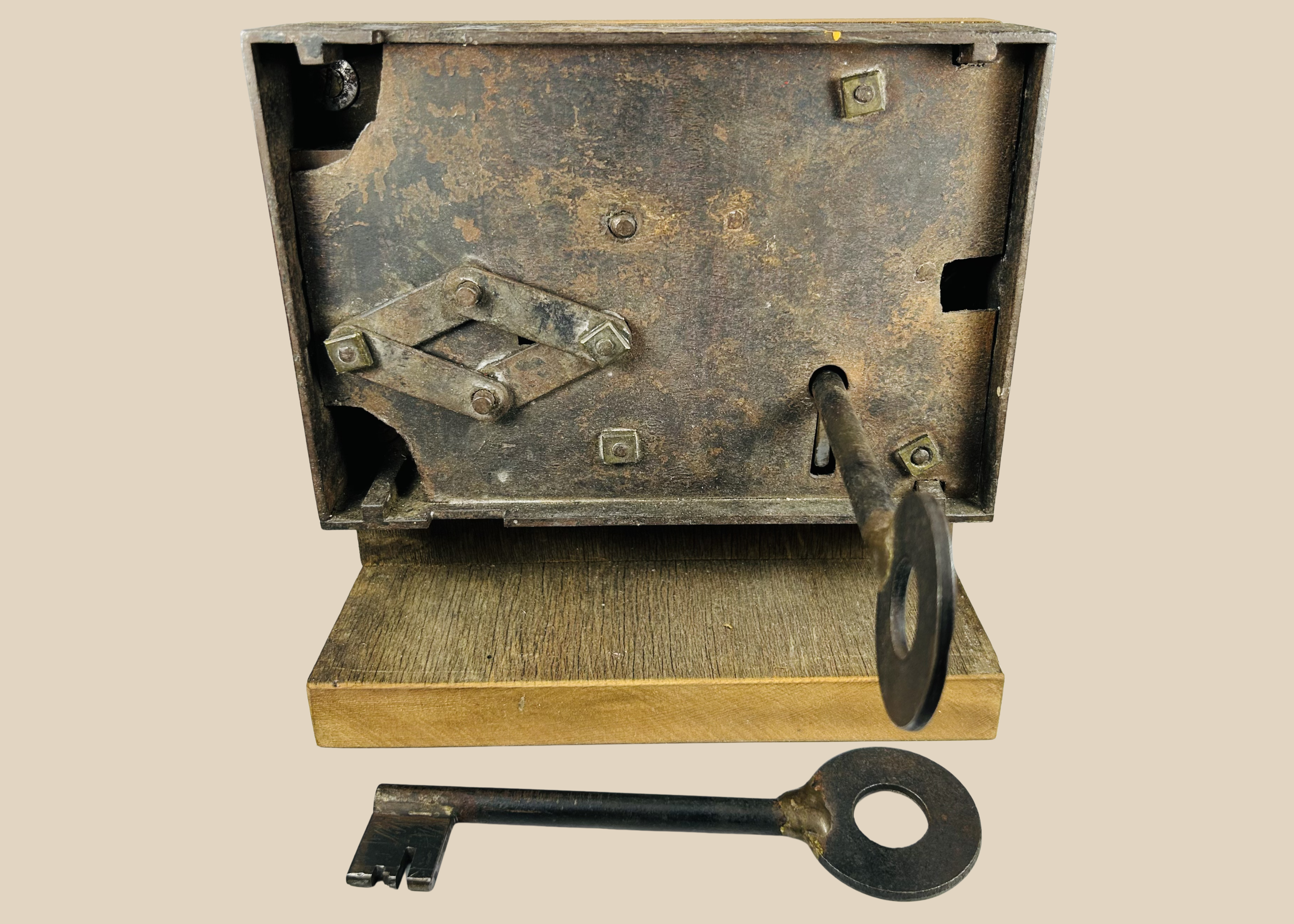
Victorian rim locks mounted directly to the surface of a door rather than being recessed into it. Their exposed mechanism and original skeleton key make them among the most visually complete antique lock and key pieces available, showing both the lock body and the tool designed to open it as a matched set.
2. Industrial age door locks

As factories and warehouses expanded during the 19th century, demand for robust, standardized locking mechanisms grew rapidly. Industrial-era locks tend to be heavier and more utilitarian than domestic pieces, with fewer decorative touches but considerably stronger construction. Finding an original key still paired with its lock is increasingly uncommon as these sets were often separated during demolitions or estate sales.
3. Curated antique padlock

For collectors who want immediate visual impact, curated display collections offer a way to present multiple pieces together in a single framed format. These shadow box arrangements show the variety of antique key and lock forms across one period or region, making them as much a display piece as a collection.
How do you identify the age and origin of an antique key?
Identifying the age and origin of an antique key involves examining the material, the manufacturing method, the bow shape, and the complexity of the bit. Before the 19th century, virtually all keys were usually hand-forged, meaning a blacksmith shaped the metal while hot using hammer and anvil.
Key identification markers by period:
-
Medieval to 16th century: Simple iron, large bow, minimal bit detail, often found with church or castle associations. Spanish Colonial examples such as the 16th to 18th-century pierced-head iron key show how colonial ironwork developed from European traditions
-
17th to 18th century: More refined bows, sometimes with decorative piercings in the head, and increasingly complex ward patterns to improve security
-
19th century: Transition to cast iron and eventually machine-cut brass; bits become more precisely cut; rim locks and mortise locks become standard domestic hardware
-
Late Victorian to Edwardian: Brass and nickel-plated keys appear, with manufacturer marks stamped into the bow or shank
For further reading on how to authenticate historical metalwork, the Smithsonian's Conservation Institute guidelines on metal artifacts offer a useful technical foundation, and the Victoria and Albert Museum's collection of European locks and keys documents how design evolved across different national traditions.
What should first-time buyers know about antique lock and key collecting?
First-time buyers should focus on three things before purchasing: condition, completeness, and authenticity documentation.
Condition matters more for display value than for historical value, but significant surface damage or structural repairs can affect both. A key with honest age-related patina, meaning natural oxidation and wear from use rather than artificial aging, is always preferable to a cleaned or polished example. Original surface color, including the deep grey-black of old iron or the warm brown of aged brass, is part of what makes antique keys visually compelling.
Completeness is especially important for antique lock and key sets. A lock sold with its original key is worth considerably more than either piece separately, because the pairing confirms that both objects were made to work together.
Authenticity documentation is particularly valuable in this category because antique keys are widely reproduced for decorative purposes. Reputable dealers provide provenance notes, acquisition history, and certificates of authenticity. Relic and Rarity includes a certificate of authenticity with every piece and backs purchases with their Authentication and Provenance guarantee, which is worth reviewing before any purchase.
Conclusion
Antique keys offer one of the most direct connections available in historical collecting: a hand-held object that once controlled access to a real place, made by a specific craftsman, used by specific people. Whether you are drawn to the elegant simplicity of a 16th-century Spanish colonial skeleton key or the robust complexity of an industrial-era antique lock and key set, the category rewards close attention. Each piece carries far more history than its modest size might suggest, and for collectors willing to look carefully, antique keys remain one of the most rewarding and accessible areas of historical hardware collecting available today.


