

Bols en terre cuite de la civilisation de la vallée de l'Indus | Motifs peints et engobe chamois | Période harappéenne tardive | Vers 1900-1300 av. J.-C.
- Prix habituel
- $500.00
- Prix soldé
- $500.00
- Prix habituel
Impossible de charger la disponibilité du service de retrait


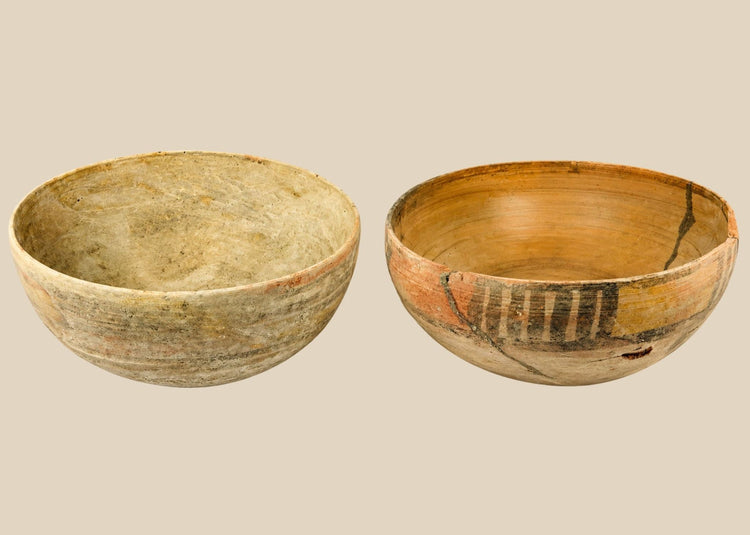


Bols en terre cuite de la civilisation de la vallée de l'Indus | Motifs peints et engobe chamois | Période harappéenne tardive | Vers 1900-1300 av. J.-C.
Description
Plus
Moins
Contexte historique et origine
Région : Nord de l'Inde / Pakistan (Civilisation de la vallée de l'Indus)
Matériau : Terre cuite avec décoration peinte à base de pigments minéraux
Période : Vers 1900-1300 av. J.-C. (Phase harappéenne tardive)
Description
Il s'agit d'une paire d'anciens bols en céramique façonnés à la main, attribués à la phase harappéenne tardive de la civilisation de la vallée de l'Indus. Ces récipients sont représentatifs de la transition culturelle qui a suivi la phase urbaine mature, présentant des motifs peints distinctifs et des formes utilitaires traditionnelles.
-
Bol A (Motif peint) : Présente une bande bien conservée de traits verticaux noirs sur un engobe chamois, encerclant le bord. Ce récipient montre des signes d'utilisation et de réparation anciennes, avec des fissures linéaires visibles stabilisées de manière professionnelle dans l'Antiquité.
-
Bol B (Points circulaires) : Plus subtilement décoré, ce bol présente des motifs circulaires rouges et ocres estompés sur le corps. Il conserve une patine terreuse d'origine et montre des preuves d'enfouissement prolongé et de contact minéral.
Caractéristiques
- Construction en argile modelée à la main
- Motifs peints géométriques et symboliques
- Fort caractère archéologique avec dépôts de surface et usure liée à l'âge
- Restes d'étiquette d'inventaire d'excavation originale sur la base
Signification culturelle
Ces récipients étaient utilisés dans des contextes domestiques et cérémoniels pendant la phase de déclin de la civilisation de la vallée de l'Indus. Leurs motifs peints peuvent représenter une signification symbolique ou rituelle, faisant écho à une tradition culturelle d'abstraction, de praticité et de continuité dans le symbolisme spirituel.
Condition
Les deux récipients présentent des pertes mineures, des éclats sur le bord et une usure de surface conforme à l'âge. Aucune restauration moderne observée. Stables et prêts à être exposés.
Dimensions (approximatives)
Diamètre : 15 cm
Hauteur : 7,5 cm
Âge (approximatif)
3 200–3 900 ans
Provenance
Anciennement partie de la collection des BC Galleries, Melbourne, Australie. Fondée en 1976, BC Galleries était un important marchand australien indépendant spécialisé dans l'art ancien et les antiquités, l'art tribal, l'ethnographie et les objets historiques provenant d'un large éventail de cultures. Par la suite, elle a été conservée dans une collection privée à Armadale, Victoria, Australie.
En savoir plus
Percez les secrets de la civilisation de la vallée de l'Indus
Découvrez d'autres artefacts remarquables de la vallée de l'Indus dans notre collection
Description
Contexte historique et origine
Région : Nord de l'Inde / Pakistan (Civilisation de la vallée de l'Indus)
Matériau : Terre cuite avec décoration peinte à base de pigments minéraux
Période : Vers 1900-1300 av. J.-C. (Phase harappéenne tardive)
Description
Il s'agit d'une paire d'anciens bols en céramique façonnés à la main, attribués à la phase harappéenne tardive de la civilisation de la vallée de l'Indus. Ces récipients sont représentatifs de la transition culturelle qui a suivi la phase urbaine mature, présentant des motifs peints distinctifs et des formes utilitaires traditionnelles.
-
Bol A (Motif peint) : Présente une bande bien conservée de traits verticaux noirs sur un engobe chamois, encerclant le bord. Ce récipient montre des signes d'utilisation et de réparation anciennes, avec des fissures linéaires visibles stabilisées de manière professionnelle dans l'Antiquité.
-
Bol B (Points circulaires) : Plus subtilement décoré, ce bol présente des motifs circulaires rouges et ocres estompés sur le corps. Il conserve une patine terreuse d'origine et montre des preuves d'enfouissement prolongé et de contact minéral.
Caractéristiques
- Construction en argile modelée à la main
- Motifs peints géométriques et symboliques
- Fort caractère archéologique avec dépôts de surface et usure liée à l'âge
- Restes d'étiquette d'inventaire d'excavation originale sur la base
Signification culturelle
Ces récipients étaient utilisés dans des contextes domestiques et cérémoniels pendant la phase de déclin de la civilisation de la vallée de l'Indus. Leurs motifs peints peuvent représenter une signification symbolique ou rituelle, faisant écho à une tradition culturelle d'abstraction, de praticité et de continuité dans le symbolisme spirituel.
Condition
Les deux récipients présentent des pertes mineures, des éclats sur le bord et une usure de surface conforme à l'âge. Aucune restauration moderne observée. Stables et prêts à être exposés.
Dimensions (approximatives)
Diamètre : 15 cm
Hauteur : 7,5 cm
Âge (approximatif)
3 200–3 900 ans
Provenance
Anciennement partie de la collection des BC Galleries, Melbourne, Australie. Fondée en 1976, BC Galleries était un important marchand australien indépendant spécialisé dans l'art ancien et les antiquités, l'art tribal, l'ethnographie et les objets historiques provenant d'un large éventail de cultures. Par la suite, elle a été conservée dans une collection privée à Armadale, Victoria, Australie.
En savoir plus
Percez les secrets de la civilisation de la vallée de l'Indus
Découvrez d'autres artefacts remarquables de la vallée de l'Indus dans notre collection
Vous aimerez peut-être aussi
