

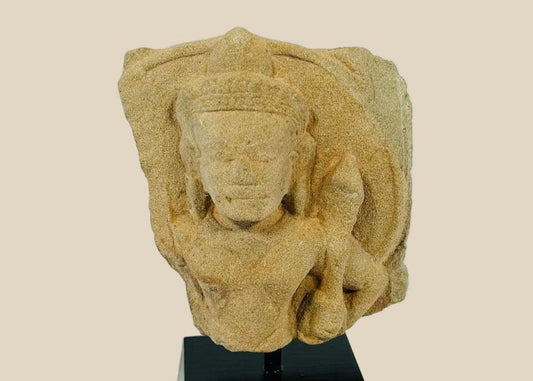

Ancient Near Eastern Limestone Idol Figure | Stylized Anthropomorphic Form | Circa 3rd–2nd Millennium BCE
- Prix habituel
- $1,250.00
- Prix soldé
- $1,250.00
- Prix habituel
Impossible de charger la disponibilité du service de retrait


Ancient Near Eastern Limestone Idol Figure | Stylized Anthropomorphic Form | Circa 3rd–2nd Millennium BCE
Description
Plus
Moins
Historical Context & Origin
Region: Levant or Anatolia (Ancient Near East)
Material: Limestone
Period: Early Bronze Age to Middle Bronze Age, circa 3rd–2nd Millennium BCE
Description
This compelling ancient limestone figure represents a highly stylized anthropomorphic form, carved in a simplified and abstract manner characteristic of early Near Eastern sculptural traditions. The figure displays a rounded, columnar body with a subtly defined head and minimal facial detailing, emphasizing form over naturalism.
The arms are rendered in low relief, folded or resting across the torso, while the lower portion transitions into a solid, grounded base. The head features faint linear incisions suggesting hair or a headdress, a common symbolic element in early idol figures.
Carved from a dense limestone, the surface exhibits extensive mineral encrustation and natural patination, indicative of long-term burial and age. The weathered texture, softened edges, and calcified deposits contribute to the piece’s authentic archaeological presence.
Such figures are often interpreted as votive idols, fertility representations, or funerary markers, reflecting early symbolic and ritualistic expression in ancient Near Eastern cultures.
Features
- Hand-carved limestone anthropomorphic figure
- Stylized, abstract form with minimal facial detailing
- Folded or resting arm positioning across torso
- Linear incisions suggesting hair or headdress
- Substantial mineral encrustation and age-consistent patina
- Solid, weighty form with stable base
Cultural Significance
Anthropomorphic stone figures from the ancient Near East represent some of the earliest known expressions of human symbolism in sculpture. Found across regions such as Anatolia and the Levant, these figures were often associated with ritual, fertility, protection, or ancestral veneration.
Their abstracted forms emphasize spiritual or symbolic identity rather than physical likeness, reflecting a worldview where representation served a ceremonial or metaphysical purpose. Pieces such as this offer a tangible connection to early human belief systems and artistic development.
Condition
Good ancient condition with heavy surface weathering, mineral deposits, and encrustation consistent with age and burial. Minor losses, surface abrasions, and softening of carved details are present throughout. No modern repairs observed.
Dimensions (Approximate)
Height: 12 in
Width: 5.5 in
Depth: 4.5 in
Age (Approximate)
3,500–5,000 years old
Learn More
Explore early anthropomorphic figures from the ancient world through Google Arts & Culture
Browse our Collection of Ancient Statues, Figures & Carvings
Description
Historical Context & Origin
Region: Levant or Anatolia (Ancient Near East)
Material: Limestone
Period: Early Bronze Age to Middle Bronze Age, circa 3rd–2nd Millennium BCE
Description
This compelling ancient limestone figure represents a highly stylized anthropomorphic form, carved in a simplified and abstract manner characteristic of early Near Eastern sculptural traditions. The figure displays a rounded, columnar body with a subtly defined head and minimal facial detailing, emphasizing form over naturalism.
The arms are rendered in low relief, folded or resting across the torso, while the lower portion transitions into a solid, grounded base. The head features faint linear incisions suggesting hair or a headdress, a common symbolic element in early idol figures.
Carved from a dense limestone, the surface exhibits extensive mineral encrustation and natural patination, indicative of long-term burial and age. The weathered texture, softened edges, and calcified deposits contribute to the piece’s authentic archaeological presence.
Such figures are often interpreted as votive idols, fertility representations, or funerary markers, reflecting early symbolic and ritualistic expression in ancient Near Eastern cultures.
Features
- Hand-carved limestone anthropomorphic figure
- Stylized, abstract form with minimal facial detailing
- Folded or resting arm positioning across torso
- Linear incisions suggesting hair or headdress
- Substantial mineral encrustation and age-consistent patina
- Solid, weighty form with stable base
Cultural Significance
Anthropomorphic stone figures from the ancient Near East represent some of the earliest known expressions of human symbolism in sculpture. Found across regions such as Anatolia and the Levant, these figures were often associated with ritual, fertility, protection, or ancestral veneration.
Their abstracted forms emphasize spiritual or symbolic identity rather than physical likeness, reflecting a worldview where representation served a ceremonial or metaphysical purpose. Pieces such as this offer a tangible connection to early human belief systems and artistic development.
Condition
Good ancient condition with heavy surface weathering, mineral deposits, and encrustation consistent with age and burial. Minor losses, surface abrasions, and softening of carved details are present throughout. No modern repairs observed.
Dimensions (Approximate)
Height: 12 in
Width: 5.5 in
Depth: 4.5 in
Age (Approximate)
3,500–5,000 years old
Learn More
Explore early anthropomorphic figures from the ancient world through Google Arts & Culture
Browse our Collection of Ancient Statues, Figures & Carvings
Vous aimerez peut-être aussi
