

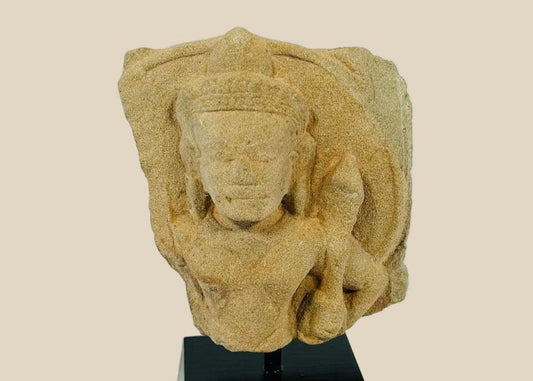

Ancient Mediterranean | Theatrical Mask Fragment | Classical Antiquity Sculpture | Circa 8th Century B.C. – 2nd Century A.D.
- Prix habituel
- $500.00
- Prix soldé
- $500.00
- Prix habituel
Impossible de charger la disponibilité du service de retrait


Ancient Mediterranean | Theatrical Mask Fragment | Classical Antiquity Sculpture | Circa 8th Century B.C. – 2nd Century A.D.
Description
Plus
Moins
Historical Context & Origin
Region: Mediterranean World (Greco-Roman)
Material: Terracotta (fired clay)
Period: Hellenistic to Roman Period, circa 8th Century B.C. – 2nd Century A.D.
Description
A striking ancient terracotta theatrical mask fragment from the Greco-Roman world, preserving the upper portion of a dramatic mask with stylized facial features. The fragment displays deeply modeled eyelids, a prominent nose, and flowing wavy hair rendered in a rhythmic pattern across the forehead.
Masks such as this were closely associated with ancient Greek and Roman theatre, where exaggerated facial expressions helped convey emotion and character to audiences in large open-air performance spaces. Terracotta masks were also produced as decorative reliefs, votive offerings, and architectural ornaments, reflecting the cultural importance of theatrical performance throughout the Mediterranean world.
Despite its fragmentary condition, the surviving portion captures the expressive sculptural quality characteristic of classical mask production. The warm orange-brown terracotta surface and natural weathering further enhance its ancient character and authenticity.
Features
- Authentic ancient Greco-Roman terracotta mask fragment
- Expressive theatrical facial modeling with closed eyelids and elongated nose
- Stylized wavy hair pattern typical of classical mask iconography
- Warm natural terracotta surface with ancient patina
- Mounted on a custom display stand for presentation
- Excellent fragment representing classical theatrical culture
Cultural Significance
Theatre was one of the most important cultural institutions in ancient Greece and Rome. Masks allowed actors to portray multiple characters while amplifying emotional expression for audiences in large amphitheatres.
Terracotta theatrical masks were also produced as votive dedications, decorative objects, and architectural embellishments. Their presence in homes and temples reflects the widespread reverence for theatrical art and Dionysian traditions throughout the classical Mediterranean world.
Condition
Fragmentary condition as expected for an ancient artifact. Losses to the sides and lower portion of the original mask are present. Visible ancient surface wear, mineral deposits, and a stable crack consistent with age and burial conditions. Mounted securely for display.
Dimensions (Approximate)
Height: 4 in
Width: 2 in
Depth: 1 in
Age (Approximate)
2,000 – 2,800 years old
Learn More
Read about a recently discovered Ancient Satyr Mask discovery at Phanagoria.
View our Roman & Greek Artifacts Collection.
Description
Historical Context & Origin
Region: Mediterranean World (Greco-Roman)
Material: Terracotta (fired clay)
Period: Hellenistic to Roman Period, circa 8th Century B.C. – 2nd Century A.D.
Description
A striking ancient terracotta theatrical mask fragment from the Greco-Roman world, preserving the upper portion of a dramatic mask with stylized facial features. The fragment displays deeply modeled eyelids, a prominent nose, and flowing wavy hair rendered in a rhythmic pattern across the forehead.
Masks such as this were closely associated with ancient Greek and Roman theatre, where exaggerated facial expressions helped convey emotion and character to audiences in large open-air performance spaces. Terracotta masks were also produced as decorative reliefs, votive offerings, and architectural ornaments, reflecting the cultural importance of theatrical performance throughout the Mediterranean world.
Despite its fragmentary condition, the surviving portion captures the expressive sculptural quality characteristic of classical mask production. The warm orange-brown terracotta surface and natural weathering further enhance its ancient character and authenticity.
Features
- Authentic ancient Greco-Roman terracotta mask fragment
- Expressive theatrical facial modeling with closed eyelids and elongated nose
- Stylized wavy hair pattern typical of classical mask iconography
- Warm natural terracotta surface with ancient patina
- Mounted on a custom display stand for presentation
- Excellent fragment representing classical theatrical culture
Cultural Significance
Theatre was one of the most important cultural institutions in ancient Greece and Rome. Masks allowed actors to portray multiple characters while amplifying emotional expression for audiences in large amphitheatres.
Terracotta theatrical masks were also produced as votive dedications, decorative objects, and architectural embellishments. Their presence in homes and temples reflects the widespread reverence for theatrical art and Dionysian traditions throughout the classical Mediterranean world.
Condition
Fragmentary condition as expected for an ancient artifact. Losses to the sides and lower portion of the original mask are present. Visible ancient surface wear, mineral deposits, and a stable crack consistent with age and burial conditions. Mounted securely for display.
Dimensions (Approximate)
Height: 4 in
Width: 2 in
Depth: 1 in
Age (Approximate)
2,000 – 2,800 years old
Learn More
Read about a recently discovered Ancient Satyr Mask discovery at Phanagoria.
View our Roman & Greek Artifacts Collection.
Vous aimerez peut-être aussi
