



18th Century French Peddler’s Crucifix | Lead Arma Christi Passion Cross | Circa 1700–1799 CE
- Prix habituel
- $600.00
- Prix soldé
- $600.00
- Prix habituel
Impossible de charger la disponibilité du service de retrait




18th Century French Peddler’s Crucifix | Lead Arma Christi Passion Cross | Circa 1700–1799 CE
Description
Plus
Moins
Historical Context & Origin
Region: France
Material: Dark-painted pine wood with embossed and pierced lead ornamentation
Period: 18th Century, circa 1700–1799 CE
Description
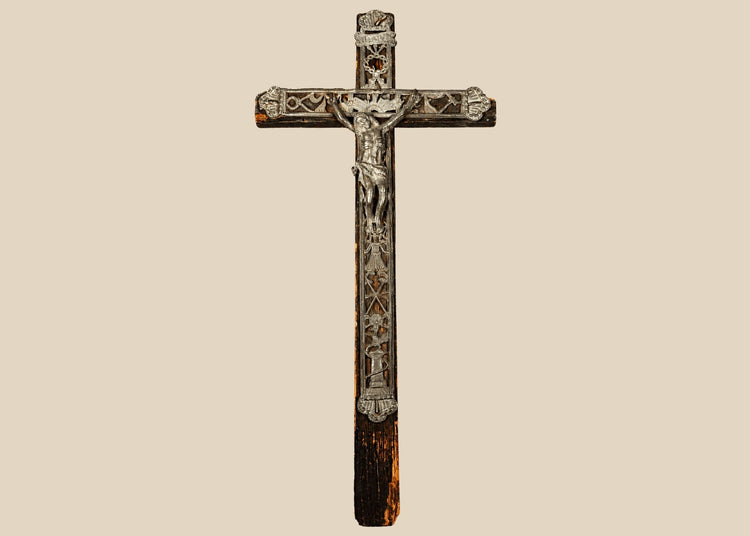
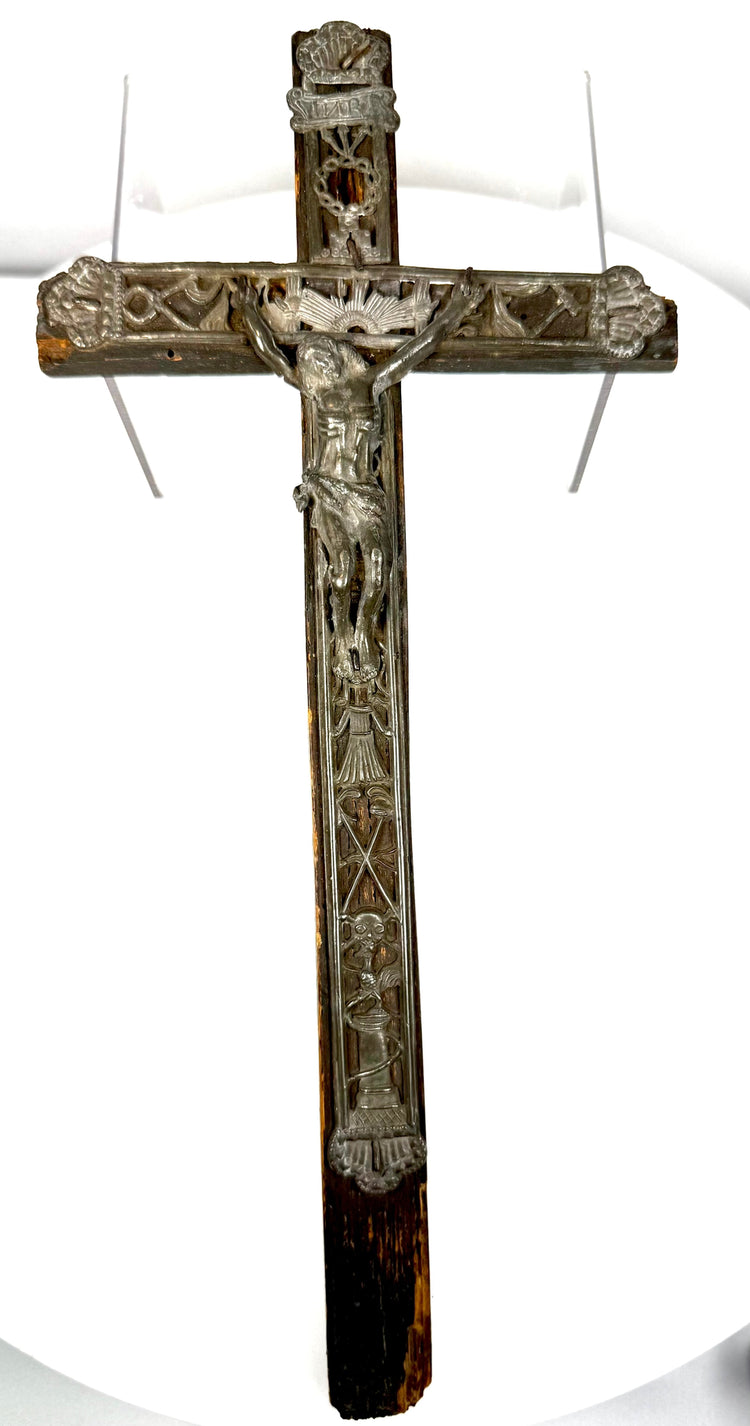
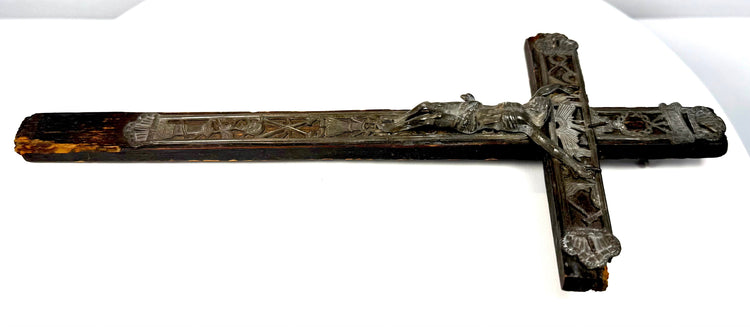
An exceptional 18th-century French devotional crucifix, traditionally identified as a peddler's cross, featuring an elaborate arrangement of embossed lead religious imagery mounted upon a dark-painted pine wooden cross. This distinctive example combines traditional Christian iconography with the rustic craftsmanship of European folk art, reflecting the religious practices and domestic devotional traditions of pre-Revolutionary France.
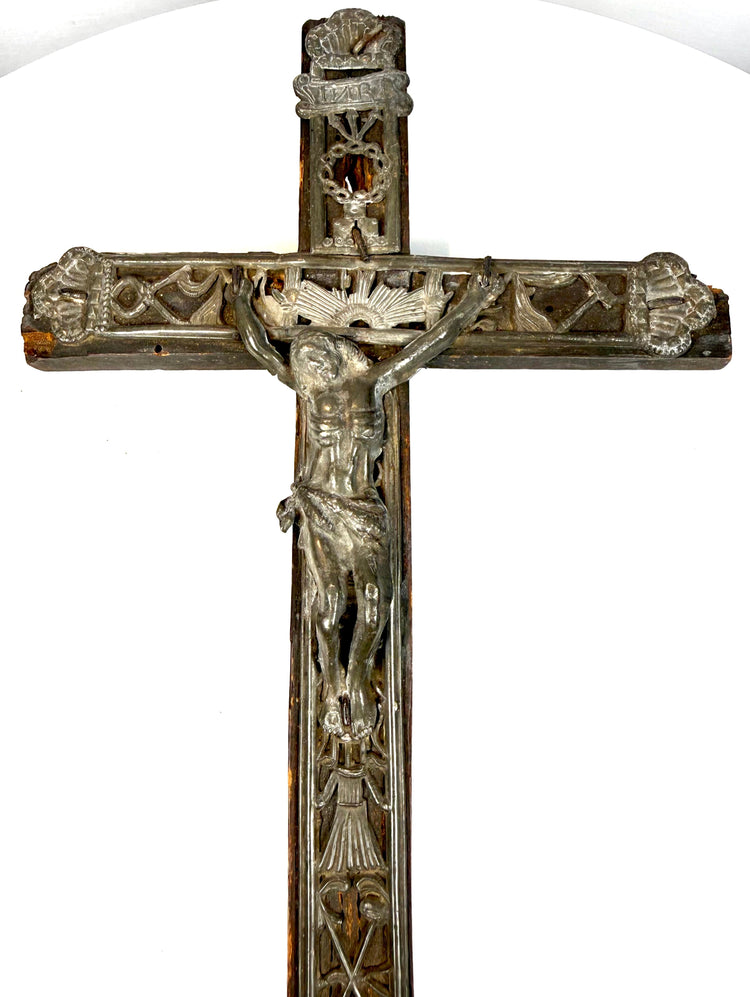
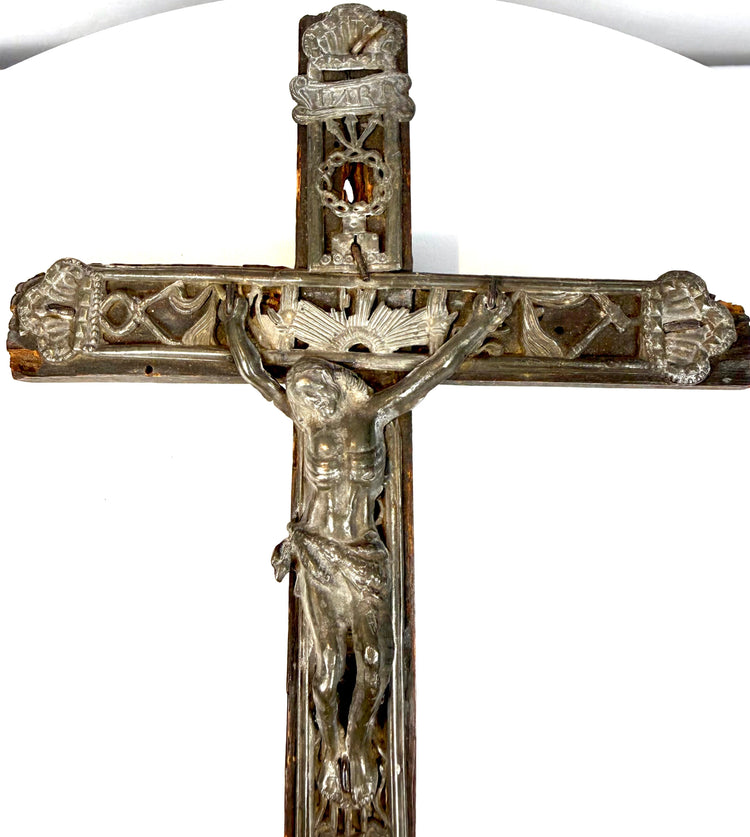
At its centre is a raised representation of the crucified Jesus Christ (Corpus Christi), depicted with outstretched arms, a bowed head, and a carefully modelled torso and loincloth. Behind the figure, an ornamental burst of radiating light emphasizes the spiritual significance of the Crucifixion. The silver-grey lead decoration contrasts dramatically with the aged, darkened wooden surface.
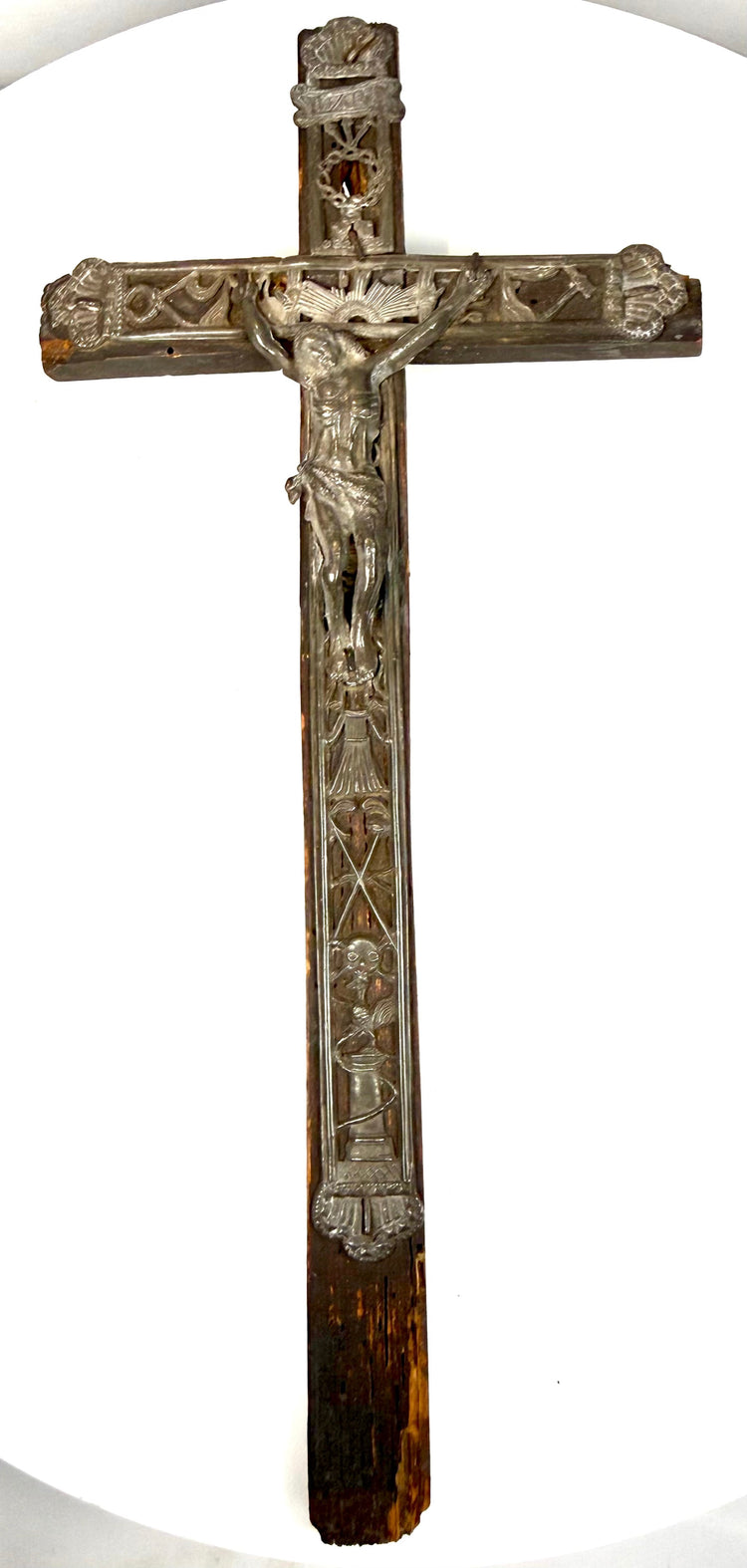
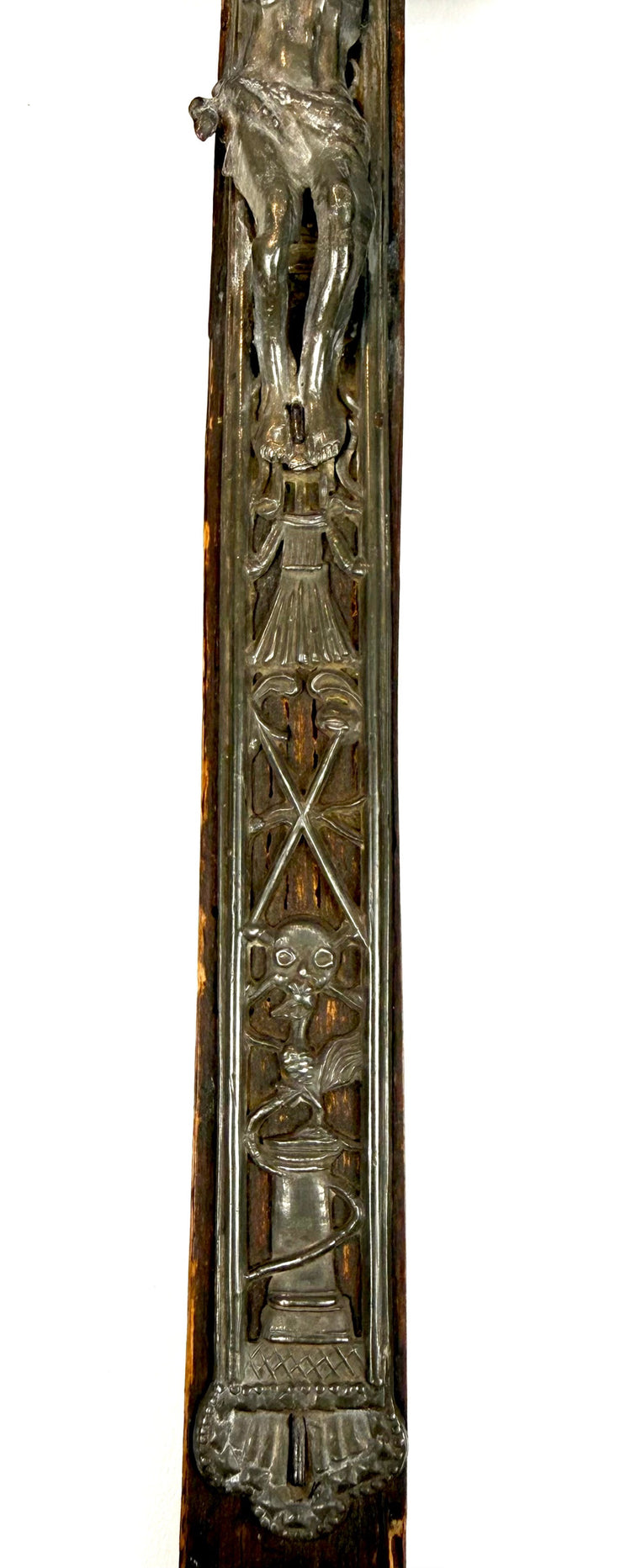
What makes this crucifix particularly fascinating is its extensive use of the Arma Christi, or Instruments of the Passion, represented through a series of small symbolic objects arranged along the vertical shaft and horizontal arms. These symbols recount the suffering, betrayal, crucifixion, and death of Jesus Christ.
Among the most recognizable details is a rooster standing upon a column near the lower portion of the cross, representing Saint Peter's three denials of Christ before the crowing of the rooster. The column and accompanying cord also reference Christ's scourging before the Crucifixion. Additional embossed implements, including crossed instruments, tools associated with the Crucifixion, and a wreath-like motif near the upper terminal, contribute to the elaborate religious narrative.
The lead ornamentation incorporates pierced openings, raised decorative borders, and carefully arranged symbolic motifs. The wooden cross retains its darkened historic surface, with exposed warm brown wood visible through areas of wear, lending the entire composition a compelling antique character.
Crucifixes of this general type were associated with itinerant French merchants, or colporteurs, who travelled between villages and rural communities selling inexpensive devotional objects for private religious use. These pieces provided ordinary households with an accessible means of displaying their Christian faith.
The survival of the decorative leadwork, expressive central figure, and substantial wooden structure makes this an intriguing example of historic French religious folk art.
Features
- Raised Corpus Christi figure depicting Jesus Christ at the Crucifixion
- Elaborate Arma Christi imagery representing the Instruments of the Passion
- Rooster and column symbolizing Saint Peter's denial and the Flagellation of Christ
- Radiating sunburst motif positioned behind the upper body of Christ
- Decorative crossed implements, religious emblems, and ornamental borders
- Pierced and embossed lead ornamentation displaying traditional folk-art craftsmanship
- Dark-painted pine wooden cross with naturally aged surface and exposed wood grain
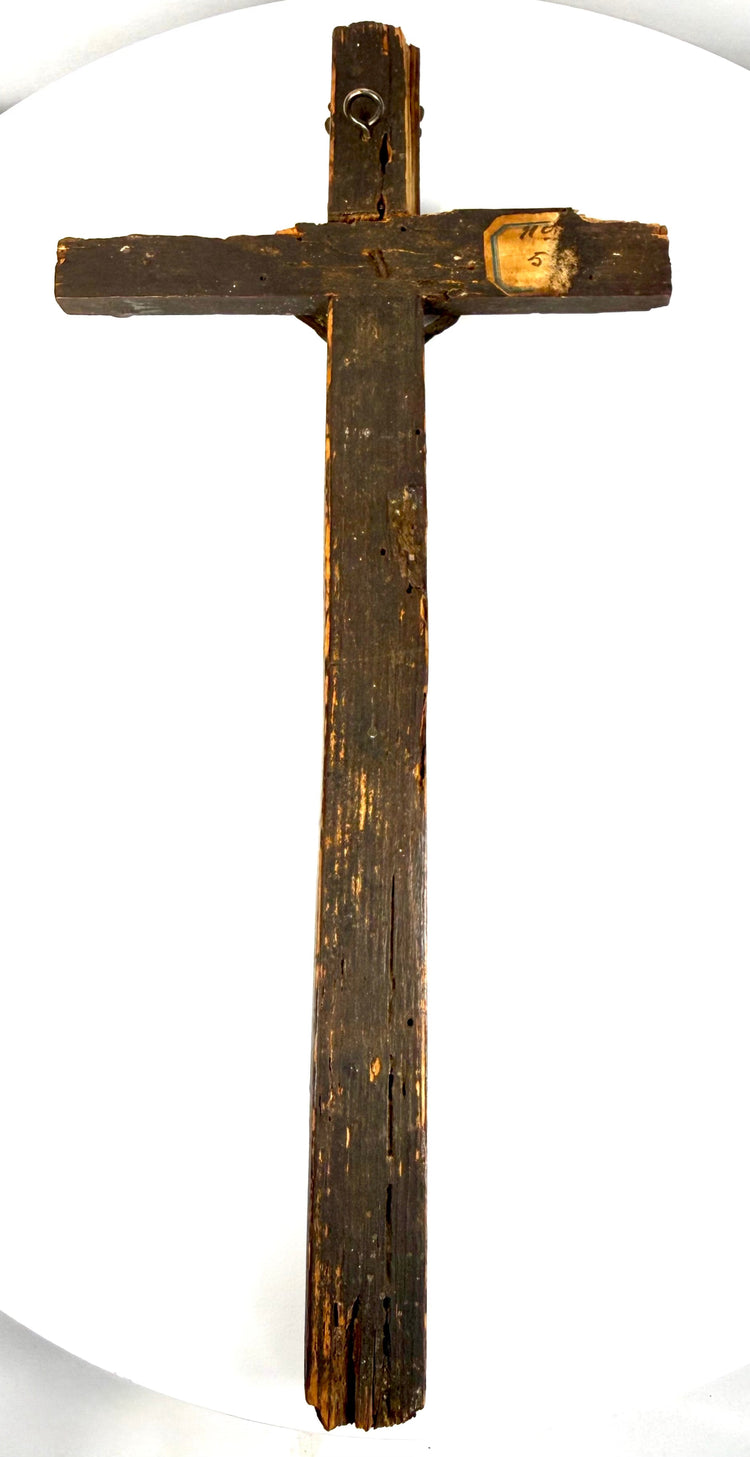
- Original-style metal suspension loop attached to the reverse for wall display
Cultural Significance
The Arma Christi, translated from Latin as the Instruments or Weapons of Christ, represents one of the most enduring symbolic traditions in European Christian art. Originating in medieval religious imagery, these objects were intended to remind worshippers of the events surrounding the Passion of Jesus Christ.
Each represented instrument carried a specific religious meaning. The hammer and nails recalled the Crucifixion, the scourging column represented Christ's physical suffering, and the rooster symbolized Saint Peter's denial and subsequent repentance. Together, these elements transformed the crucifix into a visual narrative of sacrifice, redemption, and faith.
During the 17th and 18th centuries, Catholic devotional imagery remained deeply integrated into everyday life throughout France. Religious objects were displayed in homes, carried during travel, and incorporated into personal prayer and contemplation.
Itinerant peddlers played an important role in distributing devotional goods to rural communities where access to established workshops and religious markets could be limited. Small wooden crosses decorated with relatively inexpensive metals were particularly suited to household use.
Unlike the elaborate silver and gilded crucifixes commissioned for churches and wealthy patrons, examples such as this reflect the devotional traditions of ordinary people. Their modest materials, practical construction, and densely arranged iconography demonstrate how religious belief could be expressed through accessible forms of craftsmanship.
Condition
Antique condition consistent with age and historic use. The wooden cross exhibits pronounced surface wear, darkening, abrasions, small chips, and areas of exposed natural wood, particularly toward the lower end and along the edges. The lead decoration displays age-related oxidation, rubbing, minor deformation, and localized irregularities while retaining its distinctive overall composition.
Small holes, visible fastening points, and areas of separation or loss within the ornamentation are apparent. The reverse retains an aged surface with an attached metal hanging loop. The central Corpus Christi figure and much of the surrounding religious imagery remain identifiable and visually compelling.
Dimensions (Approximate)
Height: 10.5 in
Width: 5 in
Depth: 0.875 in
Age (Approximate)
225–325 years old
Provenance
Formerly held in a private collection in Richmond, Virginia, United States.
Subsequently handled by Quinn’s Auction Galleries, Falls Church, Virginia, an established family-operated auction house founded in 1995 and specializing in fine art, antiques, decorative arts, furniture, rare books, and significant estate and private collections.
Learn More
Discover the symbolism of the Instruments of the Passion through an Arma Christi artwork at The Metropolitan Museum of Art
Explore our Collection of Religious & Spiritual Relics
Description
Historical Context & Origin
Region: France
Material: Dark-painted pine wood with embossed and pierced lead ornamentation
Period: 18th Century, circa 1700–1799 CE
Description
An exceptional 18th-century French devotional crucifix, traditionally identified as a peddler's cross, featuring an elaborate arrangement of embossed lead religious imagery mounted upon a dark-painted pine wooden cross. This distinctive example combines traditional Christian iconography with the rustic craftsmanship of European folk art, reflecting the religious practices and domestic devotional traditions of pre-Revolutionary France.
At its centre is a raised representation of the crucified Jesus Christ (Corpus Christi), depicted with outstretched arms, a bowed head, and a carefully modelled torso and loincloth. Behind the figure, an ornamental burst of radiating light emphasizes the spiritual significance of the Crucifixion. The silver-grey lead decoration contrasts dramatically with the aged, darkened wooden surface.
What makes this crucifix particularly fascinating is its extensive use of the Arma Christi, or Instruments of the Passion, represented through a series of small symbolic objects arranged along the vertical shaft and horizontal arms. These symbols recount the suffering, betrayal, crucifixion, and death of Jesus Christ.
Among the most recognizable details is a rooster standing upon a column near the lower portion of the cross, representing Saint Peter's three denials of Christ before the crowing of the rooster. The column and accompanying cord also reference Christ's scourging before the Crucifixion. Additional embossed implements, including crossed instruments, tools associated with the Crucifixion, and a wreath-like motif near the upper terminal, contribute to the elaborate religious narrative.
The lead ornamentation incorporates pierced openings, raised decorative borders, and carefully arranged symbolic motifs. The wooden cross retains its darkened historic surface, with exposed warm brown wood visible through areas of wear, lending the entire composition a compelling antique character.
Crucifixes of this general type were associated with itinerant French merchants, or colporteurs, who travelled between villages and rural communities selling inexpensive devotional objects for private religious use. These pieces provided ordinary households with an accessible means of displaying their Christian faith.
The survival of the decorative leadwork, expressive central figure, and substantial wooden structure makes this an intriguing example of historic French religious folk art.
Features
- Raised Corpus Christi figure depicting Jesus Christ at the Crucifixion
- Elaborate Arma Christi imagery representing the Instruments of the Passion
- Rooster and column symbolizing Saint Peter's denial and the Flagellation of Christ
- Radiating sunburst motif positioned behind the upper body of Christ
- Decorative crossed implements, religious emblems, and ornamental borders
- Pierced and embossed lead ornamentation displaying traditional folk-art craftsmanship
- Dark-painted pine wooden cross with naturally aged surface and exposed wood grain
- Original-style metal suspension loop attached to the reverse for wall display
Cultural Significance
The Arma Christi, translated from Latin as the Instruments or Weapons of Christ, represents one of the most enduring symbolic traditions in European Christian art. Originating in medieval religious imagery, these objects were intended to remind worshippers of the events surrounding the Passion of Jesus Christ.
Each represented instrument carried a specific religious meaning. The hammer and nails recalled the Crucifixion, the scourging column represented Christ's physical suffering, and the rooster symbolized Saint Peter's denial and subsequent repentance. Together, these elements transformed the crucifix into a visual narrative of sacrifice, redemption, and faith.
During the 17th and 18th centuries, Catholic devotional imagery remained deeply integrated into everyday life throughout France. Religious objects were displayed in homes, carried during travel, and incorporated into personal prayer and contemplation.
Itinerant peddlers played an important role in distributing devotional goods to rural communities where access to established workshops and religious markets could be limited. Small wooden crosses decorated with relatively inexpensive metals were particularly suited to household use.
Unlike the elaborate silver and gilded crucifixes commissioned for churches and wealthy patrons, examples such as this reflect the devotional traditions of ordinary people. Their modest materials, practical construction, and densely arranged iconography demonstrate how religious belief could be expressed through accessible forms of craftsmanship.
Condition
Antique condition consistent with age and historic use. The wooden cross exhibits pronounced surface wear, darkening, abrasions, small chips, and areas of exposed natural wood, particularly toward the lower end and along the edges. The lead decoration displays age-related oxidation, rubbing, minor deformation, and localized irregularities while retaining its distinctive overall composition.
Small holes, visible fastening points, and areas of separation or loss within the ornamentation are apparent. The reverse retains an aged surface with an attached metal hanging loop. The central Corpus Christi figure and much of the surrounding religious imagery remain identifiable and visually compelling.
Dimensions (Approximate)
Height: 10.5 in
Width: 5 in
Depth: 0.875 in
Age (Approximate)
225–325 years old
Provenance
Formerly held in a private collection in Richmond, Virginia, United States.
Subsequently handled by Quinn’s Auction Galleries, Falls Church, Virginia, an established family-operated auction house founded in 1995 and specializing in fine art, antiques, decorative arts, furniture, rare books, and significant estate and private collections.
Learn More
Discover the symbolism of the Instruments of the Passion through an Arma Christi artwork at The Metropolitan Museum of Art
Explore our Collection of Religious & Spiritual Relics
Vous aimerez peut-être aussi
