



Ancient Egyptian Lioness-Headed Sekhmet or Bastet Faience Amulet | Late Period | Circa 664 – 332 BCE
- Prix habituel
- $600.00
- Prix soldé
- $600.00
- Prix habituel
Impossible de charger la disponibilité du service de retrait


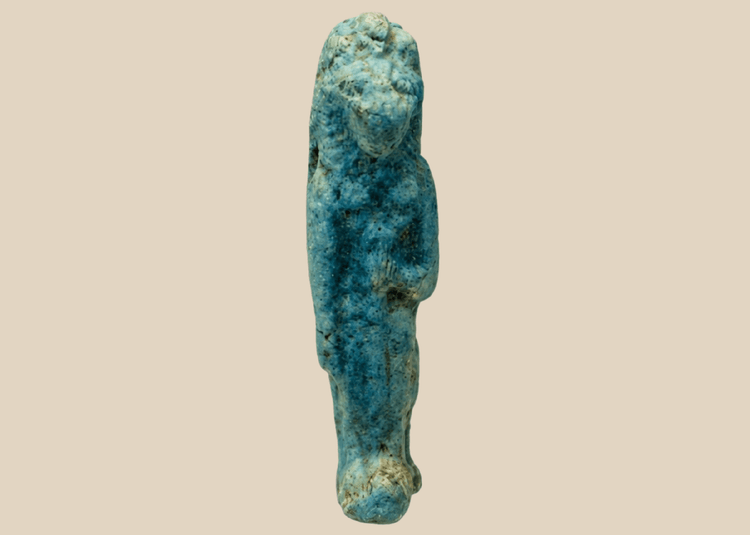


Ancient Egyptian Lioness-Headed Sekhmet or Bastet Faience Amulet | Late Period | Circa 664 – 332 BCE
Description
Plus
Moins
Historical Context & Origin
Region: Ancient Egypt, North Africa
Material: Mold-formed Egyptian faience with surviving blue-green glaze
Period: Late Period, circa 664–332 BCE
Description
An ancient Egyptian faience amulet representing a lioness-headed protective goddess, most plausibly Sekhmet, although an identification as Bastet cannot be entirely excluded due to the overlapping iconography of Egypt’s feline deities.
The goddess is presented standing upright in an elongated frontal pose upon an integral base. Her distinctly feline head projects forward with a broad, rounded muzzle, while traces of a headdress or solar attribute remain visible above the head. The figure possesses a slender human body, with one arm extending alongside the torso and the other bending inward across the abdomen.
The bent arm appears to hold a small protective or ritual attribute. Due to age-related surface wear, its precise form is difficult to determine, although it may represent a staff, sistrum, or possibly a stylized wadjet eye. Each of these symbols possessed protective significance and would have reinforced the power of the goddess represented.
A transverse suspension perforation passes through the upper body beneath the head, confirming that the figure was created as a wearable or suspended amulet. It may have been worn individually, incorporated into a necklace, or attached to funerary wrappings to protect the deceased.
The surface retains extensive areas of saturated turquoise-blue glaze, particularly across the reverse and recessed portions of the figure. In ancient Egypt, this vibrant colour evoked turquoise, vegetation, the life-giving waters of the Nile, regeneration, and eternal life.
Features
- Ancient Egyptian faience construction
- Mold-formed lioness-headed goddess
- Most plausibly identified as Sekhmet
- Possible alternative identification as Bastet
- Elongated frontal standing pose
- Feline head with broad, rounded muzzle
- Traces of a headdress or solar attribute
- Bent arm holding a possible protective or ritual symbol
- Integral rectangular base
- Ancient transverse suspension perforation
- Extensive surviving turquoise-blue glaze
- Mineral deposits and burial encrustation
Historical & Cultural Significance
Sekhmet, whose name translates approximately as “The Powerful One,” was a lioness-headed solar goddess associated with strength, healing, protection, warfare, and the destructive heat of the sun. She was believed capable of unleashing disease and violence, but she could also prevent illness and restore health when properly appeased.
Bastet similarly possessed feline characteristics and was associated with protection, fertility, motherhood, music, and the safeguarding of the household. Although she became increasingly represented with the head of a domestic cat, earlier and transitional images could retain the more formidable lioness form.
The identities of Sekhmet, Bastet, Wadjet, Mut, and other feline or leonine goddesses occasionally overlapped, particularly in small amulets where inscriptions and individual attributes were absent. Regardless of the precise identity intended, such figures invoked the fierce defensive power of the divine lioness.
Amulets of this type were worn by the living for personal protection and were also placed among funerary equipment. Their presence within a burial was intended to defend the deceased from harmful forces and assist with regeneration in the afterlife.
Condition
Good ancient condition with surface wear, glaze loss, mineral deposits, encrustation, small abrasions, and losses consistent with burial and considerable antiquity. The upper portion of the head and headdress exhibits age-related wear, while the principal feline and human features remain identifiable. Extensive areas of the original turquoise-blue glaze survive, and the ancient suspension perforation remains open.
Dimensions (Approximate)
Height: 1.4 in
Age (Approximate)
2,350–2,690 years old
Provenance
Part of the J. M. Collection, a private, family-held collection based in Fountain Hills, Arizona, USA. This amulet was acquired by the collector’s mother in 1992 and remained within the family until the collection’s later dispersal.
It was subsequently handled by Artemis Fine Arts of Louisville, Colorado, an established dealer and auction house specializing in ancient, ethnographic, and fine art since 1993.
Subsequently acquired by a well-known private collection in Toronto, Ontario, Canada.
Learn More
Discover a closely comparable Egyptian faience amulet identified as either Sakhmet or Bastet in the collection of the Smithsonian Institution
Explore our Collection of Ancient Egyptian Mummies & Artifacts
Description
Historical Context & Origin
Region: Ancient Egypt, North Africa
Material: Mold-formed Egyptian faience with surviving blue-green glaze
Period: Late Period, circa 664–332 BCE
Description
An ancient Egyptian faience amulet representing a lioness-headed protective goddess, most plausibly Sekhmet, although an identification as Bastet cannot be entirely excluded due to the overlapping iconography of Egypt’s feline deities.
The goddess is presented standing upright in an elongated frontal pose upon an integral base. Her distinctly feline head projects forward with a broad, rounded muzzle, while traces of a headdress or solar attribute remain visible above the head. The figure possesses a slender human body, with one arm extending alongside the torso and the other bending inward across the abdomen.
The bent arm appears to hold a small protective or ritual attribute. Due to age-related surface wear, its precise form is difficult to determine, although it may represent a staff, sistrum, or possibly a stylized wadjet eye. Each of these symbols possessed protective significance and would have reinforced the power of the goddess represented.
A transverse suspension perforation passes through the upper body beneath the head, confirming that the figure was created as a wearable or suspended amulet. It may have been worn individually, incorporated into a necklace, or attached to funerary wrappings to protect the deceased.
The surface retains extensive areas of saturated turquoise-blue glaze, particularly across the reverse and recessed portions of the figure. In ancient Egypt, this vibrant colour evoked turquoise, vegetation, the life-giving waters of the Nile, regeneration, and eternal life.
Features
- Ancient Egyptian faience construction
- Mold-formed lioness-headed goddess
- Most plausibly identified as Sekhmet
- Possible alternative identification as Bastet
- Elongated frontal standing pose
- Feline head with broad, rounded muzzle
- Traces of a headdress or solar attribute
- Bent arm holding a possible protective or ritual symbol
- Integral rectangular base
- Ancient transverse suspension perforation
- Extensive surviving turquoise-blue glaze
- Mineral deposits and burial encrustation
Historical & Cultural Significance
Sekhmet, whose name translates approximately as “The Powerful One,” was a lioness-headed solar goddess associated with strength, healing, protection, warfare, and the destructive heat of the sun. She was believed capable of unleashing disease and violence, but she could also prevent illness and restore health when properly appeased.
Bastet similarly possessed feline characteristics and was associated with protection, fertility, motherhood, music, and the safeguarding of the household. Although she became increasingly represented with the head of a domestic cat, earlier and transitional images could retain the more formidable lioness form.
The identities of Sekhmet, Bastet, Wadjet, Mut, and other feline or leonine goddesses occasionally overlapped, particularly in small amulets where inscriptions and individual attributes were absent. Regardless of the precise identity intended, such figures invoked the fierce defensive power of the divine lioness.
Amulets of this type were worn by the living for personal protection and were also placed among funerary equipment. Their presence within a burial was intended to defend the deceased from harmful forces and assist with regeneration in the afterlife.
Condition
Good ancient condition with surface wear, glaze loss, mineral deposits, encrustation, small abrasions, and losses consistent with burial and considerable antiquity. The upper portion of the head and headdress exhibits age-related wear, while the principal feline and human features remain identifiable. Extensive areas of the original turquoise-blue glaze survive, and the ancient suspension perforation remains open.
Dimensions (Approximate)
Height: 1.4 in
Age (Approximate)
2,350–2,690 years old
Provenance
Part of the J. M. Collection, a private, family-held collection based in Fountain Hills, Arizona, USA. This amulet was acquired by the collector’s mother in 1992 and remained within the family until the collection’s later dispersal.
It was subsequently handled by Artemis Fine Arts of Louisville, Colorado, an established dealer and auction house specializing in ancient, ethnographic, and fine art since 1993.
Subsequently acquired by a well-known private collection in Toronto, Ontario, Canada.
Learn More
Discover a closely comparable Egyptian faience amulet identified as either Sakhmet or Bastet in the collection of the Smithsonian Institution
Explore our Collection of Ancient Egyptian Mummies & Artifacts
Vous aimerez peut-être aussi
