

Pichet côtelé en terre cuite d'Afrique du Nord de la Rome antique | Tunisie | Provenance détaillée | Circa 100-500 CE
- Prix habituel
- $1,000.00
- Prix soldé
- $1,000.00
- Prix habituel
Impossible de charger la disponibilité du service de retrait





Pichet côtelé en terre cuite d'Afrique du Nord de la Rome antique | Tunisie | Provenance détaillée | Circa 100-500 CE
Description
Plus
Moins
Contexte historique et origine
Région : Afrique du Nord romaine (Tunisie actuelle)
Matériau : Terre cuite / Argile de poterie
Période : Période impériale romaine, ca. 100-500 EC
Description
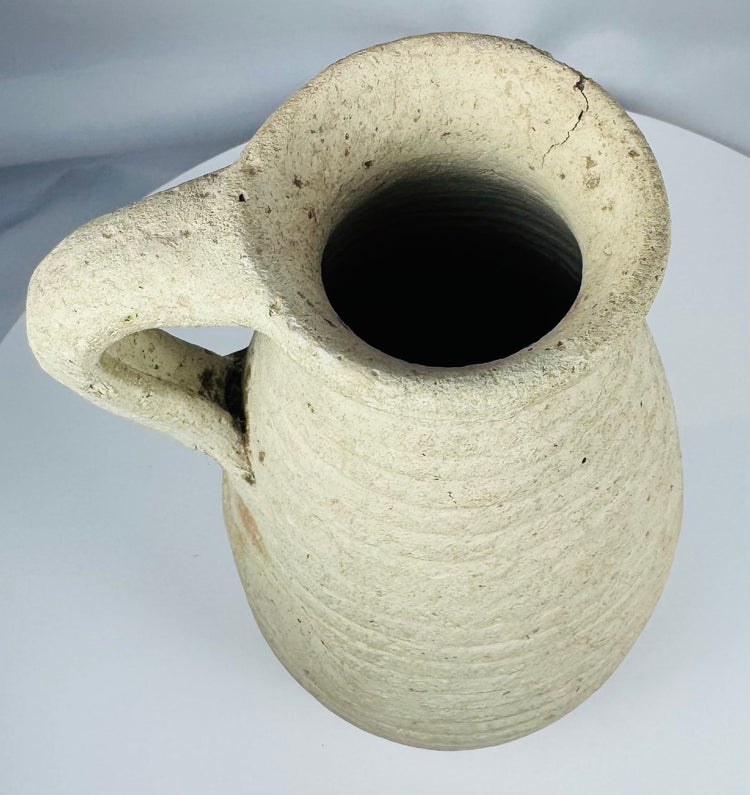
Ce pichet en terre cuite de l'ancienne Afrique du Nord romaine est un exemple bien conservé de poterie utilitaire produite dans les provinces romaines de l'actuelle Tunisie. Le vase présente un corps arrondi se rétrécissant vers un col en retrait, un large rebord évasé et une anse robuste en forme de boucle s'étendant du rebord à l'épaule. Des nervures horizontales distinctives entourent le corps, créant un subtil effet décoratif tout en renforçant la structure du vase.
Ce type de poterie était largement utilisé dans toute l'Afrique du Nord romaine pour le stockage, le transport et le service de l'eau, du vin, de l'huile et d'autres produits ménagers. Pendant la période impériale romaine, la Tunisie formait la prospère province d'Afrique Proconsulaire, l'un des centres agricoles et commerciaux les plus importants de l'Empire. Des ateliers de toute la région produisaient de grandes quantités de céramiques qui approvisionnaient les populations locales et les vastes réseaux commerciaux méditerranéens.
Le vase présente une belle surface archéologique avec des zones d'incrustations minérales, d'altération et d'usure liées à l'âge qui témoignent de son ancienneté considérable.
Caractéristiques
- Pichet authentique en terre cuite de l'Afrique du Nord romaine
- Col en retrait avec un large rebord évasé
- Décoration nervurée horizontale distinctive
- Anse robuste en forme de boucle reliant le rebord et l'épaule
- Belle surface archéologique et dépôts minéraux
- Forme utilitaire classique typique de la poterie domestique romaine
- Accompagné d'une documentation de collection exhaustive
Importance historique
L'Afrique du Nord romaine comptait parmi les régions les plus productives de l'Empire romain, fournissant céréales, huile d'olive et autres produits dans tout le monde méditerranéen. Des récipients en poterie tels que celui-ci constituaient une partie essentielle de la vie quotidienne, servant à des fins domestiques, agricoles et commerciales.
Les exemples découverts en Tunisie témoignent de l'influence des traditions céramiques indigènes nord-africaines et des pratiques de fabrication romaines plus larges. Leur large distribution illustre l'importance économique de la région et la nature interconnectée des réseaux commerciaux romains.
Condition
Bon état ancien général. Usure de surface, dépôts minéraux, imperfections de cuisson et pertes éparses conformes à l'âge. Une fissure stable est présente le long du rebord. Altération archéologique générale et usure due à la manipulation. Aucune restauration moderne significative observée.
Dimensions (Approximatives)
Hauteur : 17,8 cm
Largeur : 10,2 cm
Diamètre : 10,2 cm
Âge (Approximatif)
1 500–1 900 ans
Provenance
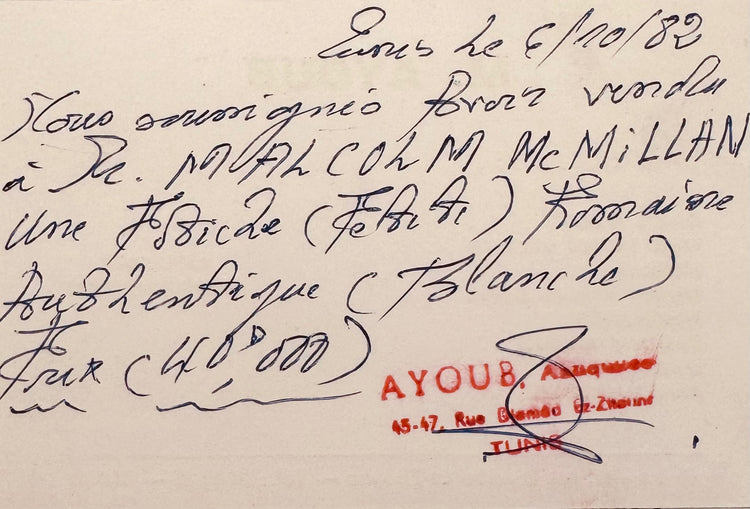
Acheté en Tunisie en 1982 chez M. Ayoub Antiquités, Tunis, Tunisie, puis conservé dans la collection McMillan, Minnesota, États-Unis, pendant plus de quarante ans.
Le vase est accompagné de sa fiche d'inventaire originale de la collection McMillan identifiant la pièce comme un pichet romain en terre naturelle de Tunisie et enregistrant son acquisition en 1982. La fiche d'inventaire comprend une photographie d'époque originale du vase tel qu'il apparaissait dans la collection dans les années 1980.
La documentation supplémentaire comprend la carte de visite originale de M. Ayoub Antiquités de Tunis, les notes manuscrites originales du marchand concernant l'objet, les registres d'inventaire originaux de la collection McMillan listant le vase comme Article n° 138, et les matériaux d'archives de la collection documentant le vase au sein de la collection plus large.
En savoir plus
Découvrez l'importance de l'Afrique du Nord romaine et son rôle en tant que l'un des principaux centres de commerce, d'agriculture et de production céramique de l'Empire romain.
Explorez notre collection de céramiques et poteries antiques
Description
Contexte historique et origine
Région : Afrique du Nord romaine (Tunisie actuelle)
Matériau : Terre cuite / Argile de poterie
Période : Période impériale romaine, ca. 100-500 EC
Description
Ce pichet en terre cuite de l'ancienne Afrique du Nord romaine est un exemple bien conservé de poterie utilitaire produite dans les provinces romaines de l'actuelle Tunisie. Le vase présente un corps arrondi se rétrécissant vers un col en retrait, un large rebord évasé et une anse robuste en forme de boucle s'étendant du rebord à l'épaule. Des nervures horizontales distinctives entourent le corps, créant un subtil effet décoratif tout en renforçant la structure du vase.
Ce type de poterie était largement utilisé dans toute l'Afrique du Nord romaine pour le stockage, le transport et le service de l'eau, du vin, de l'huile et d'autres produits ménagers. Pendant la période impériale romaine, la Tunisie formait la prospère province d'Afrique Proconsulaire, l'un des centres agricoles et commerciaux les plus importants de l'Empire. Des ateliers de toute la région produisaient de grandes quantités de céramiques qui approvisionnaient les populations locales et les vastes réseaux commerciaux méditerranéens.
Le vase présente une belle surface archéologique avec des zones d'incrustations minérales, d'altération et d'usure liées à l'âge qui témoignent de son ancienneté considérable.
Caractéristiques
- Pichet authentique en terre cuite de l'Afrique du Nord romaine
- Col en retrait avec un large rebord évasé
- Décoration nervurée horizontale distinctive
- Anse robuste en forme de boucle reliant le rebord et l'épaule
- Belle surface archéologique et dépôts minéraux
- Forme utilitaire classique typique de la poterie domestique romaine
- Accompagné d'une documentation de collection exhaustive
Importance historique
L'Afrique du Nord romaine comptait parmi les régions les plus productives de l'Empire romain, fournissant céréales, huile d'olive et autres produits dans tout le monde méditerranéen. Des récipients en poterie tels que celui-ci constituaient une partie essentielle de la vie quotidienne, servant à des fins domestiques, agricoles et commerciales.
Les exemples découverts en Tunisie témoignent de l'influence des traditions céramiques indigènes nord-africaines et des pratiques de fabrication romaines plus larges. Leur large distribution illustre l'importance économique de la région et la nature interconnectée des réseaux commerciaux romains.
Condition
Bon état ancien général. Usure de surface, dépôts minéraux, imperfections de cuisson et pertes éparses conformes à l'âge. Une fissure stable est présente le long du rebord. Altération archéologique générale et usure due à la manipulation. Aucune restauration moderne significative observée.
Dimensions (Approximatives)
Hauteur : 17,8 cm
Largeur : 10,2 cm
Diamètre : 10,2 cm
Âge (Approximatif)
1 500–1 900 ans
Provenance
Acheté en Tunisie en 1982 chez M. Ayoub Antiquités, Tunis, Tunisie, puis conservé dans la collection McMillan, Minnesota, États-Unis, pendant plus de quarante ans.
Le vase est accompagné de sa fiche d'inventaire originale de la collection McMillan identifiant la pièce comme un pichet romain en terre naturelle de Tunisie et enregistrant son acquisition en 1982. La fiche d'inventaire comprend une photographie d'époque originale du vase tel qu'il apparaissait dans la collection dans les années 1980.
La documentation supplémentaire comprend la carte de visite originale de M. Ayoub Antiquités de Tunis, les notes manuscrites originales du marchand concernant l'objet, les registres d'inventaire originaux de la collection McMillan listant le vase comme Article n° 138, et les matériaux d'archives de la collection documentant le vase au sein de la collection plus large.
En savoir plus
Découvrez l'importance de l'Afrique du Nord romaine et son rôle en tant que l'un des principaux centres de commerce, d'agriculture et de production céramique de l'Empire romain.
Explorez notre collection de céramiques et poteries antiques
Vous aimerez peut-être aussi
