


Group of Six Late Roman–Early Byzantine Bronze Finger Rings | Circa 3rd–7th Century CE
- Prix habituel
- $495.00
- Prix soldé
- $495.00
- Prix habituel
Impossible de charger la disponibilité du service de retrait


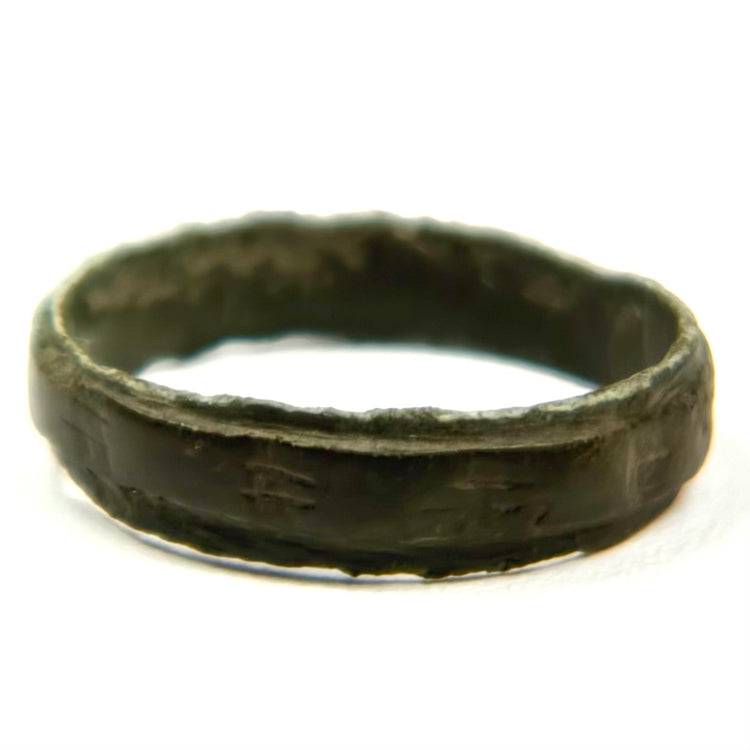
Group of Six Late Roman–Early Byzantine Bronze Finger Rings | Circa 3rd–7th Century CE
Description
Plus
Moins
Historical Context & Origin
Region: Roman Empire and Late Antique Mediterranean World
Material: Bronze (copper alloy), with surviving inset materials of uncertain composition
Period: Late Roman to Early Byzantine Period, circa 3rd–7th century CE
Description
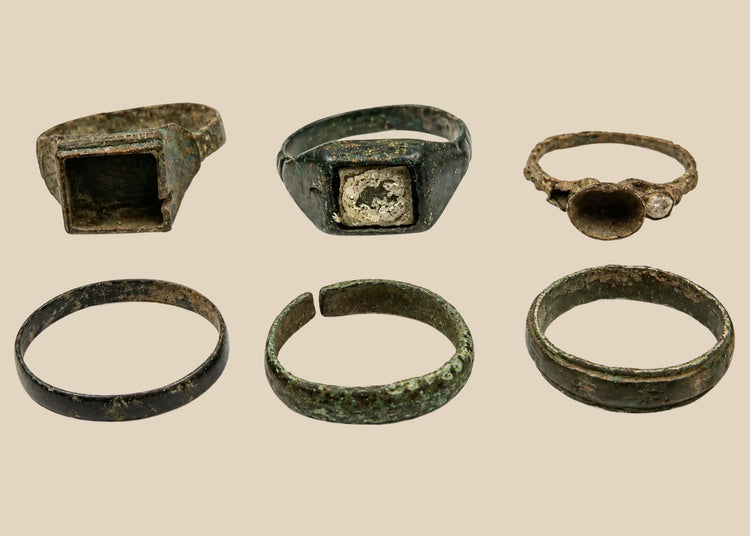
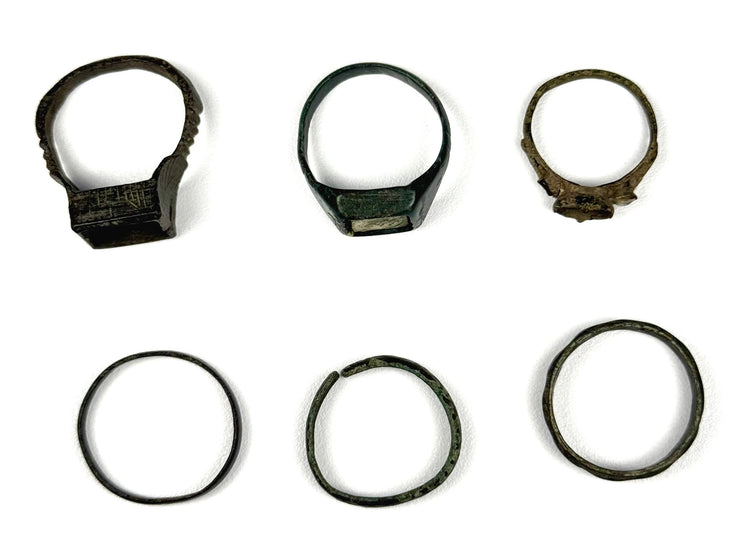
A fascinating collection of six ancient bronze finger rings representing several forms of personal adornment used during the later Roman Empire and the transition into the early Byzantine world. Offered together as a single archaeological study group, the rings range from substantial signet and bezel-set forms to simpler bronze bands, illustrating the remarkable variety of rings worn throughout Late Antiquity.
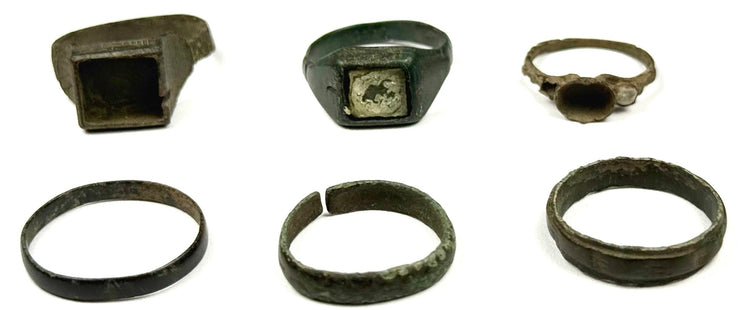
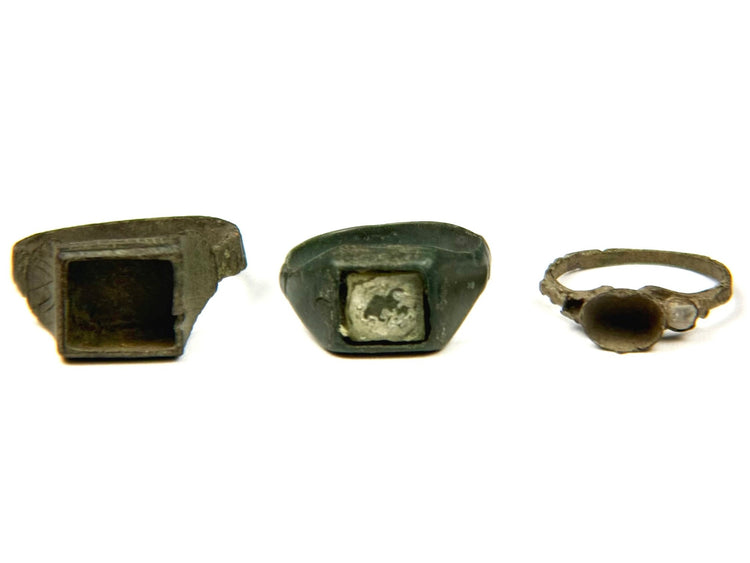
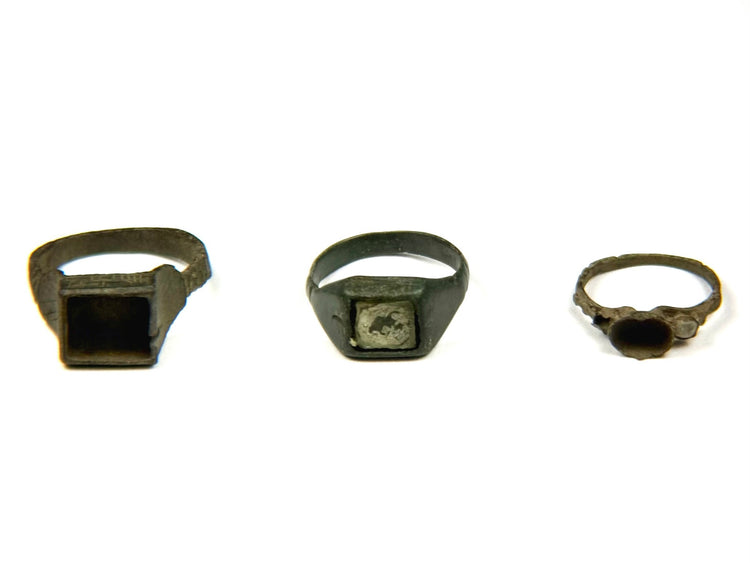
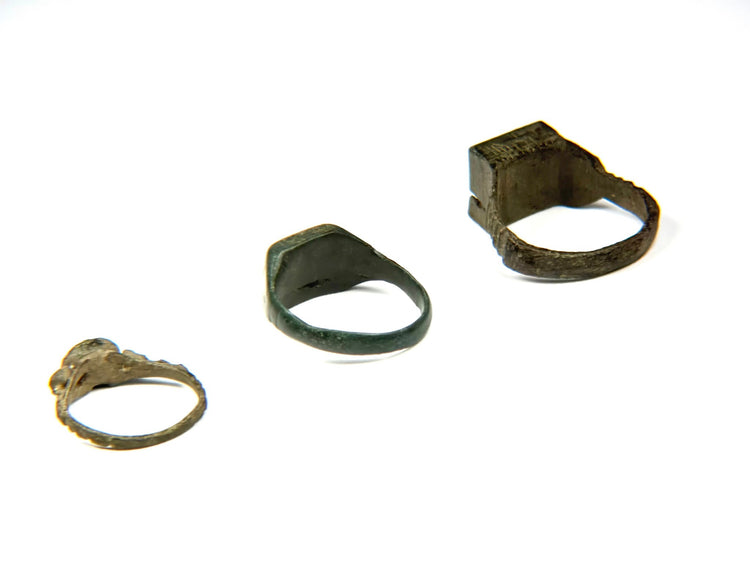
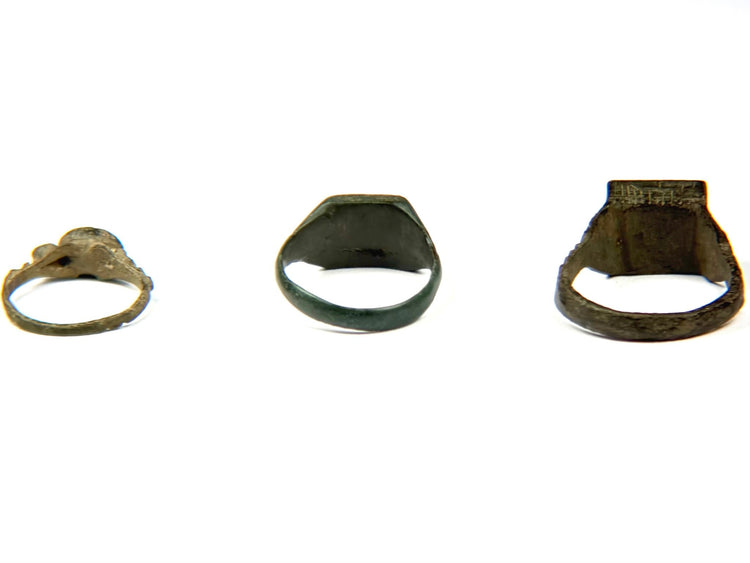
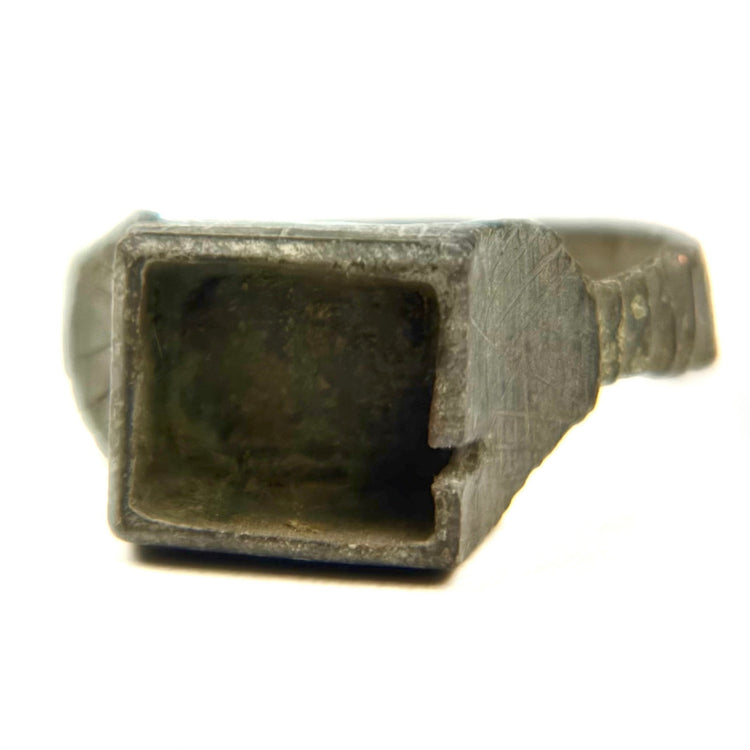
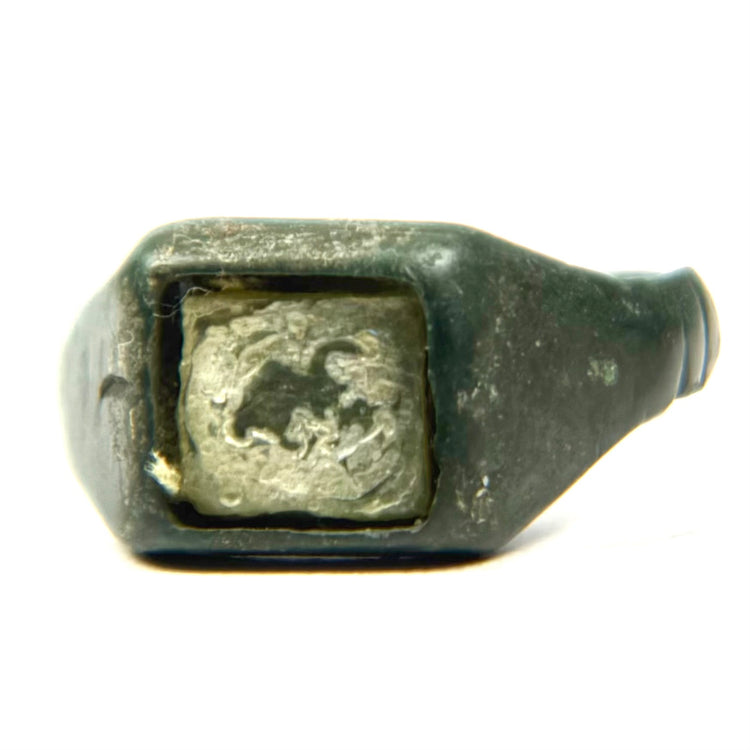
Two of the most distinctive examples feature broad shoulders supporting substantial square or rectangular bezels. One retains a deep recessed setting that is now empty, with surviving linear decoration around the bezel and shoulders. The second preserves a pale square inset within a heavy bronze frame. Its heavily worn surface appears to carry a small zoomorphic or figural motif, although the precise subject and composition of the inset remain uncertain.
These square-bezel forms are closely related to the family of Late Roman signet rings often described as Brancaster-type rings. Such rings characteristically feature broad or angular shoulders, raised square or rectangular bezels, and engraved decoration that could include inscriptions, human figures, birds, animals, or more abstract motifs.
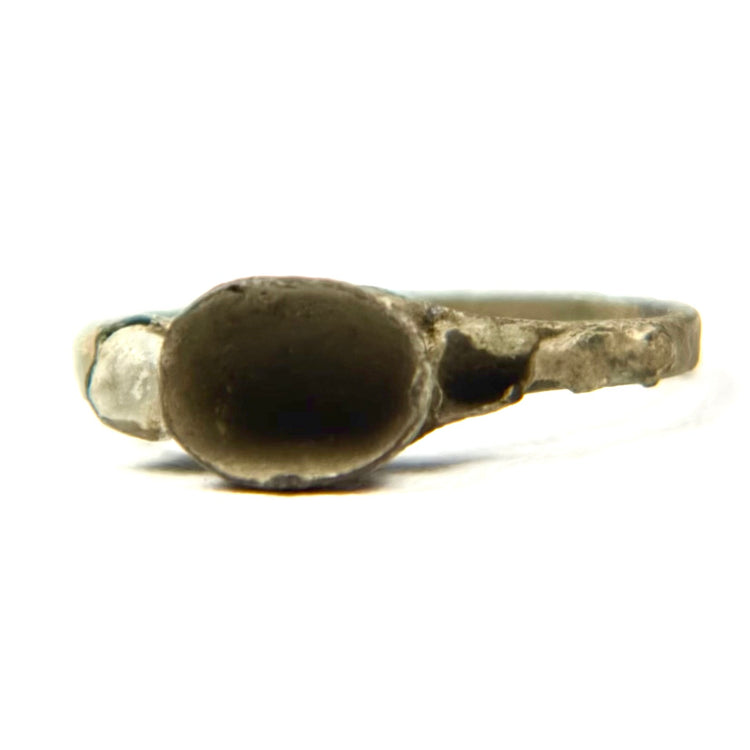
A third ring is considerably more delicate and incorporates two adjoining settings. The larger circular setting retains a dark brown-black cabochon or fill, while a smaller adjacent setting preserves a lighter material. Paired-setting bronze rings are documented within the Roman jewellery tradition and demonstrate the variety of decorative techniques available beyond conventional single-bezel signet rings.
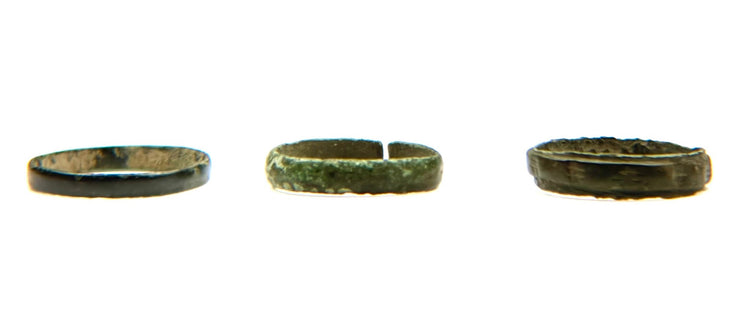
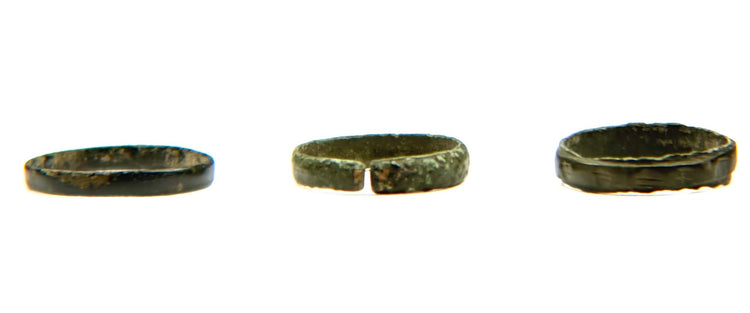
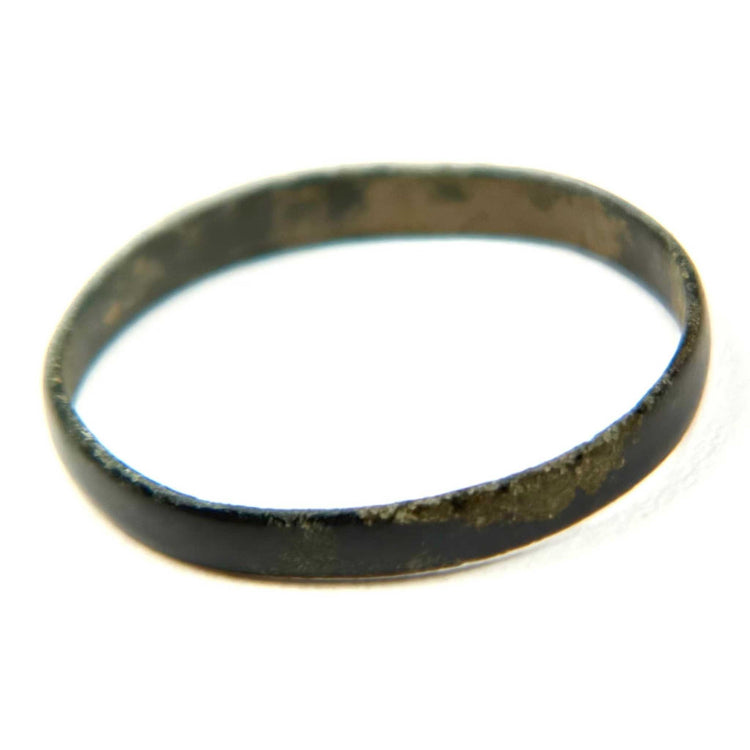
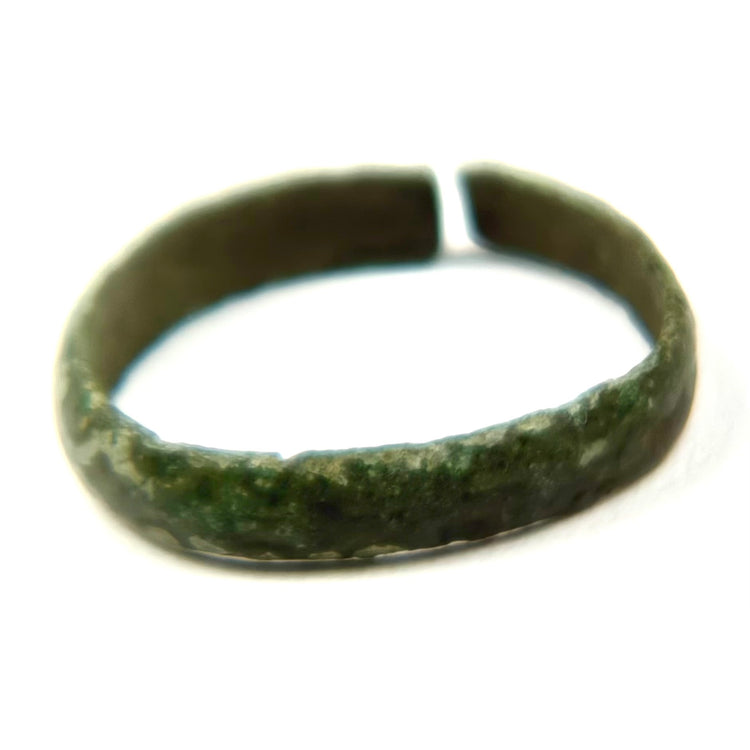
The remaining three pieces consist of bronze band rings in differing forms. One is a comparatively narrow plain hoop with a dark, smooth archaeological surface; another has an open break or gap to the band with green mineral patination; and the broadest example displays a substantial flat-section hoop with raised bordering and faint surviving linear or geometric surface decoration.
Together, the six rings form an unusually varied group encompassing signet, inset, decorative, and plain-band types and provide a tangible view of everyday personal ornament across the closing centuries of the Roman world.
Features
- Two substantial rings with raised square or rectangular bezel constructions
- One square bezel retaining a pale inset with a worn zoomorphic or figural motif
- One deep rectangular bezel with the original insert or setting now absent
- One slender ring with two adjoining circular settings and surviving inset material
- Three additional bronze band rings displaying different profiles and construction
- Surviving incised, linear, and geometric surface decoration
- Varied dark brown, black, olive-green, and green archaeological patinas
- Interesting study collection demonstrating multiple Late Antique ring forms
Cultural Significance
Finger rings occupied an important place in Roman and Late Antique society. Beyond personal decoration, rings could communicate social identity, religious affiliation, marital relationships, profession, authority, or personal taste. Signet rings equipped with engraved bezels or inserts could additionally be pressed into wax or clay to create identifying impressions for documents, containers, and correspondence.
The transition from the later Roman Empire into the Byzantine period produced an especially diverse range of copper-alloy rings. Classical gemstones and engraved signets continued to be used alongside increasingly stylized geometric, animal, monogrammatic, and Christian imagery. More modest bronze rings also demonstrate that personal jewellery was not restricted to the wealthiest levels of ancient society.
The square-bezel examples within this group are particularly noteworthy because they share characteristics with Late Roman Brancaster-type signet rings, a distinctive class generally associated with the 4th and 5th centuries CE and recognized for their substantial bezels, expanded shoulders, and engraved or inset designs.
Condition
Ancient archaeological condition with substantial age-related surface wear, patination, mineral deposits, oxidation, abrasions, and softened decorative detail throughout. One large rectangular bezel no longer retains its original inset or setting. The pale inset preserved within the second square-bezel ring shows considerable wear and surface loss. One of the band rings has an open break or gap, and the remaining rings show varying degrees of deformation and edge wear consistent with prolonged burial and age.
Dimensions (Approximate)
Ring Sizes: Ranging from US 5 to US 9
Age (Approximate)
1,300–1,800 years old
Provenance
Acquired in London during the 1970s. The artifact later entered the collection of Dr. Arnold Saslow, a noted numismatist and antiquarian who handled ancient coins, antiquities, and other historic objects over several decades, and was associated with Ye Olde Curiosity Shoppe in New Jersey. It was subsequently handled by Artemis Fine Arts, a U.S.-based gallery specializing in ancient, Classical, Pre-Columbian, and ethnographic art.
Learn More
Discover a related Early Byzantine bronze finger-ring dating to the 5th–7th century CE in the collection of the British Museum
Browse our collection of Ancient Rings & Jewelry: Historic Relics
Description
Historical Context & Origin
Region: Roman Empire and Late Antique Mediterranean World
Material: Bronze (copper alloy), with surviving inset materials of uncertain composition
Period: Late Roman to Early Byzantine Period, circa 3rd–7th century CE
Description
A fascinating collection of six ancient bronze finger rings representing several forms of personal adornment used during the later Roman Empire and the transition into the early Byzantine world. Offered together as a single archaeological study group, the rings range from substantial signet and bezel-set forms to simpler bronze bands, illustrating the remarkable variety of rings worn throughout Late Antiquity.
Two of the most distinctive examples feature broad shoulders supporting substantial square or rectangular bezels. One retains a deep recessed setting that is now empty, with surviving linear decoration around the bezel and shoulders. The second preserves a pale square inset within a heavy bronze frame. Its heavily worn surface appears to carry a small zoomorphic or figural motif, although the precise subject and composition of the inset remain uncertain.
These square-bezel forms are closely related to the family of Late Roman signet rings often described as Brancaster-type rings. Such rings characteristically feature broad or angular shoulders, raised square or rectangular bezels, and engraved decoration that could include inscriptions, human figures, birds, animals, or more abstract motifs.
A third ring is considerably more delicate and incorporates two adjoining settings. The larger circular setting retains a dark brown-black cabochon or fill, while a smaller adjacent setting preserves a lighter material. Paired-setting bronze rings are documented within the Roman jewellery tradition and demonstrate the variety of decorative techniques available beyond conventional single-bezel signet rings.
The remaining three pieces consist of bronze band rings in differing forms. One is a comparatively narrow plain hoop with a dark, smooth archaeological surface; another has an open break or gap to the band with green mineral patination; and the broadest example displays a substantial flat-section hoop with raised bordering and faint surviving linear or geometric surface decoration.
Together, the six rings form an unusually varied group encompassing signet, inset, decorative, and plain-band types and provide a tangible view of everyday personal ornament across the closing centuries of the Roman world.
Features
- Two substantial rings with raised square or rectangular bezel constructions
- One square bezel retaining a pale inset with a worn zoomorphic or figural motif
- One deep rectangular bezel with the original insert or setting now absent
- One slender ring with two adjoining circular settings and surviving inset material
- Three additional bronze band rings displaying different profiles and construction
- Surviving incised, linear, and geometric surface decoration
- Varied dark brown, black, olive-green, and green archaeological patinas
- Interesting study collection demonstrating multiple Late Antique ring forms
Cultural Significance
Finger rings occupied an important place in Roman and Late Antique society. Beyond personal decoration, rings could communicate social identity, religious affiliation, marital relationships, profession, authority, or personal taste. Signet rings equipped with engraved bezels or inserts could additionally be pressed into wax or clay to create identifying impressions for documents, containers, and correspondence.
The transition from the later Roman Empire into the Byzantine period produced an especially diverse range of copper-alloy rings. Classical gemstones and engraved signets continued to be used alongside increasingly stylized geometric, animal, monogrammatic, and Christian imagery. More modest bronze rings also demonstrate that personal jewellery was not restricted to the wealthiest levels of ancient society.
The square-bezel examples within this group are particularly noteworthy because they share characteristics with Late Roman Brancaster-type signet rings, a distinctive class generally associated with the 4th and 5th centuries CE and recognized for their substantial bezels, expanded shoulders, and engraved or inset designs.
Condition
Ancient archaeological condition with substantial age-related surface wear, patination, mineral deposits, oxidation, abrasions, and softened decorative detail throughout. One large rectangular bezel no longer retains its original inset or setting. The pale inset preserved within the second square-bezel ring shows considerable wear and surface loss. One of the band rings has an open break or gap, and the remaining rings show varying degrees of deformation and edge wear consistent with prolonged burial and age.
Dimensions (Approximate)
Ring Sizes: Ranging from US 5 to US 9
Age (Approximate)
1,300–1,800 years old
Provenance
Acquired in London during the 1970s. The artifact later entered the collection of Dr. Arnold Saslow, a noted numismatist and antiquarian who handled ancient coins, antiquities, and other historic objects over several decades, and was associated with Ye Olde Curiosity Shoppe in New Jersey. It was subsequently handled by Artemis Fine Arts, a U.S.-based gallery specializing in ancient, Classical, Pre-Columbian, and ethnographic art.
Learn More
Discover a related Early Byzantine bronze finger-ring dating to the 5th–7th century CE in the collection of the British Museum
Browse our collection of Ancient Rings & Jewelry: Historic Relics
Vous aimerez peut-être aussi
