

Pre-Columbian Taíno Three-Pointed Stone Zemi | Circa 1000–1500 CE
- Prix habituel
- $500.00
- Prix soldé
- $500.00
- Prix habituel
Impossible de charger la disponibilité du service de retrait




Pre-Columbian Taíno Three-Pointed Stone Zemi | Circa 1000–1500 CE
Description
Plus
Moins
Historical Context & Origin
Region: Greater Antilles, Caribbean, possibly Puerto Rico or Hispaniola
Culture: Taíno
Material: Carved pale stone, probably limestone
Period: Pre-Columbian, circa 1000–1500 CE
Description
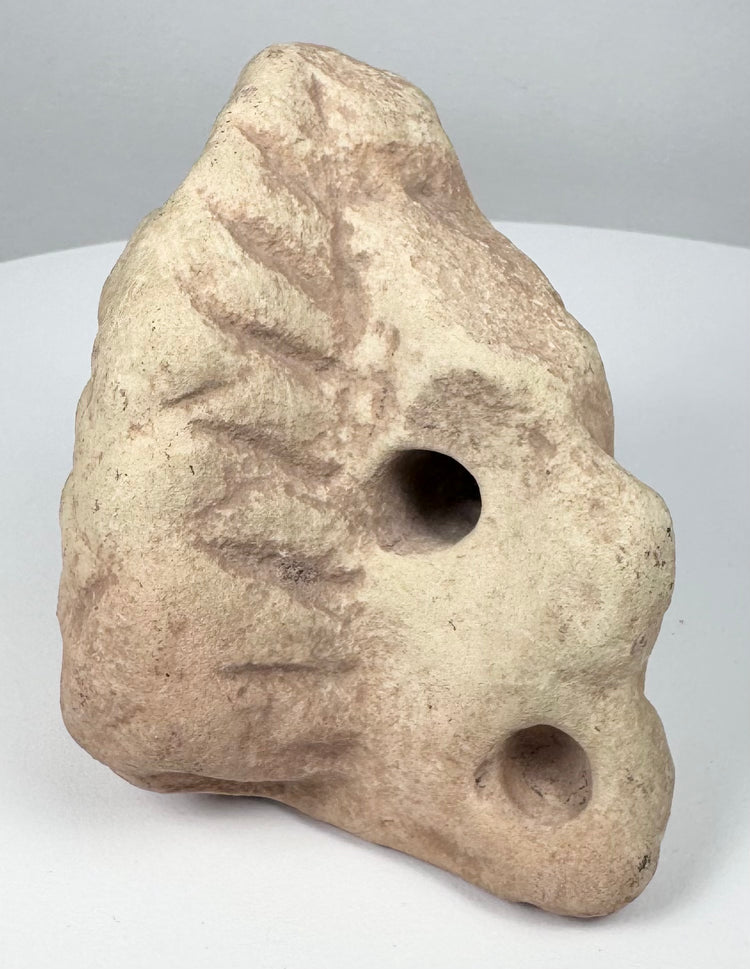
An unusual Pre-Columbian Taíno three-pointed stone, or trigonolith, associated with the distinctive zemí tradition of the Greater Antilles.
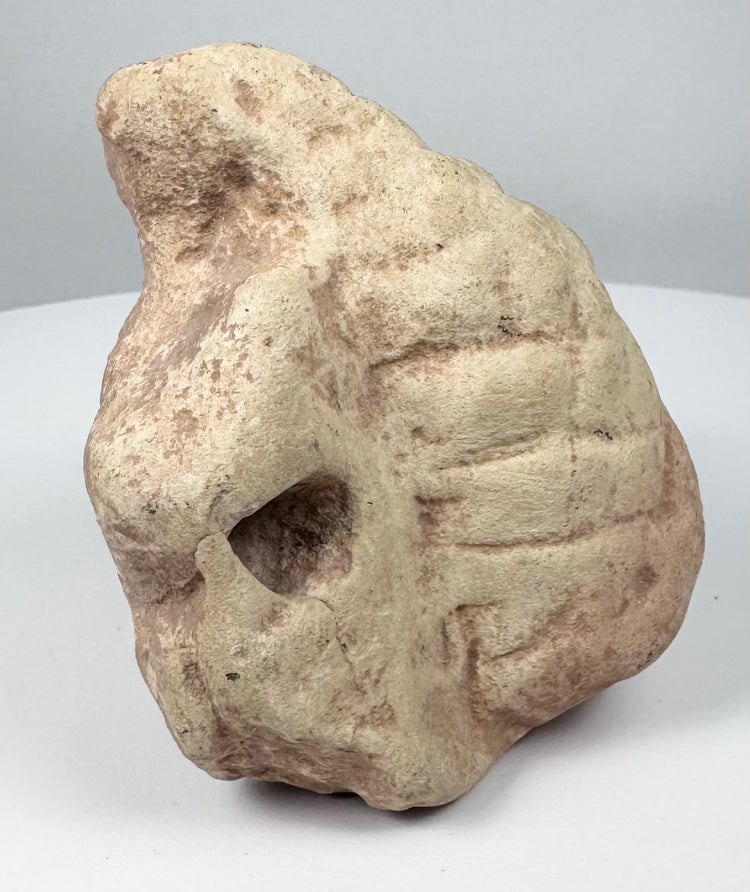
Carved from a solid pale cream-to-buff stone, the object assumes a compact triangular form dominated by a pronounced central projection rising above a broad, sculpturally modeled base. The carving does not present a clearly conventional human figure and instead appears zoomorphic, hybrid, or deliberately abstract, with rounded projecting forms and deeply worked apertures contributing to its enigmatic composition.
Several deliberately worked openings or deep recesses appear around the lateral portions of the sculpture. These features appear integral to the carved design, although their precise original function or iconographic significance cannot presently be established.
The raised central element, broad flanking forms, and compact three-pointed silhouette are consistent with the sculptural vocabulary of Taíno trigonoliths. Museum collections demonstrate that these objects could incorporate anthropomorphic, zoomorphic, hybrid, geometric, and highly abstract imagery, with individual examples varying considerably in their degree of naturalism.
The extensive surface wear has softened much of the original detailing, making identification of any specific creature, ancestor, deity, or spirit represented by the carving uncertain. For this reason, the piece is most responsibly described as a zoomorphic or abstract three-pointed stone rather than assigned to a specific animal or figure.
Features
- Pre-Columbian carved stone ritual object
- Distinctive three-pointed or trigonolith form
- Associated with the Taíno zemí tradition
- Solid carved stone construction
- Pronounced central conical projection
- Broad sculpturally modeled base
- Zoomorphic, hybrid, or abstract imagery
- Multiple deliberately worked apertures and recessed areas
- Pale cream, buff, and muted pinkish natural stone coloration
- Extensive age-related smoothing and surface weathering
- Compact portable scale
- Form strongly associated with Taíno sculptural traditions of the Greater Antilles
Cultural Significance
Three-pointed stones are among the most distinctive sculptural forms associated with the Taíno peoples of the Greater Antilles. Often referred to as trigonolitos or trigonoliths, these portable stone sculptures occur in a wide variety of sizes and may incorporate human, animal, hybrid, geometric, or abstract imagery.
These objects are closely associated with the Taíno concept of zemí, a term referring to spiritual or vital power connected with deities, ancestors, natural forces, and sacred beings. Rather than simply describing a particular class of carved object, zemí encompasses the spiritual presence or power with which such objects could be associated.
Spanish colonial accounts and later scholarship have linked three-pointed stones with the cultivation of yuca, or cassava, one of the principal staple crops of the pre-contact Caribbean. Their exact ritual roles, however, remain incompletely understood, and interpretations of individual examples vary according to archaeological context, imagery, and form.
Their imagery was not confined to conventional human representation. Institutional collections preserve three-pointed stones interpreted as birds, anthropomorphic beings, animals, and hybrid forms, as well as highly abstract compositions. This diversity demonstrates the considerable visual range of Taíno sculptural traditions.
The precise meaning of the present example cannot be recovered without archaeological context. Its deliberately abstract character and unusual apertures may have formed part of its original symbolic or ritual significance, but their specific interpretation remains uncertain.
Condition
Good ancient condition consistent with considerable age.
The stone exhibits extensive surface weathering, smoothing, abrasion, scratches, mineral discoloration, scattered deposits, minor pitting, and localized surface losses. Much of the original carved detailing has softened over time, particularly around the raised central and lateral elements.
The deliberately worked apertures remain clearly visible and appear integral to the sculptural design. Variations in cream, buff, pinkish-brown, and pale earthen coloration occur naturally across the surface.
Minor chips and irregularities are present throughout, consistent with age and historic handling.
The object remains structurally substantial and retains its distinctive three-pointed sculptural silhouette.
Dimensions (Approximate)
Height: 3 in
Length: 3.25 in
Depth: 2 in
Age (Approximate)
500–1,000 years old
Provenance
Private collection, Toronto, Ontario, Canada. Subsequently handled by A.H. Wilkens Auctions & Appraisals, Toronto, Ontario.
Founded in 2009, A.H. Wilkens is a well-established Canadian auction house specializing in fine art, decorative arts, Asian antiques, and estate collections. The firm operates from its Toronto gallery and serves both Canadian and international collectors.
Learn More
View a related Taíno three-pointed stone, or trigonolith, in the collection of The Metropolitan Museum of Art
Explore our Collection of Ancient Pre-Columbian Artifacts & Relics
Description
Historical Context & Origin
Region: Greater Antilles, Caribbean, possibly Puerto Rico or Hispaniola
Culture: Taíno
Material: Carved pale stone, probably limestone
Period: Pre-Columbian, circa 1000–1500 CE
Description
An unusual Pre-Columbian Taíno three-pointed stone, or trigonolith, associated with the distinctive zemí tradition of the Greater Antilles.
Carved from a solid pale cream-to-buff stone, the object assumes a compact triangular form dominated by a pronounced central projection rising above a broad, sculpturally modeled base. The carving does not present a clearly conventional human figure and instead appears zoomorphic, hybrid, or deliberately abstract, with rounded projecting forms and deeply worked apertures contributing to its enigmatic composition.
Several deliberately worked openings or deep recesses appear around the lateral portions of the sculpture. These features appear integral to the carved design, although their precise original function or iconographic significance cannot presently be established.
The raised central element, broad flanking forms, and compact three-pointed silhouette are consistent with the sculptural vocabulary of Taíno trigonoliths. Museum collections demonstrate that these objects could incorporate anthropomorphic, zoomorphic, hybrid, geometric, and highly abstract imagery, with individual examples varying considerably in their degree of naturalism.
The extensive surface wear has softened much of the original detailing, making identification of any specific creature, ancestor, deity, or spirit represented by the carving uncertain. For this reason, the piece is most responsibly described as a zoomorphic or abstract three-pointed stone rather than assigned to a specific animal or figure.
Features
- Pre-Columbian carved stone ritual object
- Distinctive three-pointed or trigonolith form
- Associated with the Taíno zemí tradition
- Solid carved stone construction
- Pronounced central conical projection
- Broad sculpturally modeled base
- Zoomorphic, hybrid, or abstract imagery
- Multiple deliberately worked apertures and recessed areas
- Pale cream, buff, and muted pinkish natural stone coloration
- Extensive age-related smoothing and surface weathering
- Compact portable scale
- Form strongly associated with Taíno sculptural traditions of the Greater Antilles
Cultural Significance
Three-pointed stones are among the most distinctive sculptural forms associated with the Taíno peoples of the Greater Antilles. Often referred to as trigonolitos or trigonoliths, these portable stone sculptures occur in a wide variety of sizes and may incorporate human, animal, hybrid, geometric, or abstract imagery.
These objects are closely associated with the Taíno concept of zemí, a term referring to spiritual or vital power connected with deities, ancestors, natural forces, and sacred beings. Rather than simply describing a particular class of carved object, zemí encompasses the spiritual presence or power with which such objects could be associated.
Spanish colonial accounts and later scholarship have linked three-pointed stones with the cultivation of yuca, or cassava, one of the principal staple crops of the pre-contact Caribbean. Their exact ritual roles, however, remain incompletely understood, and interpretations of individual examples vary according to archaeological context, imagery, and form.
Their imagery was not confined to conventional human representation. Institutional collections preserve three-pointed stones interpreted as birds, anthropomorphic beings, animals, and hybrid forms, as well as highly abstract compositions. This diversity demonstrates the considerable visual range of Taíno sculptural traditions.
The precise meaning of the present example cannot be recovered without archaeological context. Its deliberately abstract character and unusual apertures may have formed part of its original symbolic or ritual significance, but their specific interpretation remains uncertain.
Condition
Good ancient condition consistent with considerable age.
The stone exhibits extensive surface weathering, smoothing, abrasion, scratches, mineral discoloration, scattered deposits, minor pitting, and localized surface losses. Much of the original carved detailing has softened over time, particularly around the raised central and lateral elements.
The deliberately worked apertures remain clearly visible and appear integral to the sculptural design. Variations in cream, buff, pinkish-brown, and pale earthen coloration occur naturally across the surface.
Minor chips and irregularities are present throughout, consistent with age and historic handling.
The object remains structurally substantial and retains its distinctive three-pointed sculptural silhouette.
Dimensions (Approximate)
Height: 3 in
Length: 3.25 in
Depth: 2 in
Age (Approximate)
500–1,000 years old
Provenance
Private collection, Toronto, Ontario, Canada. Subsequently handled by A.H. Wilkens Auctions & Appraisals, Toronto, Ontario.
Founded in 2009, A.H. Wilkens is a well-established Canadian auction house specializing in fine art, decorative arts, Asian antiques, and estate collections. The firm operates from its Toronto gallery and serves both Canadian and international collectors.
Learn More
View a related Taíno three-pointed stone, or trigonolith, in the collection of The Metropolitan Museum of Art
Explore our Collection of Ancient Pre-Columbian Artifacts & Relics
Vous aimerez peut-être aussi
