



Ancient Egyptian Bronze Kohl Applicator with Double-Bulb Finial | Circa 332–30 BCE
- Precio habitual
- $400.00
- Precio de venta
- $400.00
- Precio habitual
No se pudo cargar la disponibilidad de retiro



Ancient Egyptian Bronze Kohl Applicator with Double-Bulb Finial | Circa 332–30 BCE
Descripción
Más
Menos
Historical Context & Origin
Region: Ancient Egypt
Material: Bronze (copper alloy)
Period: Ptolemaic Period, circa 332–30 BCE (attributed)
Description
This ancient Egyptian-style bronze cosmetic applicator features an exceptionally slender, elongated shaft and a distinctive double-bulb decorative finial. Traditionally attributed to the Ptolemaic Period, circa 332–30 BCE, the instrument closely resembles bronze kohl applicators associated with ancient Egyptian personal grooming and cosmetic practices. Its carefully proportioned construction combines functional simplicity with decorative metalwork, reflecting the craftsmanship of historical Egyptian personal accessories.
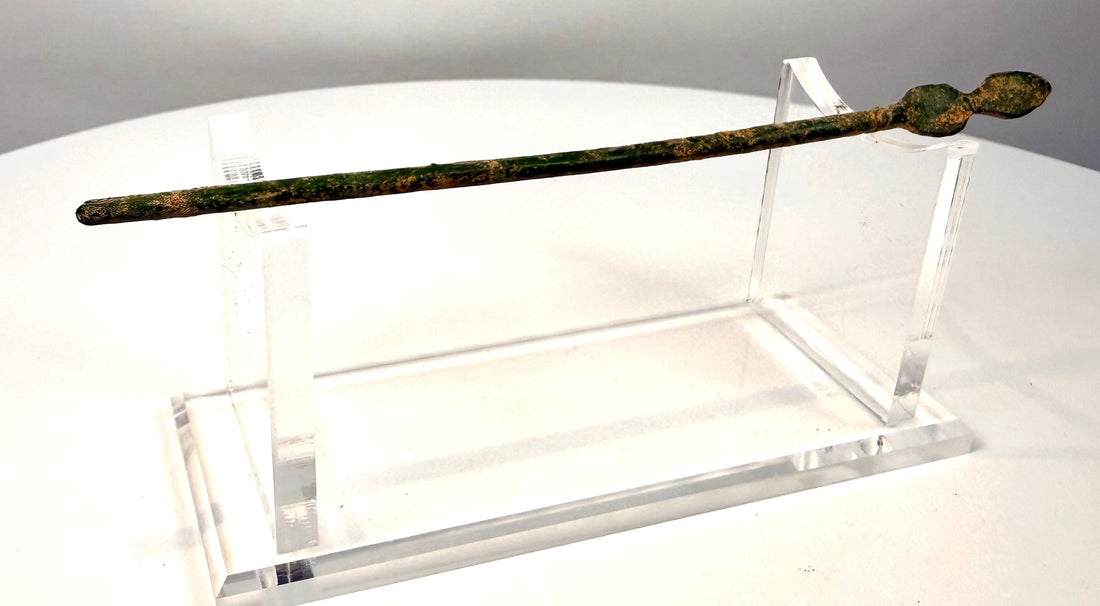
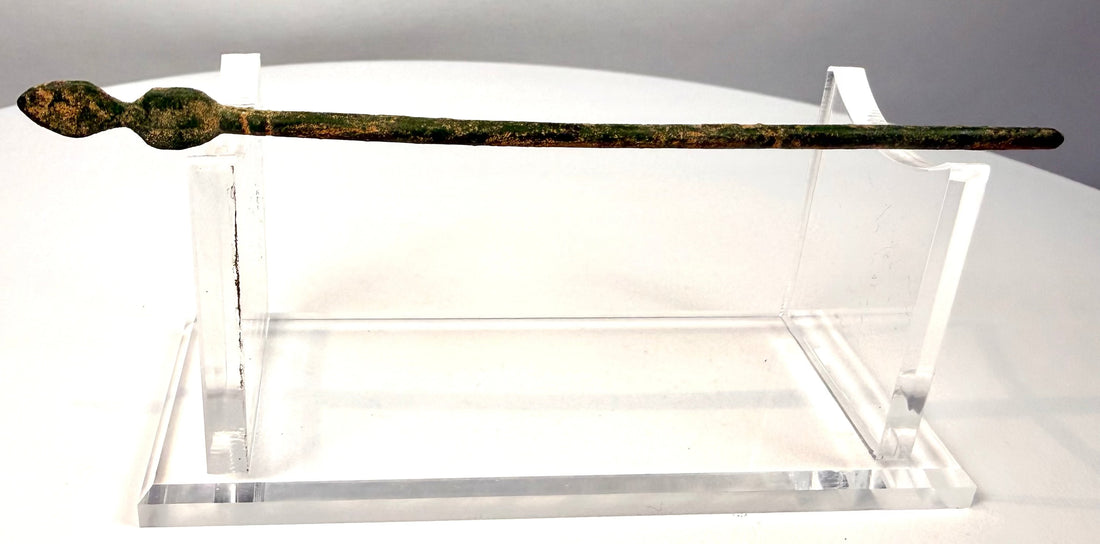
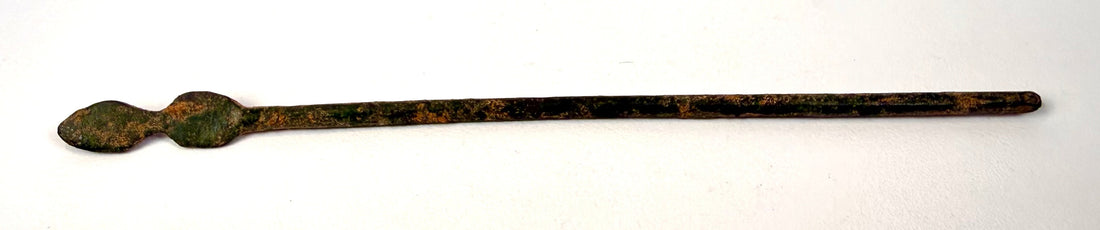
The implement consists of a long, narrow cylindrical shaft of relatively uniform thickness, terminating at one end in a smooth, rounded tip. The opposite end features two individually modelled, elongated oval projections separated by a narrow constriction, forming a distinctive double-bulb finial. The rounded contours of these decorative elements contrast with the slender shaft, creating a balanced and recognizable profile. Comparable Egyptian kohl sticks were used to mix, transfer, and apply powdered eye cosmetics, often in conjunction with narrow cosmetic containers.
The bronze surface exhibits extensive dark green, olive, and earthy brown patination, with scattered mineral-like deposits, oxidation, and localized areas of darker discolouration. The elongated shaft retains its overall straight form, displaying subtle surface irregularities, minor abrasions, and patches of brownish metal visible beneath the corrosion products. The decorative double-bulb terminal remains clearly defined, preserving the instrument's distinctive construction and historical character.
Features
- Slender bronze cosmetic applicator traditionally associated with ancient Egyptian kohl practices
- Long cylindrical shaft with a smooth, rounded terminal
- Distinctive double-bulb decorative finial at the opposite end
- Two elongated oval projections separated by a narrow constriction
- Traditional form comparable to ancient Egyptian bronze kohl sticks
- Rich dark green, olive, and earthy brown surface patination
- Scattered oxidation, minor pitting, abrasions, and mineral-like deposits
- Complete elongated form measuring approximately 5 inches in length
Cultural Significance
Cosmetics occupied an important place in ancient Egyptian society, serving aesthetic, practical, religious, and symbolic purposes. Both men and women used cosmetics, particularly dark eye makeup known as kohl, which was commonly prepared from finely ground minerals such as galena. The distinctive dark outlines applied around the eyes became one of the most recognizable features of ancient Egyptian personal adornment, reflecting traditions associated with beauty, personal care, and divine protection.
Ancient Egyptian cosmetic implements were produced using a variety of materials, including wood, ivory, stone, copper, and bronze. Kohl sticks were particularly useful for mixing and transferring pigments from narrow containers, allowing cosmetics to be applied with greater precision. These slender instruments varied in design, ranging from simple rods to more elaborate examples featuring decorative terminals and carefully modelled metalwork. Their construction illustrates the relationship between everyday functionality and artistic craftsmanship in ancient Egyptian material culture.
During the Ptolemaic Period (332–30 BCE), Egypt experienced significant cultural interaction between longstanding Egyptian traditions and the Hellenistic world established following the conquests of Alexander the Great. Despite these developments, many established Egyptian customs continued, including religious practices, personal grooming traditions, and the use of cosmetic accessories. Bronze kohl applicators and related implements provide valuable insight into these enduring traditions and the importance of personal adornment throughout ancient Egyptian history.
Condition
The instrument retains its complete overall form, including the elongated cylindrical shaft, rounded terminal, and distinctive double-bulb decorative finial. Extensive surface oxidation and patination are visible throughout, exhibiting a combination of dark green, olive, blackish, and earthy brown coloration. The decorative terminal displays scattered deposits and areas of discolouration, with minor surface irregularities and localized pitting around the individual oval projections. The shaft retains its relatively straight profile, exhibiting additional oxidation, abrasions, and areas of mineral-like encrustation along its length. The opposite terminal remains rounded, although portions of the original metal surface are obscured by corrosion products. The decorative contours remain recognizable despite age-related surface wear and accumulated deposits.
Dimensions (Approximate)
Length: 5 in
Width: 0.25 in
Age (Approximate)
2,050–2,360 years old
Provenance
Previously held in a private collection in Indianapolis, Indiana, United States.
Learn More
Explore a comparable ancient Egyptian bronze kohl stick dating to the New Kingdom, circa 1427–1396 BCE, illustrating the longstanding tradition of metal cosmetic applicators through The Metropolitan Museum of Art
Discover additional ancient Egyptian cosmetic implements, protective amulets, and historical artifacts in our Ancient Egyptian Mummies & Artifacts Collection
Descripción
Historical Context & Origin
Region: Ancient Egypt
Material: Bronze (copper alloy)
Period: Ptolemaic Period, circa 332–30 BCE (attributed)
Description
This ancient Egyptian-style bronze cosmetic applicator features an exceptionally slender, elongated shaft and a distinctive double-bulb decorative finial. Traditionally attributed to the Ptolemaic Period, circa 332–30 BCE, the instrument closely resembles bronze kohl applicators associated with ancient Egyptian personal grooming and cosmetic practices. Its carefully proportioned construction combines functional simplicity with decorative metalwork, reflecting the craftsmanship of historical Egyptian personal accessories.
The implement consists of a long, narrow cylindrical shaft of relatively uniform thickness, terminating at one end in a smooth, rounded tip. The opposite end features two individually modelled, elongated oval projections separated by a narrow constriction, forming a distinctive double-bulb finial. The rounded contours of these decorative elements contrast with the slender shaft, creating a balanced and recognizable profile. Comparable Egyptian kohl sticks were used to mix, transfer, and apply powdered eye cosmetics, often in conjunction with narrow cosmetic containers.
The bronze surface exhibits extensive dark green, olive, and earthy brown patination, with scattered mineral-like deposits, oxidation, and localized areas of darker discolouration. The elongated shaft retains its overall straight form, displaying subtle surface irregularities, minor abrasions, and patches of brownish metal visible beneath the corrosion products. The decorative double-bulb terminal remains clearly defined, preserving the instrument's distinctive construction and historical character.
Features
- Slender bronze cosmetic applicator traditionally associated with ancient Egyptian kohl practices
- Long cylindrical shaft with a smooth, rounded terminal
- Distinctive double-bulb decorative finial at the opposite end
- Two elongated oval projections separated by a narrow constriction
- Traditional form comparable to ancient Egyptian bronze kohl sticks
- Rich dark green, olive, and earthy brown surface patination
- Scattered oxidation, minor pitting, abrasions, and mineral-like deposits
- Complete elongated form measuring approximately 5 inches in length
Cultural Significance
Cosmetics occupied an important place in ancient Egyptian society, serving aesthetic, practical, religious, and symbolic purposes. Both men and women used cosmetics, particularly dark eye makeup known as kohl, which was commonly prepared from finely ground minerals such as galena. The distinctive dark outlines applied around the eyes became one of the most recognizable features of ancient Egyptian personal adornment, reflecting traditions associated with beauty, personal care, and divine protection.
Ancient Egyptian cosmetic implements were produced using a variety of materials, including wood, ivory, stone, copper, and bronze. Kohl sticks were particularly useful for mixing and transferring pigments from narrow containers, allowing cosmetics to be applied with greater precision. These slender instruments varied in design, ranging from simple rods to more elaborate examples featuring decorative terminals and carefully modelled metalwork. Their construction illustrates the relationship between everyday functionality and artistic craftsmanship in ancient Egyptian material culture.
During the Ptolemaic Period (332–30 BCE), Egypt experienced significant cultural interaction between longstanding Egyptian traditions and the Hellenistic world established following the conquests of Alexander the Great. Despite these developments, many established Egyptian customs continued, including religious practices, personal grooming traditions, and the use of cosmetic accessories. Bronze kohl applicators and related implements provide valuable insight into these enduring traditions and the importance of personal adornment throughout ancient Egyptian history.
Condition
The instrument retains its complete overall form, including the elongated cylindrical shaft, rounded terminal, and distinctive double-bulb decorative finial. Extensive surface oxidation and patination are visible throughout, exhibiting a combination of dark green, olive, blackish, and earthy brown coloration. The decorative terminal displays scattered deposits and areas of discolouration, with minor surface irregularities and localized pitting around the individual oval projections. The shaft retains its relatively straight profile, exhibiting additional oxidation, abrasions, and areas of mineral-like encrustation along its length. The opposite terminal remains rounded, although portions of the original metal surface are obscured by corrosion products. The decorative contours remain recognizable despite age-related surface wear and accumulated deposits.
Dimensions (Approximate)
Length: 5 in
Width: 0.25 in
Age (Approximate)
2,050–2,360 years old
Provenance
Previously held in a private collection in Indianapolis, Indiana, United States.
Learn More
Explore a comparable ancient Egyptian bronze kohl stick dating to the New Kingdom, circa 1427–1396 BCE, illustrating the longstanding tradition of metal cosmetic applicators through The Metropolitan Museum of Art
Discover additional ancient Egyptian cosmetic implements, protective amulets, and historical artifacts in our Ancient Egyptian Mummies & Artifacts Collection
También te puede interesar
