



Ancient Egyptian Faience Isis Nursing Horus Amulet | Late Period–Early Ptolemaic | Circa 600–300 BCE
- Precio habitual
- $400.00
- Precio de venta
- $400.00
- Precio habitual
No se pudo cargar la disponibilidad de retiro



Ancient Egyptian Faience Isis Nursing Horus Amulet | Late Period–Early Ptolemaic | Circa 600–300 BCE
Descripción
Más
Menos
Historical Context & Origin
Region: Ancient Egypt
Material: Faience (glazed siliceous composition)
Period: Late Period to Early Ptolemaic Period, circa 600–300 BCE
Description
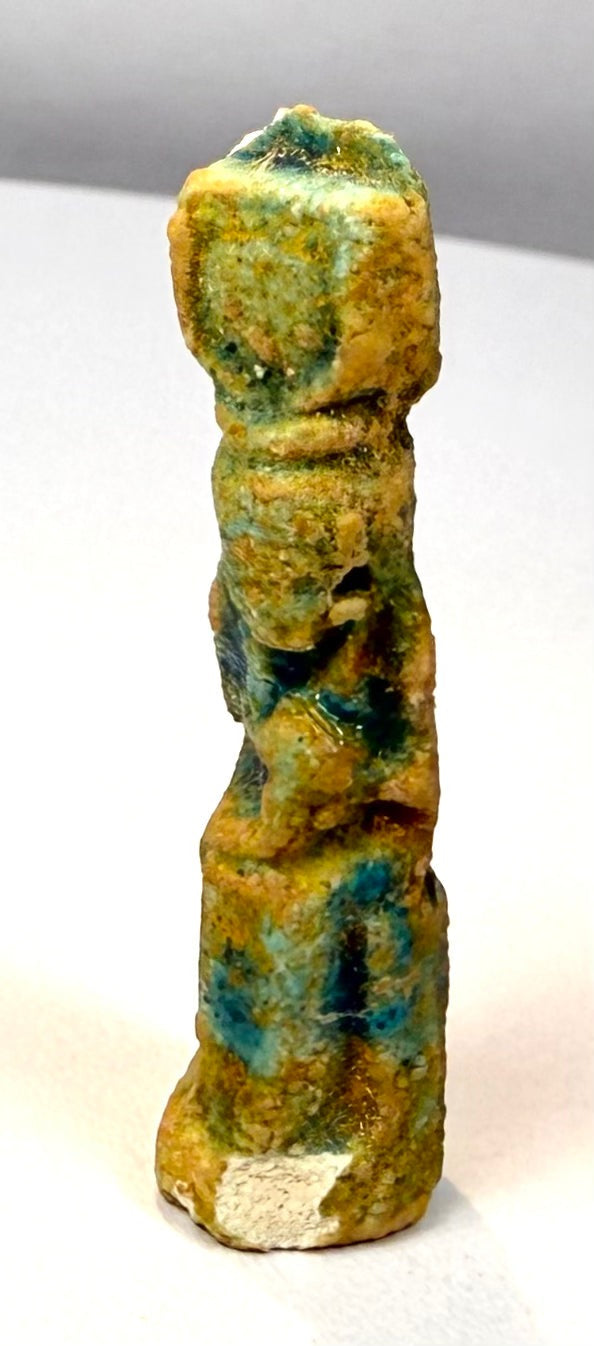
This miniature Egyptian faience amulet is traditionally identified as depicting the goddess Isis nursing her infant son Horus, an important representation of maternal protection, divine motherhood, and regeneration in ancient Egyptian religious art. Attributed to the Late Period to Early Ptolemaic Period, circa 600–300 BCE, the amulet reflects the religious symbolism and craftsmanship associated with small protective figures produced throughout ancient Egypt.
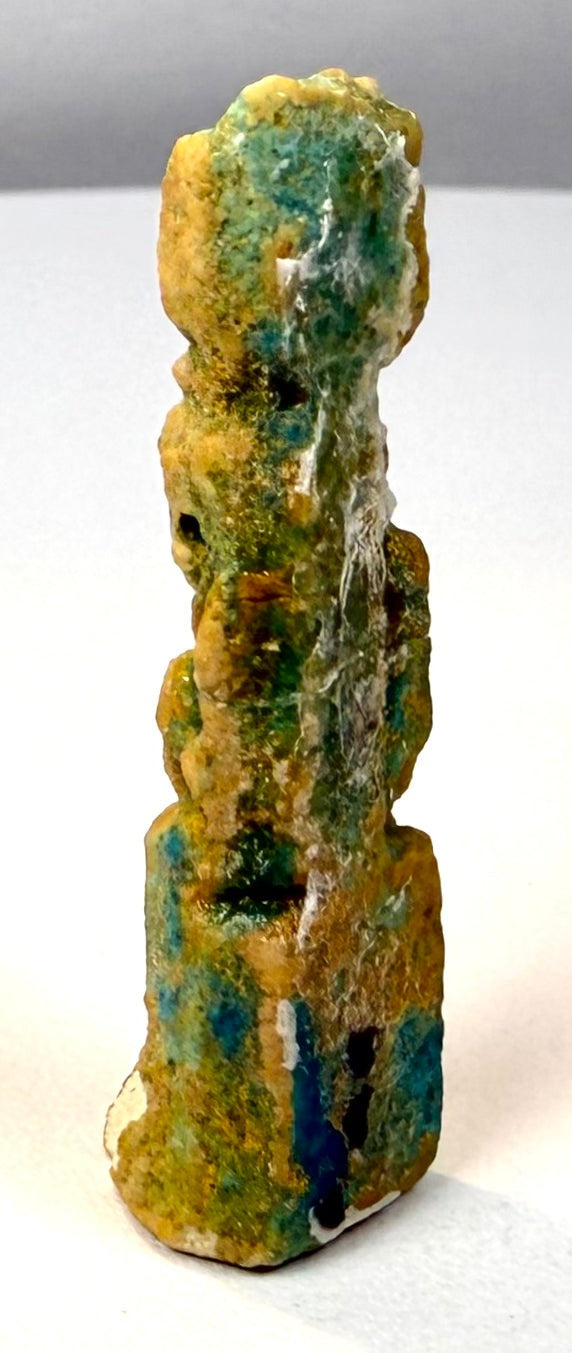
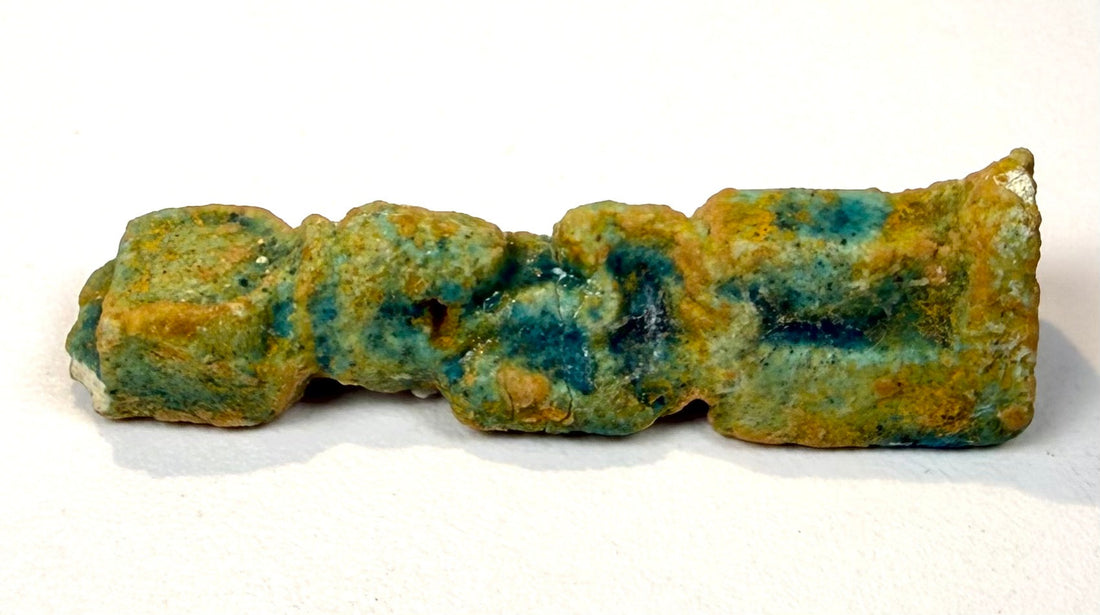
The amulet exhibits an elongated, upright form with a squared upper section, narrow central body, and rectangular lower portion. Surviving sculptural projections and recessed areas suggest the arrangement of a miniature seated figural composition, although extensive surface deterioration has obscured much of the original modelling. The upper section retains an irregular, recessed appearance, while the central and lower portions display traces of moulded details beneath accumulated surface deposits.
The surface retains striking areas of turquoise-blue and green glaze, contrasting with extensive golden-yellow, ochre, and earthy brown deposits. Small patches of pale underlying material are visible where portions of the original surface have been lost. The combination of surviving blue-green glaze, compact proportions, and traditional figural construction is comparable to Egyptian faience amulets preserved in museum collections, including representations of Isis nursing Horus from the Late and Ptolemaic periods.
Features
- Elongated upright form with squared upper section
- Narrow central body with surviving moulded figural details
- Rectangular lower section with areas of exposed underlying material
- Surviving turquoise-blue and green glazed surfaces
- Contrasting golden-yellow, ochre, and earthy brown coloration
- Extensive mineral-like encrustation and accumulated surface deposits
- Scattered chips, surface irregularities, and areas of apparent original glaze loss
Cultural Significance
Isis was among the most revered goddesses of ancient Egypt, representing motherhood, divine protection, healing, and magical power. As the wife of Osiris and mother of Horus, she occupied a central position in Egyptian religious mythology and was closely associated with the protection and legitimacy of the pharaoh. According to Egyptian tradition, Isis restored her husband Osiris following his murder by Seth, ensuring the continuation of the divine royal lineage through their son Horus.
Representations of Isis nursing the infant Horus, commonly known as Isis lactans, became especially prominent during the Late Period and continued into the Ptolemaic and Roman eras. These images emphasized the goddess's nurturing and protective qualities, symbolizing the preservation of life, divine motherhood, and regeneration. Small amulets depicting Isis and Horus were worn or carried as protective objects and were also incorporated into funerary traditions.
Faience was widely used in ancient Egyptian religious and decorative objects, particularly amulets representing deities, sacred animals, and protective symbols. Its characteristic blue-green glaze held symbolic associations with fertility, renewal, and the life-giving properties of water. The surviving glazed surfaces and traditional figural form of this amulet reflect the broader artistic and religious traditions associated with Egyptian protective objects.
Condition
The amulet remains substantially intact in its overall elongated form, exhibiting extensive surface deterioration, encrustation, and loss of original sculptural detail. Areas of turquoise-blue and green glaze survive throughout, with considerable golden-yellow and brown deposits covering much of the surface. The upper section displays irregular edges, surface losses, and a recessed opening, while the central figural details are heavily obscured by wear and accumulated material. Several small cavities, chips, and areas of exposed pale underlying composition are visible, particularly toward the lower portion. Some surfaces retain a glossy glazed appearance, while others are rough and granular, with extensive areas of apparent original glaze loss. The original facial features and finer anatomical details are no longer clearly distinguishable.
Dimensions (Approximate)
Height: 1.75 in
Width: 0.5 in
Depth: 0.5 in
Age (Approximate)
2,325–2,625 years old
Provenance
Previously held in a private collection in Indianapolis, Indiana, United States.
Learn More
Explore a comparable ancient Egyptian faience amulet of Isis and Horus dating to the 26th–30th Dynasties, circa 664–334 BCE, through The Metropolitan Museum of Art
Discover additional ancient Egyptian amulets, religious figures, and historical artifacts in our Ancient Egyptian Mummies & Artifacts Collection
Descripción
Historical Context & Origin
Region: Ancient Egypt
Material: Faience (glazed siliceous composition)
Period: Late Period to Early Ptolemaic Period, circa 600–300 BCE
Description
This miniature Egyptian faience amulet is traditionally identified as depicting the goddess Isis nursing her infant son Horus, an important representation of maternal protection, divine motherhood, and regeneration in ancient Egyptian religious art. Attributed to the Late Period to Early Ptolemaic Period, circa 600–300 BCE, the amulet reflects the religious symbolism and craftsmanship associated with small protective figures produced throughout ancient Egypt.
The amulet exhibits an elongated, upright form with a squared upper section, narrow central body, and rectangular lower portion. Surviving sculptural projections and recessed areas suggest the arrangement of a miniature seated figural composition, although extensive surface deterioration has obscured much of the original modelling. The upper section retains an irregular, recessed appearance, while the central and lower portions display traces of moulded details beneath accumulated surface deposits.
The surface retains striking areas of turquoise-blue and green glaze, contrasting with extensive golden-yellow, ochre, and earthy brown deposits. Small patches of pale underlying material are visible where portions of the original surface have been lost. The combination of surviving blue-green glaze, compact proportions, and traditional figural construction is comparable to Egyptian faience amulets preserved in museum collections, including representations of Isis nursing Horus from the Late and Ptolemaic periods.
Features
- Elongated upright form with squared upper section
- Narrow central body with surviving moulded figural details
- Rectangular lower section with areas of exposed underlying material
- Surviving turquoise-blue and green glazed surfaces
- Contrasting golden-yellow, ochre, and earthy brown coloration
- Extensive mineral-like encrustation and accumulated surface deposits
- Scattered chips, surface irregularities, and areas of apparent original glaze loss
Cultural Significance
Isis was among the most revered goddesses of ancient Egypt, representing motherhood, divine protection, healing, and magical power. As the wife of Osiris and mother of Horus, she occupied a central position in Egyptian religious mythology and was closely associated with the protection and legitimacy of the pharaoh. According to Egyptian tradition, Isis restored her husband Osiris following his murder by Seth, ensuring the continuation of the divine royal lineage through their son Horus.
Representations of Isis nursing the infant Horus, commonly known as Isis lactans, became especially prominent during the Late Period and continued into the Ptolemaic and Roman eras. These images emphasized the goddess's nurturing and protective qualities, symbolizing the preservation of life, divine motherhood, and regeneration. Small amulets depicting Isis and Horus were worn or carried as protective objects and were also incorporated into funerary traditions.
Faience was widely used in ancient Egyptian religious and decorative objects, particularly amulets representing deities, sacred animals, and protective symbols. Its characteristic blue-green glaze held symbolic associations with fertility, renewal, and the life-giving properties of water. The surviving glazed surfaces and traditional figural form of this amulet reflect the broader artistic and religious traditions associated with Egyptian protective objects.
Condition
The amulet remains substantially intact in its overall elongated form, exhibiting extensive surface deterioration, encrustation, and loss of original sculptural detail. Areas of turquoise-blue and green glaze survive throughout, with considerable golden-yellow and brown deposits covering much of the surface. The upper section displays irregular edges, surface losses, and a recessed opening, while the central figural details are heavily obscured by wear and accumulated material. Several small cavities, chips, and areas of exposed pale underlying composition are visible, particularly toward the lower portion. Some surfaces retain a glossy glazed appearance, while others are rough and granular, with extensive areas of apparent original glaze loss. The original facial features and finer anatomical details are no longer clearly distinguishable.
Dimensions (Approximate)
Height: 1.75 in
Width: 0.5 in
Depth: 0.5 in
Age (Approximate)
2,325–2,625 years old
Provenance
Previously held in a private collection in Indianapolis, Indiana, United States.
Learn More
Explore a comparable ancient Egyptian faience amulet of Isis and Horus dating to the 26th–30th Dynasties, circa 664–334 BCE, through The Metropolitan Museum of Art
Discover additional ancient Egyptian amulets, religious figures, and historical artifacts in our Ancient Egyptian Mummies & Artifacts Collection
También te puede interesar
