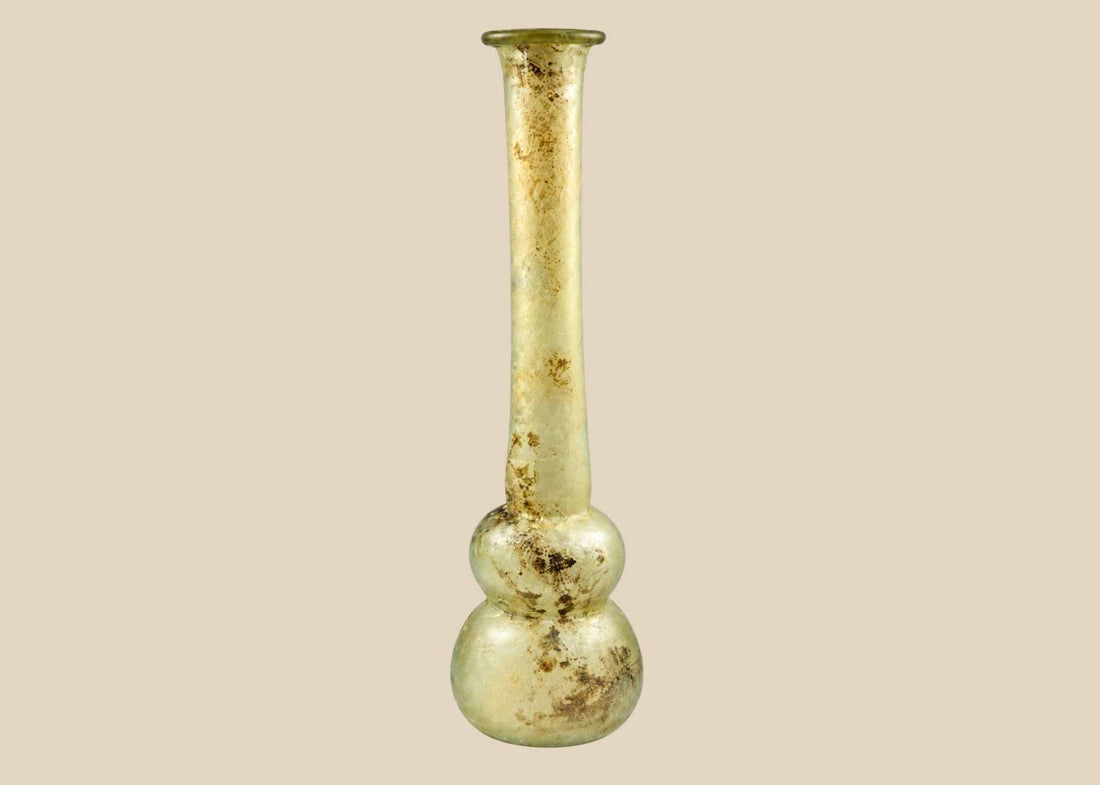


Candelero romano de doble calabaza de vidrio transparente, balsamario | Hacia los siglos II y III d. C.

Historial de procedencia y propiedad

Ofrecido por Waddington’s Auctioneers & Appraisers, Toronto, Ontario, en su subasta Cabinet of Curiositiesdel 14 de diciembre de 2023, como Lote 642. Después de la subasta, la pieza entró en una destacada colección privada en Toronto, Ontario, Canadá.

Precio habitual
$600.00
Precio de venta
$600.00
Precio habitual
Envío calculado al finalizar la compra.

This is a one-of-a-kind historical object. Once sold, this exact piece will not be restocked.

Questions before acquiring? Additional photographs, condition details, documentation, shipping information or a private viewing are available upon request.
Ancient Roman pale green blown-glass tear bottle from the Israel region, 2nd century CE, with a double-bulb body and golden iridescence.
360-degree video showcasing an ancient Roman pale green blown-glass tear bottle from the Israel region, dating to the 2nd century CE. Features an elongated cylindrical neck, folded flared rim, distinctive double-bulb body, natural golden iridescence, and centuries-old mineral deposits and surface patina.
Ancient Roman blown-glass tear bottle from the Israel region, dating to the 2nd century CE, featuring a tall cylindrical neck and distinctive double-bulb body.
Roman blown-glass tear bottle with an elongated cylindrical neck, folded flared rim, and two rounded bulbs connected by a narrow waist.
Ancient Roman glass unguentarium dating to circa 100–200 CE, displaying naturally developed golden iridescence and scattered brown burial deposits.
Eastern Mediterranean Roman blown-glass tear bottle featuring a smaller upper bulb, larger rounded lower bulb, and slender cylindrical neck.
Ancient Roman cosmetic or perfume bottle crafted from pale green glass, preserving its distinctive double-bulb silhouette and delicate flared opening.
Archaeological Roman glass vessel from the 2nd century CE, displaying shimmering golden iridescence, mineral encrustations, and natural surface weathering.
Roman blown-glass tear bottle featuring a folded rim and exceptionally tall cylindrical neck, reflecting ancient Eastern Mediterranean glassmaking traditions.
Ancient Roman double-bulb glass bottle with a narrow central waist, pale green translucent surfaces, and golden iridescent patina from centuries of burial.
Ancient Roman glass tear bottle attributed to the Israel region, featuring a tall neck and two rounded chambers of differing sizes.
Second-century Roman blown-glass tear bottle with scattered brown mineral deposits, golden iridescence, and archaeological surface weathering.
Ancient Roman pale green glass unguentarium measuring approximately 9.5 inches tall, featuring a double-bulb body and naturally weathered iridescent surface.
Ancient Roman double-bulb blown-glass tear bottle from the Israel region, presented in an acrylic display case with golden iridescence and archaeological patina.
  • Ancient Roman pale green blown-glass tear bottle from the Israel region, 2nd century CE, with a double-bulb body and golden iridescence.
  • 360-degree video showcasing an ancient Roman pale green blown-glass tear bottle from the Israel region, dating to the 2nd century CE. Features an elongated cylindrical neck, folded flared rim, distinctive double-bulb body, natural golden iridescence, and centuries-old mineral deposits and surface patina.
  • Ancient Roman blown-glass tear bottle from the Israel region, dating to the 2nd century CE, featuring a tall cylindrical neck and distinctive double-bulb body.
  • Roman blown-glass tear bottle with an elongated cylindrical neck, folded flared rim, and two rounded bulbs connected by a narrow waist.
  • Ancient Roman glass unguentarium dating to circa 100–200 CE, displaying naturally developed golden iridescence and scattered brown burial deposits.
  • Eastern Mediterranean Roman blown-glass tear bottle featuring a smaller upper bulb, larger rounded lower bulb, and slender cylindrical neck.
  • Ancient Roman cosmetic or perfume bottle crafted from pale green glass, preserving its distinctive double-bulb silhouette and delicate flared opening.
  • Archaeological Roman glass vessel from the 2nd century CE, displaying shimmering golden iridescence, mineral encrustations, and natural surface weathering.
  • Roman blown-glass tear bottle featuring a folded rim and exceptionally tall cylindrical neck, reflecting ancient Eastern Mediterranean glassmaking traditions.
  • Ancient Roman double-bulb glass bottle with a narrow central waist, pale green translucent surfaces, and golden iridescent patina from centuries of burial.
  • Ancient Roman glass tear bottle attributed to the Israel region, featuring a tall neck and two rounded chambers of differing sizes.
  • Second-century Roman blown-glass tear bottle with scattered brown mineral deposits, golden iridescence, and archaeological surface weathering.
  • Ancient Roman pale green glass unguentarium measuring approximately 9.5 inches tall, featuring a double-bulb body and naturally weathered iridescent surface.
  • Ancient Roman double-bulb blown-glass tear bottle from the Israel region, presented in an acrylic display case with golden iridescence and archaeological patina.
Ancient Roman pale green blown-glass tear bottle from the Israel region, 2nd century CE, with a double-bulb body and golden iridescence.
360-degree video showcasing an ancient Roman pale green blown-glass tear bottle from the Israel region, dating to the 2nd century CE. Features an elongated cylindrical neck, folded flared rim, distinctive double-bulb body, natural golden iridescence, and centuries-old mineral deposits and surface patina.
Ancient Roman blown-glass tear bottle from the Israel region, dating to the 2nd century CE, featuring a tall cylindrical neck and distinctive double-bulb body.
Roman blown-glass tear bottle with an elongated cylindrical neck, folded flared rim, and two rounded bulbs connected by a narrow waist.
Ancient Roman glass unguentarium dating to circa 100–200 CE, displaying naturally developed golden iridescence and scattered brown burial deposits.
Eastern Mediterranean Roman blown-glass tear bottle featuring a smaller upper bulb, larger rounded lower bulb, and slender cylindrical neck.
Ancient Roman cosmetic or perfume bottle crafted from pale green glass, preserving its distinctive double-bulb silhouette and delicate flared opening.
Archaeological Roman glass vessel from the 2nd century CE, displaying shimmering golden iridescence, mineral encrustations, and natural surface weathering.
Roman blown-glass tear bottle featuring a folded rim and exceptionally tall cylindrical neck, reflecting ancient Eastern Mediterranean glassmaking traditions.
Ancient Roman double-bulb glass bottle with a narrow central waist, pale green translucent surfaces, and golden iridescent patina from centuries of burial.
Ancient Roman glass tear bottle attributed to the Israel region, featuring a tall neck and two rounded chambers of differing sizes.
Second-century Roman blown-glass tear bottle with scattered brown mineral deposits, golden iridescence, and archaeological surface weathering.
Ancient Roman pale green glass unguentarium measuring approximately 9.5 inches tall, featuring a double-bulb body and naturally weathered iridescent surface.
Ancient Roman double-bulb blown-glass tear bottle from the Israel region, presented in an acrylic display case with golden iridescence and archaeological patina.
Authenticity and secure checkout guarantee

Candelero romano de doble calabaza de vidrio transparente, balsamario | Hacia los siglos II y III d. C.

Descripción

Contexto histórico y origen

Región: Imperio Romano (probablemente Mediterráneo Oriental)
Material: Vidrio transparente con pátina iridiscente natural
Período: Siglos II-III d. C.

Descripción

Este balsamario de vidrio transparente romano con forma de calabaza doble es un ejemplo de la elegancia y practicidad de la fabricación de vidrio romana. Elaborado con dos secciones globulares unidas por un cuello delgado, el recipiente fue diseñado para minimizar la evaporación y preservar contenidos preciosos como perfumes, bálsamos o ungüentos. A lo largo de los siglos, la superficie ha desarrollado una iridiscencia brillante, lo que realza su belleza y subraya su antigüedad.

Características

- Forma de calabaza doble con cuello estrecho para la conservación de líquidos

- Construcción de vidrio transparente, apreciada en Roma por su almacenamiento no poroso

- Pátina iridiscente desarrollada naturalmente por siglos de enterramiento

- Tamaño sustancial, diseñado tanto para la función como para el refinamiento

- Guardado en una vitrina acrílica para una exhibición segura

Importancia cultural

Los balsamarios eran esenciales en la vida diaria romana, particularmente dentro de la cultura de los baños, donde los perfumes y aceites simbolizaban refinamiento, lujo y cuidado personal. Utilizados por la élite, estos recipientes encarnaban el dominio romano de la fabricación de vidrio y su énfasis en la belleza, la utilidad y el estatus. Su forma práctica combinada con el atractivo estético refleja la sofisticación cultural de la sociedad romana en su apogeo.

Estado

La vasija se conserva en excelentes condiciones, con una rica superficie iridiscente que realza su valor visual e histórico. No se aprecian reparaciones modernas. Presentado en una vitrina acrílica, permanece protegido y listo para exhibir.

Dimensiones (aproximadas)

Altura: 9.5 pulgadas
Ancho: 4 pulgadas

Edad (aproximada)

1,725–1,825 años

Procedencia

Ofrecido por Waddington’s Auctioneers & Appraisers, Toronto, Ontario, en su subasta Cabinet of Curiosities del 14 de diciembre de 2023, como Lote 642. Después de la subasta, la pieza pasó a formar parte de una destacada colección privada en Toronto, Ontario, Canadá.

Más información

Estudie el uso de recipientes de vidrio cosméticos romanos y rituales de belleza antiguos

Explore nuestra colección de artefactos romanos y griegos

Descripción

Contexto histórico y origen

Región: Imperio Romano (probablemente Mediterráneo Oriental)
Material: Vidrio transparente con pátina iridiscente natural
Período: Siglos II-III d. C.

Descripción

Este balsamario de vidrio transparente romano con forma de calabaza doble es un ejemplo de la elegancia y practicidad de la fabricación de vidrio romana. Elaborado con dos secciones globulares unidas por un cuello delgado, el recipiente fue diseñado para minimizar la evaporación y preservar contenidos preciosos como perfumes, bálsamos o ungüentos. A lo largo de los siglos, la superficie ha desarrollado una iridiscencia brillante, lo que realza su belleza y subraya su antigüedad.

Características

- Forma de calabaza doble con cuello estrecho para la conservación de líquidos

- Construcción de vidrio transparente, apreciada en Roma por su almacenamiento no poroso

- Pátina iridiscente desarrollada naturalmente por siglos de enterramiento

- Tamaño sustancial, diseñado tanto para la función como para el refinamiento

- Guardado en una vitrina acrílica para una exhibición segura

Importancia cultural

Los balsamarios eran esenciales en la vida diaria romana, particularmente dentro de la cultura de los baños, donde los perfumes y aceites simbolizaban refinamiento, lujo y cuidado personal. Utilizados por la élite, estos recipientes encarnaban el dominio romano de la fabricación de vidrio y su énfasis en la belleza, la utilidad y el estatus. Su forma práctica combinada con el atractivo estético refleja la sofisticación cultural de la sociedad romana en su apogeo.

Estado

La vasija se conserva en excelentes condiciones, con una rica superficie iridiscente que realza su valor visual e histórico. No se aprecian reparaciones modernas. Presentado en una vitrina acrílica, permanece protegido y listo para exhibir.

Dimensiones (aproximadas)

Altura: 9.5 pulgadas
Ancho: 4 pulgadas

Edad (aproximada)

1,725–1,825 años

Procedencia

Ofrecido por Waddington’s Auctioneers & Appraisers, Toronto, Ontario, en su subasta Cabinet of Curiosities del 14 de diciembre de 2023, como Lote 642. Después de la subasta, la pieza pasó a formar parte de una destacada colección privada en Toronto, Ontario, Canadá.

Más información

Estudie el uso de recipientes de vidrio cosméticos romanos y rituales de belleza antiguos

Explore nuestra colección de artefactos romanos y griegos

También te puede interesar