

Anglo-Indian Marquetry Trinket Box with Figural Inlay | Circa 1890 – 1920
- Precio habitual
- $375.00
- Precio de venta
- $375.00
- Precio habitual
No se pudo cargar la disponibilidad de retiro





Anglo-Indian Marquetry Trinket Box with Figural Inlay | Circa 1890 – 1920
Descripción
Más
Menos
Historical Context & Origin
Region: India, likely Anglo-Indian export production
Material: Wood with blackened or lacquered finish, contrasting wood marquetry and mosaic inlay, brass hinges
Period: Late 19th–Early 20th Century, Circa 1890–1920
Description
An attractive Anglo-Indian rectangular trinket or keepsake box combining a deep black decorative ground with warm contrasting wood inlay and finely worked geometric mosaic banding.
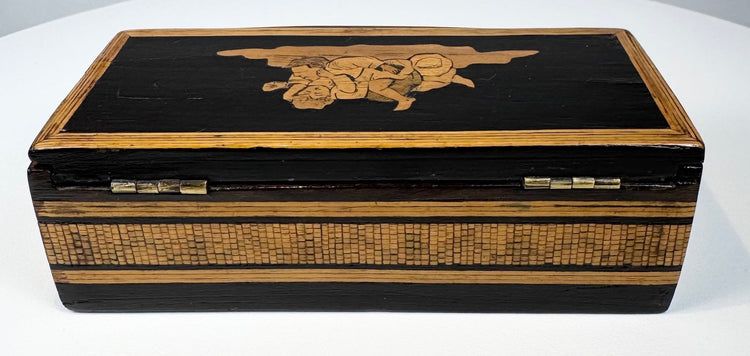
The hinged lid is framed by multiple narrow bands of pale wood surrounding a broad black central field. At its centre is an unusual figural marquetry composition depicting two reclining figures in an intimate or affectionate scene, rendered in contrasting golden-brown woods with finely incised details defining their faces, garments, limbs, and surrounding objects.
The exact narrative of the scene cannot be established with certainty. It may represent an amorous couple, a domestic or courtly episode, or a scene derived from Indian pictorial traditions. Similar Indian decorative arts frequently incorporated courtly, devotional, domestic, and amorous figural subjects, including images of couples. Historical Indian art also uses the mithuna, or amorous couple, as an established artistic theme.
The exterior sides are particularly distinctive. A broad central band consists of numerous individually arranged narrow pieces of pale wood, creating a dense rhythmic mosaic pattern bordered above and below by contrasting dark and light stringing. This treatment is reminiscent of the micromosaic and parquetry techniques associated with Anglo-Indian Sadeli work, although the relatively simple linear pattern differs from the elaborate star and rosette mosaics seen on the finest Bombay examples.
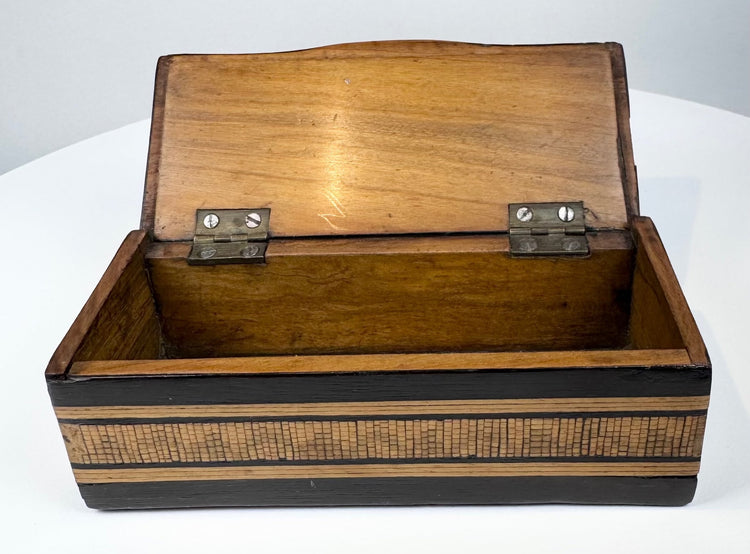
The box opens on a pair of brass butt hinges to reveal an undecorated warm-toned wooden interior. The absence of lining suggests it may originally have served as a general-purpose trinket, jewellery, keepsake, or personal storage box.
The underside is similarly plain, exposing the natural grain and construction of the wooden carcass.
Features
- Blackened or lacquered exterior
- Contrasting wood marquetry
- Central figural scene depicting reclining figures
- Possible amorous or courtly subject
- Fine incised details within the figural inlay
- Multiple contrasting wood borders
- Sadeli-style micromosaic or parquetry banding around the sides
- Numerous individually arranged narrow wooden tesserae
- Brass butt hinges with slotted screws
- Unlined natural wood interior
- Original age-related surface wear and patina
- Compact size suitable for jewellery, keepsakes, or small personal objects
Cultural Significance
Decorative Anglo-Indian boxes illustrate the interaction between Indian craftsmanship and European collecting tastes during the British colonial period.
Indian workshops became particularly accomplished in the production of sandalwood, ebony, rosewood, and other hardwood boxes incorporating carving, marquetry, bone or ivory inlay, metal stringing, and Sadeli micromosaic. A circa-1850 Anglo-Indian work box sold by Christie's was specifically associated with the Sadeli manufacturers of Bombay and employed mosaiced chequer parquetry.
The Victoria and Albert Museum similarly records a mid-19th-century Indian writing box made from rosewood, sandalwood, ebony, ivory, brass, inlay, and mosaic, demonstrating the diversity of materials used in this tradition.
Although the present box has sometimes been described as Tunbridge ware, the term is best reserved for the distinctive English mosaic woodworking industry centred around Tunbridge Wells. This example's figural imagery, blackened finish, construction, and mosaic treatment are more compatible with Anglo-Indian decorative marquetry influenced by Sadeli and related micromosaic traditions.
Condition
Good antique condition with substantial age-related character.
The black exterior surface exhibits scratches, abrasions, fine cracking, finish loss, and localized wear. There are minor separations and losses within the decorative borders and inlaid areas, together with general surface irregularities consistent with age and handmade construction.
The lid displays visible warping along its front edge and does not sit entirely flush with the body. The interior shows staining, scratches, discoloration, and evidence of historical use.
Both brass hinges remain present, with age-related oxidation and wear to the hardware and surrounding wood.
The figural marquetry and majority of the geometric mosaic decoration remain well preserved and clearly legible.
Dimensions (Approximate)
Length: 4.25 in
Width: 1.8 in
Height: 1.3 in
Age (Approximate)
105–135 years old
Provenance
From the Estate of Henry and Ann Soukup. Henry L. “Hank” Soukup and his wife, Ann Butler Soukup, were longtime antiques enthusiasts who founded The Lair Antiques together in 1965, establishing a decades-long connection with the antiques trade and collecting.
Subsequently handled by Diederich Auction Gallery, Winchester, Kentucky, an auction house specializing in fine antiques, estate collections, fine art, and other historically significant material.
Learn More
Explore the traditional Sadeli micromosaic technique through an Indian writing box at The Metropolitan Museum of Art
Browse our Collection of Eastern Antiquities & Cultural Relics
Descripción
Historical Context & Origin
Region: India, likely Anglo-Indian export production
Material: Wood with blackened or lacquered finish, contrasting wood marquetry and mosaic inlay, brass hinges
Period: Late 19th–Early 20th Century, Circa 1890–1920
Description
An attractive Anglo-Indian rectangular trinket or keepsake box combining a deep black decorative ground with warm contrasting wood inlay and finely worked geometric mosaic banding.
The hinged lid is framed by multiple narrow bands of pale wood surrounding a broad black central field. At its centre is an unusual figural marquetry composition depicting two reclining figures in an intimate or affectionate scene, rendered in contrasting golden-brown woods with finely incised details defining their faces, garments, limbs, and surrounding objects.
The exact narrative of the scene cannot be established with certainty. It may represent an amorous couple, a domestic or courtly episode, or a scene derived from Indian pictorial traditions. Similar Indian decorative arts frequently incorporated courtly, devotional, domestic, and amorous figural subjects, including images of couples. Historical Indian art also uses the mithuna, or amorous couple, as an established artistic theme.
The exterior sides are particularly distinctive. A broad central band consists of numerous individually arranged narrow pieces of pale wood, creating a dense rhythmic mosaic pattern bordered above and below by contrasting dark and light stringing. This treatment is reminiscent of the micromosaic and parquetry techniques associated with Anglo-Indian Sadeli work, although the relatively simple linear pattern differs from the elaborate star and rosette mosaics seen on the finest Bombay examples.
The box opens on a pair of brass butt hinges to reveal an undecorated warm-toned wooden interior. The absence of lining suggests it may originally have served as a general-purpose trinket, jewellery, keepsake, or personal storage box.
The underside is similarly plain, exposing the natural grain and construction of the wooden carcass.
Features
- Blackened or lacquered exterior
- Contrasting wood marquetry
- Central figural scene depicting reclining figures
- Possible amorous or courtly subject
- Fine incised details within the figural inlay
- Multiple contrasting wood borders
- Sadeli-style micromosaic or parquetry banding around the sides
- Numerous individually arranged narrow wooden tesserae
- Brass butt hinges with slotted screws
- Unlined natural wood interior
- Original age-related surface wear and patina
- Compact size suitable for jewellery, keepsakes, or small personal objects
Cultural Significance
Decorative Anglo-Indian boxes illustrate the interaction between Indian craftsmanship and European collecting tastes during the British colonial period.
Indian workshops became particularly accomplished in the production of sandalwood, ebony, rosewood, and other hardwood boxes incorporating carving, marquetry, bone or ivory inlay, metal stringing, and Sadeli micromosaic. A circa-1850 Anglo-Indian work box sold by Christie's was specifically associated with the Sadeli manufacturers of Bombay and employed mosaiced chequer parquetry.
The Victoria and Albert Museum similarly records a mid-19th-century Indian writing box made from rosewood, sandalwood, ebony, ivory, brass, inlay, and mosaic, demonstrating the diversity of materials used in this tradition.
Although the present box has sometimes been described as Tunbridge ware, the term is best reserved for the distinctive English mosaic woodworking industry centred around Tunbridge Wells. This example's figural imagery, blackened finish, construction, and mosaic treatment are more compatible with Anglo-Indian decorative marquetry influenced by Sadeli and related micromosaic traditions.
Condition
Good antique condition with substantial age-related character.
The black exterior surface exhibits scratches, abrasions, fine cracking, finish loss, and localized wear. There are minor separations and losses within the decorative borders and inlaid areas, together with general surface irregularities consistent with age and handmade construction.
The lid displays visible warping along its front edge and does not sit entirely flush with the body. The interior shows staining, scratches, discoloration, and evidence of historical use.
Both brass hinges remain present, with age-related oxidation and wear to the hardware and surrounding wood.
The figural marquetry and majority of the geometric mosaic decoration remain well preserved and clearly legible.
Dimensions (Approximate)
Length: 4.25 in
Width: 1.8 in
Height: 1.3 in
Age (Approximate)
105–135 years old
Provenance
From the Estate of Henry and Ann Soukup. Henry L. “Hank” Soukup and his wife, Ann Butler Soukup, were longtime antiques enthusiasts who founded The Lair Antiques together in 1965, establishing a decades-long connection with the antiques trade and collecting.
Subsequently handled by Diederich Auction Gallery, Winchester, Kentucky, an auction house specializing in fine antiques, estate collections, fine art, and other historically significant material.
Learn More
Explore the traditional Sadeli micromosaic technique through an Indian writing box at The Metropolitan Museum of Art
Browse our Collection of Eastern Antiquities & Cultural Relics
También te puede interesar
