



European | Continental Arched Wood Relief of a Standing Saint | Circa 1800 – 1900
- Precio habitual
- $400.00
- Precio de venta
- $400.00
- Precio habitual
No se pudo cargar la disponibilidad de retiro


European | Continental Arched Wood Relief of a Standing Saint | Circa 1800 – 1900
Descripción
Más
Menos
Historical Context & Origin
Region: Continental Europe
Material: Hand-carved wood mounted upon a later wooden backing panel
Period: 19th century, circa 1800–1900
Description
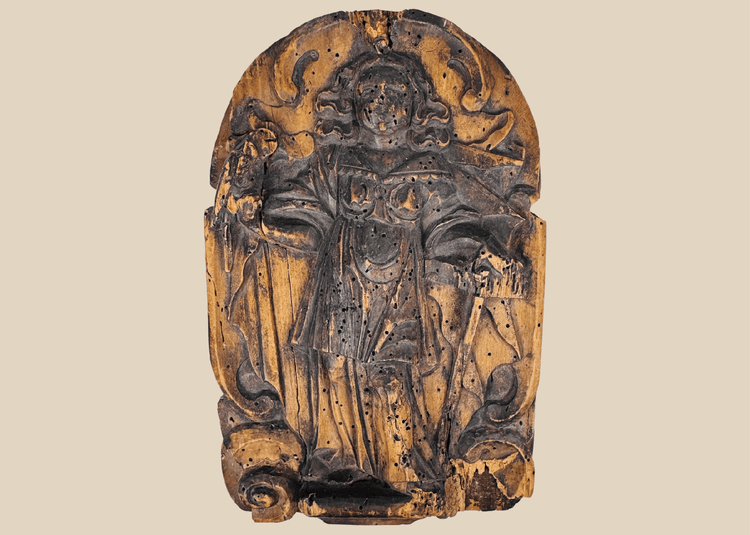
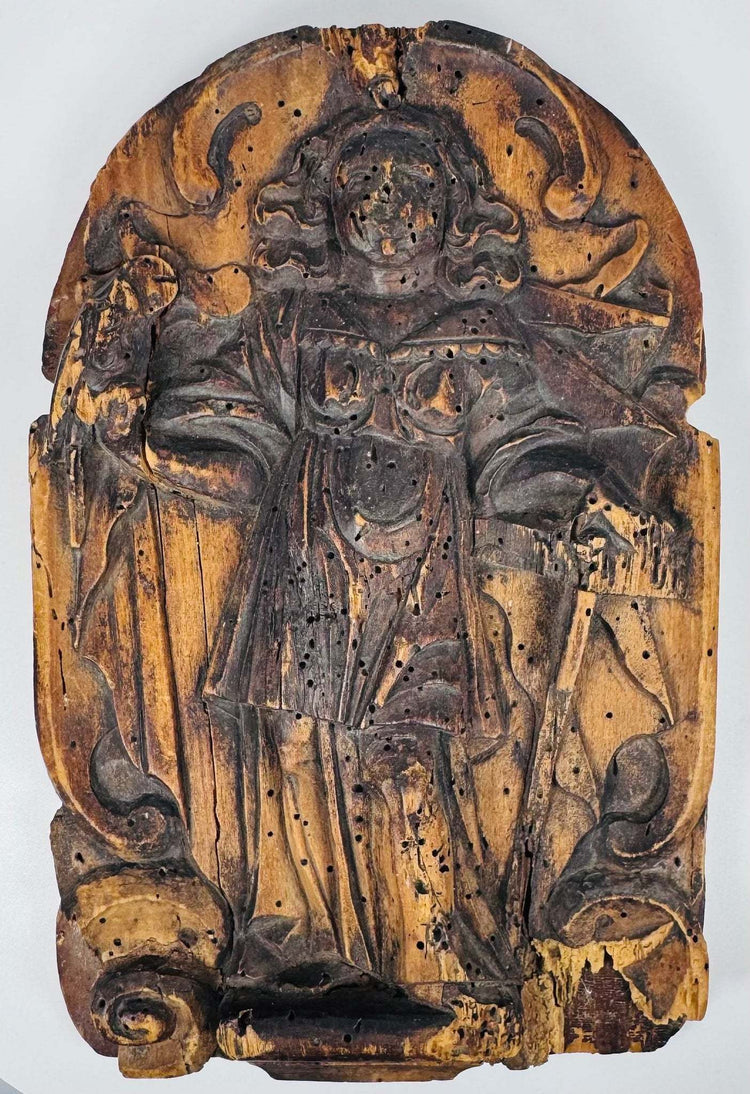
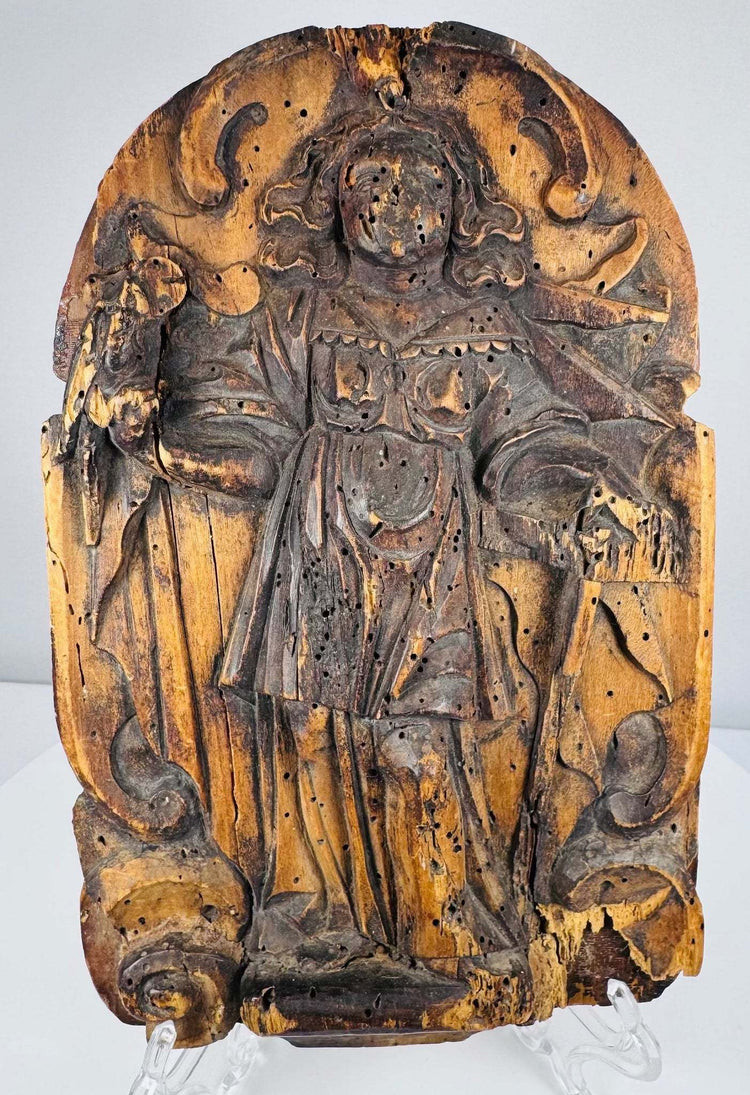
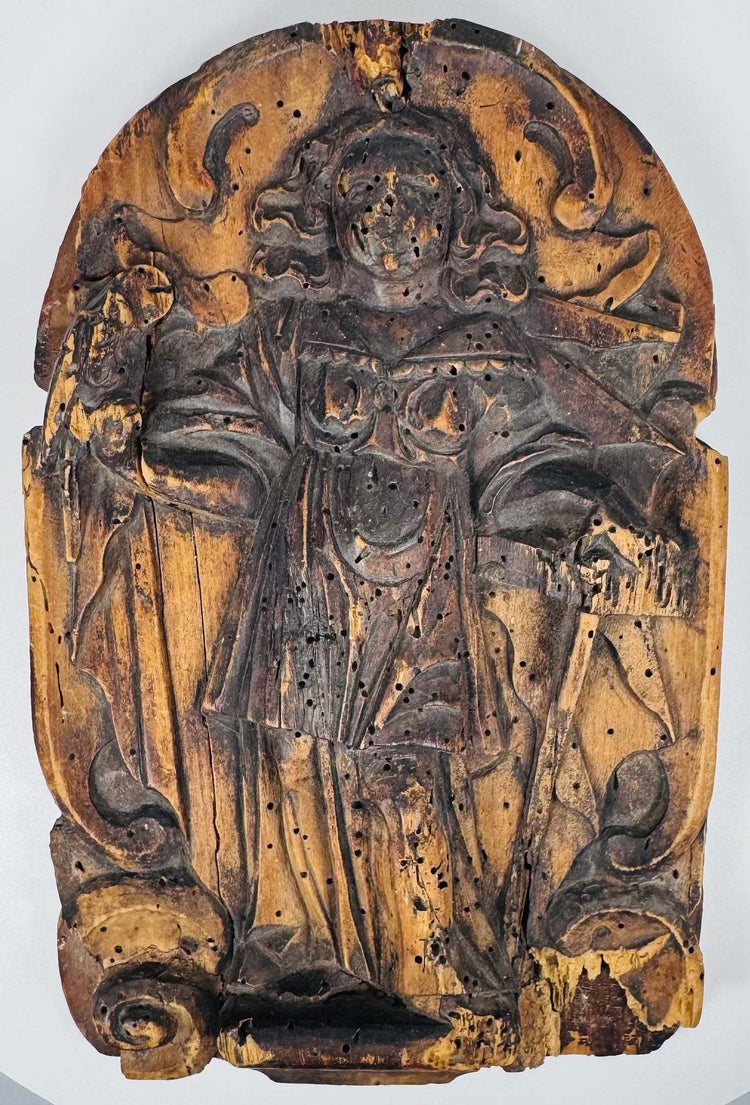
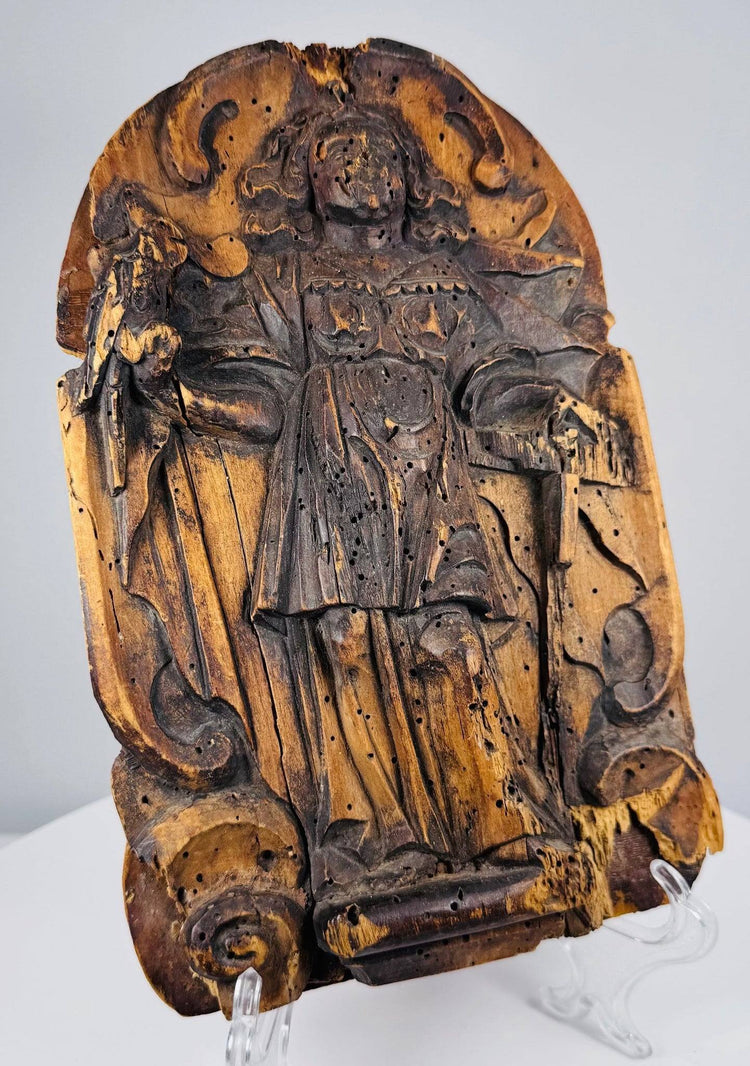
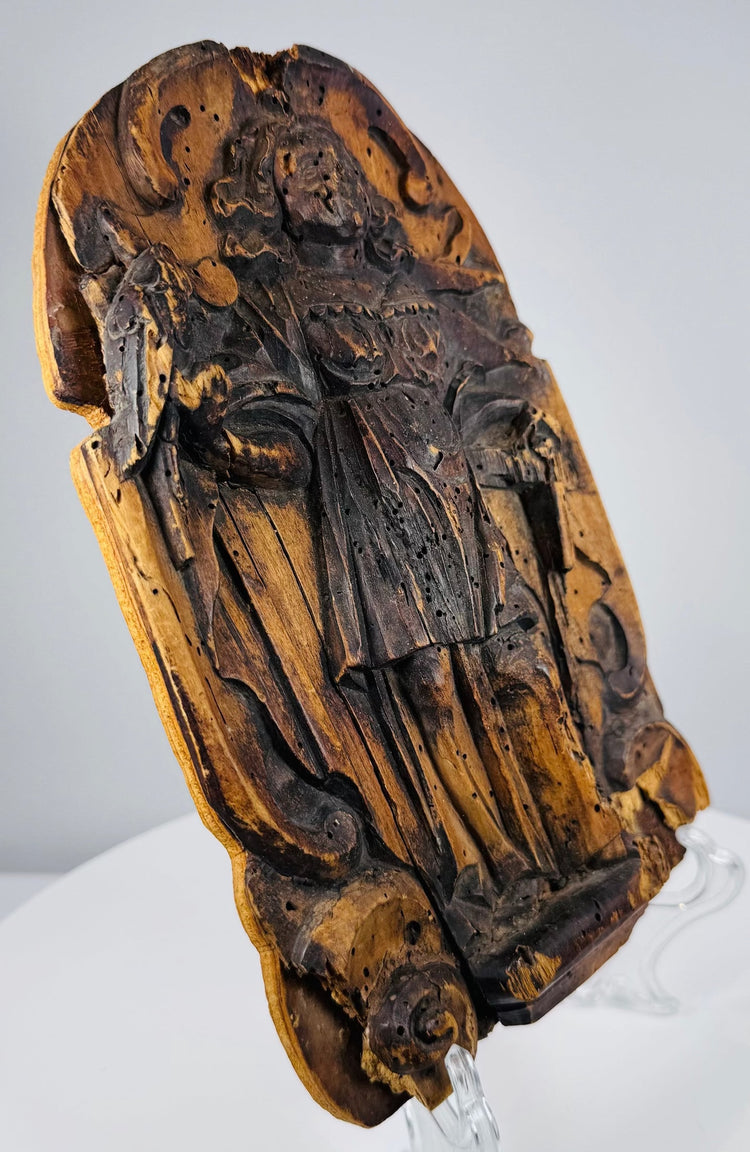
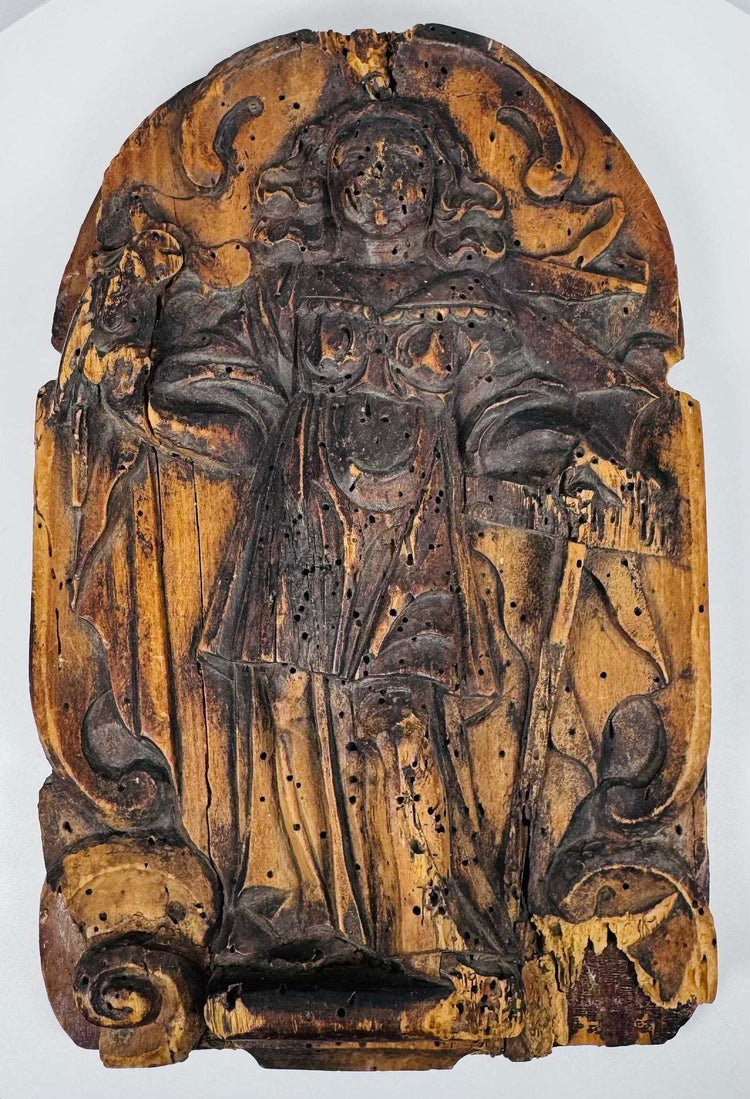
This heavily weathered Continental European devotional relief depicts a standing Christian saint framed within a rounded arch and surrounded by deeply carved foliate and cloudlike ornamentation. The figure wears a long robe and appears beneath a circular halo or radiating frame.
A tall cross- or staff-like attribute rises beside the saint, while a smaller attendant, animal, or symbolic figure appears at the opposite side. These surviving elements prompted an earlier auction attribution identifying the subject as possibly Saint John the Evangelist or Saint George.
Of these possibilities, Saint John may be the more plausible identification if the small attendant was intended as an eagle, his traditional symbol. Saint George is more commonly represented with armour, a lance, and a dragon. However, extensive erosion and losses have obscured the attributes sufficiently that the figure should be presented conservatively as an unidentified standing saint.
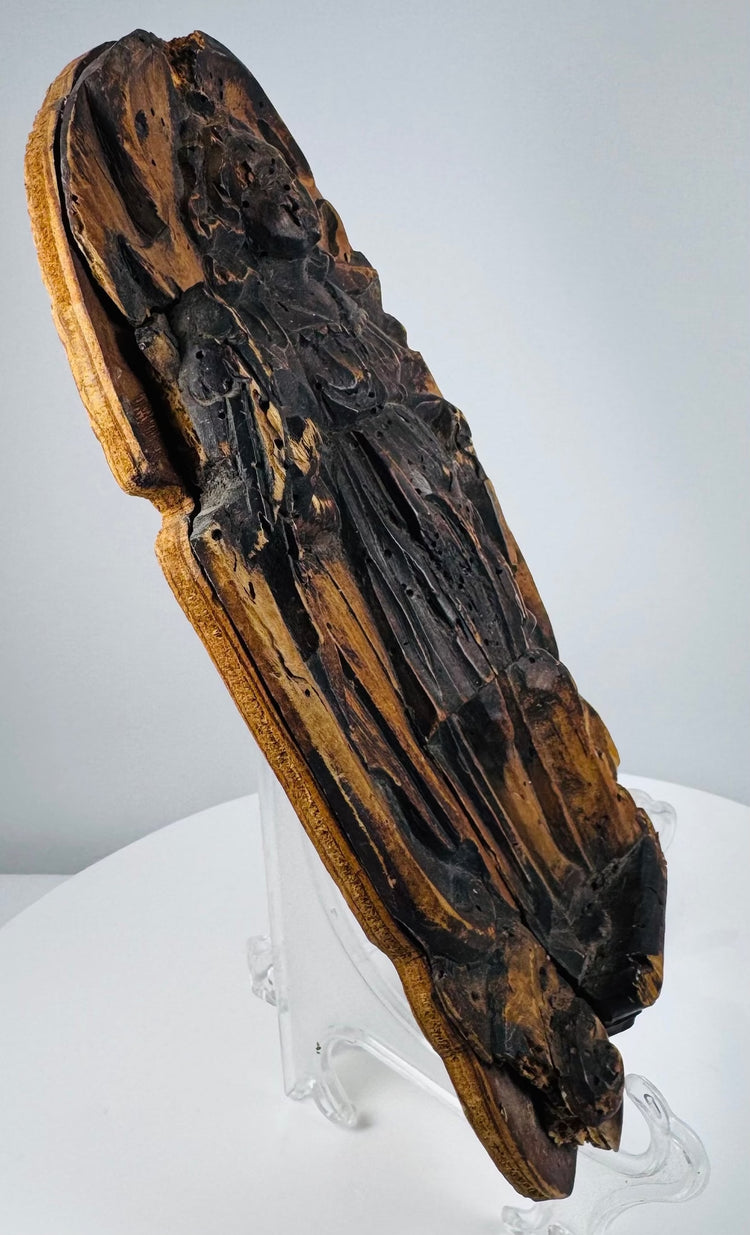
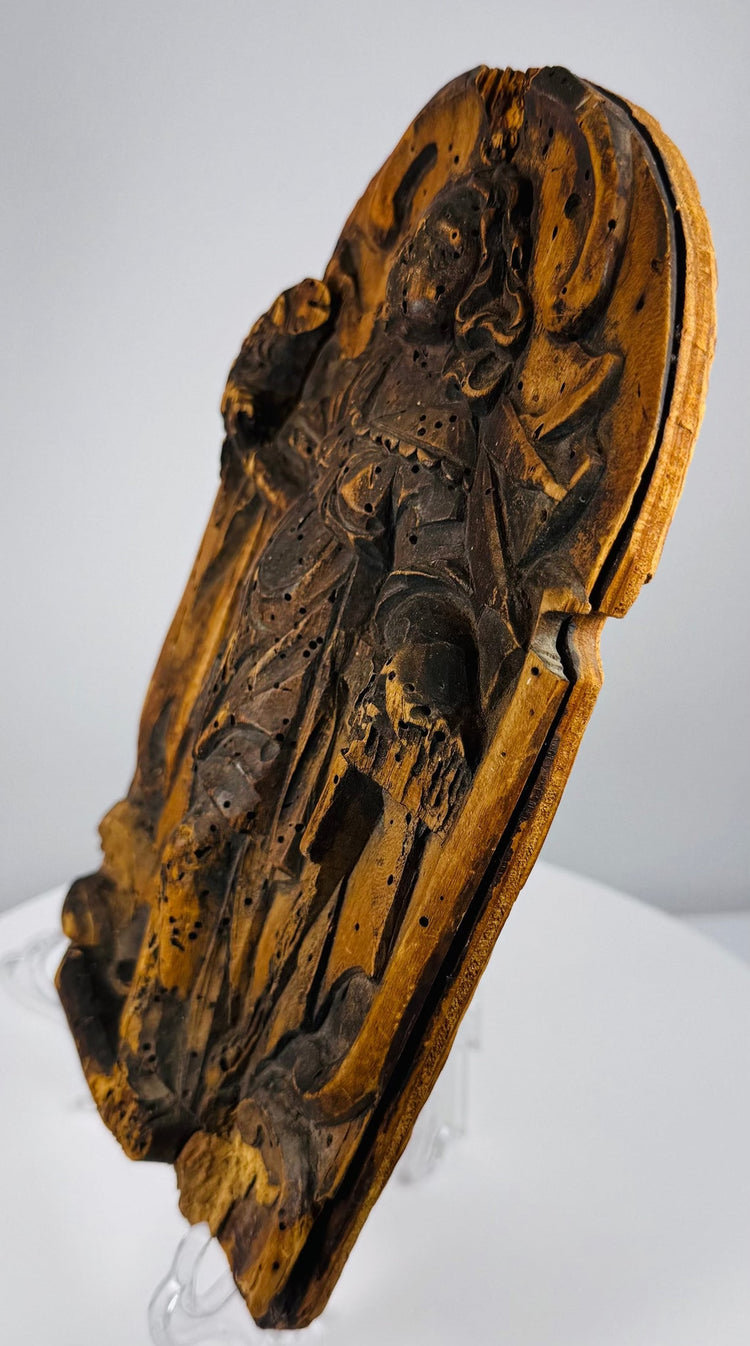
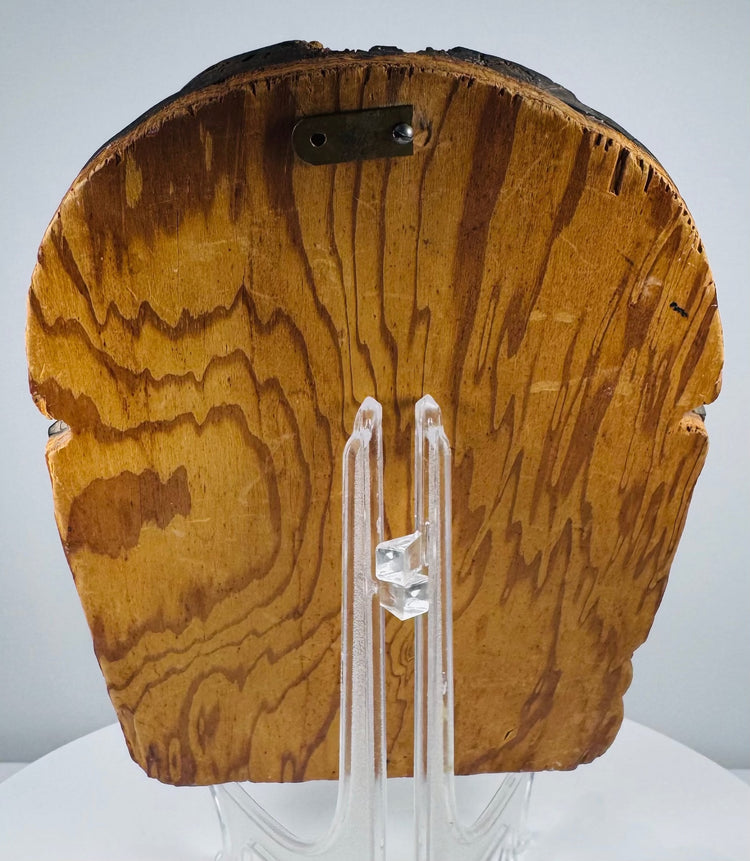
The carved relief has subsequently been mounted upon a shaped wooden backing panel and fitted with metal hanging hardware for wall display.
Features
- Hand-carved Continental European religious relief
- Standing robed saint beneath an arched frame
- Circular halo or radiating element surrounding the head
- Cross- or staff-like devotional attribute
- Small attendant or animal figure beside the saint
- Deeply carved foliate and cloudlike ornamentation
- Darkened, extensively weathered surface
- Later wooden backing panel and metal hanging bracket
Cultural Significance
Carved wooden reliefs played an important role in European Christian devotional practice. They could be incorporated into church furnishings, altarpieces, chapel interiors, processional objects, or private domestic shrines, bringing recognizable saints and their protective associations into spaces of worship.
The identity of a saint was traditionally communicated through specific attributes. Saint John the Evangelist was frequently accompanied by an eagle, book, quill, or chalice, while Saint George was generally represented with a cross, lance, armour, or dragon. Although the surviving imagery suggests one of these traditions, the considerable surface loss prevents a conclusive attribution.
Condition
Heavily weathered antique condition with extensive surface erosion, numerous wormholes from historic insect activity, structural cracking, splitting, abrasions, discoloration, and substantial losses throughout. Particularly notable losses are visible around the crown of the arch, lower perimeter, right side, attendant figure, and several projecting carved details.
The original surface finish is extensively worn and darkened. The relief has been mounted upon a later wooden backing panel, with separation and gaps visible around portions of the perimeter. A later metal hanging bracket is attached to the reverse.
Dimensions (Approximate)
Height: 9 in
Width: 6 in
Depth: 1.5 in
Age (Approximate)
125–225 years old
Provenance
Formerly in a private collection in Chevy Chase, Maryland, USA, specializing in Asian art and related religious objects.
Subsequently handled by Sloans & Kenyon Auctioneers and Appraisers, a longstanding Maryland auction house serving the greater Washington, D.C., region. Tracing its history to Sloan & Co., established in 1853, the firm conducts professionally catalogued auctions featuring fine art, antiques, and historical collectibles.
Lastly acquired by a private collection in Toronto, Ontario, Canada.
Learn More
Discover a related late medieval devotional relief depicting the Holy Trinity in the collection of The Walters Art Museum
Explore our Collection of Religious & Spiritual Relics
Descripción
Historical Context & Origin
Region: Continental Europe
Material: Hand-carved wood mounted upon a later wooden backing panel
Period: 19th century, circa 1800–1900
Description
This heavily weathered Continental European devotional relief depicts a standing Christian saint framed within a rounded arch and surrounded by deeply carved foliate and cloudlike ornamentation. The figure wears a long robe and appears beneath a circular halo or radiating frame.
A tall cross- or staff-like attribute rises beside the saint, while a smaller attendant, animal, or symbolic figure appears at the opposite side. These surviving elements prompted an earlier auction attribution identifying the subject as possibly Saint John the Evangelist or Saint George.
Of these possibilities, Saint John may be the more plausible identification if the small attendant was intended as an eagle, his traditional symbol. Saint George is more commonly represented with armour, a lance, and a dragon. However, extensive erosion and losses have obscured the attributes sufficiently that the figure should be presented conservatively as an unidentified standing saint.
The carved relief has subsequently been mounted upon a shaped wooden backing panel and fitted with metal hanging hardware for wall display.
Features
- Hand-carved Continental European religious relief
- Standing robed saint beneath an arched frame
- Circular halo or radiating element surrounding the head
- Cross- or staff-like devotional attribute
- Small attendant or animal figure beside the saint
- Deeply carved foliate and cloudlike ornamentation
- Darkened, extensively weathered surface
- Later wooden backing panel and metal hanging bracket
Cultural Significance
Carved wooden reliefs played an important role in European Christian devotional practice. They could be incorporated into church furnishings, altarpieces, chapel interiors, processional objects, or private domestic shrines, bringing recognizable saints and their protective associations into spaces of worship.
The identity of a saint was traditionally communicated through specific attributes. Saint John the Evangelist was frequently accompanied by an eagle, book, quill, or chalice, while Saint George was generally represented with a cross, lance, armour, or dragon. Although the surviving imagery suggests one of these traditions, the considerable surface loss prevents a conclusive attribution.
Condition
Heavily weathered antique condition with extensive surface erosion, numerous wormholes from historic insect activity, structural cracking, splitting, abrasions, discoloration, and substantial losses throughout. Particularly notable losses are visible around the crown of the arch, lower perimeter, right side, attendant figure, and several projecting carved details.
The original surface finish is extensively worn and darkened. The relief has been mounted upon a later wooden backing panel, with separation and gaps visible around portions of the perimeter. A later metal hanging bracket is attached to the reverse.
Dimensions (Approximate)
Height: 9 in
Width: 6 in
Depth: 1.5 in
Age (Approximate)
125–225 years old
Provenance
Formerly in a private collection in Chevy Chase, Maryland, USA, specializing in Asian art and related religious objects.
Subsequently handled by Sloans & Kenyon Auctioneers and Appraisers, a longstanding Maryland auction house serving the greater Washington, D.C., region. Tracing its history to Sloan & Co., established in 1853, the firm conducts professionally catalogued auctions featuring fine art, antiques, and historical collectibles.
Lastly acquired by a private collection in Toronto, Ontario, Canada.
Learn More
Discover a related late medieval devotional relief depicting the Holy Trinity in the collection of The Walters Art Museum
Explore our Collection of Religious & Spiritual Relics
También te puede interesar
