


Prehistoric Bison Foot from Doggerland | Ice Age Subfossil | Circa 10,000 Years Old
- Precio habitual
- $1,250.00
- Precio de venta
- $1,250.00
- Precio habitual
No se pudo cargar la disponibilidad de retiro




Prehistoric Bison Foot from Doggerland | Ice Age Subfossil | Circa 10,000 Years Old
Descripción
Más
Menos
Historical Context & Origin
Region: Doggerland / North Sea, Northwestern Europe
Material: Subfossilized bone with natural mineral and marine sediment patination
Period: Prehistoric / Ice Age, approximately 10,000 years old
Description
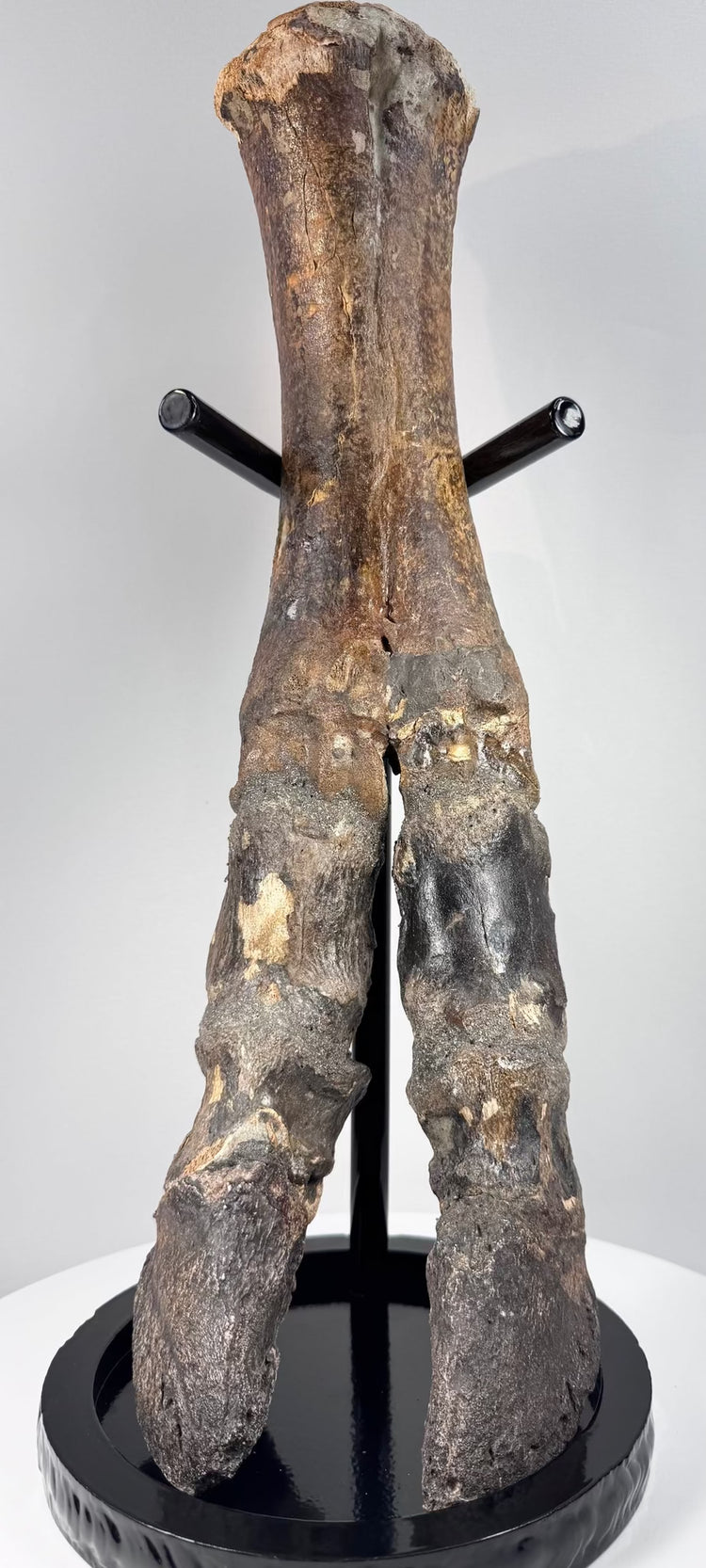
An impressive prehistoric bison foot from the submerged landscape of Doggerland, preserving a substantial portion of the animal's distal lower limb and paired terminal digits. Identified as bison and consistent with the large bovids that inhabited the grasslands of northern Europe during the closing stages of the Ice Age, the specimen offers a remarkable physical connection to a landscape now hidden beneath the North Sea.
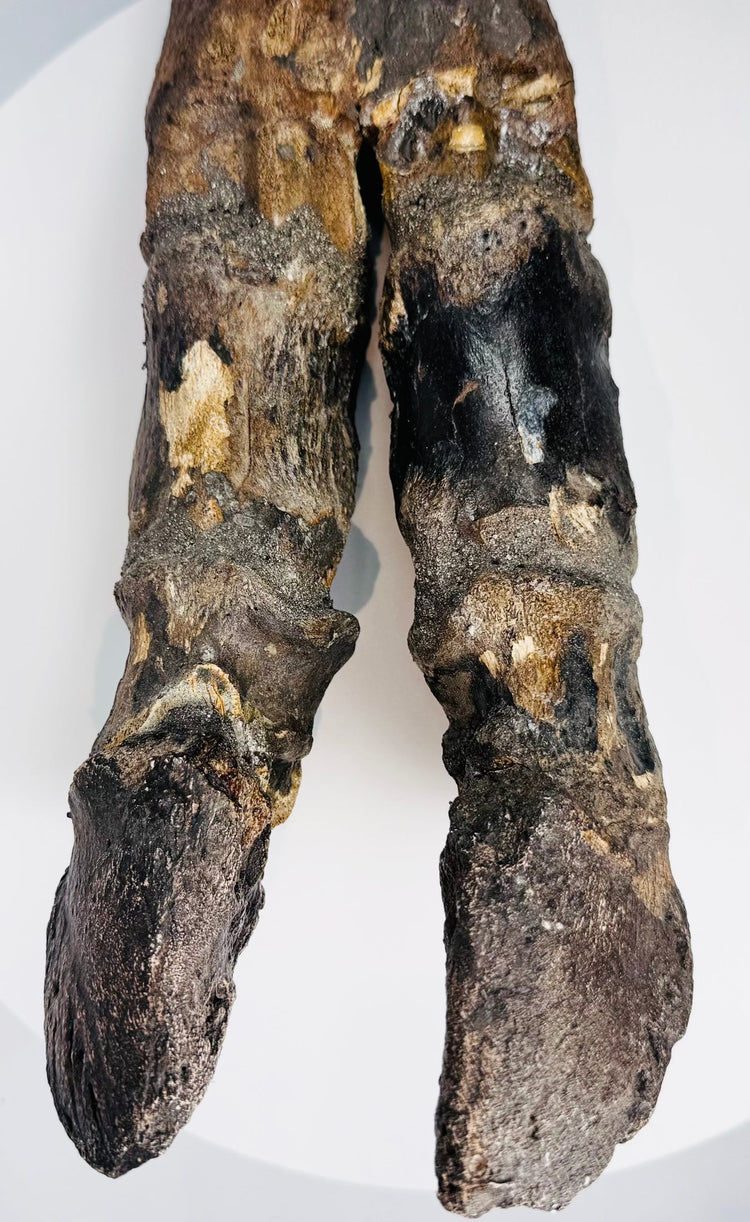
The elongated central bone retains its naturally robust form before expanding into the lower joint structure and two clearly separated digits. Considerable anatomical detail remains visible throughout, including joint surfaces, dense cortical bone, exposed porous interior structure, and the broad terminal portions of the foot.
Its surface displays striking variation from warm ochre and brown through charcoal and deep black, together with lighter mineral deposits. This coloration and texture contribute considerably to its appearance and are characteristic of ancient bone preserved for millennia within sedimentary and marine environments.
Doggerland once occupied the region now beneath the North Sea and connected Britain with continental Europe. Its plains supported substantial populations of large mammals before rising sea levels gradually submerged the landscape.
Presented vertically on a modern black metal display stand, the specimen has a commanding sculptural presence and is particularly well suited to a natural history, fossil, Ice Age, or cabinet-of-curiosities collection.
Features
- Attributed to the Doggerland region of the North Sea
- Approximately 10,000 years old
- Substantial preservation of the elongated lower limb structure
- Distinctive paired terminal digits remain clearly recognizable
- Visible joint and anatomical structures
- Exposed porous internal bone structure in several areas
- Naturally developed brown, ochre, grey, and black coloration
- Mineral and sediment deposits retained across the surface
- Significant size and strong visual presence
- Mounted vertically on a modern black metal display stand
- An exceptional display specimen representing Ice Age European megafauna
Cultural Significance
Doggerland is one of Europe's most fascinating prehistoric landscapes. During periods of lower sea level, the region extended across what is now the North Sea and formed a broad terrestrial connection between Britain and continental Europe. Its plains, river systems, wetlands, and grasslands supported both prehistoric human communities and a rich population of large mammals.
Bison were among the powerful grazing animals inhabiting these northern landscapes. Remains recovered from the North Sea provide important evidence of ecosystems that disappeared as the climate warmed and rising waters gradually transformed and submerged Doggerland.
Unlike an isolated tooth or fragmentary bone, this specimen preserves a substantial and readily recognizable portion of the animal's foot, giving it particular educational and display value as an illustration of the anatomy and scale of prehistoric European fauna.
Condition
The specimen remains in good archaeological and paleontological condition for its considerable age. Natural surface erosion, mineralization, cracking, losses, exposed cancellous bone, discoloration, sediment deposits, and areas of fragmentation are present throughout and are consistent with prolonged burial and preservation within a prehistoric sedimentary environment.
The lower foot retains substantial anatomical definition despite ancient losses and weathering. Areas of stabilization or historic conservation may be present within the specimen.
Dimensions (Approximate)
Overall Height with Stand: 16.75 in
Width: 6.5 in
Depth: 6.5 in
Age (Approximate)
10,000 years old
Provenance
Acquired from Broken Rock Fossil Shop, Belfast, Prince Edward Island, Canada, an independent fossil and mineral shop operated by Linda Nobles and specializing in dinosaur fossils, minerals, crystals, and other natural-history specimens.
Subsequently acquired by a private collector in Toronto, Ontario, Canada.
Learn More
Explore a complete prehistoric Steppe Bison (Bison priscus) skeleton on permanent display at the Brukenthal National Museum – Museum of Natural History
Discover our curated Prehistoric Wonders: Ancient Relics & Art Collection
Descripción
Historical Context & Origin
Region: Doggerland / North Sea, Northwestern Europe
Material: Subfossilized bone with natural mineral and marine sediment patination
Period: Prehistoric / Ice Age, approximately 10,000 years old
Description
An impressive prehistoric bison foot from the submerged landscape of Doggerland, preserving a substantial portion of the animal's distal lower limb and paired terminal digits. Identified as bison and consistent with the large bovids that inhabited the grasslands of northern Europe during the closing stages of the Ice Age, the specimen offers a remarkable physical connection to a landscape now hidden beneath the North Sea.
The elongated central bone retains its naturally robust form before expanding into the lower joint structure and two clearly separated digits. Considerable anatomical detail remains visible throughout, including joint surfaces, dense cortical bone, exposed porous interior structure, and the broad terminal portions of the foot.
Its surface displays striking variation from warm ochre and brown through charcoal and deep black, together with lighter mineral deposits. This coloration and texture contribute considerably to its appearance and are characteristic of ancient bone preserved for millennia within sedimentary and marine environments.
Doggerland once occupied the region now beneath the North Sea and connected Britain with continental Europe. Its plains supported substantial populations of large mammals before rising sea levels gradually submerged the landscape.
Presented vertically on a modern black metal display stand, the specimen has a commanding sculptural presence and is particularly well suited to a natural history, fossil, Ice Age, or cabinet-of-curiosities collection.
Features
- Attributed to the Doggerland region of the North Sea
- Approximately 10,000 years old
- Substantial preservation of the elongated lower limb structure
- Distinctive paired terminal digits remain clearly recognizable
- Visible joint and anatomical structures
- Exposed porous internal bone structure in several areas
- Naturally developed brown, ochre, grey, and black coloration
- Mineral and sediment deposits retained across the surface
- Significant size and strong visual presence
- Mounted vertically on a modern black metal display stand
- An exceptional display specimen representing Ice Age European megafauna
Cultural Significance
Doggerland is one of Europe's most fascinating prehistoric landscapes. During periods of lower sea level, the region extended across what is now the North Sea and formed a broad terrestrial connection between Britain and continental Europe. Its plains, river systems, wetlands, and grasslands supported both prehistoric human communities and a rich population of large mammals.
Bison were among the powerful grazing animals inhabiting these northern landscapes. Remains recovered from the North Sea provide important evidence of ecosystems that disappeared as the climate warmed and rising waters gradually transformed and submerged Doggerland.
Unlike an isolated tooth or fragmentary bone, this specimen preserves a substantial and readily recognizable portion of the animal's foot, giving it particular educational and display value as an illustration of the anatomy and scale of prehistoric European fauna.
Condition
The specimen remains in good archaeological and paleontological condition for its considerable age. Natural surface erosion, mineralization, cracking, losses, exposed cancellous bone, discoloration, sediment deposits, and areas of fragmentation are present throughout and are consistent with prolonged burial and preservation within a prehistoric sedimentary environment.
The lower foot retains substantial anatomical definition despite ancient losses and weathering. Areas of stabilization or historic conservation may be present within the specimen.
Dimensions (Approximate)
Overall Height with Stand: 16.75 in
Width: 6.5 in
Depth: 6.5 in
Age (Approximate)
10,000 years old
Provenance
Acquired from Broken Rock Fossil Shop, Belfast, Prince Edward Island, Canada, an independent fossil and mineral shop operated by Linda Nobles and specializing in dinosaur fossils, minerals, crystals, and other natural-history specimens.
Subsequently acquired by a private collector in Toronto, Ontario, Canada.
Learn More
Explore a complete prehistoric Steppe Bison (Bison priscus) skeleton on permanent display at the Brukenthal National Museum – Museum of Natural History
Discover our curated Prehistoric Wonders: Ancient Relics & Art Collection
También te puede interesar
