



Mid-19th Century American Cased Portrait Photograph Attributed to Dr. Paul Sears | Sears Family Collection | Circa 1855–1865 CE
- Precio habitual
- $400.00
- Precio de venta
- $400.00
- Precio habitual
No se pudo cargar la disponibilidad de retiro


Mid-19th Century American Cased Portrait Photograph Attributed to Dr. Paul Sears | Sears Family Collection | Circa 1855–1865 CE
Descripción
Más
Menos
Historical Context & Origin
Region: United States
Material: Early photographic image, gilt-metal photographic mat, protective glass, embossed photographic case, and decorative velvet lining
Period: Mid-19th Century, Victorian Era, circa 1855–1865 CE
Description
An original mid-19th-century American cased photographic portrait attributed to Dr. Paul Sears (born 1820), a prominent nineteenth-century physician associated with Mount Carmel, Illinois. Dating to circa 1855–1865 CE, this historically significant portrait preserves the likeness of a documented member of the Sears family, whose ancestry extends to early colonial New England.
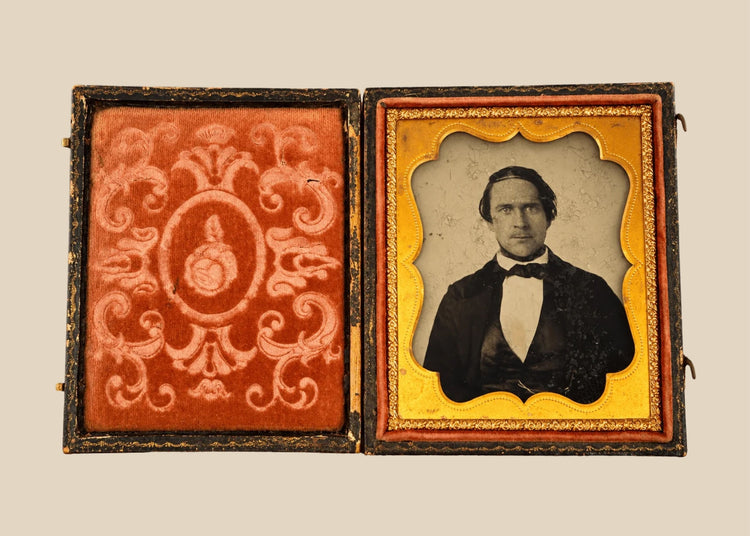
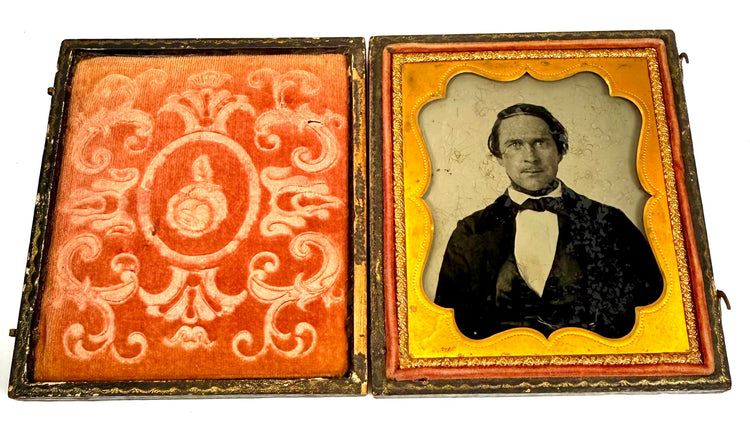
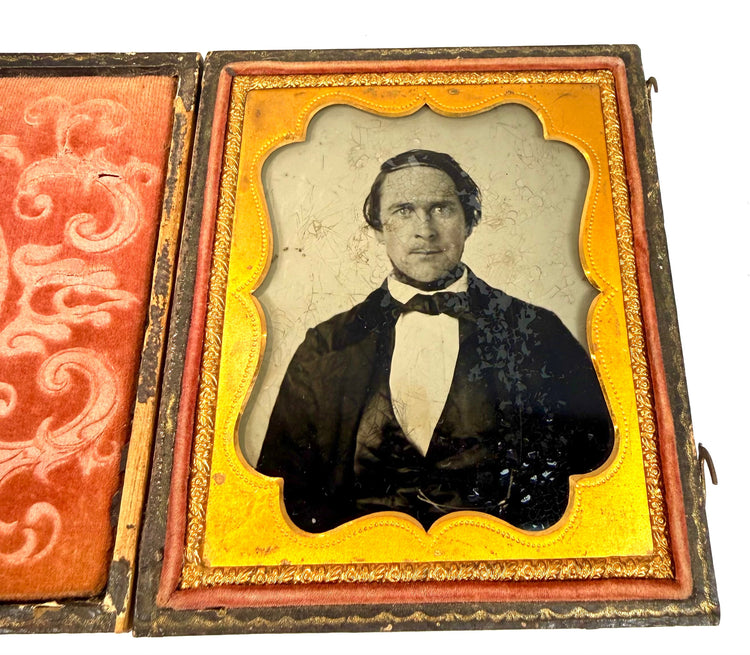
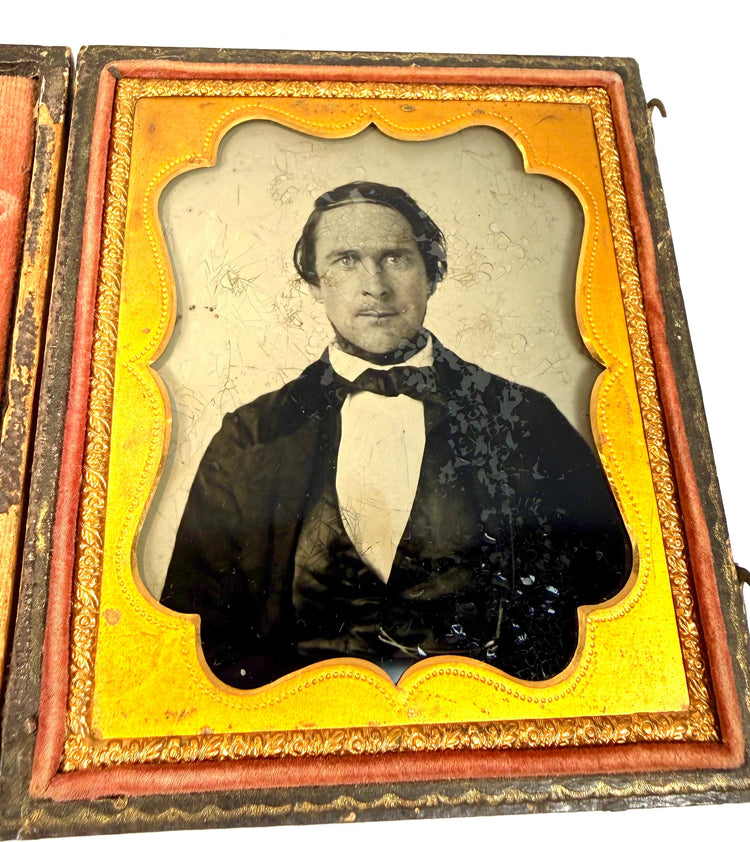
The photograph depicts a distinguished gentleman seated in a formal studio setting, wearing a dark tailored coat, waistcoat, white shirt, and carefully arranged black necktie. His dark hair is neatly combed away from his forehead, and he gazes directly toward the camera with a composed and serious expression characteristic of formal mid-nineteenth-century portraiture.
The sitter's clothing and presentation reflect the professional appearance favoured by educated American gentlemen during the Victorian period. His carefully arranged attire, upright posture, and direct gaze convey the formality associated with early photographic portraits.
The image is surrounded by an elaborate gilt-metal mat featuring a decorative scalloped opening, finely embossed borders, and ornamental detailing. This distinctive presentation is characteristic of the daguerreotype and ambrotype photographic traditions of the mid-nineteenth century.
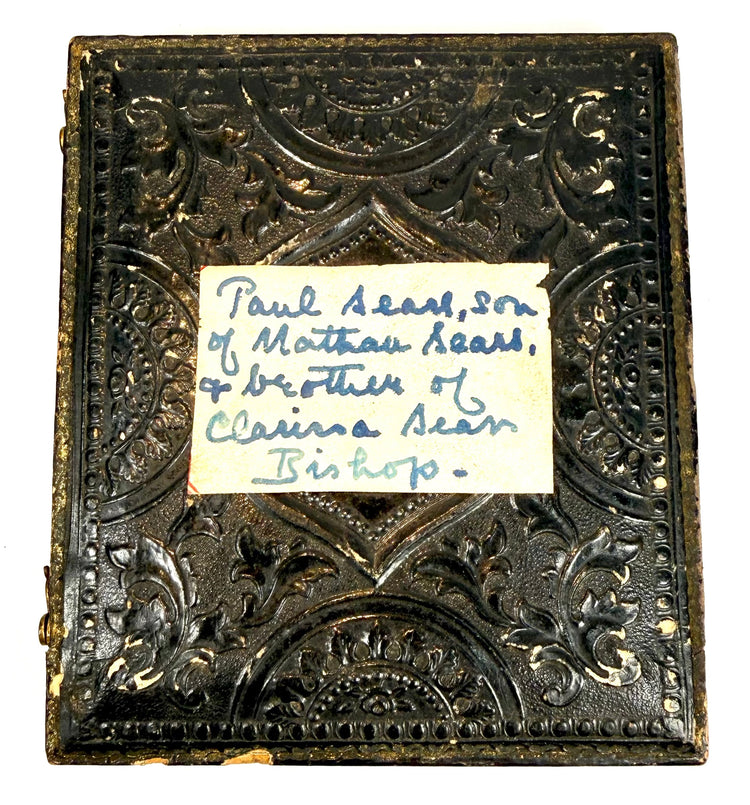
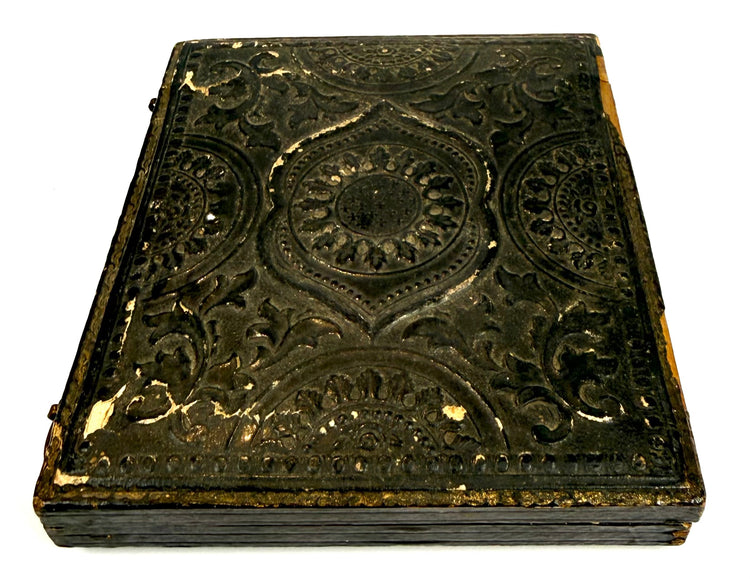
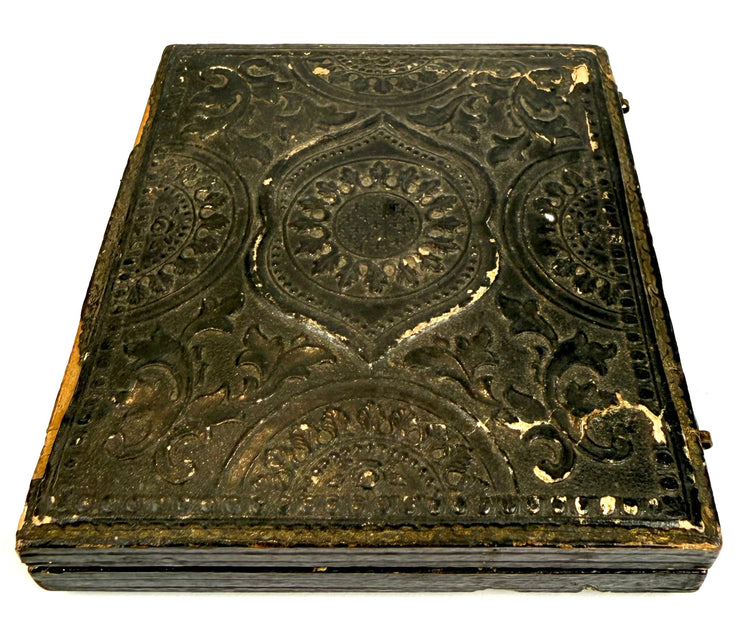
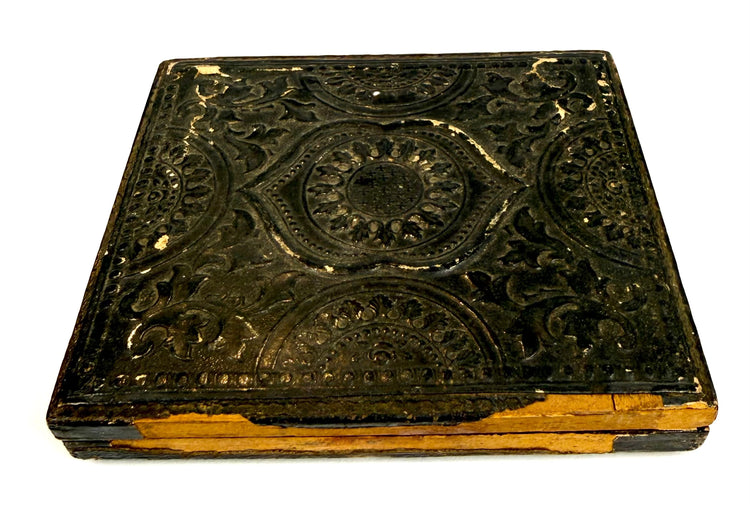
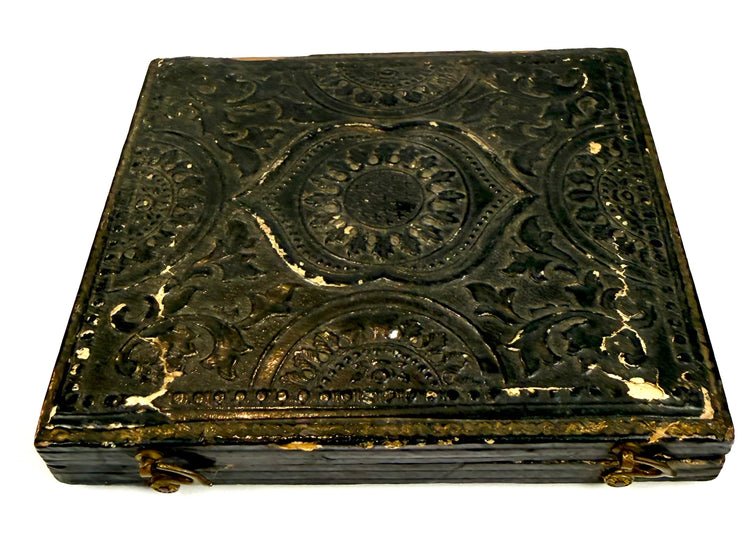
The photograph is housed within an ornate hinged protective case featuring a dark embossed exterior decorated with elaborate scrolling foliate motifs, circular medallions, and geometric patterns. Traces of the original decorative finish remain visible across the exterior.
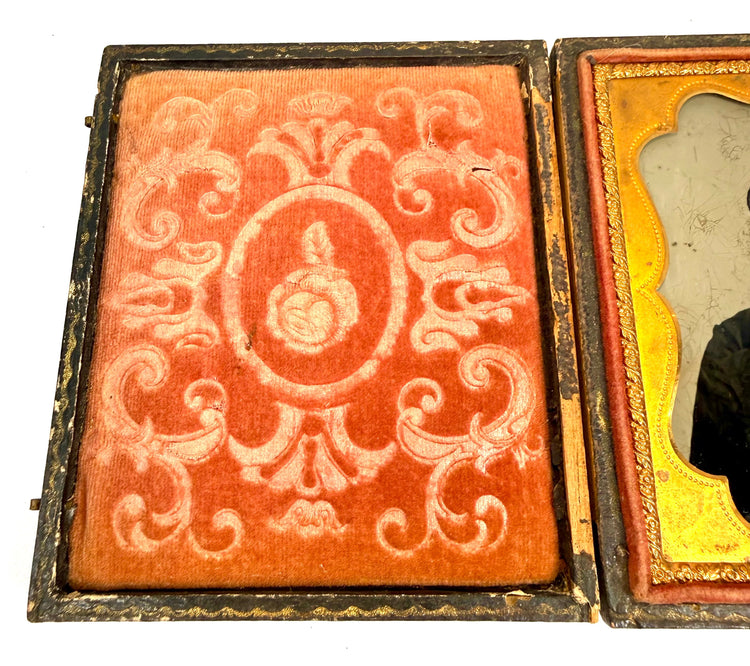
The opposite interior panel retains a richly coloured reddish-orange velvet lining displaying an elaborate symmetrical design of scrolling foliage surrounding a central ornamental medallion. The decorative velvet provides an attractive contrast to the gilt-metal photographic surround and reflects the craftsmanship associated with early American photographic cases.
The photographic image exhibits distinctive surface characteristics, including fine cracking and areas of dark coating deterioration. These features are consistent with deterioration encountered in early cased photographic materials. The precise photographic process has not been independently confirmed.
An especially important feature is the surviving handwritten identification label affixed to the exterior of the case. The inscription identifies the sitter as Paul Sears, son of Nathan Sears and brother of Clarissa Sears Bishop.
This identification is supported by nineteenth-century historical documentation, including family correspondence and published genealogical research identifying Dr. Paul Sears as a physician practising in Mount Carmel, Illinois.
Features
- Original mid-19th-century American cased photographic portrait, circa 1855–1865
- Attributed to Dr. Paul Sears, born June 5, 1820
- Formal portrait depicting a gentleman wearing a dark coat, waistcoat, white shirt, and necktie
- Early photographic presentation associated with daguerreotype and ambrotype traditions
- Hinged protective photographic case with ornate embossed exterior
- Decorative medallions, scrolling foliate motifs, and geometric patterns
- Rich reddish-orange velvet interior with a central ornamental design
- Decorative gilt-metal photographic mat with a scalloped portrait opening
- Surviving handwritten identification label on the exterior of the case
- Historical family relationships supported by nineteenth-century correspondence
- Associated with a documented American physician and the Sears family of New England
- Provenance from the estate of Joseph W. Haley, Pride's Crossing, Massachusetts
Cultural Significance
The development of photography during the nineteenth century fundamentally transformed the preservation of personal identity and family history. Before the introduction of practical photographic processes, commissioned portraits were generally expensive and remained beyond the financial reach of many individuals.
The invention of the daguerreotype in 1839 revolutionized portraiture by allowing photographers to capture highly detailed likenesses directly from life. By the 1850s, photographic studios had become increasingly established throughout the United States, allowing professionals, merchants, physicians, and ordinary families to preserve their images for future generations.
The development of ambrotype photography during the 1850s provided another important advancement. Produced using the wet-collodion process on glass, ambrotypes offered a comparatively affordable method of creating detailed photographic portraits. When viewed against a dark backing, the photographic negative appeared as a positive image.
Both daguerreotypes and ambrotypes were commonly presented within elaborate protective cases featuring gilt-metal surrounds, embossed coverings, and decorative velvet interiors. These cases were designed to preserve fragile photographic images while transforming them into intimate personal keepsakes.
Dr. Paul Sears and Nineteenth-Century American Medicine
Born on June 5, 1820, in Zanesville, Ohio, Paul Sears was the son of Dr. Nathan Sears and Grace Loper Sears. His father was a Massachusetts-born physician who subsequently practised medicine in several developing American communities.
Paul Sears received his early education in Ohio before relocating with his family to Michigan in 1834. He later moved to Mount Carmel, Illinois, where he studied medicine under his father and assisted with his medical practice.
In 1843, he entered the Ohio Medical College, graduating in 1845 before establishing his own medical practice in Mount Carmel.
According to Samuel Pearce May's The Descendants of Richard Sares (Sears) of Yarmouth, Massachusetts, 1638–1888, published in 1890, Dr. Sears developed an extensive medical practice throughout Wabash County and surrounding communities.
The historical account describes a physician who frequently travelled considerable distances to attend patients, sometimes covering approximately sixty miles within a twenty-four-hour period. In addition to his medical practice, he maintained interests in commercial enterprises, including a dry goods business.
Contemporary family correspondence dated January 8, 1850, further describes Paul Sears as an established physician enjoying substantial professional and financial success.
Condition
The photograph survives in fair to good antique condition consistent with its considerable age, retaining a clearly recognizable male portrait with visible facial features, clothing, and formal photographic composition.
The photographic image displays extensive age-related deterioration, including fine crackling or crazing across portions of the background and sitter's face, together with areas of dark irregular surface markings and apparent coating loss, most noticeably along the right side of the portrait and clothing.
Despite these imperfections, the subject's principal facial features remain clearly recognizable.
The gilt-metal photographic mat retains its decorative scalloped opening and surrounding embossed ornamentation, with expected age-related discolouration and surface wear.
The reddish-orange velvet interior preserves its decorative central medallion and scrolling foliate motifs, displaying visible age-related wear, minor surface marks, and small areas of deterioration.
The exterior photographic case exhibits considerable surface wear, including abrasions, scratches, areas of finish loss, edge deterioration, and exposed underlying material along portions of the perimeter. The spine is damaged and has separated from the frame. Its original embossed ornamental design remains readily recognizable.
A handwritten identification label remains affixed to the exterior of the case. The label itself exhibits minor age-related discolouration and handling wear.
Dimensions (Approximate)
Height: 3.75 in
Width: 3.25 in
Depth: 0.7 in
(case closed)
Age (Approximate)
161–171 years old
Provenance
Formerly part of the estate of the late Joseph W. Haley of Pride's Crossing, Massachusetts, United States, whose extensive collection included American and European antiques, fine and decorative arts, historical documents, early books, and objects reflecting a lifelong interest in history, travel, and collecting.
Handwritten Identification and Historical Attribution
Of particular historical importance, the exterior of the photographic case retains a handwritten identification label naming the sitter as Paul Sears, son of Nathan Sears and brother of Clarissa Sears Bishop.
The information recorded on this label corresponds closely with independently documented nineteenth-century Sears family records, providing substantial support for the attribution of the portrait to Dr. Paul Sears (born 1820).
Sears Family Historical Research
Genealogical research identifies Dr. Paul Sears as the son of Dr. Nathan Sears (1791–1848), a physician born in Ashfield, Massachusetts, and his wife Grace Loper Sears.
Dr. Nathan Sears subsequently practised medicine in Ohio, Michigan, and Illinois before his death in 1848. His children included Paul Sears, Clarissa Sears Bishop, and Nathan Henry Sears.
Paul Sears was born on June 5, 1820, in Zanesville, Ohio. He received his education at Elyria High School and Granville College before studying medicine under his father. After graduating from the Ohio Medical College in 1845, he established a successful medical practice in Mount Carmel, Illinois.
His professional accomplishments were documented in Samuel Pearce May's 1890 genealogical publication, The Descendants of Richard Sares (Sears) of Yarmouth, Massachusetts, 1638–1888, which describes his extensive medical practice, commercial interests, and standing within his community.
An especially noteworthy historical connection appears in The Ranney Letters: Family Correspondence During the Yankee Migration, which preserves an original letter dated January 8, 1850.
Written by Lyman Ranney from Van Buren, Arkansas, the correspondence independently identifies Paul Sears as the son of Nathan Sears and confirms that his siblings included Clarissa Sears Bishop and Henry Sears.
The letter specifically describes Paul Sears as a successful physician in Mount Carmel, Illinois, and provides contemporary evidence of his professional standing.
These documented family relationships correspond with the handwritten inscription surviving on the photographic case, strengthening the historical attribution and establishing a compelling connection between the portrait and the recorded Sears family lineage.
Learn More
View a nineteenth-century cased portrait of a gentleman featuring an ornate gilt-metal surround and decorative velvet interior in the Smithsonian Institution's collection
Descripción
Historical Context & Origin
Region: United States
Material: Early photographic image, gilt-metal photographic mat, protective glass, embossed photographic case, and decorative velvet lining
Period: Mid-19th Century, Victorian Era, circa 1855–1865 CE
Description
An original mid-19th-century American cased photographic portrait attributed to Dr. Paul Sears (born 1820), a prominent nineteenth-century physician associated with Mount Carmel, Illinois. Dating to circa 1855–1865 CE, this historically significant portrait preserves the likeness of a documented member of the Sears family, whose ancestry extends to early colonial New England.
The photograph depicts a distinguished gentleman seated in a formal studio setting, wearing a dark tailored coat, waistcoat, white shirt, and carefully arranged black necktie. His dark hair is neatly combed away from his forehead, and he gazes directly toward the camera with a composed and serious expression characteristic of formal mid-nineteenth-century portraiture.
The sitter's clothing and presentation reflect the professional appearance favoured by educated American gentlemen during the Victorian period. His carefully arranged attire, upright posture, and direct gaze convey the formality associated with early photographic portraits.
The image is surrounded by an elaborate gilt-metal mat featuring a decorative scalloped opening, finely embossed borders, and ornamental detailing. This distinctive presentation is characteristic of the daguerreotype and ambrotype photographic traditions of the mid-nineteenth century.
The photograph is housed within an ornate hinged protective case featuring a dark embossed exterior decorated with elaborate scrolling foliate motifs, circular medallions, and geometric patterns. Traces of the original decorative finish remain visible across the exterior.
The opposite interior panel retains a richly coloured reddish-orange velvet lining displaying an elaborate symmetrical design of scrolling foliage surrounding a central ornamental medallion. The decorative velvet provides an attractive contrast to the gilt-metal photographic surround and reflects the craftsmanship associated with early American photographic cases.
The photographic image exhibits distinctive surface characteristics, including fine cracking and areas of dark coating deterioration. These features are consistent with deterioration encountered in early cased photographic materials. The precise photographic process has not been independently confirmed.
An especially important feature is the surviving handwritten identification label affixed to the exterior of the case. The inscription identifies the sitter as Paul Sears, son of Nathan Sears and brother of Clarissa Sears Bishop.
This identification is supported by nineteenth-century historical documentation, including family correspondence and published genealogical research identifying Dr. Paul Sears as a physician practising in Mount Carmel, Illinois.
Features
- Original mid-19th-century American cased photographic portrait, circa 1855–1865
- Attributed to Dr. Paul Sears, born June 5, 1820
- Formal portrait depicting a gentleman wearing a dark coat, waistcoat, white shirt, and necktie
- Early photographic presentation associated with daguerreotype and ambrotype traditions
- Hinged protective photographic case with ornate embossed exterior
- Decorative medallions, scrolling foliate motifs, and geometric patterns
- Rich reddish-orange velvet interior with a central ornamental design
- Decorative gilt-metal photographic mat with a scalloped portrait opening
- Surviving handwritten identification label on the exterior of the case
- Historical family relationships supported by nineteenth-century correspondence
- Associated with a documented American physician and the Sears family of New England
- Provenance from the estate of Joseph W. Haley, Pride's Crossing, Massachusetts
Cultural Significance
The development of photography during the nineteenth century fundamentally transformed the preservation of personal identity and family history. Before the introduction of practical photographic processes, commissioned portraits were generally expensive and remained beyond the financial reach of many individuals.
The invention of the daguerreotype in 1839 revolutionized portraiture by allowing photographers to capture highly detailed likenesses directly from life. By the 1850s, photographic studios had become increasingly established throughout the United States, allowing professionals, merchants, physicians, and ordinary families to preserve their images for future generations.
The development of ambrotype photography during the 1850s provided another important advancement. Produced using the wet-collodion process on glass, ambrotypes offered a comparatively affordable method of creating detailed photographic portraits. When viewed against a dark backing, the photographic negative appeared as a positive image.
Both daguerreotypes and ambrotypes were commonly presented within elaborate protective cases featuring gilt-metal surrounds, embossed coverings, and decorative velvet interiors. These cases were designed to preserve fragile photographic images while transforming them into intimate personal keepsakes.
Dr. Paul Sears and Nineteenth-Century American Medicine
Born on June 5, 1820, in Zanesville, Ohio, Paul Sears was the son of Dr. Nathan Sears and Grace Loper Sears. His father was a Massachusetts-born physician who subsequently practised medicine in several developing American communities.
Paul Sears received his early education in Ohio before relocating with his family to Michigan in 1834. He later moved to Mount Carmel, Illinois, where he studied medicine under his father and assisted with his medical practice.
In 1843, he entered the Ohio Medical College, graduating in 1845 before establishing his own medical practice in Mount Carmel.
According to Samuel Pearce May's The Descendants of Richard Sares (Sears) of Yarmouth, Massachusetts, 1638–1888, published in 1890, Dr. Sears developed an extensive medical practice throughout Wabash County and surrounding communities.
The historical account describes a physician who frequently travelled considerable distances to attend patients, sometimes covering approximately sixty miles within a twenty-four-hour period. In addition to his medical practice, he maintained interests in commercial enterprises, including a dry goods business.
Contemporary family correspondence dated January 8, 1850, further describes Paul Sears as an established physician enjoying substantial professional and financial success.
Condition
The photograph survives in fair to good antique condition consistent with its considerable age, retaining a clearly recognizable male portrait with visible facial features, clothing, and formal photographic composition.
The photographic image displays extensive age-related deterioration, including fine crackling or crazing across portions of the background and sitter's face, together with areas of dark irregular surface markings and apparent coating loss, most noticeably along the right side of the portrait and clothing.
Despite these imperfections, the subject's principal facial features remain clearly recognizable.
The gilt-metal photographic mat retains its decorative scalloped opening and surrounding embossed ornamentation, with expected age-related discolouration and surface wear.
The reddish-orange velvet interior preserves its decorative central medallion and scrolling foliate motifs, displaying visible age-related wear, minor surface marks, and small areas of deterioration.
The exterior photographic case exhibits considerable surface wear, including abrasions, scratches, areas of finish loss, edge deterioration, and exposed underlying material along portions of the perimeter. The spine is damaged and has separated from the frame. Its original embossed ornamental design remains readily recognizable.
A handwritten identification label remains affixed to the exterior of the case. The label itself exhibits minor age-related discolouration and handling wear.
Dimensions (Approximate)
Height: 3.75 in
Width: 3.25 in
Depth: 0.7 in
(case closed)
Age (Approximate)
161–171 years old
Provenance
Formerly part of the estate of the late Joseph W. Haley of Pride's Crossing, Massachusetts, United States, whose extensive collection included American and European antiques, fine and decorative arts, historical documents, early books, and objects reflecting a lifelong interest in history, travel, and collecting.
Handwritten Identification and Historical Attribution
Of particular historical importance, the exterior of the photographic case retains a handwritten identification label naming the sitter as Paul Sears, son of Nathan Sears and brother of Clarissa Sears Bishop.
The information recorded on this label corresponds closely with independently documented nineteenth-century Sears family records, providing substantial support for the attribution of the portrait to Dr. Paul Sears (born 1820).
Sears Family Historical Research
Genealogical research identifies Dr. Paul Sears as the son of Dr. Nathan Sears (1791–1848), a physician born in Ashfield, Massachusetts, and his wife Grace Loper Sears.
Dr. Nathan Sears subsequently practised medicine in Ohio, Michigan, and Illinois before his death in 1848. His children included Paul Sears, Clarissa Sears Bishop, and Nathan Henry Sears.
Paul Sears was born on June 5, 1820, in Zanesville, Ohio. He received his education at Elyria High School and Granville College before studying medicine under his father. After graduating from the Ohio Medical College in 1845, he established a successful medical practice in Mount Carmel, Illinois.
His professional accomplishments were documented in Samuel Pearce May's 1890 genealogical publication, The Descendants of Richard Sares (Sears) of Yarmouth, Massachusetts, 1638–1888, which describes his extensive medical practice, commercial interests, and standing within his community.
An especially noteworthy historical connection appears in The Ranney Letters: Family Correspondence During the Yankee Migration, which preserves an original letter dated January 8, 1850.
Written by Lyman Ranney from Van Buren, Arkansas, the correspondence independently identifies Paul Sears as the son of Nathan Sears and confirms that his siblings included Clarissa Sears Bishop and Henry Sears.
The letter specifically describes Paul Sears as a successful physician in Mount Carmel, Illinois, and provides contemporary evidence of his professional standing.
These documented family relationships correspond with the handwritten inscription surviving on the photographic case, strengthening the historical attribution and establishing a compelling connection between the portrait and the recorded Sears family lineage.
Learn More
View a nineteenth-century cased portrait of a gentleman featuring an ornate gilt-metal surround and decorative velvet interior in the Smithsonian Institution's collection
También te puede interesar
