



Indonesian Dragon/Lion Betel Nut Cutter with Silver-Covered Handles | 19th Century
- Precio habitual
- $475.00
- Precio de venta
- $475.00
- Precio habitual
No se pudo cargar la disponibilidad de retiro


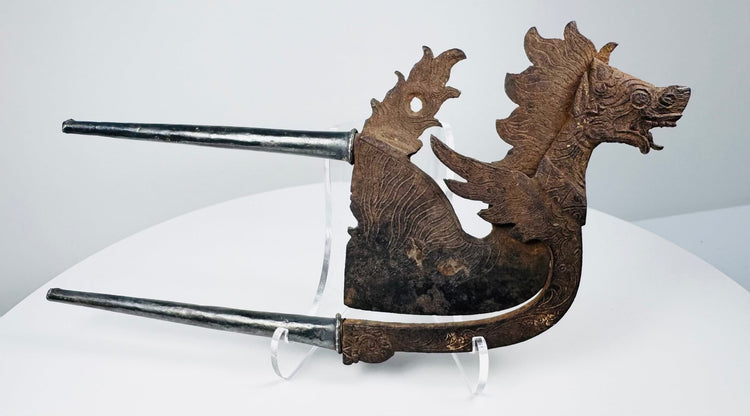


Indonesian Dragon/Lion Betel Nut Cutter with Silver-Covered Handles | 19th Century
Descripción
Más
Menos
Historical Context & Origin
Region: Indonesia, likely Bali
Material: Iron with silver-covered handles
Period: 19th Century or Earlier
Description
An exceptionally decorative Indonesian areca nut cutter, commonly referred to as a betel nut cutter, likely originating from Bali and dating to the 19th century or earlier. Traditionally used for slicing the hard areca nut prepared for betel chewing, the implement combines practical function with elaborate zoomorphic metalwork.
Forged primarily from iron, the cutter is conceived as a dramatic mythical creature with characteristics recalling a dragon or lion. The sculptural head displays a projecting toothy snout, pronounced eyes, an elaborate flame-like mane or crest, and richly worked surface ornamentation. Closely related Balinese cutters preserved in museum collections are similarly described as dragon- or lion-form implements.
The creature's body curves downward to frame the cutting mechanism, integrating the blade, hinge, and decorative elements into a unified sculptural composition. The cutting blade retains extensive incised linear and curvilinear ornament, while additional scrolling decoration continues along the curved lower portion of the frame.
Two long tapering handles extend from the body and are covered in silver-toned metal, providing a striking visual contrast with the darker patinated iron. The combination of iron and silver closely parallels documented Balinese areca nut cutters of the late 19th and early 20th centuries, in which functional cutting implements were transformed into highly decorative objects through elaborate animal and mythical-creature imagery.
The substantial size, sculptural modeling, contrasting metals, and richly ornamented surface make this an especially striking example of Southeast Asian decorative metalwork associated with the long-established culture of betel chewing.
Features
- Indonesian areca nut cutter, commonly known as a betel nut cutter
- Likely Balinese origin
- Elaborately modeled dragon- or lion-like mythical creature
- Projecting toothy snout with strongly defined facial features
- Dramatic flame-like mane and ornamental crest
- Decorated iron cutting blade with incised linear and curvilinear motifs
- Long tapering handles with silver-colored covering
- Additional scrolling ornament along the curved lower frame
- Functional hinged cutting construction
- Rich darkened patina with age-related oxidation and surface wear
- Unusual combination of functional implement and sculptural decorative art
Cultural Significance
Although traditionally called a “betel nut cutter,” the implement was principally used to slice the hard nut of the areca palm. Thin pieces of areca nut were combined with betel leaf and other ingredients to form a preparation commonly known as a betel quid.
Betel chewing was practiced for centuries throughout much of South and Southeast Asia and became deeply embedded within everyday social life and ceremonial traditions. In the Indonesian archipelago, equipment associated with the preparation and presentation of betel could include specialized containers, boxes, pounders, and cutters, with more elaborate examples reflecting considerable skill in metalworking and silversmithing.
In Bali and neighboring regions, areca nut cutters were often fashioned from iron or steel with silver-covered handles and decorated with animals or mythical creatures. The functional components of the cutter provided craftsmen with an opportunity to create highly imaginative compositions in which the blade, handles, hinge, and sculptural imagery became part of a single decorative object.
This example's dragon- or lion-like creature, elaborate crest, incised decoration, and contrasting silver-covered handles closely relate it to this distinctive tradition of Indonesian decorative metalwork.
Condition
Good antique condition consistent with considerable age and historical use. The iron surfaces exhibit oxidation, darkened patination, surface wear, discoloration, areas of encrustation, and minor abrasions throughout.
Wear and localized losses are present to portions of the silver-colored handle covering. Small irregularities, age-related marks, and surface deposits are visible throughout. The engraved and incised decoration remains readily visible, and the elaborate zoomorphic form retains strong sculptural definition.
Dimensions (Approximate)
Length: 8.25 in
Height: 4.2 in
Age (Approximate)
100–200 years old
Provenance
Long Island, New York collection, where the piece was preserved as part of an established collection of Asian art and historical objects.
Formerly in the collection of Nancy and John Hyde Devoe, New York City and New Jersey, active collectors during the 1950s–1970s. Their collection was assembled during an important period of American collecting interest in Asian, ancient, and ethnographic works of art.
Subsequently handled by Artemis Fine Arts Gallery, a specialist dealer in ancient, classical, ethnographic, and culturally significant works of art.
Learn More
Learn about a comparable Balinese iron and silver areca nut cutter in dragon/lion form in the collection of the British Museum
Browse our Collection of Functional Tools, Ancient Implements and Historic Craft
Descripción
Historical Context & Origin
Region: Indonesia, likely Bali
Material: Iron with silver-covered handles
Period: 19th Century or Earlier
Description
An exceptionally decorative Indonesian areca nut cutter, commonly referred to as a betel nut cutter, likely originating from Bali and dating to the 19th century or earlier. Traditionally used for slicing the hard areca nut prepared for betel chewing, the implement combines practical function with elaborate zoomorphic metalwork.
Forged primarily from iron, the cutter is conceived as a dramatic mythical creature with characteristics recalling a dragon or lion. The sculptural head displays a projecting toothy snout, pronounced eyes, an elaborate flame-like mane or crest, and richly worked surface ornamentation. Closely related Balinese cutters preserved in museum collections are similarly described as dragon- or lion-form implements.
The creature's body curves downward to frame the cutting mechanism, integrating the blade, hinge, and decorative elements into a unified sculptural composition. The cutting blade retains extensive incised linear and curvilinear ornament, while additional scrolling decoration continues along the curved lower portion of the frame.
Two long tapering handles extend from the body and are covered in silver-toned metal, providing a striking visual contrast with the darker patinated iron. The combination of iron and silver closely parallels documented Balinese areca nut cutters of the late 19th and early 20th centuries, in which functional cutting implements were transformed into highly decorative objects through elaborate animal and mythical-creature imagery.
The substantial size, sculptural modeling, contrasting metals, and richly ornamented surface make this an especially striking example of Southeast Asian decorative metalwork associated with the long-established culture of betel chewing.
Features
- Indonesian areca nut cutter, commonly known as a betel nut cutter
- Likely Balinese origin
- Elaborately modeled dragon- or lion-like mythical creature
- Projecting toothy snout with strongly defined facial features
- Dramatic flame-like mane and ornamental crest
- Decorated iron cutting blade with incised linear and curvilinear motifs
- Long tapering handles with silver-colored covering
- Additional scrolling ornament along the curved lower frame
- Functional hinged cutting construction
- Rich darkened patina with age-related oxidation and surface wear
- Unusual combination of functional implement and sculptural decorative art
Cultural Significance
Although traditionally called a “betel nut cutter,” the implement was principally used to slice the hard nut of the areca palm. Thin pieces of areca nut were combined with betel leaf and other ingredients to form a preparation commonly known as a betel quid.
Betel chewing was practiced for centuries throughout much of South and Southeast Asia and became deeply embedded within everyday social life and ceremonial traditions. In the Indonesian archipelago, equipment associated with the preparation and presentation of betel could include specialized containers, boxes, pounders, and cutters, with more elaborate examples reflecting considerable skill in metalworking and silversmithing.
In Bali and neighboring regions, areca nut cutters were often fashioned from iron or steel with silver-covered handles and decorated with animals or mythical creatures. The functional components of the cutter provided craftsmen with an opportunity to create highly imaginative compositions in which the blade, handles, hinge, and sculptural imagery became part of a single decorative object.
This example's dragon- or lion-like creature, elaborate crest, incised decoration, and contrasting silver-covered handles closely relate it to this distinctive tradition of Indonesian decorative metalwork.
Condition
Good antique condition consistent with considerable age and historical use. The iron surfaces exhibit oxidation, darkened patination, surface wear, discoloration, areas of encrustation, and minor abrasions throughout.
Wear and localized losses are present to portions of the silver-colored handle covering. Small irregularities, age-related marks, and surface deposits are visible throughout. The engraved and incised decoration remains readily visible, and the elaborate zoomorphic form retains strong sculptural definition.
Dimensions (Approximate)
Length: 8.25 in
Height: 4.2 in
Age (Approximate)
100–200 years old
Provenance
Long Island, New York collection, where the piece was preserved as part of an established collection of Asian art and historical objects.
Formerly in the collection of Nancy and John Hyde Devoe, New York City and New Jersey, active collectors during the 1950s–1970s. Their collection was assembled during an important period of American collecting interest in Asian, ancient, and ethnographic works of art.
Subsequently handled by Artemis Fine Arts Gallery, a specialist dealer in ancient, classical, ethnographic, and culturally significant works of art.
Learn More
Learn about a comparable Balinese iron and silver areca nut cutter in dragon/lion form in the collection of the British Museum
Browse our Collection of Functional Tools, Ancient Implements and Historic Craft
También te puede interesar
