



Italian Gilt Bronze Minerva Sculpture | Roman Goddess of Wisdom | Circa 17th Century
- Precio habitual
- $1,450.00
- Precio de venta
- $1,450.00
- Precio habitual
No se pudo cargar la disponibilidad de retiro


Italian Gilt Bronze Minerva Sculpture | Roman Goddess of Wisdom | Circa 17th Century
Descripción
Más
Menos
Historical Context & Origin
Region: Northern Italy, Possibly Venetian Tradition
Material: Gilt Bronze, Mounted on a Fabric-Covered Wooden Display Stand
Period: Traditionally Attributed to the 17th Century, circa 1600–1700
Description
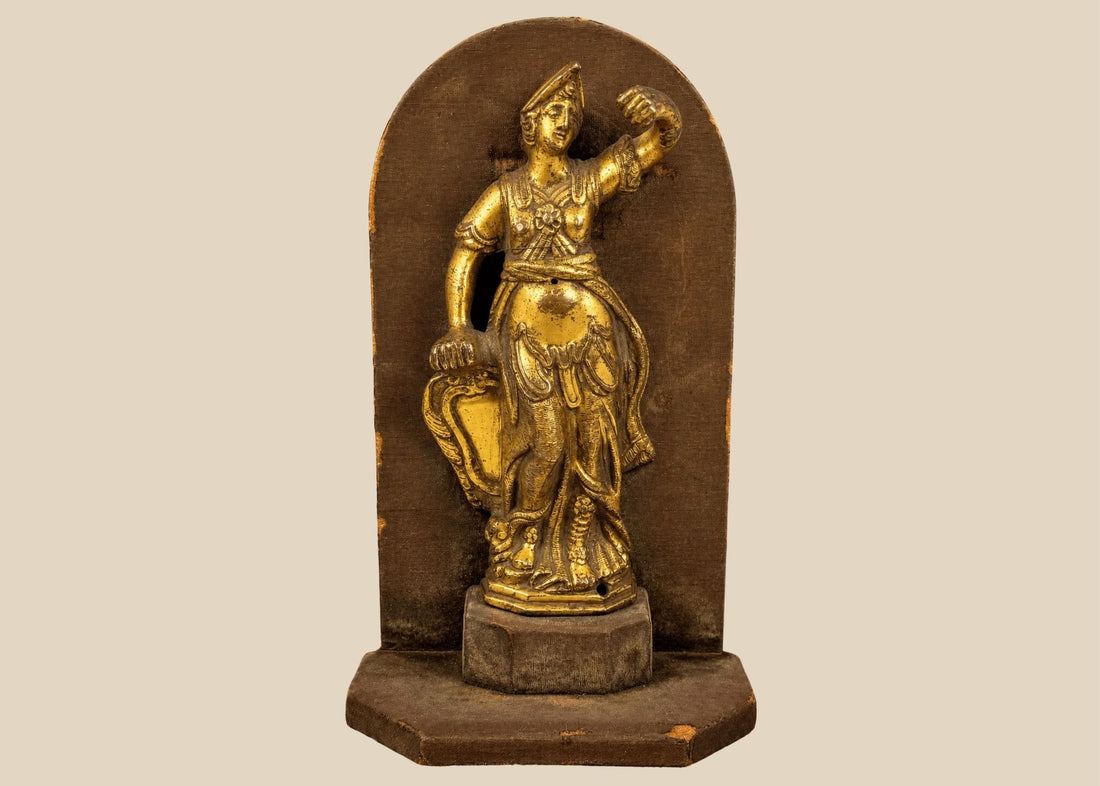
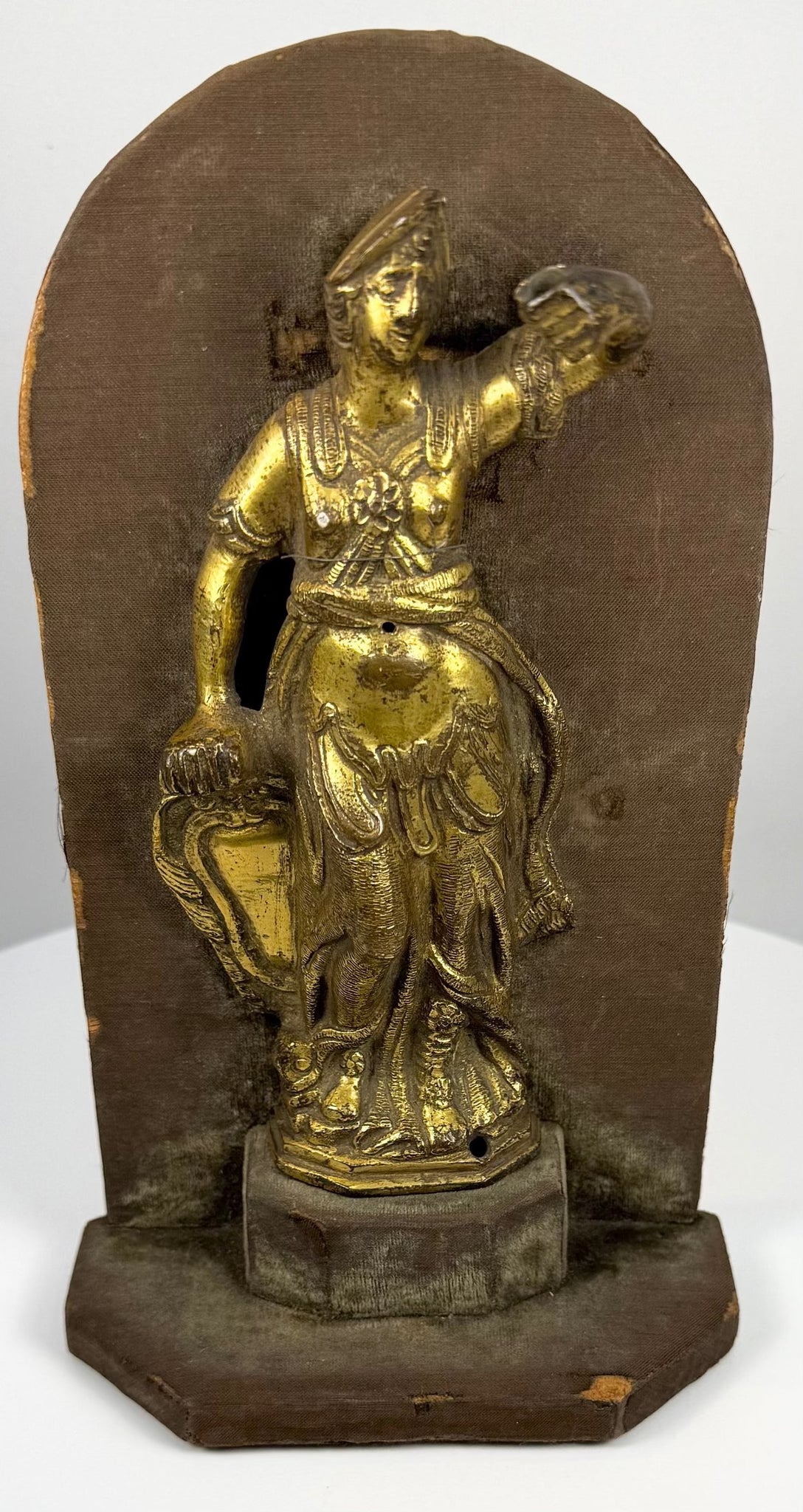
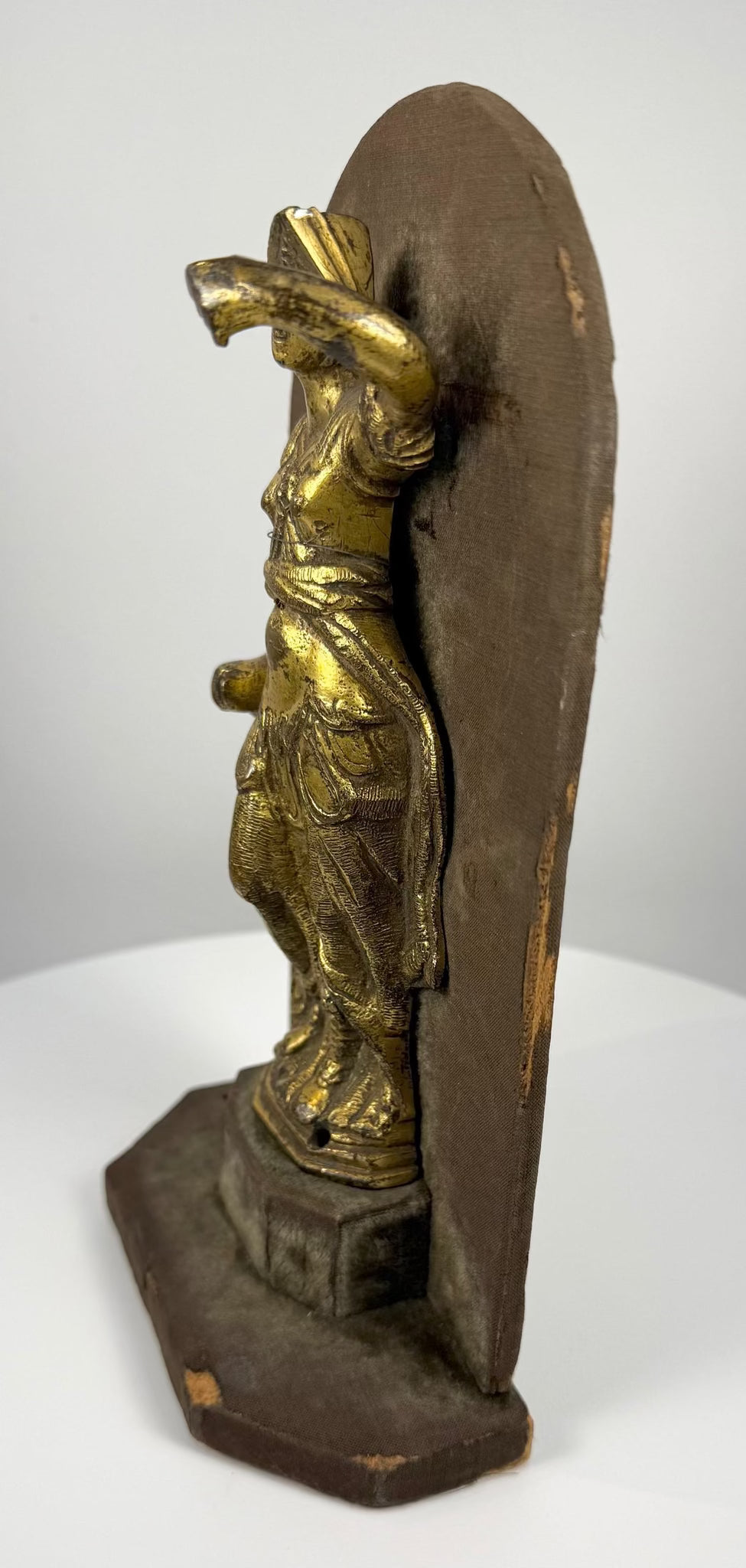
This elegant antique gilt-bronze sculpture depicts Minerva, the Roman goddess of wisdom, strategic warfare, and the arts, standing in an animated pose with an elaborate classical costume, finely modelled facial features, and richly ornamented drapery.
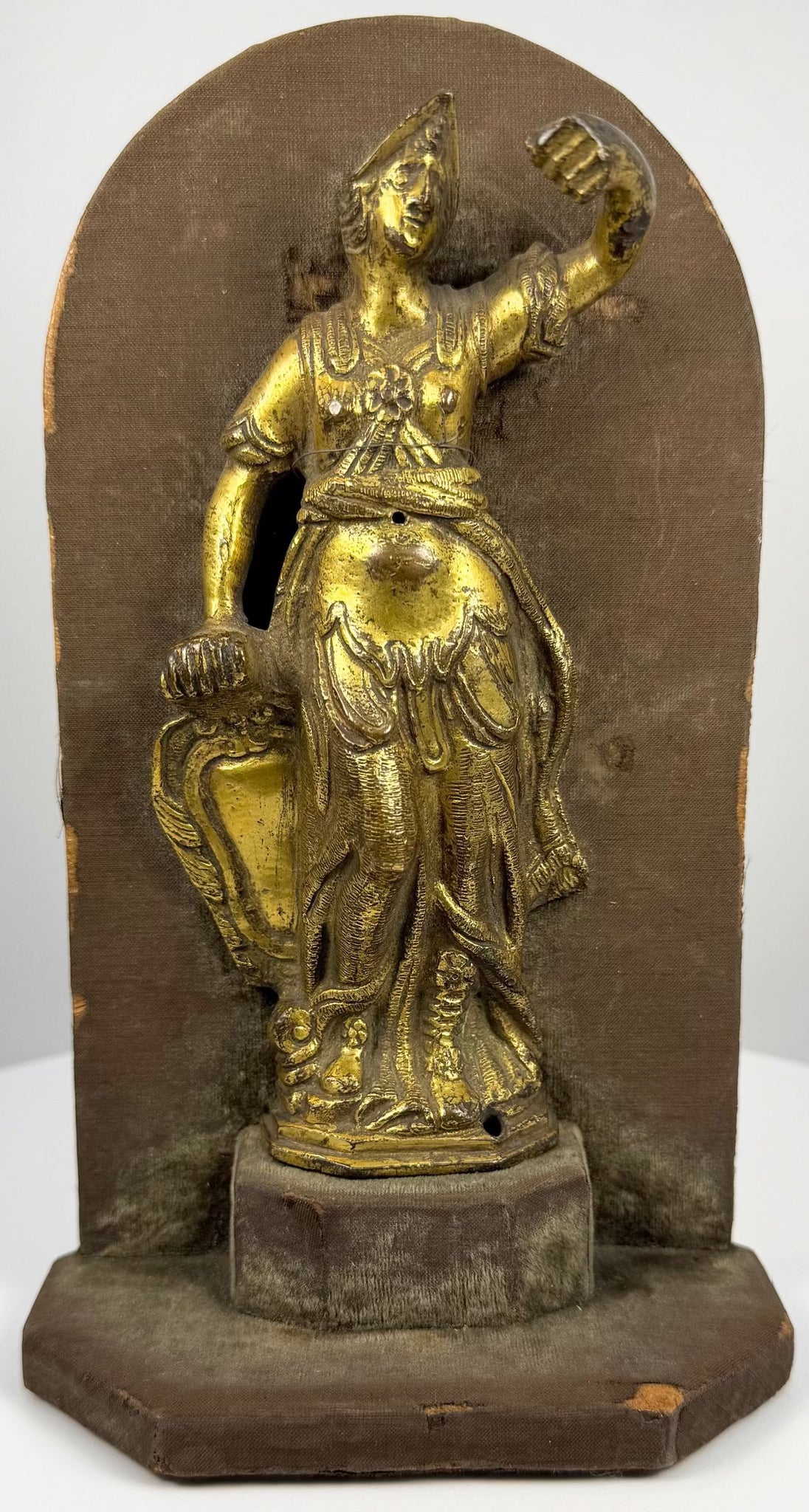
The figure wears a distinctive classical helmet, beneath which delicately sculpted hair flows around the face and shoulders. Her facial features are carefully modelled, contributing to the sculpture's refined appearance and expressive composition.
The upper costume displays decorative shoulder bands, an ornamental floral motif positioned prominently at the chest, and detailed borders accentuating the garment's classical design.
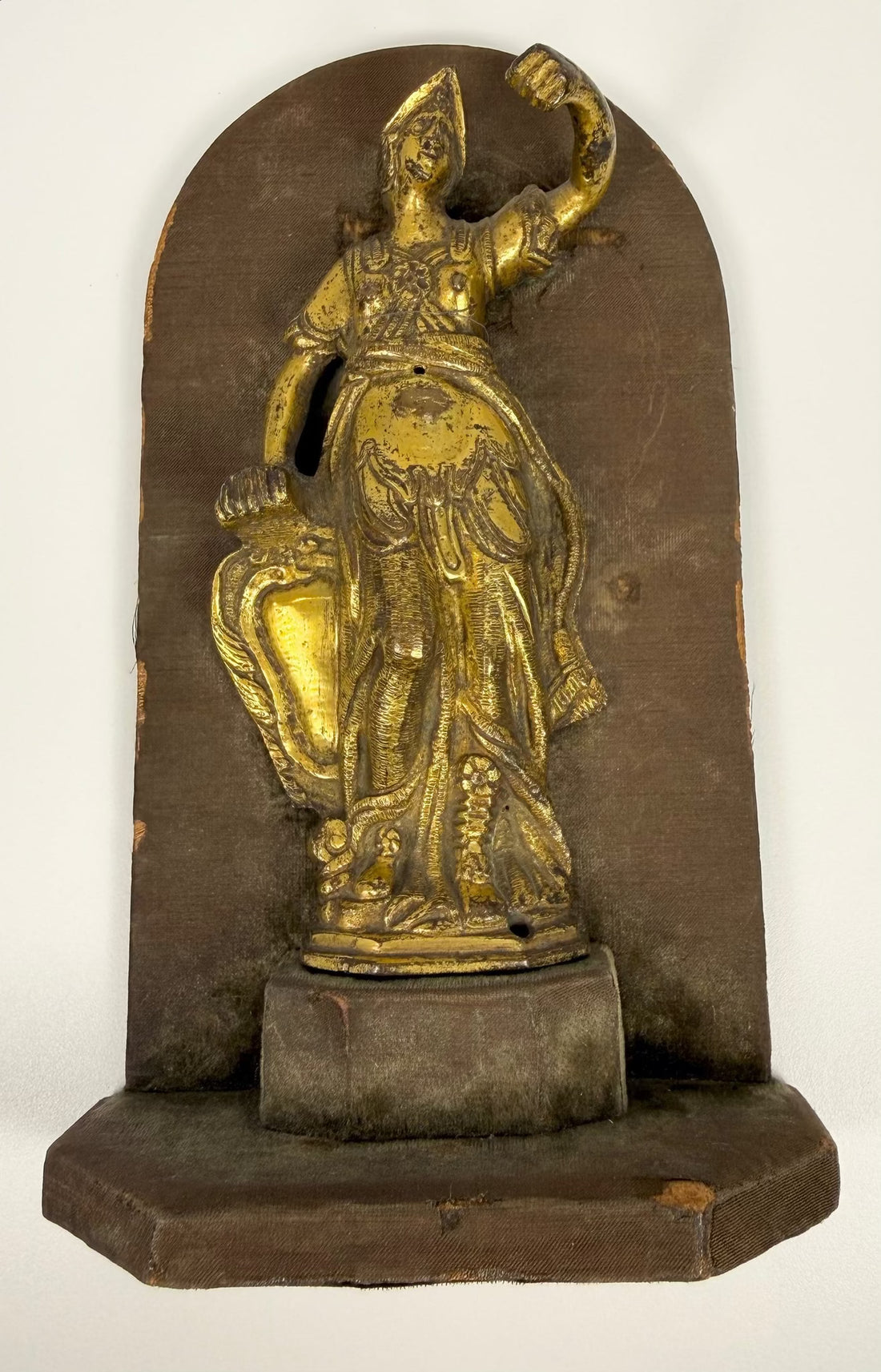
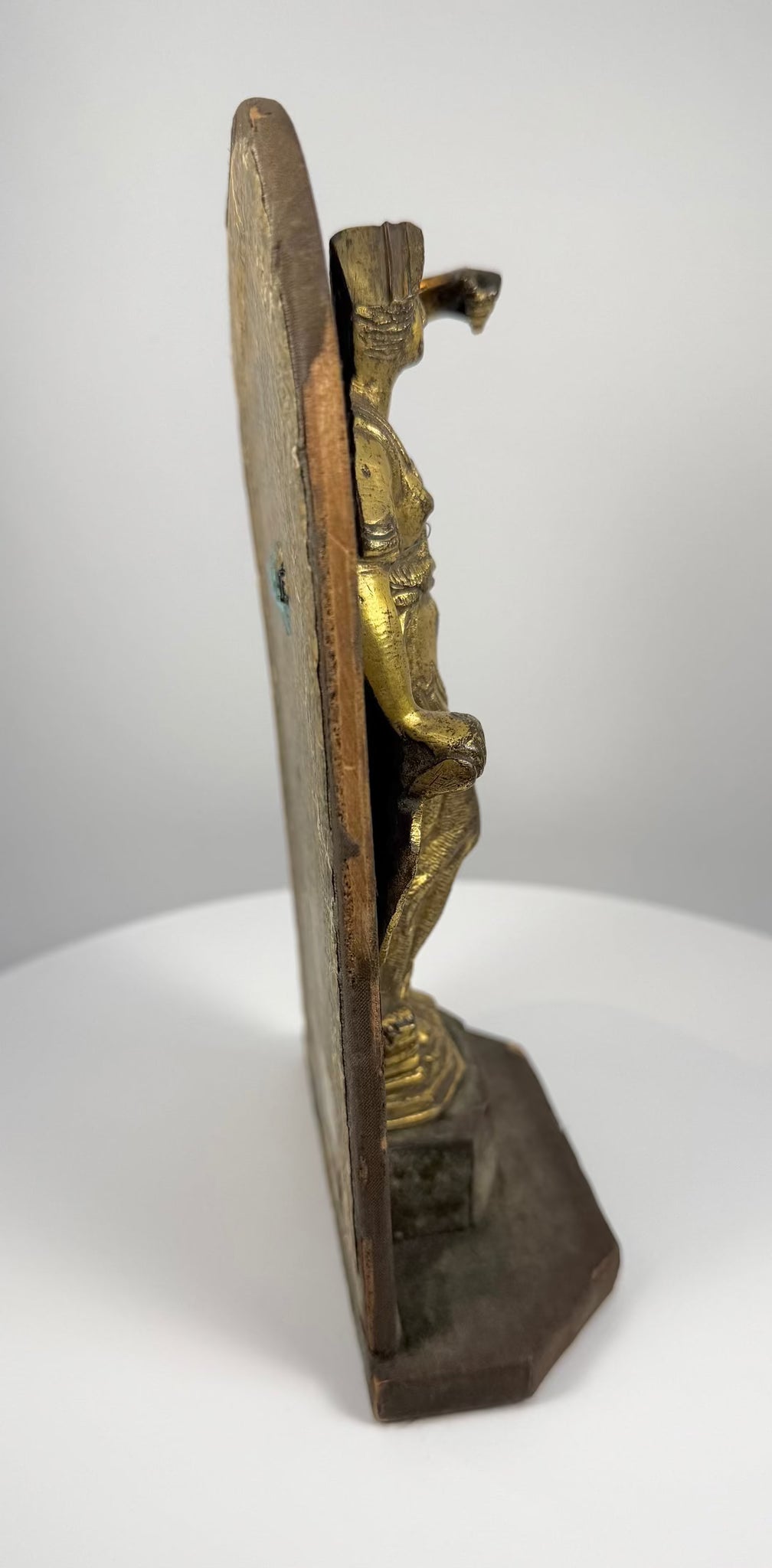
One arm is raised in a commanding gesture, with the open hand originally intended to accommodate a separately fitted attribute, now missing. This was probably a spear, traditionally associated with Minerva's iconography as a goddess of strategic warfare and protection.
The opposite hand rests upon an elaborately decorated shield positioned beside the figure's leg, reinforcing her identification with the Roman goddess and her association with defensive strength and military wisdom.
The lower portion of the sculpture features deeply modelled flowing drapery, with ornamental swags, overlapping folds, and carefully sculpted fabric descending toward the feet. These decorative elements create a sense of movement and contribute to the composition's elegant proportions.
The bronze retains areas of original-style gilded decoration in warm golden tones, contrasting with darker surface patination that accentuates the sculptural modelling. Rubbing, surface wear, and variations in the surviving gilding are visible throughout.
Small circular holes are present in the bronze, possibly associated with an earlier attachment or mounting arrangement, although their precise original purpose remains undetermined.
Features
-
Animated standing pose with one arm raised
-
Distinctive classical helmet with flowing hair and finely modelled facial features
-
Elaborate costume featuring decorative shoulder bands and ornamental borders
-
Prominent floral ornament positioned at the chest
-
Raised open hand originally intended to hold a separate attribute, probably a spear, now missing
-
Opposite hand resting on a decorated shield beside the leg
-
Deeply modelled flowing drapery with ornamental swags and layered folds extending to the feet
-
Partially preserved gilding exhibiting warm golden tones and darker patination
-
Surface rubbing, abrasions, and localized wear to the gilded finish
Cultural Significance
Minerva occupied an important position within ancient Roman religion and mythology, representing wisdom, strategic warfare, skilled craftsmanship, learning, and the arts.
Together with Jupiter and Juno, she formed part of the Capitoline Triad, the group of principal deities honoured in Roman state religion.
Closely associated with the Greek goddess Athena, Minerva was traditionally depicted wearing a helmet and carrying martial attributes, particularly a spear and shield. These symbols represented her connection to military strategy, protection, intelligence, and disciplined judgment.
Her image remained influential long after the decline of the ancient Roman world, becoming a prominent subject within European Renaissance and Baroque art.
During these periods, artists, sculptors, and bronze founders frequently drew inspiration from classical mythology, incorporating representations of ancient deities into decorative sculpture, architectural ornamentation, furniture mounts, and elaborate interior furnishings.
Minerva's association with wisdom, education, the arts, and military strength made her an especially appropriate subject for works intended to communicate intellectual accomplishment, authority, and classical learning.
European gilt-bronze sculpture developed sophisticated decorative traditions combining detailed figural modelling, ornamental metalwork, and gilded surfaces. Such objects could serve as independent decorative figures or form components of larger sculptural and architectural ensembles.
The present figure reflects this broader tradition through its animated classical pose, finely modelled helmet and facial features, ornamental costume, flowing drapery, and surviving gilded finish.
Its raised arm, originally designed to hold a separate attribute, and the decorated shield positioned beside the leg preserve the recognizable iconography of Minerva.
The sculpture's elaborate costume and sculptural detailing offer an intriguing connection to the enduring influence of classical mythology on European decorative arts.
Condition
The sculpture displays visible surface wear, rubbing to the gilded finish, areas of darker patination, and minor abrasions consistent with its present condition.
The figure retains its helmet, finely modelled facial features, flowing hair, decorative costume, deeply sculpted drapery, and shield.
One raised hand remains open and is presently without its original separately fitted attribute, probably a spear.
The surviving gilding exhibits variations in golden coloration, with localized rubbing and darker surface deposits emphasizing the sculptural details.
Small circular holes are visible in the bronze. Their original function has not been established.
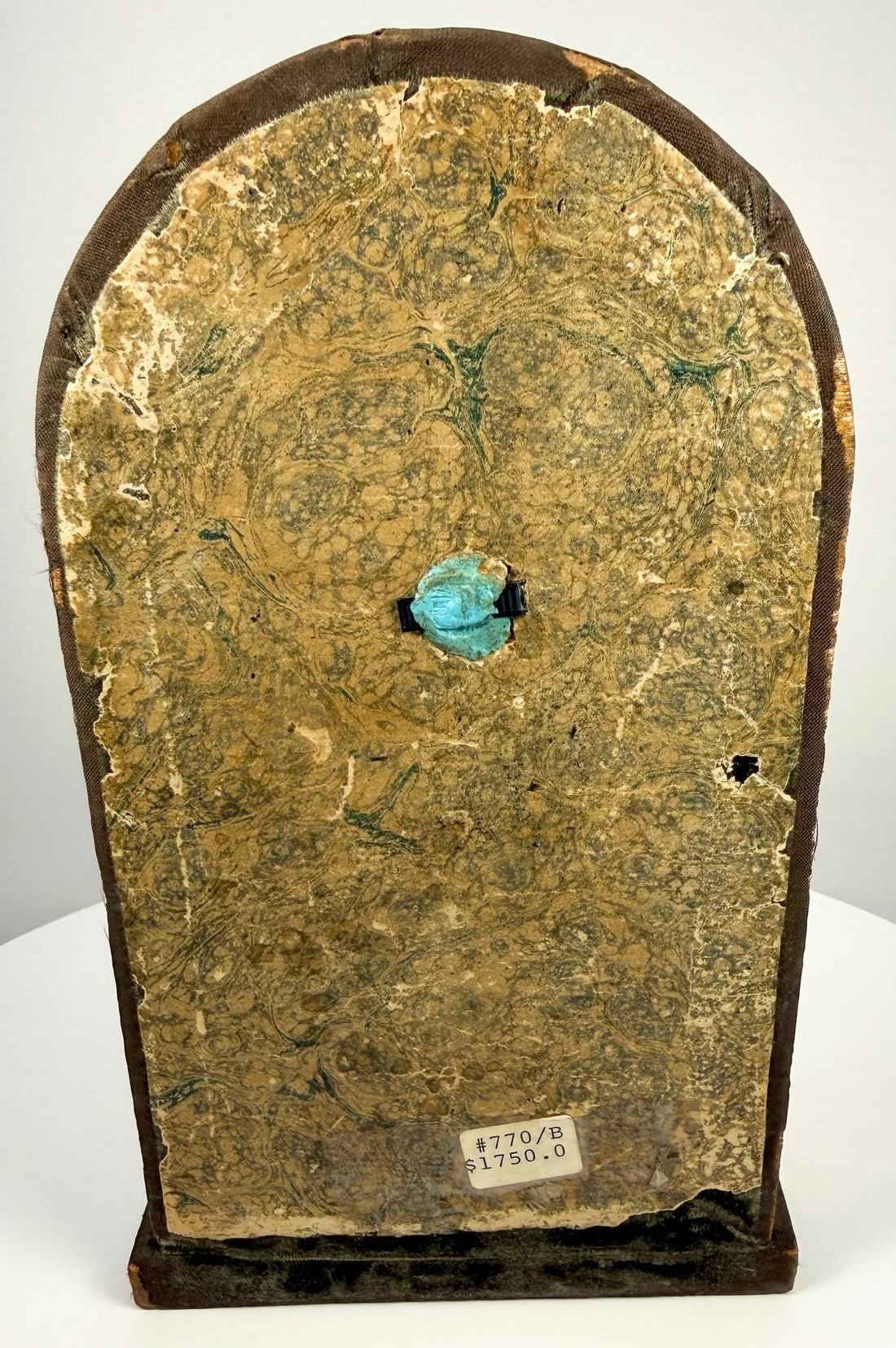
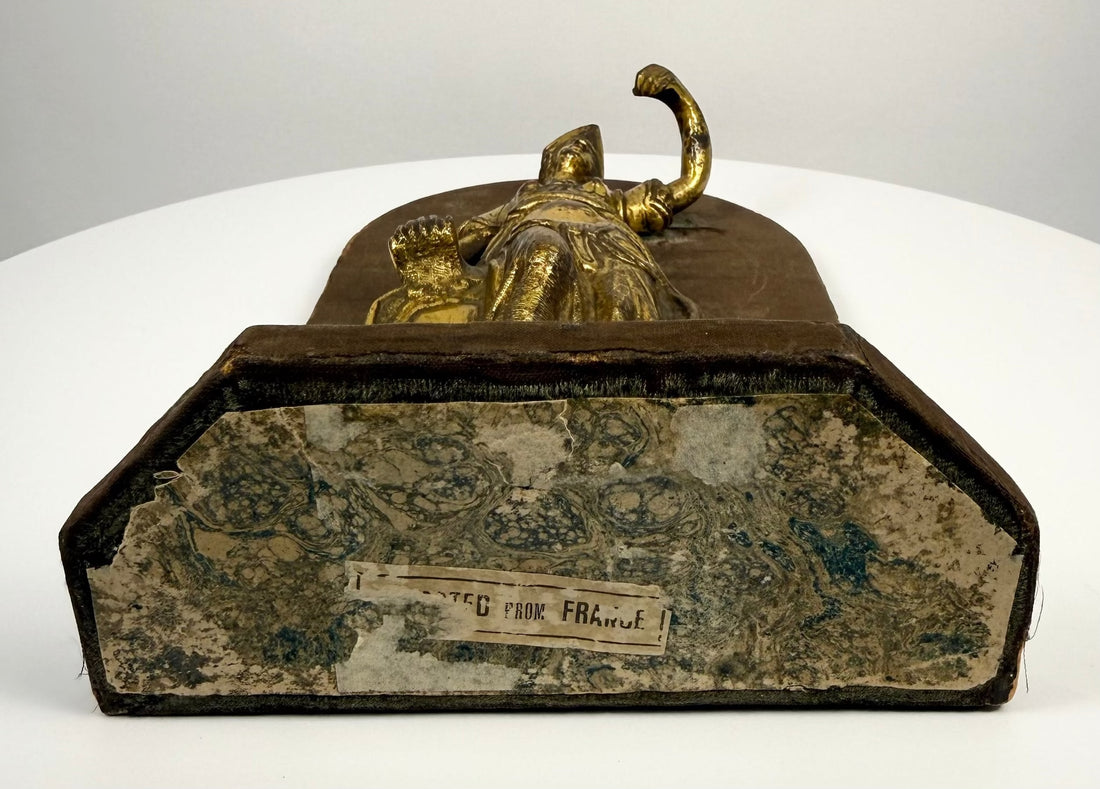
The fabric-covered wooden display mount exhibits age-related wear, minor abrasions, localized edge losses, and deterioration to portions of the paper backing. Older labels remain attached to the underside.
The specialist identified the sculpture as a gilt-bronze figure of Minerva, depicted standing in an animated pose wearing a classical helmet, with finely modelled facial features and flowing hair. The assessment noted the decorative shoulder bands, floral ornament at the chest, ornamental costume borders, and deeply modelled drapery with flowing swags extending to the feet. One raised hand was identified as originally intended to hold a separate attribute, now missing, probably a spear, while the opposite hand rests upon a decorated shield positioned beside the leg. The specialist also documented partially preserved gilding in golden tones, darker patination, surface rubbing and wear, and small circular holes in the bronze.
The supplied assessment establishes the figure's iconographic identification and observable characteristics but does not specify a confirmed geographical origin, workshop, or manufacturing date.
Dimensions (Approximate)
Overall, Including Display Mount:
Height: 7.875 in
Width: 4.5 in
Depth: 2 in
Age (Approximate)
325–425 years old
Provenance
Formerly from a private collection in Richmond, Virginia, USA.
Subsequently, handled by Quinn's Auction Galleries, Falls Church, Virginia, USA. Quinn's Auction Galleries traces its origins to 1995, when Paul Quinn and his son David established the Auction House of Falls Church in Virginia. The family-operated business subsequently developed into an established Washington, D.C.-area auction house specializing in antiques and collectables.
Expert Assessment: Examined by Luca Salvaggio, an Italian archaeologist specializing in ancient Mediterranean material, with a Postgraduate Diploma from the Italian Archaeological School at Athens (IASA) and accreditation for preventive archaeology from the Italian Ministry of Culture (MiC). He identified the sculpture as a gilt-bronze figure of Minerva, depicted standing in an animated pose wearing a classical helmet, with finely modelled facial features and flowing hair. The assessment noted the decorative shoulder bands, floral ornament at the chest, ornamental costume borders, and deeply modelled drapery with flowing swags extending to the feet. One raised hand was identified as originally intended to hold a separate attribute, now missing, probably a spear, while the opposite hand rests upon a decorated shield positioned beside the leg.
Learn More
Discover a closely comparable early 17th-century Italian gilt-bronze Minerva sculpture at Christie's
Browse Our Collection of Statues, Figures & Carvings
Descripción
Historical Context & Origin
Region: Northern Italy, Possibly Venetian Tradition
Material: Gilt Bronze, Mounted on a Fabric-Covered Wooden Display Stand
Period: Traditionally Attributed to the 17th Century, circa 1600–1700
Description
This elegant antique gilt-bronze sculpture depicts Minerva, the Roman goddess of wisdom, strategic warfare, and the arts, standing in an animated pose with an elaborate classical costume, finely modelled facial features, and richly ornamented drapery.
The figure wears a distinctive classical helmet, beneath which delicately sculpted hair flows around the face and shoulders. Her facial features are carefully modelled, contributing to the sculpture's refined appearance and expressive composition.
The upper costume displays decorative shoulder bands, an ornamental floral motif positioned prominently at the chest, and detailed borders accentuating the garment's classical design.
One arm is raised in a commanding gesture, with the open hand originally intended to accommodate a separately fitted attribute, now missing. This was probably a spear, traditionally associated with Minerva's iconography as a goddess of strategic warfare and protection.
The opposite hand rests upon an elaborately decorated shield positioned beside the figure's leg, reinforcing her identification with the Roman goddess and her association with defensive strength and military wisdom.
The lower portion of the sculpture features deeply modelled flowing drapery, with ornamental swags, overlapping folds, and carefully sculpted fabric descending toward the feet. These decorative elements create a sense of movement and contribute to the composition's elegant proportions.
The bronze retains areas of original-style gilded decoration in warm golden tones, contrasting with darker surface patination that accentuates the sculptural modelling. Rubbing, surface wear, and variations in the surviving gilding are visible throughout.
Small circular holes are present in the bronze, possibly associated with an earlier attachment or mounting arrangement, although their precise original purpose remains undetermined.
Features
-
Animated standing pose with one arm raised
-
Distinctive classical helmet with flowing hair and finely modelled facial features
-
Elaborate costume featuring decorative shoulder bands and ornamental borders
-
Prominent floral ornament positioned at the chest
-
Raised open hand originally intended to hold a separate attribute, probably a spear, now missing
-
Opposite hand resting on a decorated shield beside the leg
-
Deeply modelled flowing drapery with ornamental swags and layered folds extending to the feet
-
Partially preserved gilding exhibiting warm golden tones and darker patination
-
Surface rubbing, abrasions, and localized wear to the gilded finish
Cultural Significance
Minerva occupied an important position within ancient Roman religion and mythology, representing wisdom, strategic warfare, skilled craftsmanship, learning, and the arts.
Together with Jupiter and Juno, she formed part of the Capitoline Triad, the group of principal deities honoured in Roman state religion.
Closely associated with the Greek goddess Athena, Minerva was traditionally depicted wearing a helmet and carrying martial attributes, particularly a spear and shield. These symbols represented her connection to military strategy, protection, intelligence, and disciplined judgment.
Her image remained influential long after the decline of the ancient Roman world, becoming a prominent subject within European Renaissance and Baroque art.
During these periods, artists, sculptors, and bronze founders frequently drew inspiration from classical mythology, incorporating representations of ancient deities into decorative sculpture, architectural ornamentation, furniture mounts, and elaborate interior furnishings.
Minerva's association with wisdom, education, the arts, and military strength made her an especially appropriate subject for works intended to communicate intellectual accomplishment, authority, and classical learning.
European gilt-bronze sculpture developed sophisticated decorative traditions combining detailed figural modelling, ornamental metalwork, and gilded surfaces. Such objects could serve as independent decorative figures or form components of larger sculptural and architectural ensembles.
The present figure reflects this broader tradition through its animated classical pose, finely modelled helmet and facial features, ornamental costume, flowing drapery, and surviving gilded finish.
Its raised arm, originally designed to hold a separate attribute, and the decorated shield positioned beside the leg preserve the recognizable iconography of Minerva.
The sculpture's elaborate costume and sculptural detailing offer an intriguing connection to the enduring influence of classical mythology on European decorative arts.
Condition
The sculpture displays visible surface wear, rubbing to the gilded finish, areas of darker patination, and minor abrasions consistent with its present condition.
The figure retains its helmet, finely modelled facial features, flowing hair, decorative costume, deeply sculpted drapery, and shield.
One raised hand remains open and is presently without its original separately fitted attribute, probably a spear.
The surviving gilding exhibits variations in golden coloration, with localized rubbing and darker surface deposits emphasizing the sculptural details.
Small circular holes are visible in the bronze. Their original function has not been established.
The fabric-covered wooden display mount exhibits age-related wear, minor abrasions, localized edge losses, and deterioration to portions of the paper backing. Older labels remain attached to the underside.
The specialist identified the sculpture as a gilt-bronze figure of Minerva, depicted standing in an animated pose wearing a classical helmet, with finely modelled facial features and flowing hair. The assessment noted the decorative shoulder bands, floral ornament at the chest, ornamental costume borders, and deeply modelled drapery with flowing swags extending to the feet. One raised hand was identified as originally intended to hold a separate attribute, now missing, probably a spear, while the opposite hand rests upon a decorated shield positioned beside the leg. The specialist also documented partially preserved gilding in golden tones, darker patination, surface rubbing and wear, and small circular holes in the bronze.
The supplied assessment establishes the figure's iconographic identification and observable characteristics but does not specify a confirmed geographical origin, workshop, or manufacturing date.
Dimensions (Approximate)
Overall, Including Display Mount:
Height: 7.875 in
Width: 4.5 in
Depth: 2 in
Age (Approximate)
325–425 years old
Provenance
Formerly from a private collection in Richmond, Virginia, USA.
Subsequently, handled by Quinn's Auction Galleries, Falls Church, Virginia, USA. Quinn's Auction Galleries traces its origins to 1995, when Paul Quinn and his son David established the Auction House of Falls Church in Virginia. The family-operated business subsequently developed into an established Washington, D.C.-area auction house specializing in antiques and collectables.
Expert Assessment: Examined by Luca Salvaggio, an Italian archaeologist specializing in ancient Mediterranean material, with a Postgraduate Diploma from the Italian Archaeological School at Athens (IASA) and accreditation for preventive archaeology from the Italian Ministry of Culture (MiC). He identified the sculpture as a gilt-bronze figure of Minerva, depicted standing in an animated pose wearing a classical helmet, with finely modelled facial features and flowing hair. The assessment noted the decorative shoulder bands, floral ornament at the chest, ornamental costume borders, and deeply modelled drapery with flowing swags extending to the feet. One raised hand was identified as originally intended to hold a separate attribute, now missing, probably a spear, while the opposite hand rests upon a decorated shield positioned beside the leg.
Learn More
Discover a closely comparable early 17th-century Italian gilt-bronze Minerva sculpture at Christie's
Browse Our Collection of Statues, Figures & Carvings
También te puede interesar
