



Spanish Caravaca Cross Crucifix Pendant | Bronze with Angels & Religious Imagery| Circa 17th Century
- Precio habitual
- $400.00
- Precio de venta
- $400.00
- Precio habitual
No se pudo cargar la disponibilidad de retiro


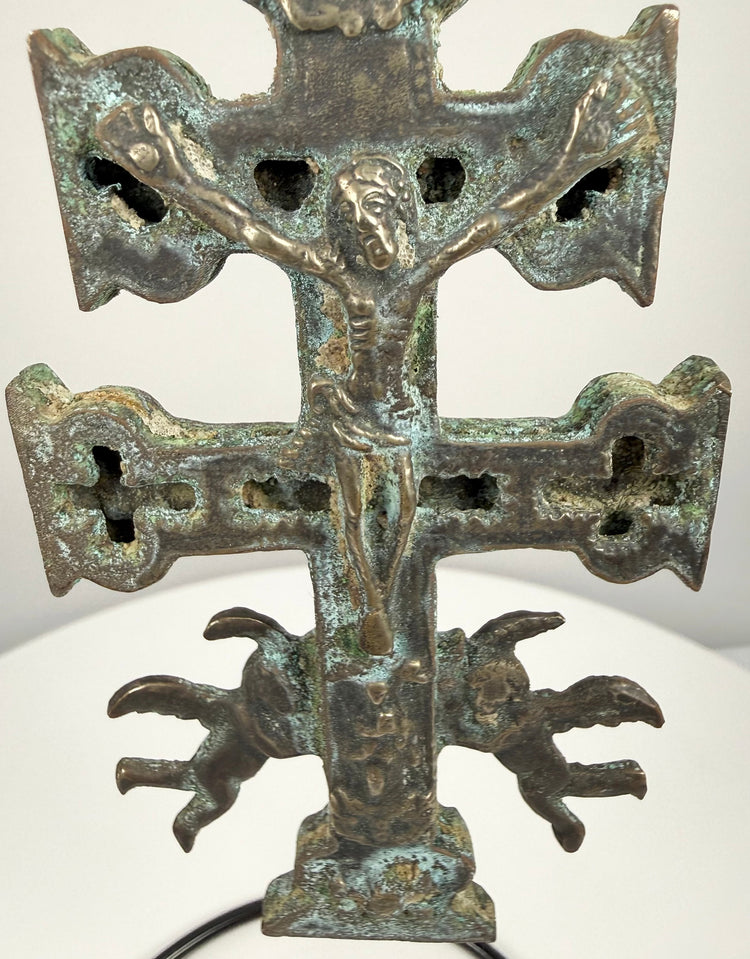


Spanish Caravaca Cross Crucifix Pendant | Bronze with Angels & Religious Imagery| Circa 17th Century
Descripción
Más
Menos
Historical Context & Origin
Region: Spain, Associated with Caravaca de la Cruz, Murcia
Material: Cast Bronze or Copper Alloy with Traces of Silver-Coloured Finish
Period: 17th Century, circa 1600–1700 (Attributed)
Description
This exceptional antique Spanish Cross of Caravaca, also known as the Cruz de Caravaca or Vera Cruz, features an elaborate double-barred design with finely modelled religious imagery on both sides. Its distinctive form, detailed figural decoration, and accompanying angels reflect the rich traditions of Spanish devotional metalwork.
Cast in substantial bronze or a related copper alloy, the cross features a centrally positioned figure of the crucified Christ, rendered in raised relief with outstretched arms, carefully defined anatomy, and a flowing loincloth. The figure occupies the upper portion of the composition, emphasizing the suffering and sacrifice of the Crucifixion.
Beneath Christ appears a smaller Marian devotional figure associated with the Immaculate Conception, enclosed within a decorative arrangement of raised ornamentation.
One of the most striking features is the pair of winged angels extending outward from the lower section of the cross. Their dramatically outstretched wings and animated poses recall the miraculous appearance of the Cross of Caravaca, in which two angels are traditionally believed to have carried the sacred relic from heaven.
The horizontal crossbars feature distinctive shaped terminals and pierced openings, creating an intricate architectural design associated with historic Spanish religious metalwork. These openings reflect the decorative pierced construction found on traditional Caravaca crosses.
The reverse displays additional religious figures and symbolic elements arranged across the central shaft and horizontal arms. The composition incorporates imagery associated with the legendary Mass of Caravaca, including a central religious figure, flanking attendants or witnesses, and smaller devotional symbols. Such detailed narrative decoration distinguishes elaborate Caravaca crosses from simpler religious pendants.
A substantial suspension loop extends from the top, indicating that the piece was designed for hanging or devotional display.
The bronze has developed a richly varied brown and green patina, with areas of turquoise-coloured copper oxidation and surviving traces of a lighter metallic finish. The contrast between the darkened recesses and worn raised decoration emphasizes the intricate sculptural details and historical character of the piece.
Features
- Antique Spanish Cross of Caravaca featuring a distinctive double-barred design
- Cast bronze or copper-alloy construction with substantial sculptural detailing
- Raised depiction of the crucified Christ with outstretched arms
- Marian devotional imagery associated with the Immaculate Conception
- Pair of winged angels extending outward from the lower section
- Decorative crossbars with shaped terminals and pierced openings
- Additional religious imagery on the reverse associated with the Miracle of Caravaca
- Integral upper suspension loop for hanging or devotional display
- Surviving traces of a historic silver-coloured surface finish
- Rich brown patination with green and turquoise copper oxidation
Cultural Significance
The Cross of Caravaca occupies an important position in Spanish religious and cultural history, particularly within the devotional traditions surrounding the veneration of the True Cross.
Its origins are associated with the medieval town of Caravaca de la Cruz in southeastern Spain, where a revered relic traditionally believed to contain a fragment of the True Cross became the focus of centuries of Christian pilgrimage and devotion.
According to a tradition dating to 1232, a Christian priest named Ginés Pérez Chirinos was celebrating Mass before a Muslim ruler when he discovered that the necessary crucifix was missing. At that moment, two angels miraculously appeared carrying a double-barred cross, allowing the ceremony to continue.
This event became central to the religious identity of Caravaca, inspiring generations of devotional crosses, pendants, and religious artworks incorporating the miraculous appearance of the angels.
Unlike the conventional Latin crucifix, the Cross of Caravaca is characterized by two horizontal arms, reflecting the traditional patriarchal cross form. Its distinctive silhouette became an enduring symbol of the religious heritage of Caravaca de la Cruz.
During the early modern period, Caravaca crosses were widely treasured as religious pendants, pilgrimage souvenirs, and objects of private devotion. They were also traditionally associated with protection against misfortune, storms, illness, and other dangers.
Examples combining the Crucifixion, Marian imagery, winged angels, and narrative scenes associated with the Miracle of Caravaca are particularly significant for their rich religious symbolism. These elements preserve several interconnected aspects of Spanish Christian devotional tradition within a single object.
The present cross reflects this longstanding religious heritage through its elaborate double-barred construction, sculptural imagery, and richly patinated bronze surface.
Condition
Good antique condition, displaying substantial surface patination and wear consistent with its reported age and historic devotional use.
The bronze exhibits extensive green and turquoise oxidation, darkened recesses, surface irregularities, and worn high points. Traces of a historic silver-coloured finish remain visible in selected areas.
The raised religious figures and decorative elements remain recognizable, while the suspension loop shows age-related wear.
Dimensions (Approximate)
Height: 5.5 in
Width: 2.5 in
Depth: 0.75 in
Age (Approximate)
325–425 years old
Provenance
Formerly from a private collection in Richmond, Virginia, USA.
Subsequently, handled by Quinn's Auction Galleries, Falls Church, Virginia, USA. Quinn's Auction Galleries traces its origins to 1995, when Paul Quinn and his son David established the Auction House of Falls Church in Virginia. The family-operated business subsequently developed into an established Washington, D.C.-area auction house specializing in antiques and collectables.
Learn More
Discover a comparable historic Spanish Cross of Caravaca featuring the Crucifixion, Immaculate Conception, and winged angels in the Spanish State Museum Collections
Browse Our Collection of Religious & Spiritual Relics
Descripción
Historical Context & Origin
Region: Spain, Associated with Caravaca de la Cruz, Murcia
Material: Cast Bronze or Copper Alloy with Traces of Silver-Coloured Finish
Period: 17th Century, circa 1600–1700 (Attributed)
Description
This exceptional antique Spanish Cross of Caravaca, also known as the Cruz de Caravaca or Vera Cruz, features an elaborate double-barred design with finely modelled religious imagery on both sides. Its distinctive form, detailed figural decoration, and accompanying angels reflect the rich traditions of Spanish devotional metalwork.
Cast in substantial bronze or a related copper alloy, the cross features a centrally positioned figure of the crucified Christ, rendered in raised relief with outstretched arms, carefully defined anatomy, and a flowing loincloth. The figure occupies the upper portion of the composition, emphasizing the suffering and sacrifice of the Crucifixion.
Beneath Christ appears a smaller Marian devotional figure associated with the Immaculate Conception, enclosed within a decorative arrangement of raised ornamentation.
One of the most striking features is the pair of winged angels extending outward from the lower section of the cross. Their dramatically outstretched wings and animated poses recall the miraculous appearance of the Cross of Caravaca, in which two angels are traditionally believed to have carried the sacred relic from heaven.
The horizontal crossbars feature distinctive shaped terminals and pierced openings, creating an intricate architectural design associated with historic Spanish religious metalwork. These openings reflect the decorative pierced construction found on traditional Caravaca crosses.
The reverse displays additional religious figures and symbolic elements arranged across the central shaft and horizontal arms. The composition incorporates imagery associated with the legendary Mass of Caravaca, including a central religious figure, flanking attendants or witnesses, and smaller devotional symbols. Such detailed narrative decoration distinguishes elaborate Caravaca crosses from simpler religious pendants.
A substantial suspension loop extends from the top, indicating that the piece was designed for hanging or devotional display.
The bronze has developed a richly varied brown and green patina, with areas of turquoise-coloured copper oxidation and surviving traces of a lighter metallic finish. The contrast between the darkened recesses and worn raised decoration emphasizes the intricate sculptural details and historical character of the piece.
Features
- Antique Spanish Cross of Caravaca featuring a distinctive double-barred design
- Cast bronze or copper-alloy construction with substantial sculptural detailing
- Raised depiction of the crucified Christ with outstretched arms
- Marian devotional imagery associated with the Immaculate Conception
- Pair of winged angels extending outward from the lower section
- Decorative crossbars with shaped terminals and pierced openings
- Additional religious imagery on the reverse associated with the Miracle of Caravaca
- Integral upper suspension loop for hanging or devotional display
- Surviving traces of a historic silver-coloured surface finish
- Rich brown patination with green and turquoise copper oxidation
Cultural Significance
The Cross of Caravaca occupies an important position in Spanish religious and cultural history, particularly within the devotional traditions surrounding the veneration of the True Cross.
Its origins are associated with the medieval town of Caravaca de la Cruz in southeastern Spain, where a revered relic traditionally believed to contain a fragment of the True Cross became the focus of centuries of Christian pilgrimage and devotion.
According to a tradition dating to 1232, a Christian priest named Ginés Pérez Chirinos was celebrating Mass before a Muslim ruler when he discovered that the necessary crucifix was missing. At that moment, two angels miraculously appeared carrying a double-barred cross, allowing the ceremony to continue.
This event became central to the religious identity of Caravaca, inspiring generations of devotional crosses, pendants, and religious artworks incorporating the miraculous appearance of the angels.
Unlike the conventional Latin crucifix, the Cross of Caravaca is characterized by two horizontal arms, reflecting the traditional patriarchal cross form. Its distinctive silhouette became an enduring symbol of the religious heritage of Caravaca de la Cruz.
During the early modern period, Caravaca crosses were widely treasured as religious pendants, pilgrimage souvenirs, and objects of private devotion. They were also traditionally associated with protection against misfortune, storms, illness, and other dangers.
Examples combining the Crucifixion, Marian imagery, winged angels, and narrative scenes associated with the Miracle of Caravaca are particularly significant for their rich religious symbolism. These elements preserve several interconnected aspects of Spanish Christian devotional tradition within a single object.
The present cross reflects this longstanding religious heritage through its elaborate double-barred construction, sculptural imagery, and richly patinated bronze surface.
Condition
Good antique condition, displaying substantial surface patination and wear consistent with its reported age and historic devotional use.
The bronze exhibits extensive green and turquoise oxidation, darkened recesses, surface irregularities, and worn high points. Traces of a historic silver-coloured finish remain visible in selected areas.
The raised religious figures and decorative elements remain recognizable, while the suspension loop shows age-related wear.
Dimensions (Approximate)
Height: 5.5 in
Width: 2.5 in
Depth: 0.75 in
Age (Approximate)
325–425 years old
Provenance
Formerly from a private collection in Richmond, Virginia, USA.
Subsequently, handled by Quinn's Auction Galleries, Falls Church, Virginia, USA. Quinn's Auction Galleries traces its origins to 1995, when Paul Quinn and his son David established the Auction House of Falls Church in Virginia. The family-operated business subsequently developed into an established Washington, D.C.-area auction house specializing in antiques and collectables.
Learn More
Discover a comparable historic Spanish Cross of Caravaca featuring the Crucifixion, Immaculate Conception, and winged angels in the Spanish State Museum Collections
Browse Our Collection of Religious & Spiritual Relics
También te puede interesar
