



Thai Gilt Bronze Buddha Hand Sculpture | Vitarka Mudra | Rattanakosin Period | Circa 19th Century
- Precio habitual
- $1,450.00
- Precio de venta
- $1,450.00
- Precio habitual
No se pudo cargar la disponibilidad de retiro


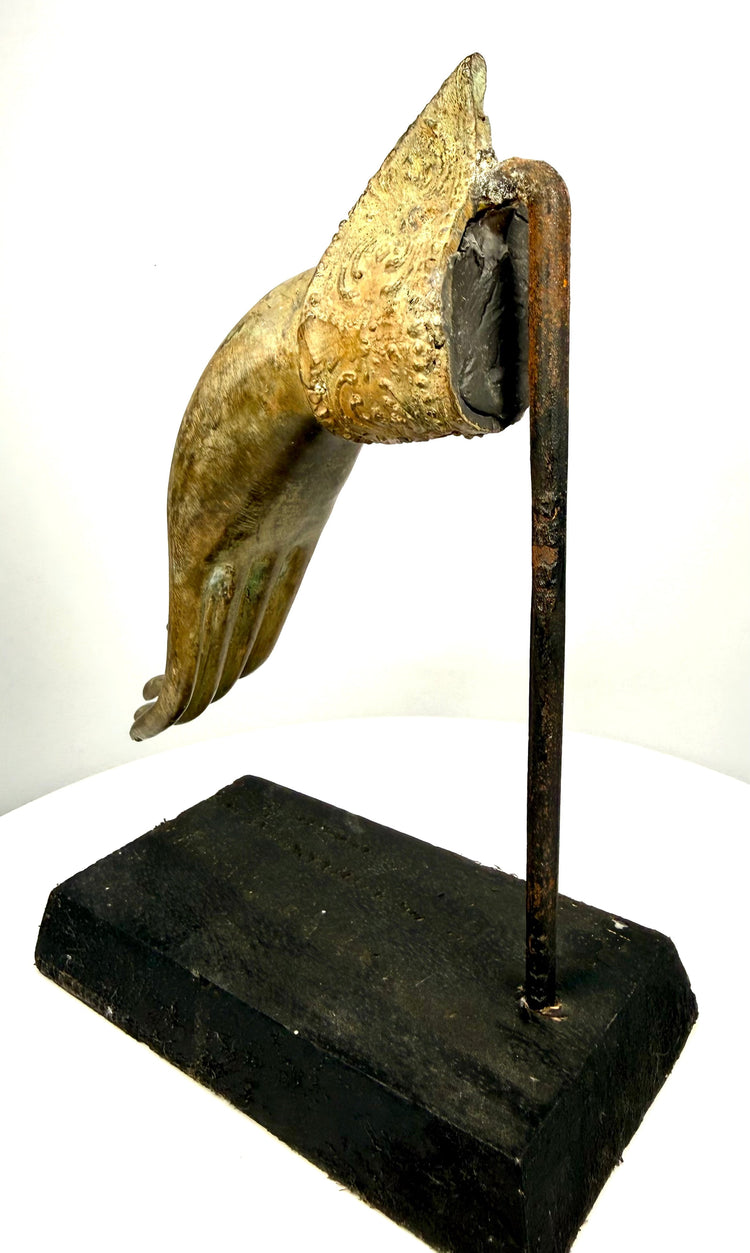


Thai Gilt Bronze Buddha Hand Sculpture | Vitarka Mudra | Rattanakosin Period | Circa 19th Century
Descripción
Más
Menos
Historical Context & Origin
Region: Thailand, Southeast Asia
Material: Cast Bronze or Copper Alloy with a Gold-Toned Surface and Natural Patination
Period: 19th Century, circa 1800–1900
Description
This impressive antique Thai bronze Buddhist hand sculpture displays the graceful proportions, symbolic gesture, and elaborate ornamental detailing associated with Southeast Asian religious metalwork. Dating to the 19th century, the sculptural fragment represents the hand of a Buddha or Buddhist devotional figure, preserved independently from a larger religious image.
The hand is beautifully modelled with an elegantly curved wrist, elongated fingers, and a distinctive configuration in which the thumb and forefinger approach one another to form a circular opening. This gesture is associated with the Vitarka Mudra, the Buddhist gesture of teaching, discussion, and the transmission of spiritual knowledge. The remaining fingers extend outward in a graceful arrangement, giving the sculpture a remarkable sense of movement and refinement.
One of the most distinctive features is the raised floral rosette positioned centrally on the palm. This carefully modelled emblem resembles a stylized lotus blossom, a motif closely associated with purity, enlightenment, and spiritual awakening in Buddhist art. Such auspicious markings also recall the symbolic wheel or Dharmachakra, representing the teachings of the Buddha.
Particularly striking is the elaborate ornamental cuff surrounding the wrist. Unlike simpler Buddhist hand fragments, this example features a pronounced, pointed sleeve-like extension decorated with raised scrolling foliage, floral patterns, and beaded borders. The richly textured decoration contrasts beautifully with the comparatively smooth modelling of the hand, illustrating the sculptor's attention to both symbolic detail and decorative craftsmanship.
The bronze retains a warm golden appearance, complemented by areas of greenish oxidation, darker patination, and irregular surface wear. These variations create an attractive contrast across the hand, particularly around the fingers, raised palm decoration, and heavily ornamented cuff.
The wrist terminates in an open section, consistent with a separately cast component or fragment from a larger sculptural composition. This type of construction was employed in the production of substantial Buddhist images, where individual elements could be cast and subsequently assembled.
The sculpture is presented on a black rectangular display base with an upright metal support, allowing its flowing form, finely decorated cuff, and symbolic gesture to be appreciated from multiple angles.
Features
- Antique Thai bronze Buddhist hand sculpture dating to the 19th century
- Gracefully extended fingers forming a gesture associated with the Vitarka Mudra
- Raised floral rosette prominently positioned in the centre of the palm
- Symbolic decoration associated with Buddhist teachings and enlightenment
- Elaborately ornamented wrist cuff with scrolling floral relief decoration
- Distinctive pointed extension rising above the decorated cuff
- Delicate beaded borders separating the ornamented wrist from the smooth hand
- Warm golden surface with areas of green and dark brown patination
- Naturalistic hand modelling with individually defined fingers and gently curved contours
- Open wrist section reflecting its fragmentary or separately cast construction
- Presented on a modern black rectangular display base with an upright metal support
Cultural Significance
The representation of the Buddha's hands occupies an important position in Buddhist religious art. Hand gestures, known as mudras, communicate specific teachings, spiritual qualities, and significant episodes in the Buddha's life. These gestures allow the viewer to recognize the symbolic meaning of a sculpture even when other identifying characteristics are absent.
The Vitarka Mudra is traditionally associated with the communication of Buddhist doctrine and the intellectual transmission of wisdom. The circular configuration formed by the thumb and forefinger is commonly interpreted as an expression of the continuous nature of teaching and the perfection of spiritual understanding.
In Thailand, Buddhist sculptural traditions developed over many centuries, drawing upon earlier Indian, Mon-Dvaravati, Sukhothai, and Ayutthaya artistic influences. During the Rattanakosin period, beginning with the establishment of Bangkok as the royal capital in 1782, artisans continued these established traditions while producing increasingly elaborate religious imagery for temples, monasteries, and devotional settings.
Gilded bronze became an important medium for the representation of Buddhist figures. Gold symbolized spiritual radiance and was used to emphasize the sacred nature of devotional images. Decorative elements such as stylized lotus blossoms, floral scrollwork, and ornamental garments further enhanced the religious and aesthetic significance of these sculptures.
The raised floral emblem visible on this hand is particularly noteworthy. The lotus is one of Buddhism's most enduring symbols, representing purity arising from an imperfect world. Circular floral and wheel-like emblems also appear on the palms and soles of Buddha images as auspicious signs associated with spiritual attainment.
The elaborate wrist decoration reflects an artistic tradition that placed considerable emphasis on ceremonial ornamentation. Such decorative treatment is found in Thai Buddhist imagery, including representations of richly adorned or royal-form Buddhist figures.
Although its original sculptural context is no longer preserved, the surviving hand retains much of the symbolic language associated with Buddhist devotional art. As an independent sculptural fragment, it provides an opportunity to appreciate the detailed craftsmanship, aesthetic principles, and religious symbolism characteristic of historical Southeast Asian bronze casting.
Condition
Good antique condition, displaying visible surface characteristics consistent with an aged bronze sculptural fragment.
The hand retains its principal sculptural features, including the elongated fingers, raised floral emblem, and substantial portions of the elaborate wrist ornamentation.
The surface exhibits areas of rubbing, scratches, small abrasions, irregular discoloration, and localized greenish oxidation. The golden surface varies considerably in appearance, with darker patches and areas of exposed bronze-toned metal contributing to its aged character.
The raised floral and scroll decoration surrounding the wrist shows localized softening, surface irregularities, and areas of wear. The open wrist section exhibits an irregular edge and visible interior material associated with the object's fragmentary construction and present mounting.
Dimensions (Approximate)
Hand Sculpture:
Length: 7 in (wrist to longest fingertip)
Width: 3 in
Overall Height (Including Stand): 8 in
Display Base:
Width: 5 in
Depth: 3 in
Age (Approximate)
125–225 years old
Provenance
Formerly part of an extensive private collection in Toronto, Ontario, Canada.
The previous owner enjoyed a distinguished 35-year career working for the United States government, during which they lived in various countries around the world. Over several decades, they assembled an extensive personal collection of antiques, artifacts, and culturally significant objects, reflecting a longstanding appreciation for world history, international cultures, and traditional artistic craftsmanship.
Learn More
Discover the traditional Buddhist teaching gesture, known as Vitarka Mudra, through a historic Thai bronze Buddha sculpture at The Cleveland Museum of Art
Browse our collection of Buddhist & Hindu Relics and Sacred Statues
Descripción
Historical Context & Origin
Region: Thailand, Southeast Asia
Material: Cast Bronze or Copper Alloy with a Gold-Toned Surface and Natural Patination
Period: 19th Century, circa 1800–1900
Description
This impressive antique Thai bronze Buddhist hand sculpture displays the graceful proportions, symbolic gesture, and elaborate ornamental detailing associated with Southeast Asian religious metalwork. Dating to the 19th century, the sculptural fragment represents the hand of a Buddha or Buddhist devotional figure, preserved independently from a larger religious image.
The hand is beautifully modelled with an elegantly curved wrist, elongated fingers, and a distinctive configuration in which the thumb and forefinger approach one another to form a circular opening. This gesture is associated with the Vitarka Mudra, the Buddhist gesture of teaching, discussion, and the transmission of spiritual knowledge. The remaining fingers extend outward in a graceful arrangement, giving the sculpture a remarkable sense of movement and refinement.
One of the most distinctive features is the raised floral rosette positioned centrally on the palm. This carefully modelled emblem resembles a stylized lotus blossom, a motif closely associated with purity, enlightenment, and spiritual awakening in Buddhist art. Such auspicious markings also recall the symbolic wheel or Dharmachakra, representing the teachings of the Buddha.
Particularly striking is the elaborate ornamental cuff surrounding the wrist. Unlike simpler Buddhist hand fragments, this example features a pronounced, pointed sleeve-like extension decorated with raised scrolling foliage, floral patterns, and beaded borders. The richly textured decoration contrasts beautifully with the comparatively smooth modelling of the hand, illustrating the sculptor's attention to both symbolic detail and decorative craftsmanship.
The bronze retains a warm golden appearance, complemented by areas of greenish oxidation, darker patination, and irregular surface wear. These variations create an attractive contrast across the hand, particularly around the fingers, raised palm decoration, and heavily ornamented cuff.
The wrist terminates in an open section, consistent with a separately cast component or fragment from a larger sculptural composition. This type of construction was employed in the production of substantial Buddhist images, where individual elements could be cast and subsequently assembled.
The sculpture is presented on a black rectangular display base with an upright metal support, allowing its flowing form, finely decorated cuff, and symbolic gesture to be appreciated from multiple angles.
Features
- Antique Thai bronze Buddhist hand sculpture dating to the 19th century
- Gracefully extended fingers forming a gesture associated with the Vitarka Mudra
- Raised floral rosette prominently positioned in the centre of the palm
- Symbolic decoration associated with Buddhist teachings and enlightenment
- Elaborately ornamented wrist cuff with scrolling floral relief decoration
- Distinctive pointed extension rising above the decorated cuff
- Delicate beaded borders separating the ornamented wrist from the smooth hand
- Warm golden surface with areas of green and dark brown patination
- Naturalistic hand modelling with individually defined fingers and gently curved contours
- Open wrist section reflecting its fragmentary or separately cast construction
- Presented on a modern black rectangular display base with an upright metal support
Cultural Significance
The representation of the Buddha's hands occupies an important position in Buddhist religious art. Hand gestures, known as mudras, communicate specific teachings, spiritual qualities, and significant episodes in the Buddha's life. These gestures allow the viewer to recognize the symbolic meaning of a sculpture even when other identifying characteristics are absent.
The Vitarka Mudra is traditionally associated with the communication of Buddhist doctrine and the intellectual transmission of wisdom. The circular configuration formed by the thumb and forefinger is commonly interpreted as an expression of the continuous nature of teaching and the perfection of spiritual understanding.
In Thailand, Buddhist sculptural traditions developed over many centuries, drawing upon earlier Indian, Mon-Dvaravati, Sukhothai, and Ayutthaya artistic influences. During the Rattanakosin period, beginning with the establishment of Bangkok as the royal capital in 1782, artisans continued these established traditions while producing increasingly elaborate religious imagery for temples, monasteries, and devotional settings.
Gilded bronze became an important medium for the representation of Buddhist figures. Gold symbolized spiritual radiance and was used to emphasize the sacred nature of devotional images. Decorative elements such as stylized lotus blossoms, floral scrollwork, and ornamental garments further enhanced the religious and aesthetic significance of these sculptures.
The raised floral emblem visible on this hand is particularly noteworthy. The lotus is one of Buddhism's most enduring symbols, representing purity arising from an imperfect world. Circular floral and wheel-like emblems also appear on the palms and soles of Buddha images as auspicious signs associated with spiritual attainment.
The elaborate wrist decoration reflects an artistic tradition that placed considerable emphasis on ceremonial ornamentation. Such decorative treatment is found in Thai Buddhist imagery, including representations of richly adorned or royal-form Buddhist figures.
Although its original sculptural context is no longer preserved, the surviving hand retains much of the symbolic language associated with Buddhist devotional art. As an independent sculptural fragment, it provides an opportunity to appreciate the detailed craftsmanship, aesthetic principles, and religious symbolism characteristic of historical Southeast Asian bronze casting.
Condition
Good antique condition, displaying visible surface characteristics consistent with an aged bronze sculptural fragment.
The hand retains its principal sculptural features, including the elongated fingers, raised floral emblem, and substantial portions of the elaborate wrist ornamentation.
The surface exhibits areas of rubbing, scratches, small abrasions, irregular discoloration, and localized greenish oxidation. The golden surface varies considerably in appearance, with darker patches and areas of exposed bronze-toned metal contributing to its aged character.
The raised floral and scroll decoration surrounding the wrist shows localized softening, surface irregularities, and areas of wear. The open wrist section exhibits an irregular edge and visible interior material associated with the object's fragmentary construction and present mounting.
Dimensions (Approximate)
Hand Sculpture:
Length: 7 in (wrist to longest fingertip)
Width: 3 in
Overall Height (Including Stand): 8 in
Display Base:
Width: 5 in
Depth: 3 in
Age (Approximate)
125–225 years old
Provenance
Formerly part of an extensive private collection in Toronto, Ontario, Canada.
The previous owner enjoyed a distinguished 35-year career working for the United States government, during which they lived in various countries around the world. Over several decades, they assembled an extensive personal collection of antiques, artifacts, and culturally significant objects, reflecting a longstanding appreciation for world history, international cultures, and traditional artistic craftsmanship.
Learn More
Discover the traditional Buddhist teaching gesture, known as Vitarka Mudra, through a historic Thai bronze Buddha sculpture at The Cleveland Museum of Art
Browse our collection of Buddhist & Hindu Relics and Sacred Statues
También te puede interesar
