



Thai Bronze Buddha Head | Rattanakosin Period, Sukhothai Style | Circa 1800–1900 CE
- Precio habitual
- $1,500.00
- Precio de venta
- $1,500.00
- Precio habitual
No se pudo cargar la disponibilidad de retiro


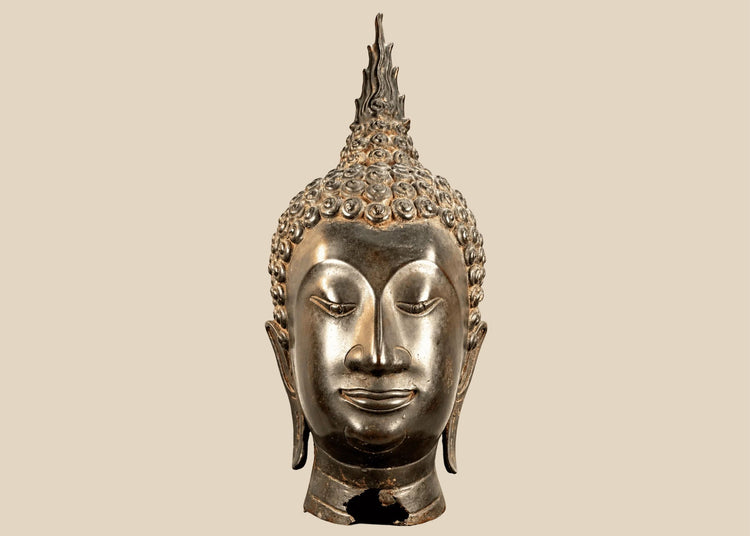
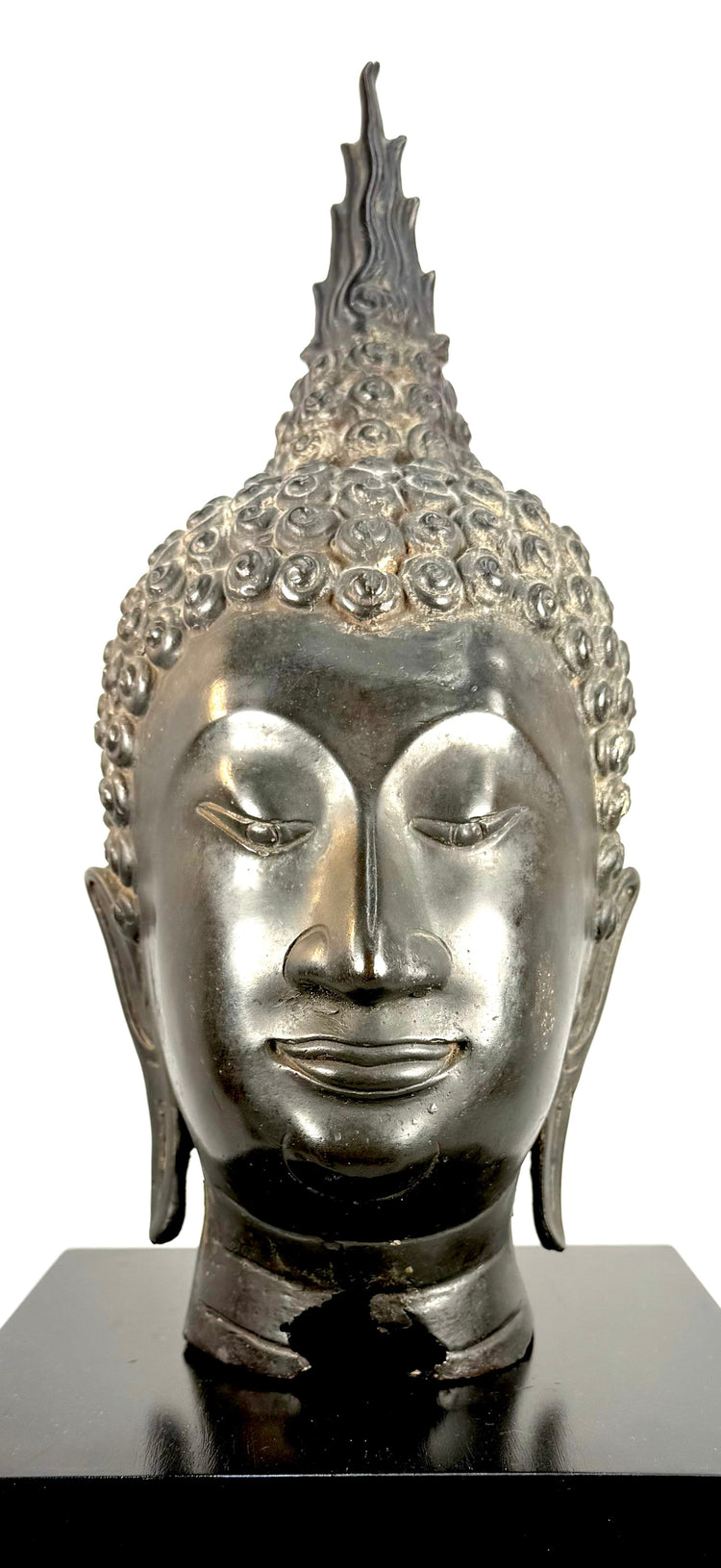
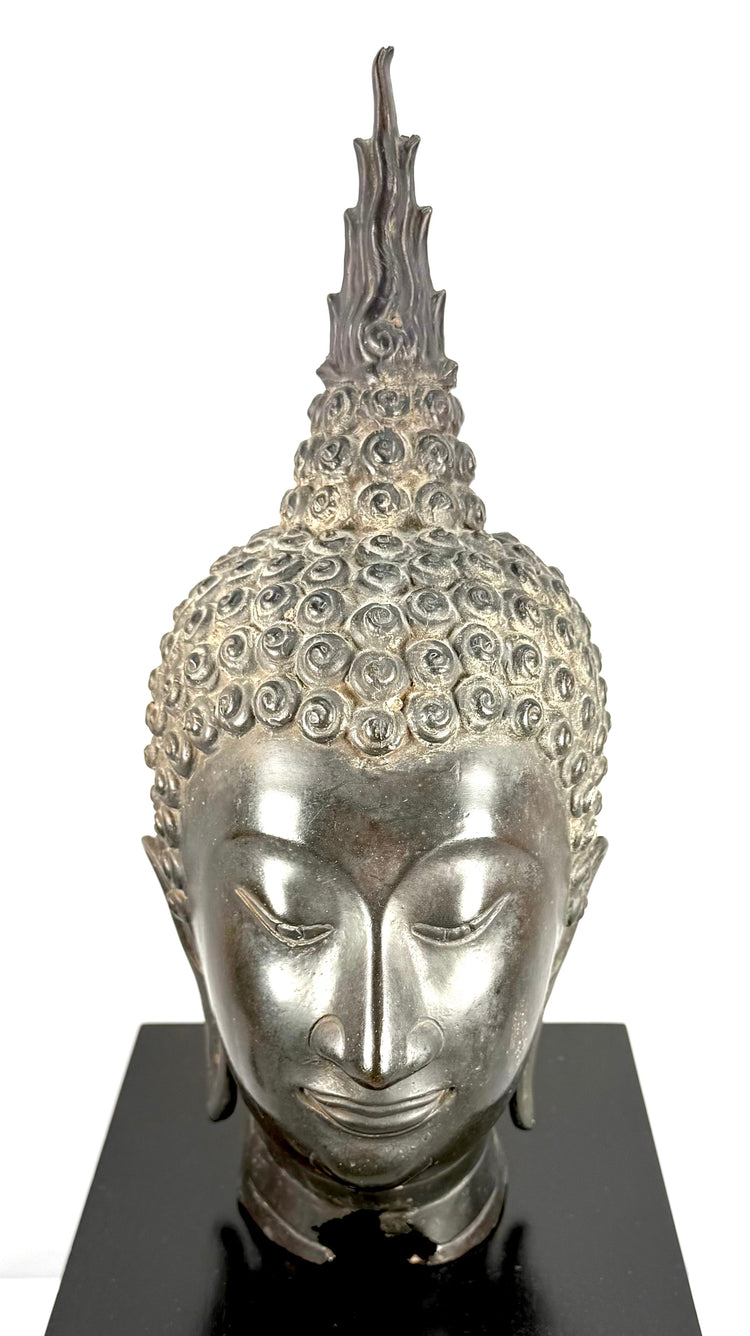
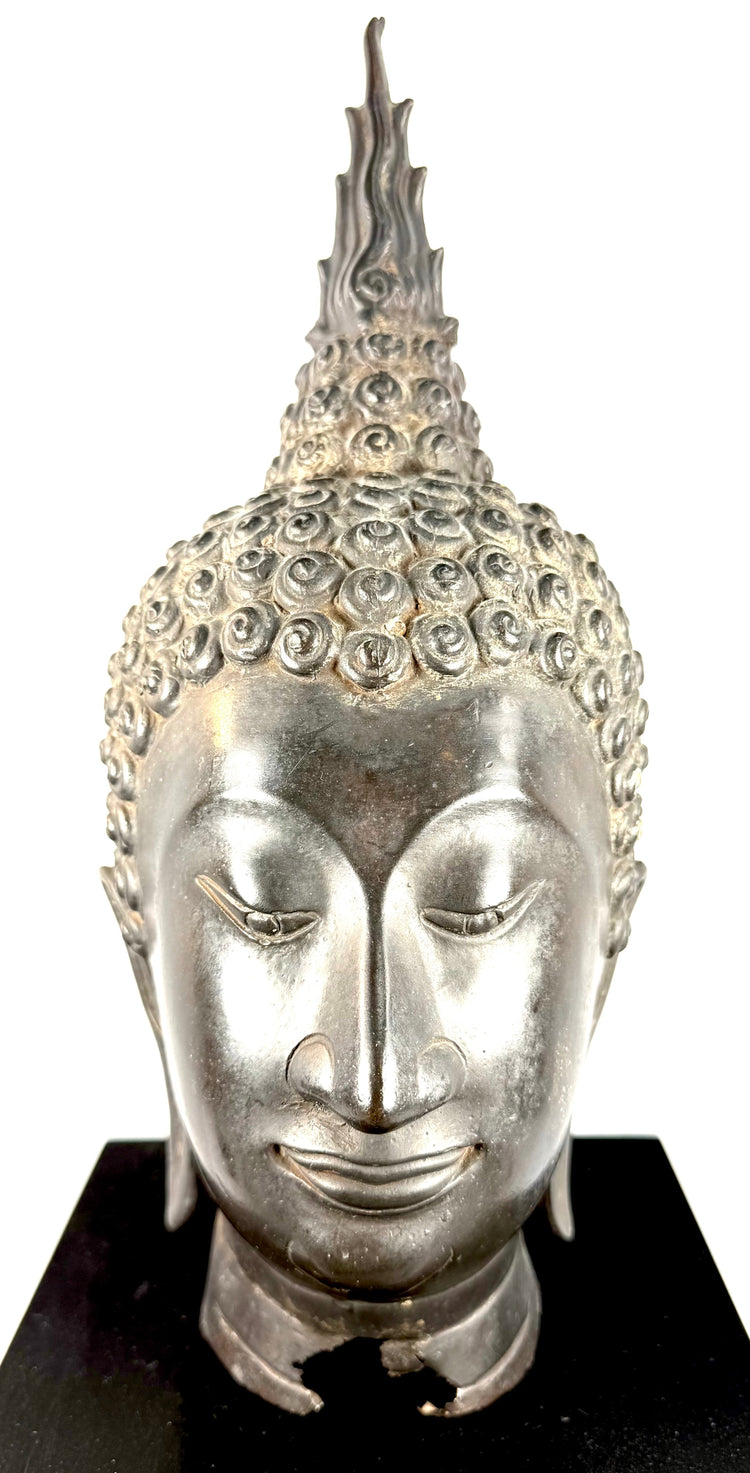
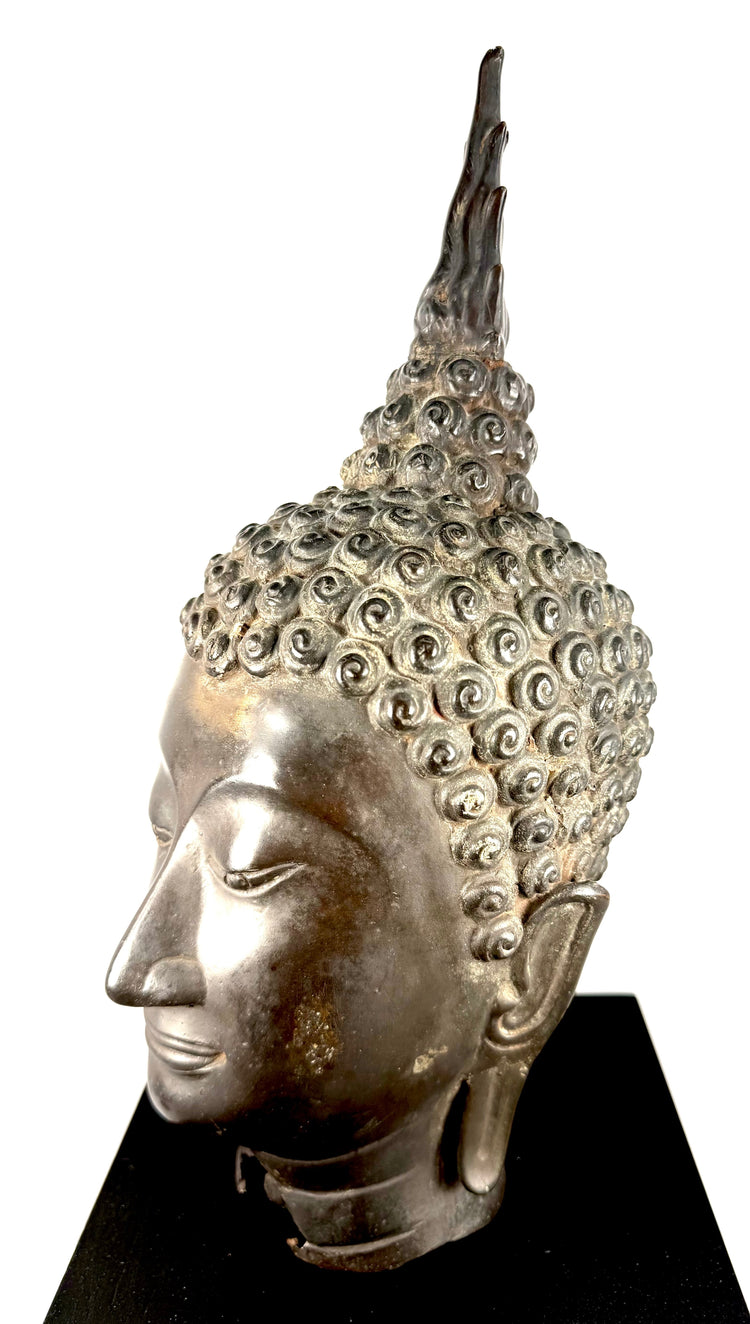
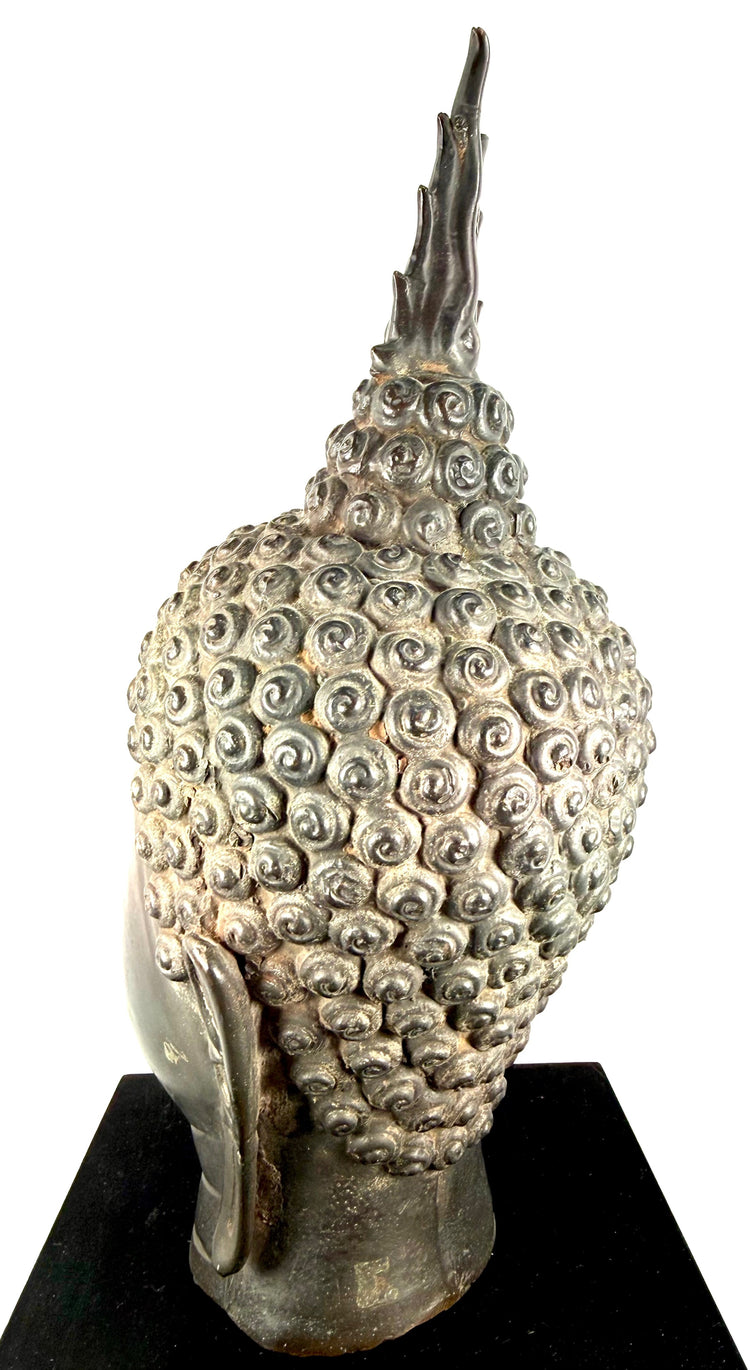
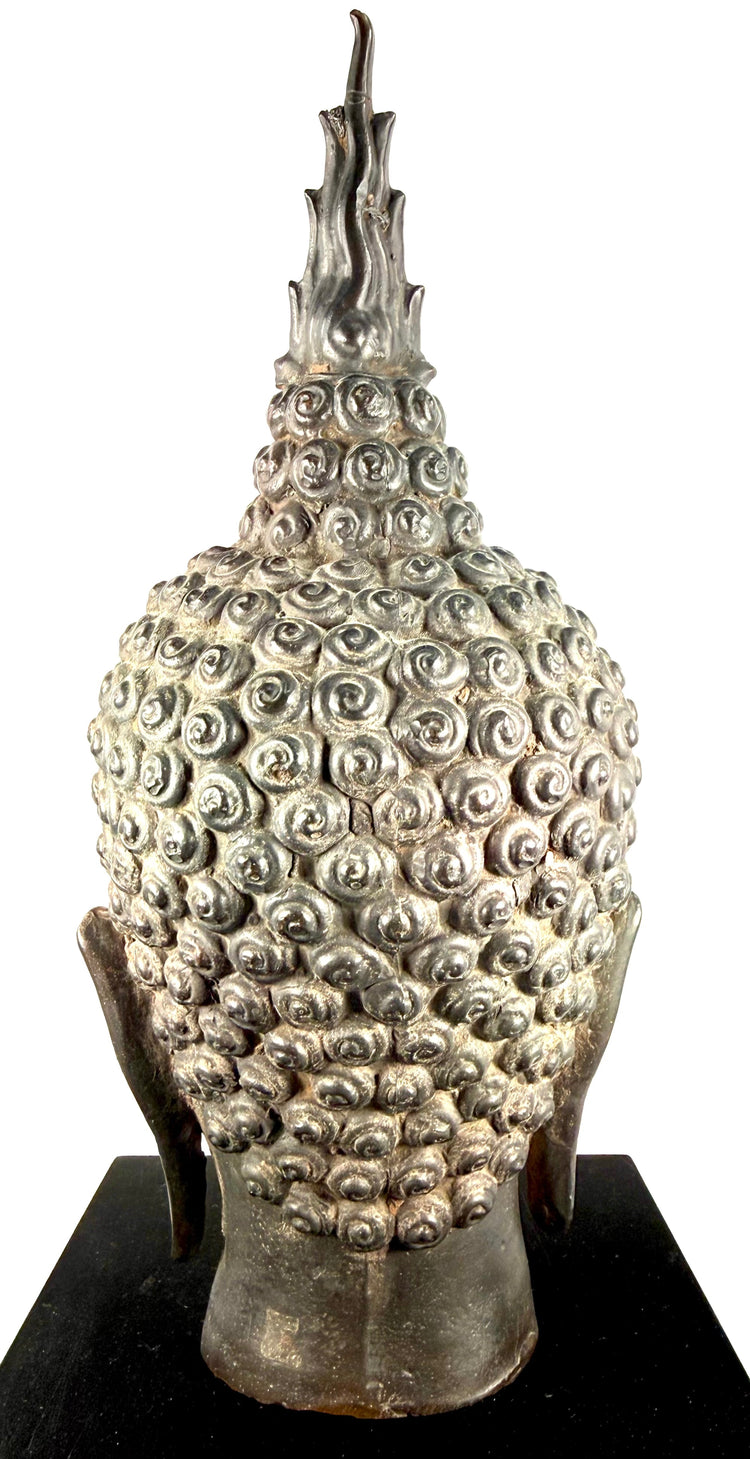
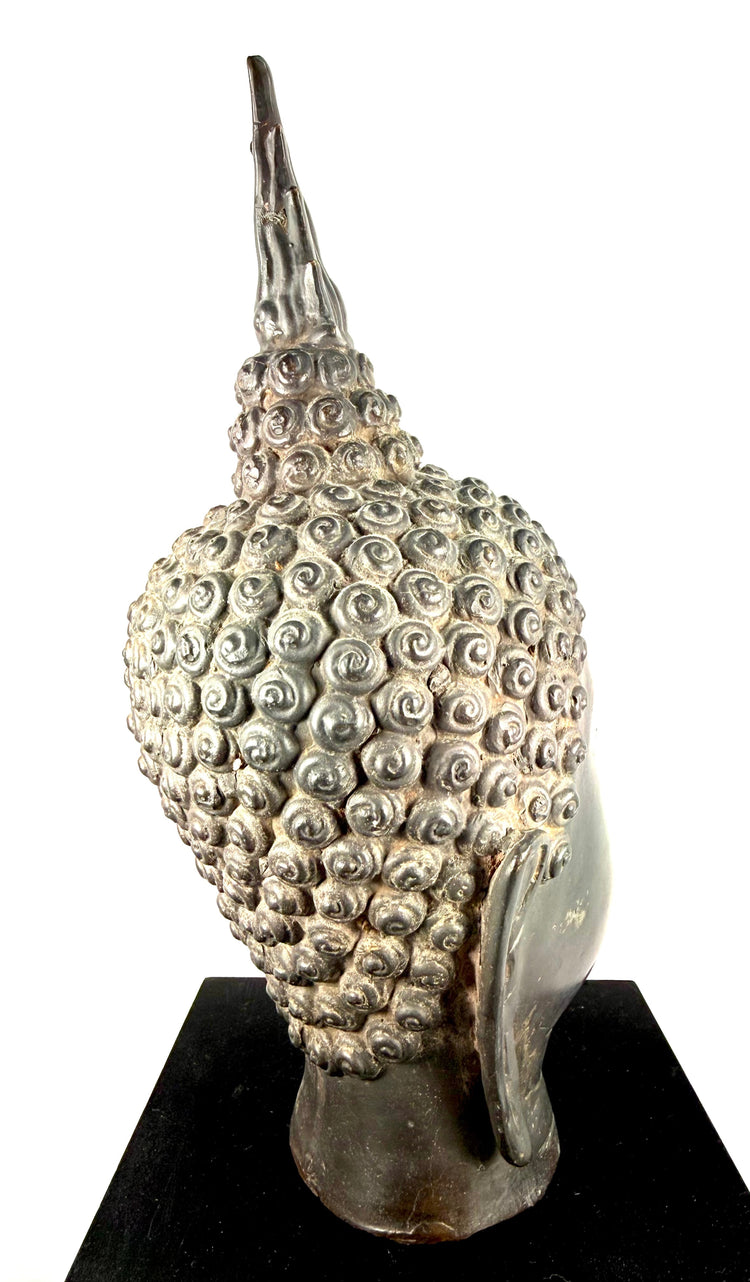
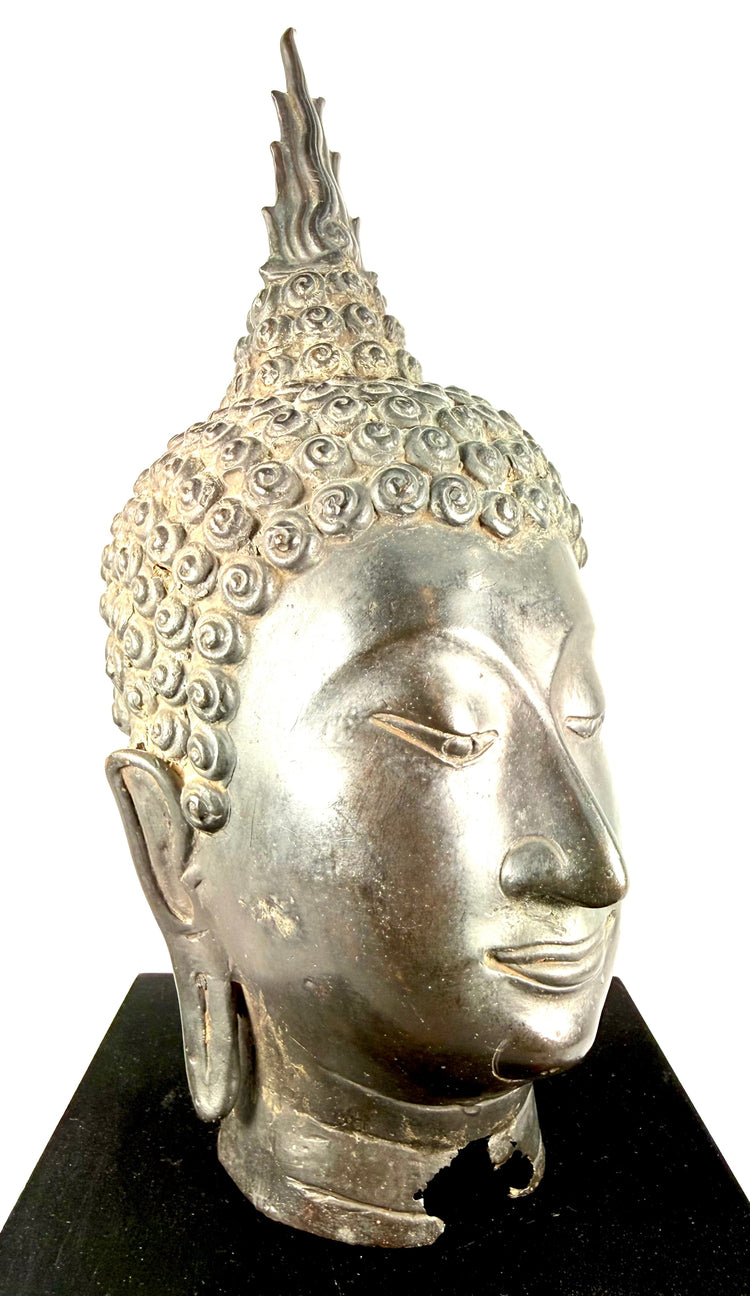
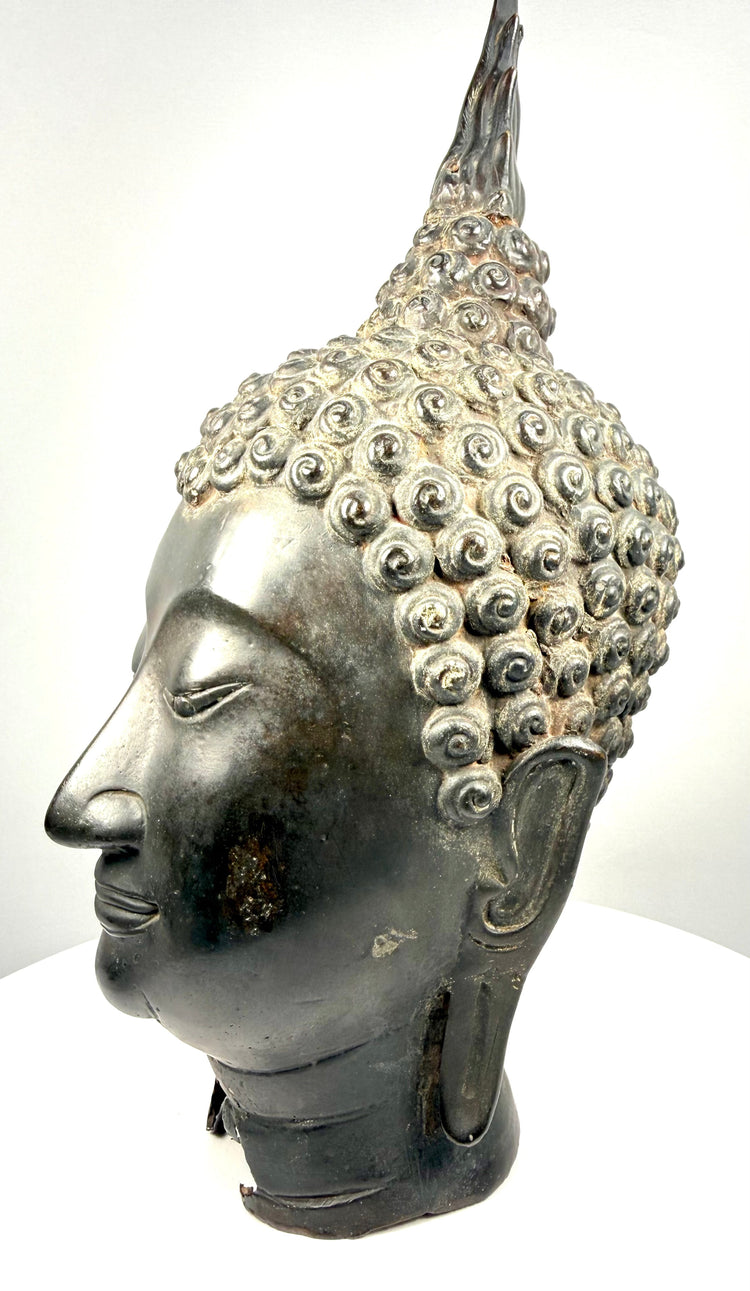
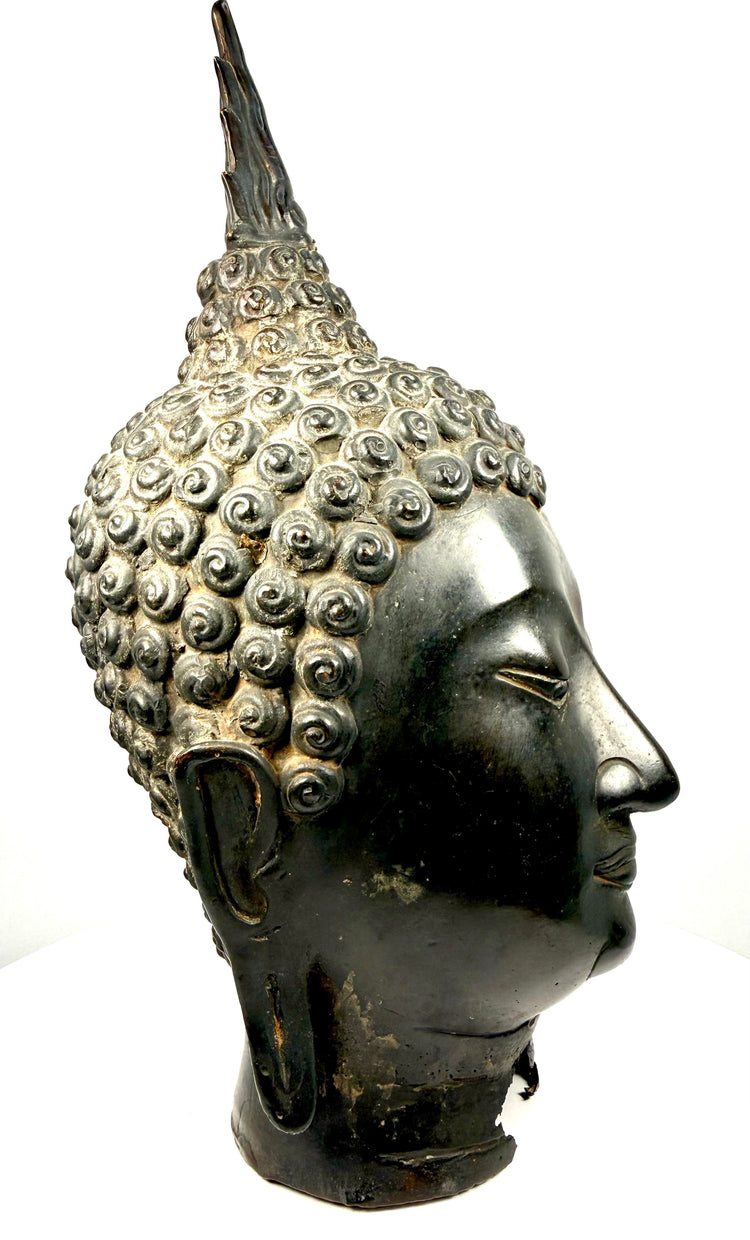
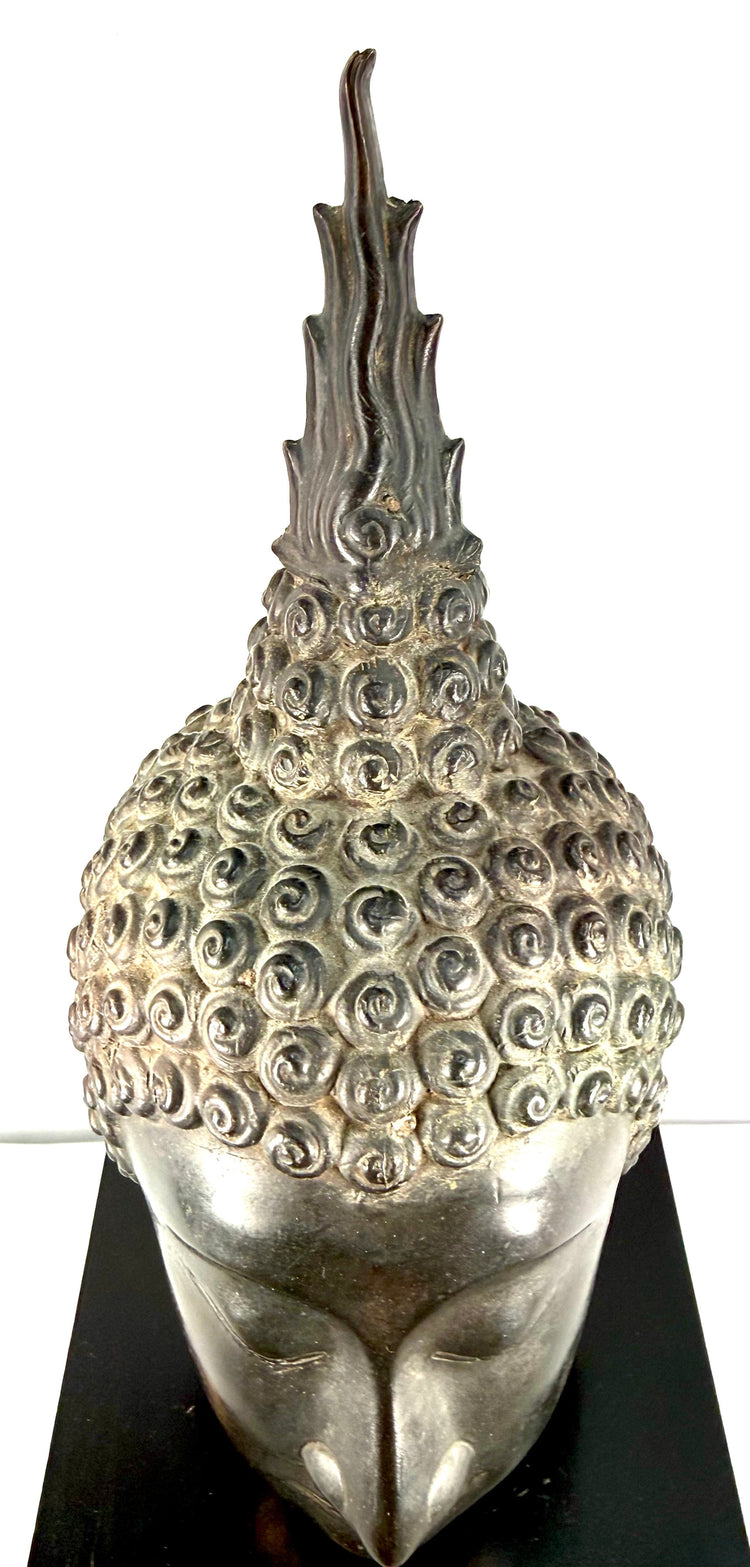
Thai Bronze Buddha Head | Rattanakosin Period, Sukhothai Style | Circa 1800–1900 CE
Descripción
Más
Menos
Historical Context & Origin
Region: Southeast Asia, likely Thailand
Material: Cast copper-alloy metal, probably bronze, with dark metallic patination and areas of polished surface
Period: Attributed to the 19th century, circa 1800–1900 CE, Rattanakosin Period, Thailand, in the traditional Sukhothai style
Description
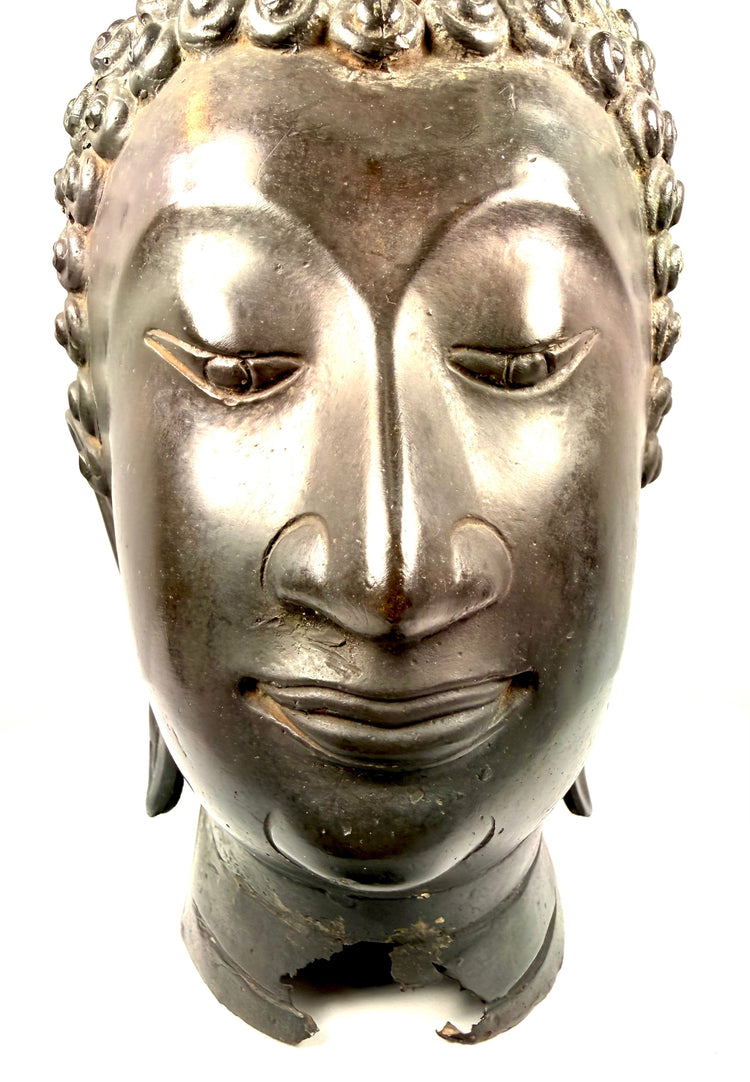
An impressive large-scale cast metal head of the Buddha, standing approximately 18 inches tall and displaying the distinctive artistic characteristics associated with the Sukhothai tradition of Thailand. The sculpture presents an exceptionally serene facial expression, with gracefully arched eyebrows, elongated downcast eyes, a prominent sculpted nose, softly modelled cheeks, and full lips forming a gentle, contemplative smile.
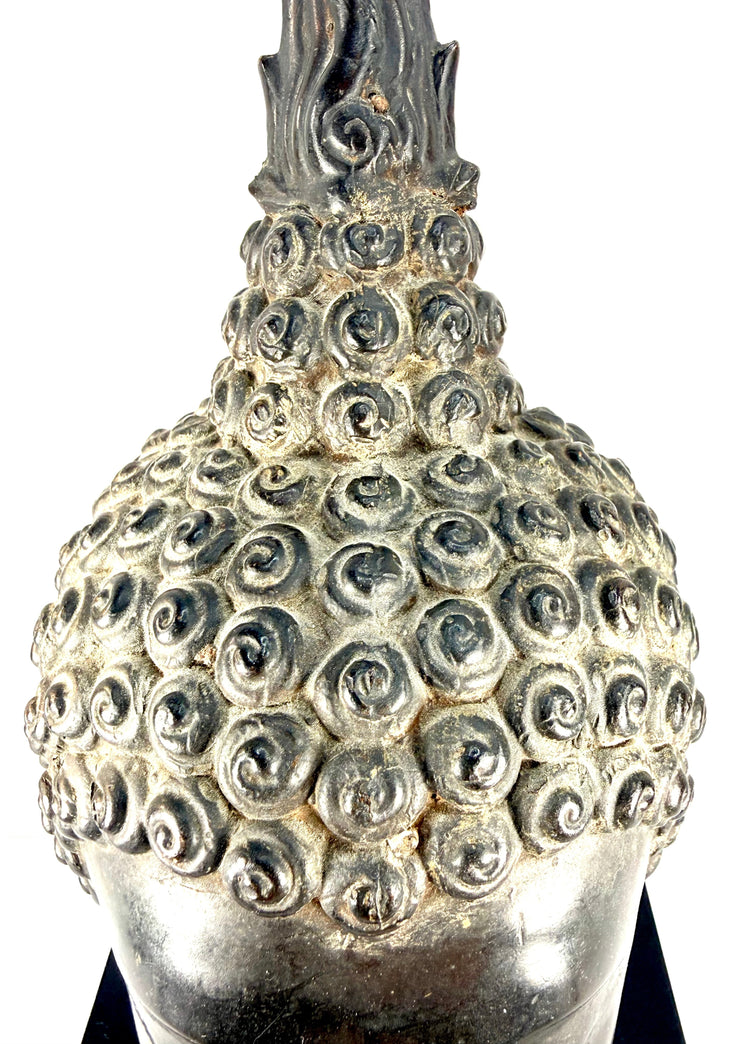
The Buddha's head is covered with numerous individually defined spiral curls, arranged in closely spaced rows that extend upward into a pronounced cranial protuberance known as the ushnisha. Rising dramatically above this is a tall, flame-shaped finial, rendered with flowing vertical ridges and irregular upward-reaching points. This distinctive feature is one of the most recognizable elements of classical Thai Buddhist sculpture, traditionally representing the spiritual wisdom and enlightenment of the Buddha.
The elongated earlobes extend downward on either side of the face, retaining their gracefully modelled form and contributing to the sculpture's balanced, symmetrical appearance. The slightly lowered eyelids and restrained smile create an expression of profound tranquillity, intended to communicate meditation, compassion, and freedom from worldly attachment.
The sculpture possesses a dark grey to brown metallic surface with areas of considerable lustre, particularly across the forehead, cheeks, nose, and lips. The raised spiral curls retain contrasting darker deposits and lighter highlights, emphasizing the careful modelling of the hair and the dimensional quality of the casting.
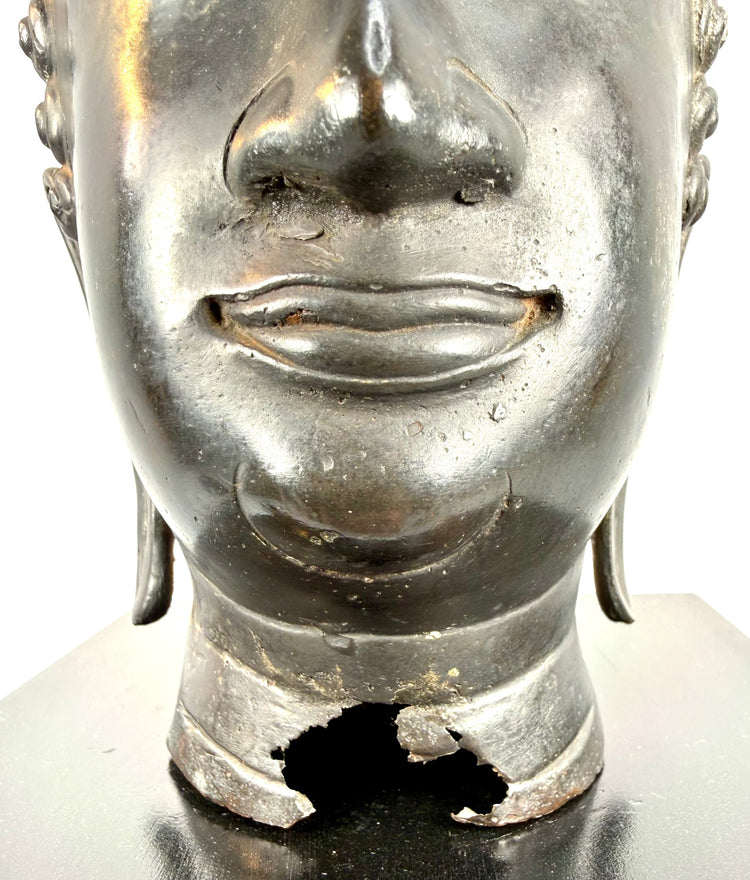
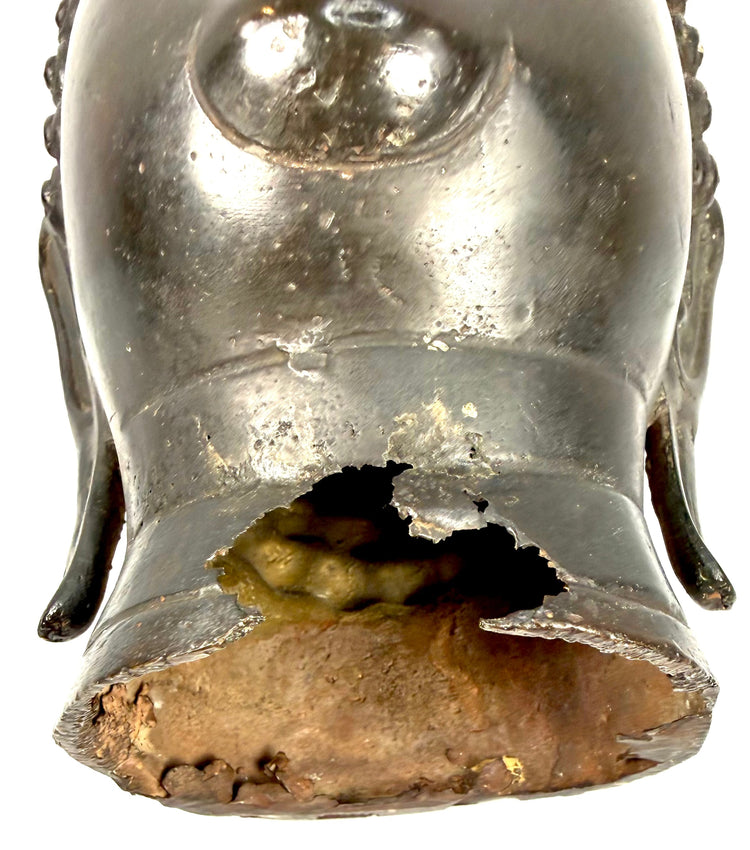
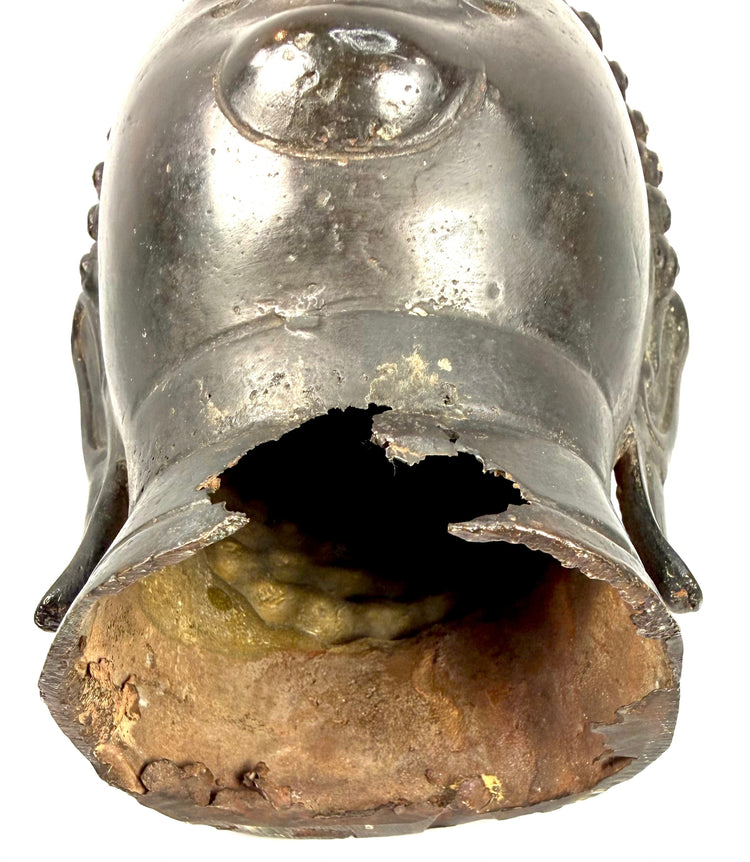
The head terminates in a substantial cylindrical neck section with a defined lower rim. A large irregular opening is present at the front of the neck, exposing the interior and remnants of earthen material that may relate to the casting process or subsequent filling. The construction and neck configuration are compatible with traditions in which sculptural heads were cast separately and attached to larger Buddha figures, although the original configuration of this particular example has not been established.
Features
- Gracefully elongated face with softly rounded cheeks and symmetrical proportions.
- Distinctive arched eyebrows flowing toward the prominent central nose.
- Heavily lidded, downcast eyes conveying a peaceful meditative expression.
- Full, gently smiling lips with finely defined upper and lower contours.
- Numerous individually modelled spiral curls covering the head and cranial protuberance.
- Tall, elaborately sculpted flame-shaped ushnisha finial with flowing vertical ridges.
- Extended earlobes characteristic of traditional Buddhist iconography.
- Dark metallic patination with contrasting polished highlights and surface variations.
Cultural Significance
The Sukhothai period represents one of the most influential chapters in the history of Thai Buddhist sculpture. Flourishing between the 13th and 15th centuries in what is now north-central Thailand, the Sukhothai kingdom became an important centre of Theravada Buddhism and developed an artistic vocabulary that profoundly influenced subsequent generations of Thai sculptors.
Sukhothai artists sought to portray the Buddha not merely as a historical religious teacher, but as the embodiment of spiritual perfection. Sculptural forms emphasized idealized beauty, harmonious proportions, gently flowing contours, and expressions of inward tranquillity. These characteristics distinguished the Sukhothai tradition and established enduring conventions for Buddhist imagery throughout Thailand.
One of the most significant iconographic elements is the ushnisha, the raised cranial protuberance associated with the Buddha's extraordinary spiritual wisdom. In Thai sculpture, this feature frequently culminates in an elongated flame, representing the radiance of enlightened consciousness. The particularly prominent flame finial on this example directly reflects that longstanding artistic tradition.
The tightly arranged spiral curls are another established characteristic of Buddhist imagery. Together with the elongated earlobes, they contribute to the recognizable visual identity of the Buddha. The extended ears recall Siddhartha Gautama's former princely status and his renunciation of worldly wealth in pursuit of spiritual understanding.
The partially closed eyes communicate inward concentration and meditative awareness, while the restrained smile expresses serenity and compassion. Rather than portraying a fleeting human emotion, these features represent the Buddhist ideal of a mind liberated from suffering, attachment, and ignorance.
The influence of Sukhothai sculpture continued well beyond the kingdom's political existence. Its artistic conventions were preserved, adapted, and reproduced during the Ayutthaya and Bangkok periods and remain influential in Thai Buddhist sculpture today. This head reflects that remarkable continuity of religious symbolism and aesthetic tradition.
Condition
The sculpture displays surface wear, scratches, abrasions, areas of discoloration, and variations in patination. The facial features remain clearly defined, including the eyebrows, eyes, nose, lips, and sculpted chin. The spiral curls and tall flame finial retain their principal decorative forms.
There is significant visible material loss at the lower front portion of the neck, including a large irregular opening with jagged edges and adjacent cracking or chipping. The damage exposes reddish-brown interior material and sections of the metal casting. Additional localized surface irregularities and possible historic filling or repair material are visible around the lower neck and underside; these have not been independently assessed.
Areas of the metallic surface appear heavily polished or burnished, producing a brighter finish across portions of the face. Minor pits, scratches, and variations in surface texture are also visible.
Dimensions (Approximate)
Height: 18 in
Width: 7 in
Depth: 7 in
Age (Approximate)
125–225 years old
Provenance
Formerly part of an extensive private collection in Toronto, Ontario, Canada. The previous owner enjoyed a distinguished 35-year career working for the United States government, during which they lived in various countries around the world. Over several decades, they assembled an extensive personal collection of antiques, artifacts, and culturally significant objects, reflecting a longstanding appreciation for world history, international cultures, and traditional artistic craftsmanship.
Learn More
Explore traditional Thai Buddhist sculpture through the Walters Art Museum
Browse Our Collection of Artifacts of Worship, Devotion & Sacred Relics
Descripción
Historical Context & Origin
Region: Southeast Asia, likely Thailand
Material: Cast copper-alloy metal, probably bronze, with dark metallic patination and areas of polished surface
Period: Attributed to the 19th century, circa 1800–1900 CE, Rattanakosin Period, Thailand, in the traditional Sukhothai style
Description
An impressive large-scale cast metal head of the Buddha, standing approximately 18 inches tall and displaying the distinctive artistic characteristics associated with the Sukhothai tradition of Thailand. The sculpture presents an exceptionally serene facial expression, with gracefully arched eyebrows, elongated downcast eyes, a prominent sculpted nose, softly modelled cheeks, and full lips forming a gentle, contemplative smile.
The Buddha's head is covered with numerous individually defined spiral curls, arranged in closely spaced rows that extend upward into a pronounced cranial protuberance known as the ushnisha. Rising dramatically above this is a tall, flame-shaped finial, rendered with flowing vertical ridges and irregular upward-reaching points. This distinctive feature is one of the most recognizable elements of classical Thai Buddhist sculpture, traditionally representing the spiritual wisdom and enlightenment of the Buddha.
The elongated earlobes extend downward on either side of the face, retaining their gracefully modelled form and contributing to the sculpture's balanced, symmetrical appearance. The slightly lowered eyelids and restrained smile create an expression of profound tranquillity, intended to communicate meditation, compassion, and freedom from worldly attachment.
The sculpture possesses a dark grey to brown metallic surface with areas of considerable lustre, particularly across the forehead, cheeks, nose, and lips. The raised spiral curls retain contrasting darker deposits and lighter highlights, emphasizing the careful modelling of the hair and the dimensional quality of the casting.
The head terminates in a substantial cylindrical neck section with a defined lower rim. A large irregular opening is present at the front of the neck, exposing the interior and remnants of earthen material that may relate to the casting process or subsequent filling. The construction and neck configuration are compatible with traditions in which sculptural heads were cast separately and attached to larger Buddha figures, although the original configuration of this particular example has not been established.
Features
- Gracefully elongated face with softly rounded cheeks and symmetrical proportions.
- Distinctive arched eyebrows flowing toward the prominent central nose.
- Heavily lidded, downcast eyes conveying a peaceful meditative expression.
- Full, gently smiling lips with finely defined upper and lower contours.
- Numerous individually modelled spiral curls covering the head and cranial protuberance.
- Tall, elaborately sculpted flame-shaped ushnisha finial with flowing vertical ridges.
- Extended earlobes characteristic of traditional Buddhist iconography.
- Dark metallic patination with contrasting polished highlights and surface variations.
Cultural Significance
The Sukhothai period represents one of the most influential chapters in the history of Thai Buddhist sculpture. Flourishing between the 13th and 15th centuries in what is now north-central Thailand, the Sukhothai kingdom became an important centre of Theravada Buddhism and developed an artistic vocabulary that profoundly influenced subsequent generations of Thai sculptors.
Sukhothai artists sought to portray the Buddha not merely as a historical religious teacher, but as the embodiment of spiritual perfection. Sculptural forms emphasized idealized beauty, harmonious proportions, gently flowing contours, and expressions of inward tranquillity. These characteristics distinguished the Sukhothai tradition and established enduring conventions for Buddhist imagery throughout Thailand.
One of the most significant iconographic elements is the ushnisha, the raised cranial protuberance associated with the Buddha's extraordinary spiritual wisdom. In Thai sculpture, this feature frequently culminates in an elongated flame, representing the radiance of enlightened consciousness. The particularly prominent flame finial on this example directly reflects that longstanding artistic tradition.
The tightly arranged spiral curls are another established characteristic of Buddhist imagery. Together with the elongated earlobes, they contribute to the recognizable visual identity of the Buddha. The extended ears recall Siddhartha Gautama's former princely status and his renunciation of worldly wealth in pursuit of spiritual understanding.
The partially closed eyes communicate inward concentration and meditative awareness, while the restrained smile expresses serenity and compassion. Rather than portraying a fleeting human emotion, these features represent the Buddhist ideal of a mind liberated from suffering, attachment, and ignorance.
The influence of Sukhothai sculpture continued well beyond the kingdom's political existence. Its artistic conventions were preserved, adapted, and reproduced during the Ayutthaya and Bangkok periods and remain influential in Thai Buddhist sculpture today. This head reflects that remarkable continuity of religious symbolism and aesthetic tradition.
Condition
The sculpture displays surface wear, scratches, abrasions, areas of discoloration, and variations in patination. The facial features remain clearly defined, including the eyebrows, eyes, nose, lips, and sculpted chin. The spiral curls and tall flame finial retain their principal decorative forms.
There is significant visible material loss at the lower front portion of the neck, including a large irregular opening with jagged edges and adjacent cracking or chipping. The damage exposes reddish-brown interior material and sections of the metal casting. Additional localized surface irregularities and possible historic filling or repair material are visible around the lower neck and underside; these have not been independently assessed.
Areas of the metallic surface appear heavily polished or burnished, producing a brighter finish across portions of the face. Minor pits, scratches, and variations in surface texture are also visible.
Dimensions (Approximate)
Height: 18 in
Width: 7 in
Depth: 7 in
Age (Approximate)
125–225 years old
Provenance
Formerly part of an extensive private collection in Toronto, Ontario, Canada. The previous owner enjoyed a distinguished 35-year career working for the United States government, during which they lived in various countries around the world. Over several decades, they assembled an extensive personal collection of antiques, artifacts, and culturally significant objects, reflecting a longstanding appreciation for world history, international cultures, and traditional artistic craftsmanship.
Learn More
Explore traditional Thai Buddhist sculpture through the Walters Art Museum
Browse Our Collection of Artifacts of Worship, Devotion & Sacred Relics
También te puede interesar
