



Victorian Brass Field-Type Dissecting Microscope with J.W. Queen & Co. Entomological Slides | Circa 1860–1880
- Precio habitual
- $1,200.00
- Precio de venta
- $1,200.00
- Precio habitual
No se pudo cargar la disponibilidad de retiro




Victorian Brass Field-Type Dissecting Microscope with J.W. Queen & Co. Entomological Slides | Circa 1860–1880
Descripción
Más
Menos
Historical Context & Origin
Region: England / United States
Material: Lacquered Brass, Blackened Metal, Glass, Mahogany, Velvet & Paper
Period: Victorian Era, Circa 1860–1880 CE
The second half of the 19th century witnessed an extraordinary expansion of microscopy as scientific instruments became increasingly accessible to physicians, naturalists, students, collectors, and amateur scientists. Simple dissecting microscopes occupied an important position between handheld magnifiers and more elaborate compound microscopes, allowing specimens to be examined and physically manipulated under low magnification.
This example belongs to the recognizable Field-type tradition of dissecting microscopes, characterized by a vertical brass pillar, adjustable lens arm, open specimen stage, illuminating mirror, and a compact wooden case that could also serve as the instrument's working base. A closely comparable Field-type example preserved by Harvard University is dated circa 1860 and incorporates stackable lenses, rack-and-pinion focusing, a square stage, mirror, tweezers and a fitted mahogany case.
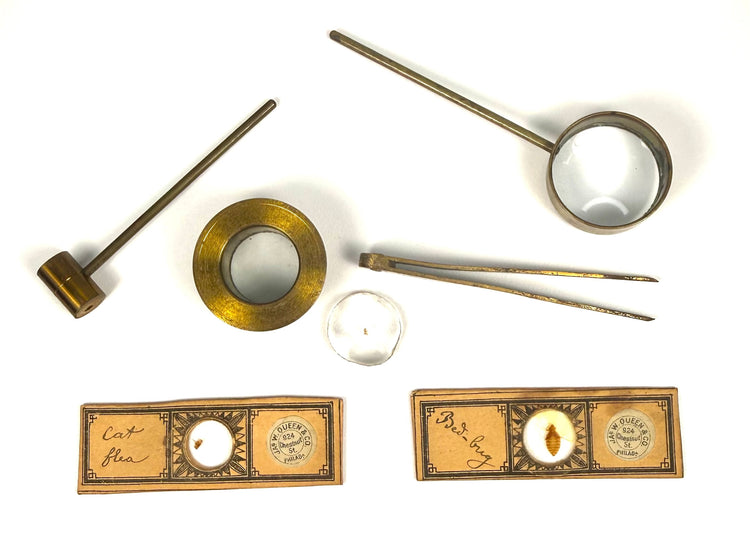
The set is particularly interesting because it retains two Victorian prepared entomological microscope slides retailed by James W. Queen & Co. of Philadelphia, one handwritten “Cat Flea” and the other “Bed Bug.” Queen was one of America's important 19th-century suppliers of microscopes, optical equipment and scientific apparatus, and its catalogues offered microscopes and microscopic specimens to professional and amateur users alike.
Description
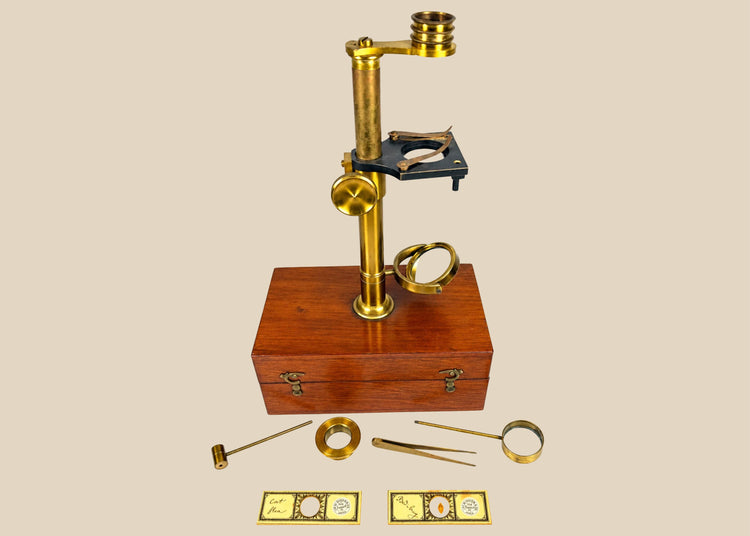
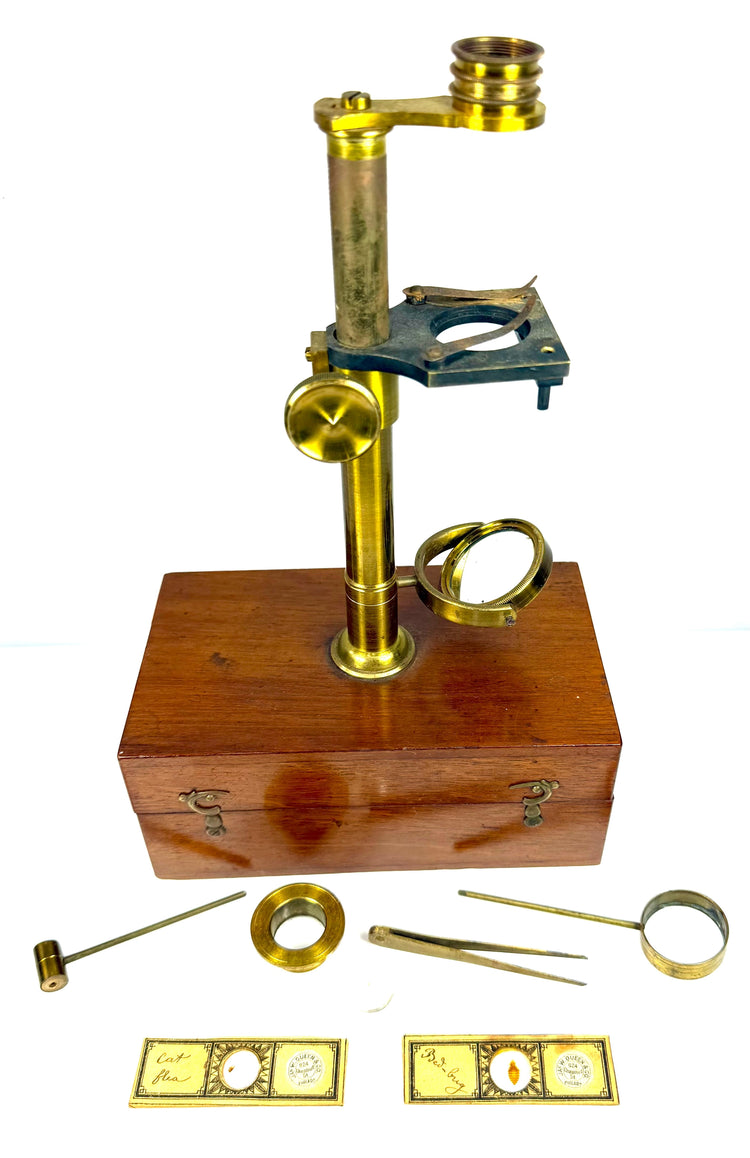
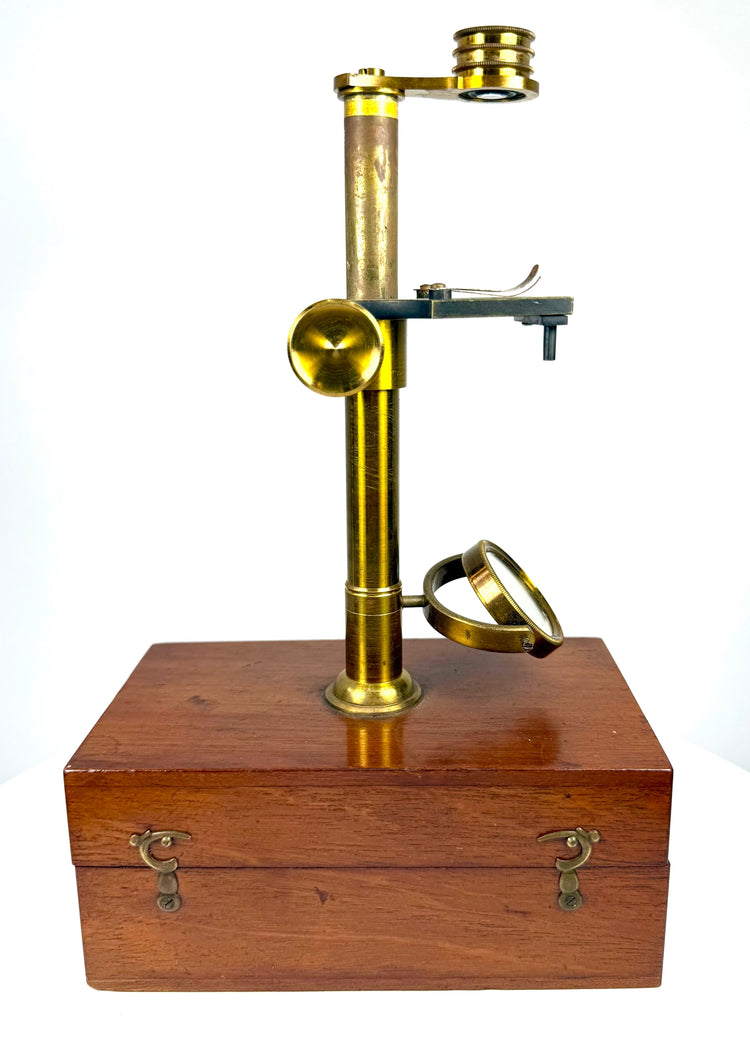
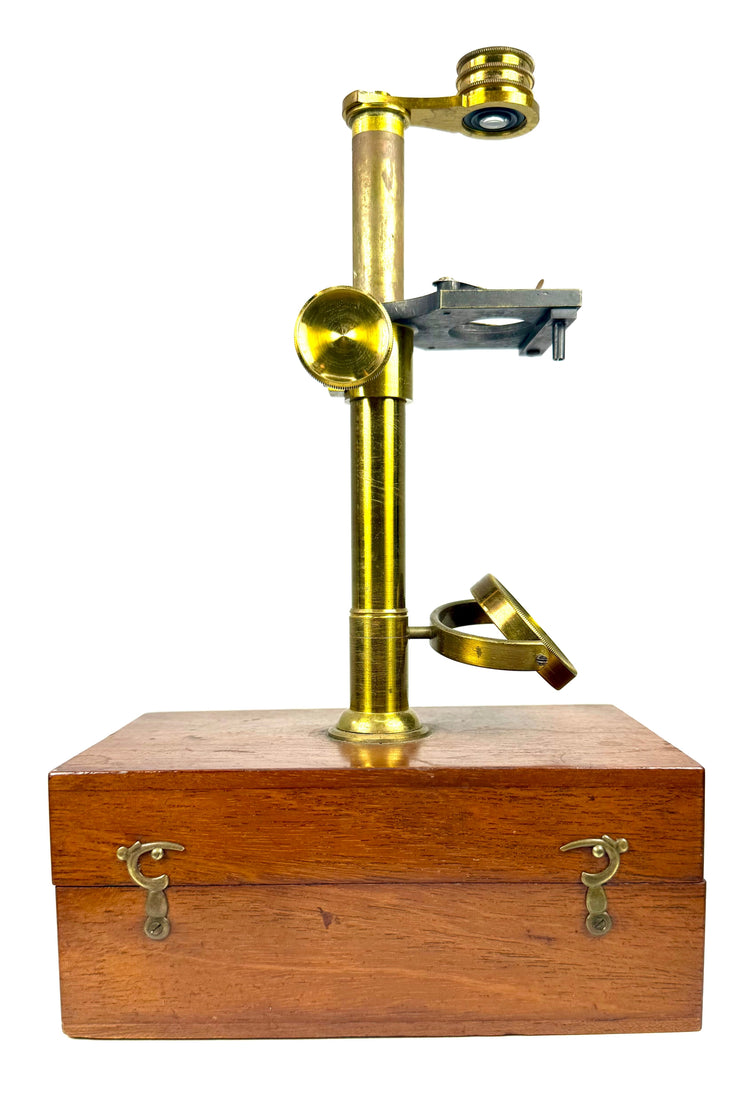
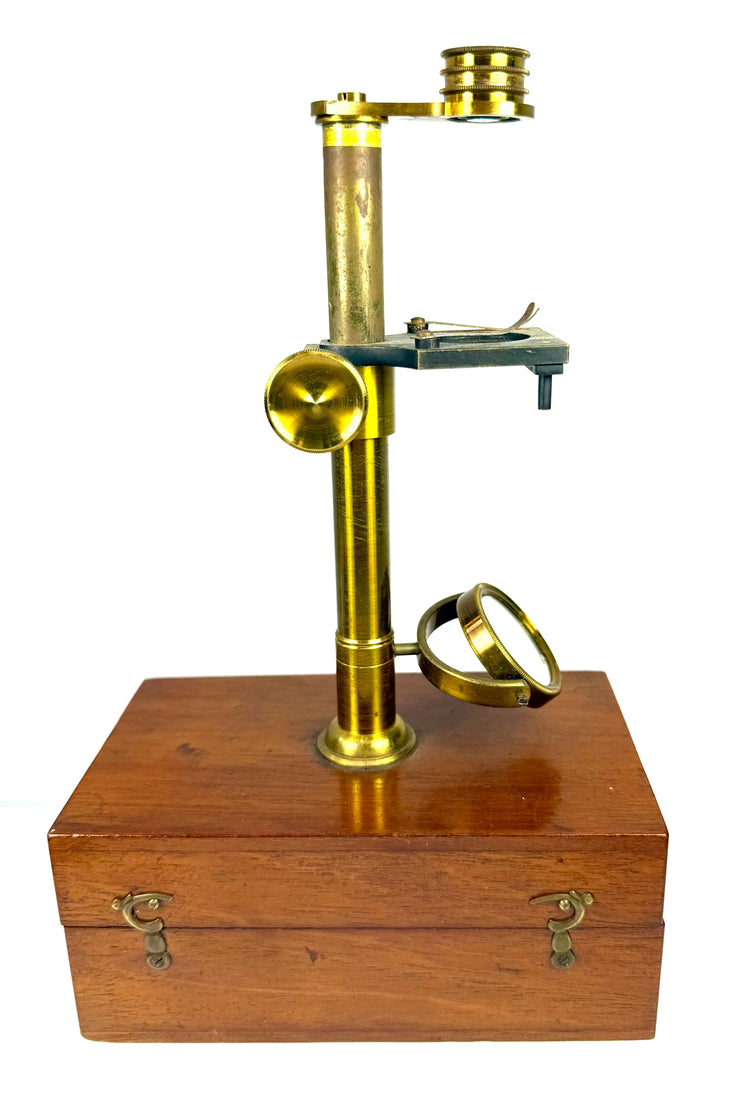
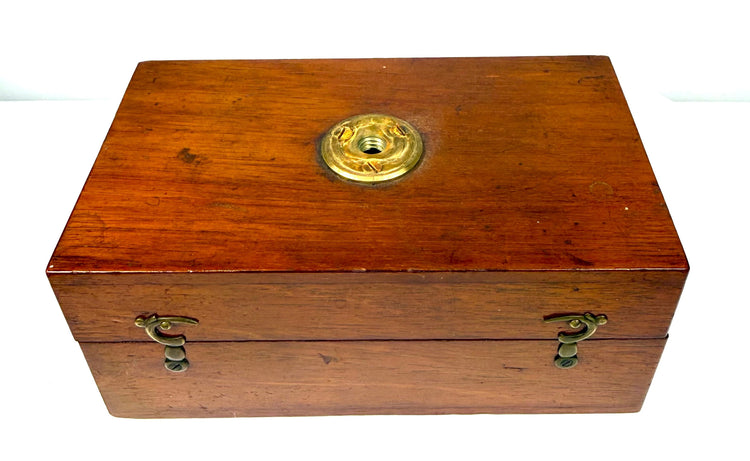
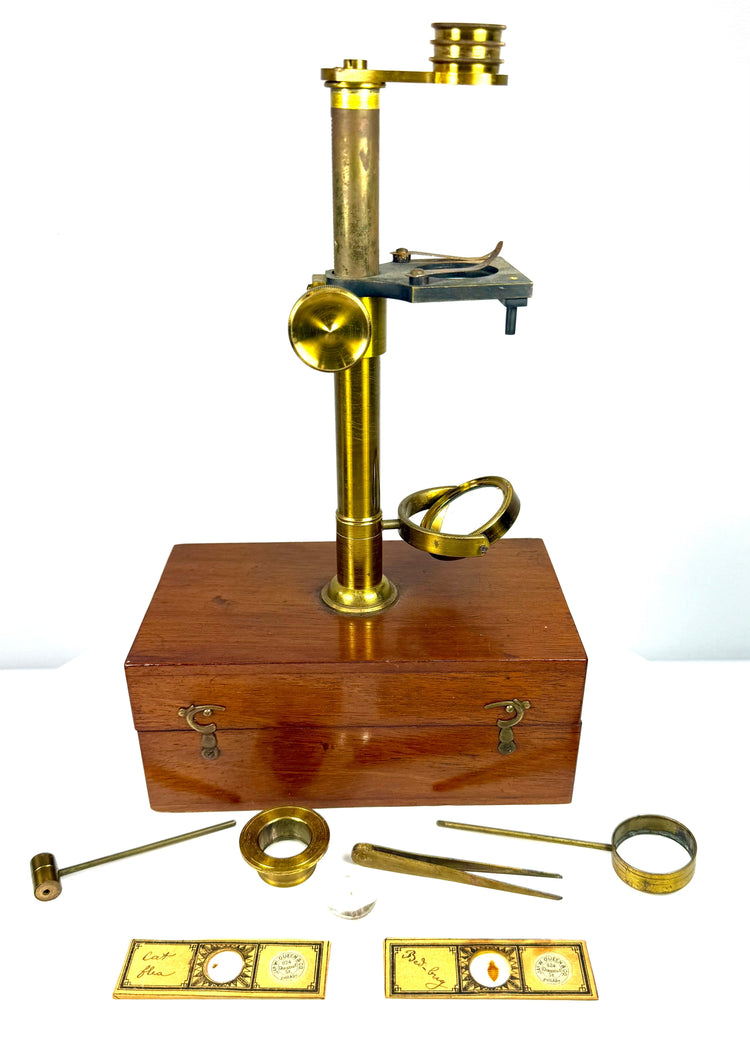
This handsome Victorian scientific instrument is a portable simple dissecting microscope, constructed predominantly from lacquered brass and mounted for use upon its original mahogany storage case.
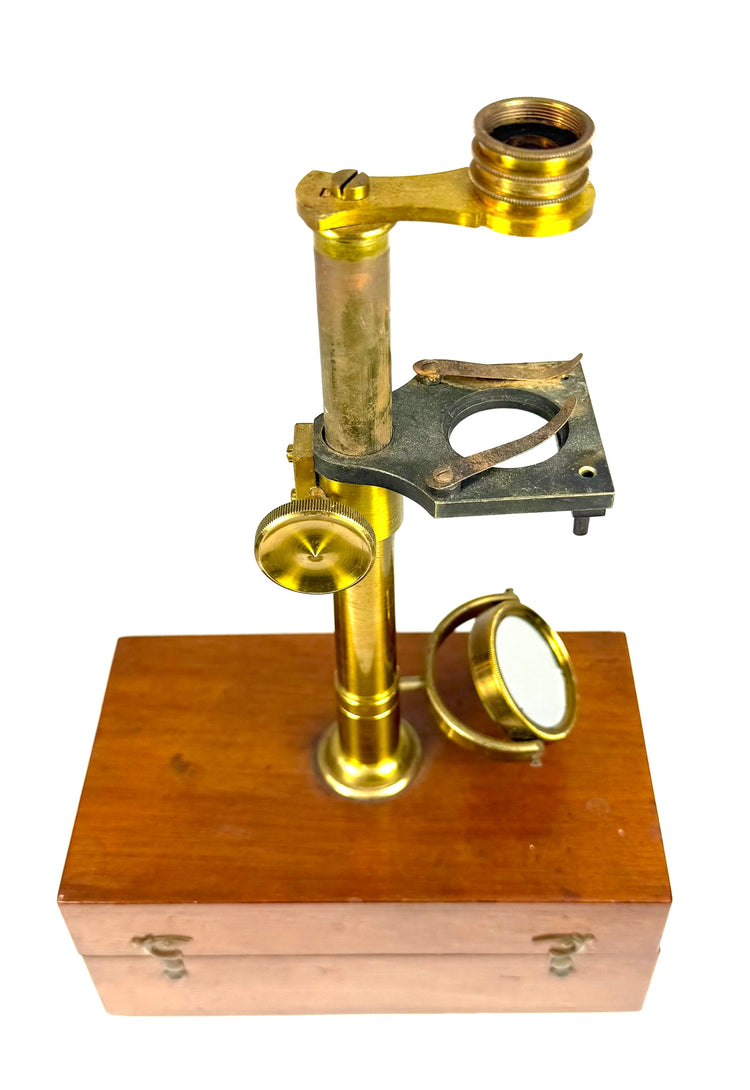
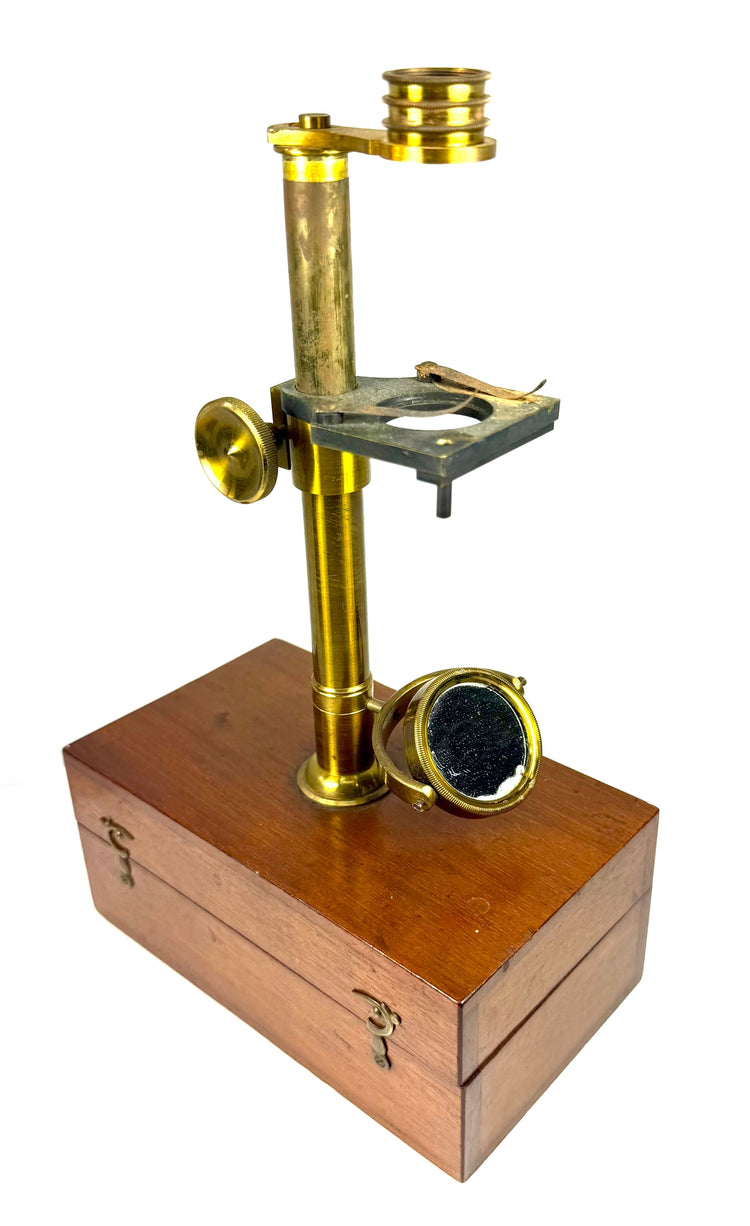
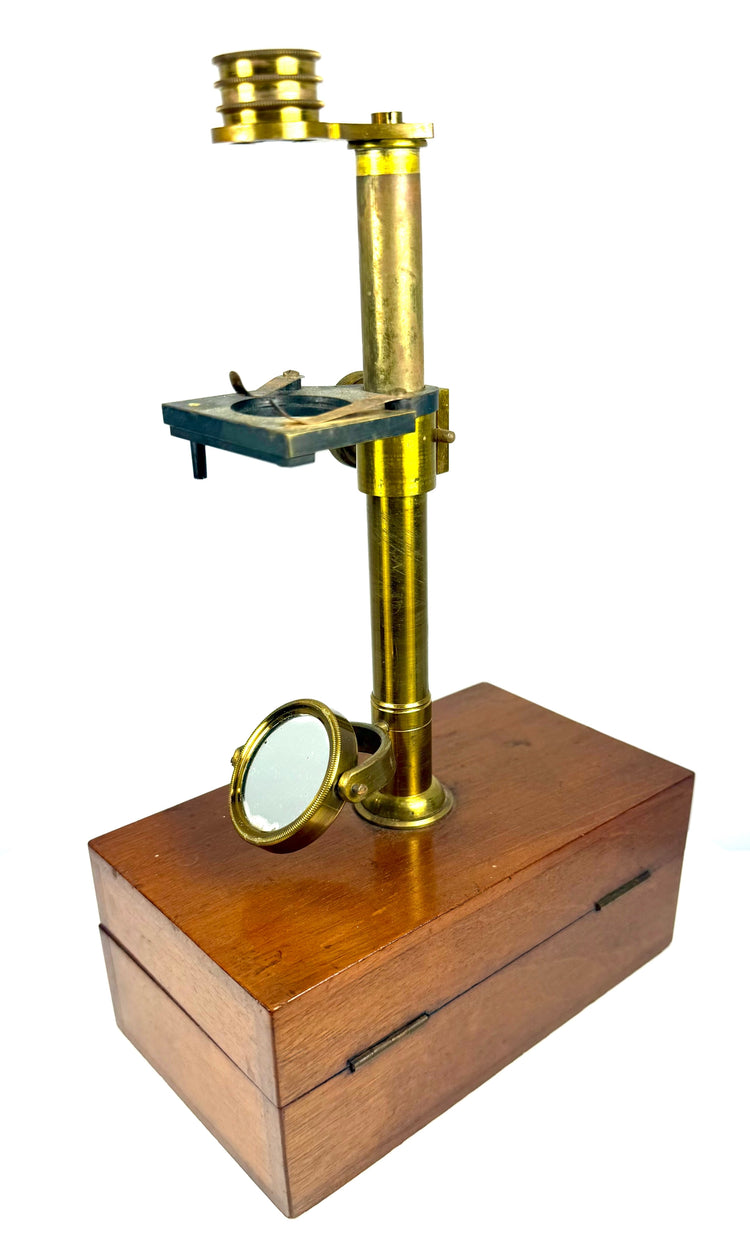
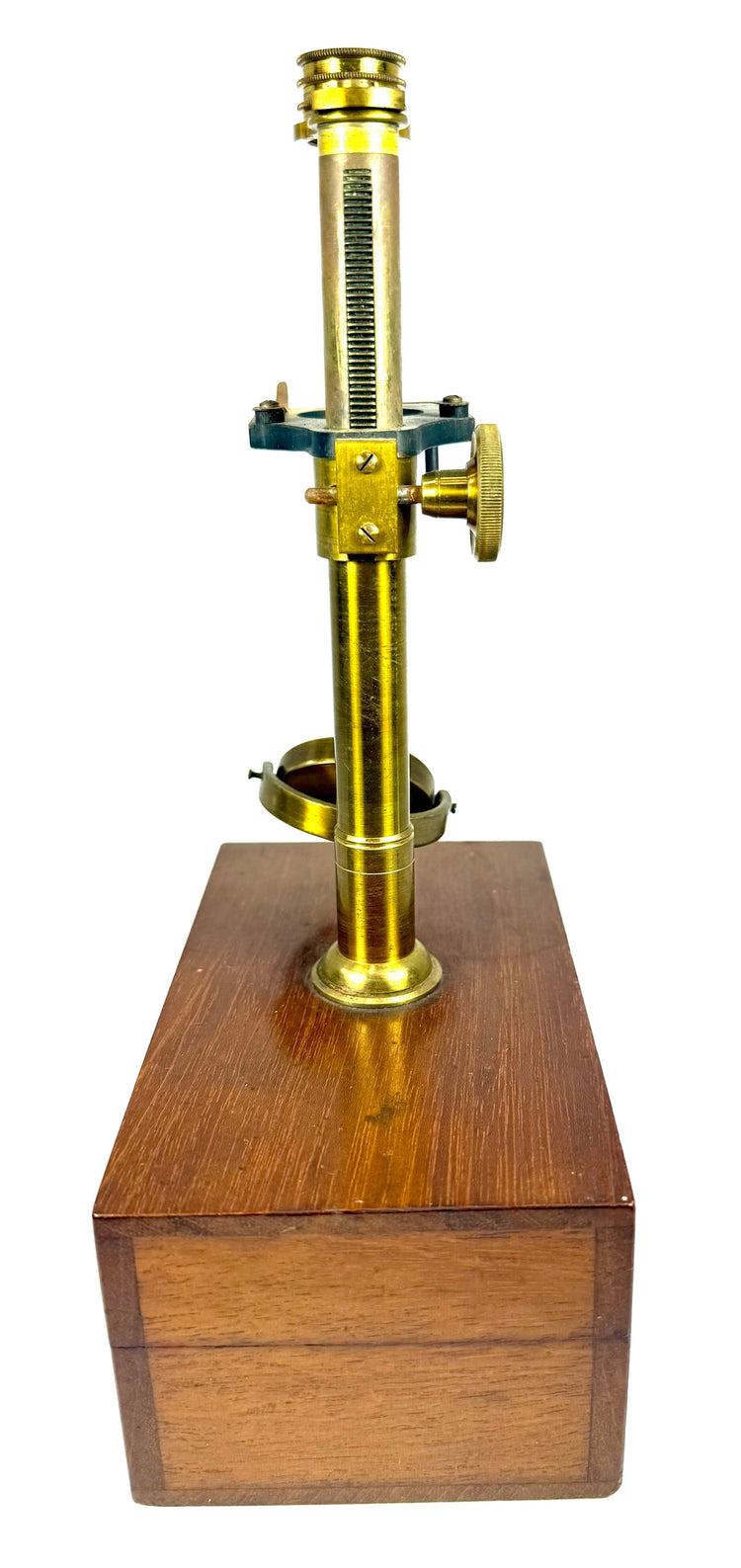
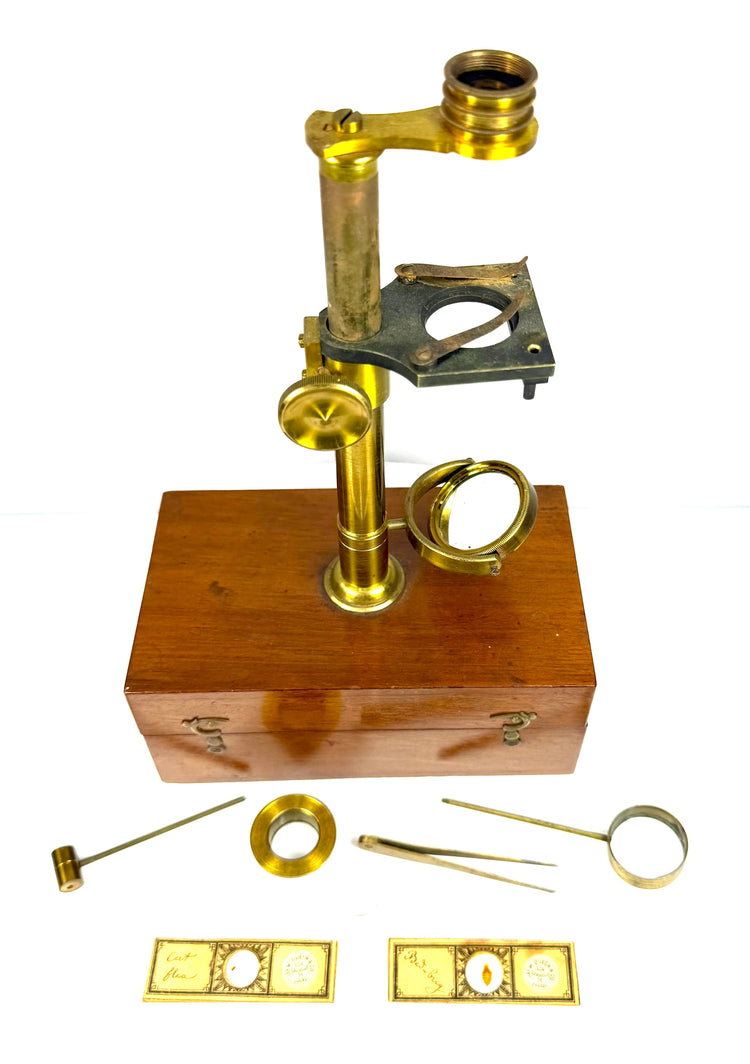
The microscope is centred around a tall cylindrical brass pillar supporting a darkened rectangular specimen stage. The stage incorporates a large central viewing aperture and spring clips for retaining specimens or slides during examination. A substantial side-mounted focusing control operates the adjustable upper assembly, allowing the magnifying lens to be raised or lowered relative to the specimen.
Above the stage is a horizontal brass arm terminating in a threaded lens holder. Rather than employing the compound optical tube associated with conventional laboratory microscopes, this type of instrument uses individual or combined magnifying lenses, providing a wide working distance especially suited to dissection, specimen preparation, botanical examination, entomology and slide mounting.
Below the stage is an adjustable circular mirror in a brass mounting. By changing its angle, ambient or artificial light could be reflected upward through the specimen—a fundamental feature of 19th-century transmitted-light microscopy.
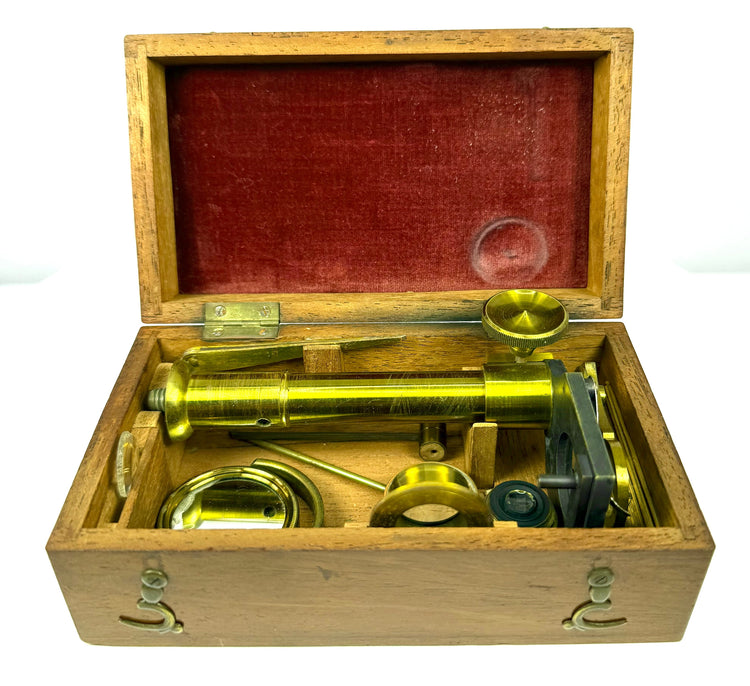
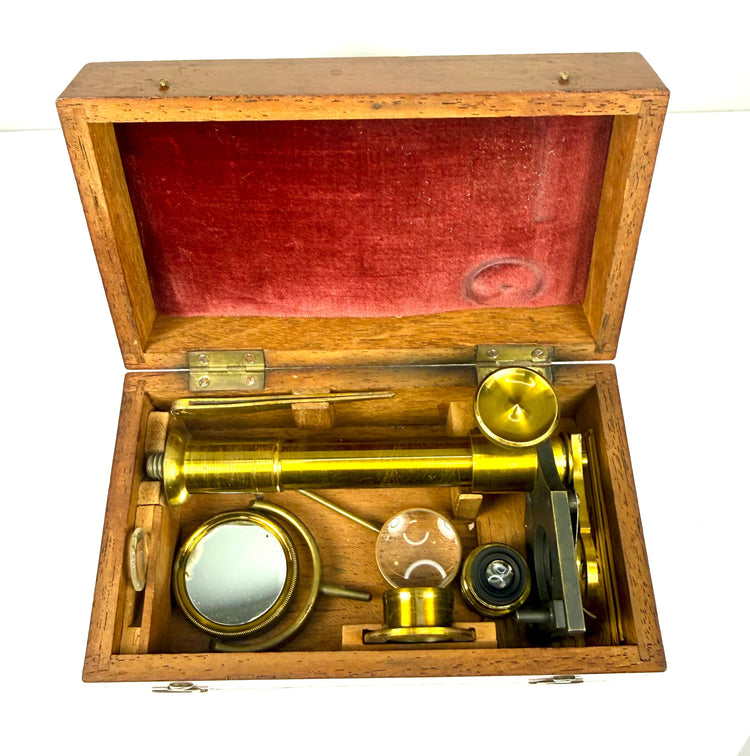
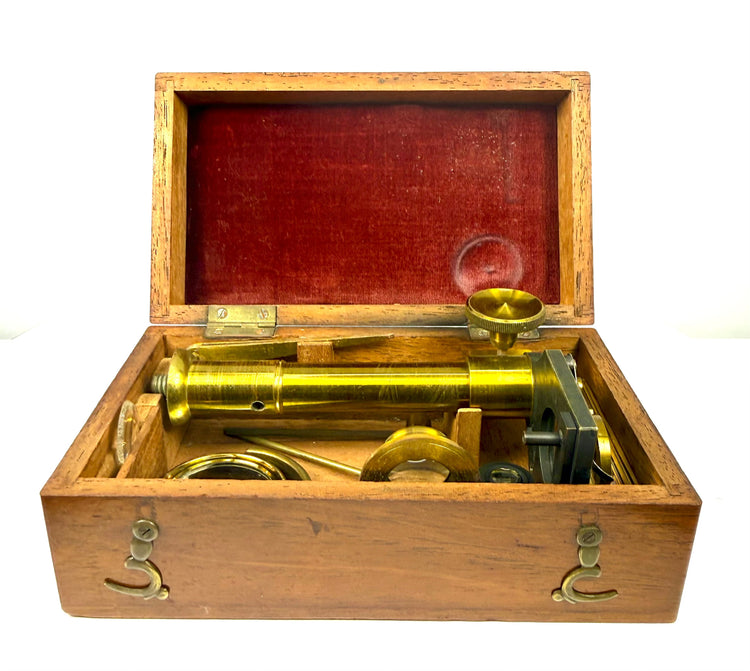
The fitted mahogany box serves both as storage and as a substantial base when the microscope is assembled. Its interior retains a red textile lining along with fitted wooden supports for securing components during transport.
A selection of accompanying period accessories remains with the microscope, including brass-mounted optical components, magnifying lenses, tweezers/forceps and a loose glass optical element.
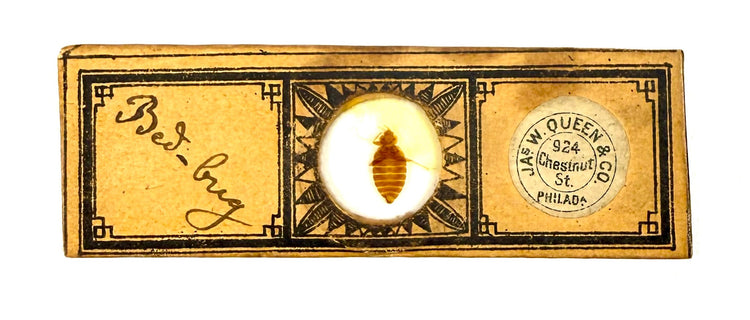
Especially noteworthy are the two period prepared microscopic specimens. Each is mounted within an ornate paper-covered slide and bears a circular printed retailer's label reading:
“Jas. W. Queen & Co. / 924 Chestnut St. / Philada.”
The slides are individually handwritten “Cat Flea” and “Bed Bug,” with surviving specimens visible beneath their circular glass mounts. The 924 Chestnut Street address dates the Queen-labelled slides to before the firm's 1891 relocation, providing a useful historical reference point for the associated material.
Features
- Lacquered-brass vertical pillar and focusing mechanism
- Rack-and-pinion style height/focus adjustment
- Adjustable upper lens arm with threaded optical mount
- Darkened rectangular specimen stage with central aperture and spring clips
- Adjustable brass-mounted substage illuminating mirror
- Original-style mahogany carrying and storage case
- Red textile lining inside the case lid
- Assortment of brass optical and dissecting accessories
- Period tweezers/forceps and additional optical components
- Two Victorian prepared entomological microscope slides
- Both slides retain Jas. W. Queen & Co., 924 Chestnut Street, Philadelphia retailer labels
- Attractive surviving example of portable Victorian scientific equipment
Cultural Significance
Instruments such as this reflect the transformation of microscopy during the Victorian period from a highly specialized scientific pursuit into a considerably broader intellectual and educational activity. Natural history collecting, botany, entomology and microscopic specimen preparation became popular not only in universities and medical institutions but among educated amateur naturalists.
The uncomplicated optical arrangement of the simple dissecting microscope allowed the observer to work directly beneath the magnifying lens. This made it particularly useful when examining insects, botanical material and small anatomical specimens or when preparing objects for mounting onto microscope slides.
The accompanying Queen slides strengthen this scientific context considerably. James W. Queen & Co. was established in Philadelphia during the 19th century and became a major American supplier of optical and scientific apparatus. Historical Queen catalogues document the firm's extensive involvement with microscopes and microscopic accessories; Smithsonian collections likewise preserve Queen instruments and catalogues from this period.
Condition
Good antique condition consistent with age and scientific use.
The lacquered brass exhibits expected areas of tarnish, oxidation, surface wear and handling marks. The blackened specimen stage retains age-related wear, while the mahogany case displays scattered scratches, marks and variations to its finish consistent with approximately 150 years of use and storage.
The interior textile lining shows expected age and wear. The period microscope slides retain discoloration, edge wear and aging to their paper mounts, while the specimens and labels remain readily visible.
Accessories are included as photographed. The microscope appears to be unmarked. Individual optical components have not been professionally calibrated or scientifically tested, and the instrument is offered primarily as a historical scientific collectible.
Dimensions (Approximate)
Length: 9.25 inches
Width: 5.75 inches
Height: 3.25 inches
Age (Approximate)
146–166 years old
Provenance
Formerly from a private collection in Richmond, Virginia, USA.
Accompanied by two period entomological microscope slides bearing printed retailer's labels for Jas. W. Queen & Co., 924 Chestnut Street, Philadelphia, individually identified in manuscript as “Cat Flea” and “Bed Bug.”
James W. Queen established his Philadelphia scientific instrument business in 1853, with the firm subsequently operating as James W. Queen & Co. The company remained at 924 Chestnut Street until 1891, when it relocated to 1010 Chestnut Street. The address appearing on these slides therefore establishes that they were retailed before 1891.
Learn More
Explore the Harvard Collection of Historical Scientific Instruments to learn more about Victorian dissecting microscopes.
Browse our collection of Science, Exploration & Curiosities to discover more historical scientific instruments and artifacts.
Descripción
Historical Context & Origin
Region: England / United States
Material: Lacquered Brass, Blackened Metal, Glass, Mahogany, Velvet & Paper
Period: Victorian Era, Circa 1860–1880 CE
The second half of the 19th century witnessed an extraordinary expansion of microscopy as scientific instruments became increasingly accessible to physicians, naturalists, students, collectors, and amateur scientists. Simple dissecting microscopes occupied an important position between handheld magnifiers and more elaborate compound microscopes, allowing specimens to be examined and physically manipulated under low magnification.
This example belongs to the recognizable Field-type tradition of dissecting microscopes, characterized by a vertical brass pillar, adjustable lens arm, open specimen stage, illuminating mirror, and a compact wooden case that could also serve as the instrument's working base. A closely comparable Field-type example preserved by Harvard University is dated circa 1860 and incorporates stackable lenses, rack-and-pinion focusing, a square stage, mirror, tweezers and a fitted mahogany case.
The set is particularly interesting because it retains two Victorian prepared entomological microscope slides retailed by James W. Queen & Co. of Philadelphia, one handwritten “Cat Flea” and the other “Bed Bug.” Queen was one of America's important 19th-century suppliers of microscopes, optical equipment and scientific apparatus, and its catalogues offered microscopes and microscopic specimens to professional and amateur users alike.
Description
This handsome Victorian scientific instrument is a portable simple dissecting microscope, constructed predominantly from lacquered brass and mounted for use upon its original mahogany storage case.
The microscope is centred around a tall cylindrical brass pillar supporting a darkened rectangular specimen stage. The stage incorporates a large central viewing aperture and spring clips for retaining specimens or slides during examination. A substantial side-mounted focusing control operates the adjustable upper assembly, allowing the magnifying lens to be raised or lowered relative to the specimen.
Above the stage is a horizontal brass arm terminating in a threaded lens holder. Rather than employing the compound optical tube associated with conventional laboratory microscopes, this type of instrument uses individual or combined magnifying lenses, providing a wide working distance especially suited to dissection, specimen preparation, botanical examination, entomology and slide mounting.
Below the stage is an adjustable circular mirror in a brass mounting. By changing its angle, ambient or artificial light could be reflected upward through the specimen—a fundamental feature of 19th-century transmitted-light microscopy.
The fitted mahogany box serves both as storage and as a substantial base when the microscope is assembled. Its interior retains a red textile lining along with fitted wooden supports for securing components during transport.
A selection of accompanying period accessories remains with the microscope, including brass-mounted optical components, magnifying lenses, tweezers/forceps and a loose glass optical element.
Especially noteworthy are the two period prepared microscopic specimens. Each is mounted within an ornate paper-covered slide and bears a circular printed retailer's label reading:
“Jas. W. Queen & Co. / 924 Chestnut St. / Philada.”
The slides are individually handwritten “Cat Flea” and “Bed Bug,” with surviving specimens visible beneath their circular glass mounts. The 924 Chestnut Street address dates the Queen-labelled slides to before the firm's 1891 relocation, providing a useful historical reference point for the associated material.
Features
- Lacquered-brass vertical pillar and focusing mechanism
- Rack-and-pinion style height/focus adjustment
- Adjustable upper lens arm with threaded optical mount
- Darkened rectangular specimen stage with central aperture and spring clips
- Adjustable brass-mounted substage illuminating mirror
- Original-style mahogany carrying and storage case
- Red textile lining inside the case lid
- Assortment of brass optical and dissecting accessories
- Period tweezers/forceps and additional optical components
- Two Victorian prepared entomological microscope slides
- Both slides retain Jas. W. Queen & Co., 924 Chestnut Street, Philadelphia retailer labels
- Attractive surviving example of portable Victorian scientific equipment
Cultural Significance
Instruments such as this reflect the transformation of microscopy during the Victorian period from a highly specialized scientific pursuit into a considerably broader intellectual and educational activity. Natural history collecting, botany, entomology and microscopic specimen preparation became popular not only in universities and medical institutions but among educated amateur naturalists.
The uncomplicated optical arrangement of the simple dissecting microscope allowed the observer to work directly beneath the magnifying lens. This made it particularly useful when examining insects, botanical material and small anatomical specimens or when preparing objects for mounting onto microscope slides.
The accompanying Queen slides strengthen this scientific context considerably. James W. Queen & Co. was established in Philadelphia during the 19th century and became a major American supplier of optical and scientific apparatus. Historical Queen catalogues document the firm's extensive involvement with microscopes and microscopic accessories; Smithsonian collections likewise preserve Queen instruments and catalogues from this period.
Condition
Good antique condition consistent with age and scientific use.
The lacquered brass exhibits expected areas of tarnish, oxidation, surface wear and handling marks. The blackened specimen stage retains age-related wear, while the mahogany case displays scattered scratches, marks and variations to its finish consistent with approximately 150 years of use and storage.
The interior textile lining shows expected age and wear. The period microscope slides retain discoloration, edge wear and aging to their paper mounts, while the specimens and labels remain readily visible.
Accessories are included as photographed. The microscope appears to be unmarked. Individual optical components have not been professionally calibrated or scientifically tested, and the instrument is offered primarily as a historical scientific collectible.
Dimensions (Approximate)
Length: 9.25 inches
Width: 5.75 inches
Height: 3.25 inches
Age (Approximate)
146–166 years old
Provenance
Formerly from a private collection in Richmond, Virginia, USA.
Accompanied by two period entomological microscope slides bearing printed retailer's labels for Jas. W. Queen & Co., 924 Chestnut Street, Philadelphia, individually identified in manuscript as “Cat Flea” and “Bed Bug.”
James W. Queen established his Philadelphia scientific instrument business in 1853, with the firm subsequently operating as James W. Queen & Co. The company remained at 924 Chestnut Street until 1891, when it relocated to 1010 Chestnut Street. The address appearing on these slides therefore establishes that they were retailed before 1891.
Learn More
Explore the Harvard Collection of Historical Scientific Instruments to learn more about Victorian dissecting microscopes.
Browse our collection of Science, Exploration & Curiosities to discover more historical scientific instruments and artifacts.
También te puede interesar
