



Ancient Roman & Late Antique Bronze Coin Collection of 20 | Circa 3rd – 6th Century CE
- Prix habituel
- $250.00
- Prix soldé
- $250.00
- Prix habituel
Impossible de charger la disponibilité du service de retrait


Ancient Roman & Late Antique Bronze Coin Collection of 20 | Circa 3rd – 6th Century CE
Description
Plus
Moins
Historical Context & Origin
Region: Roman Empire and Late Antique Mediterranean world
Material: Bronze and copper alloy
Period: Predominantly Late Roman to Early Byzantine, circa 3rd–6th Century CE
This collection comprises twenty ancient bronze and copper-alloy coins, most consistent with Roman Imperial and Late Antique monetary traditions. The considerable variation in diameter, thickness, flan shape, and surviving imagery suggests that the group was assembled from multiple denominations and possibly several different periods or mints.
Bronze coinage circulated on an enormous scale throughout the Roman world. By the late Imperial period, denominations generally grouped today under terms such as nummus formed an essential part of everyday commerce. Museum examples demonstrate considerable variation in size: a bronze nummus of Constantius I from circa 300 CE measures approximately 29 mm, while later 4th- and 5th-century bronze issues could be substantially smaller.
Description
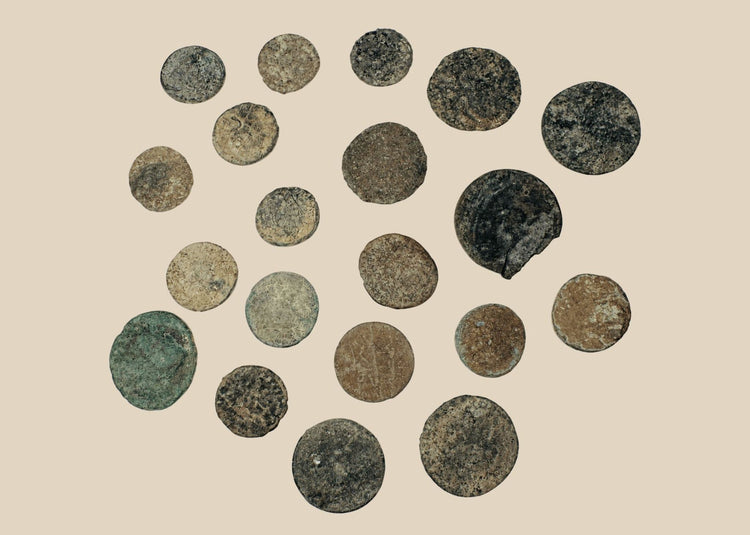
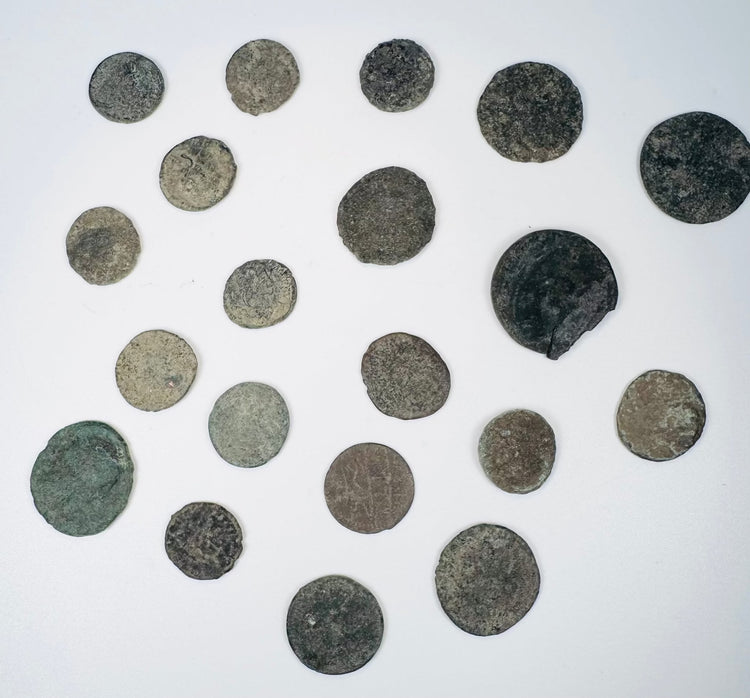
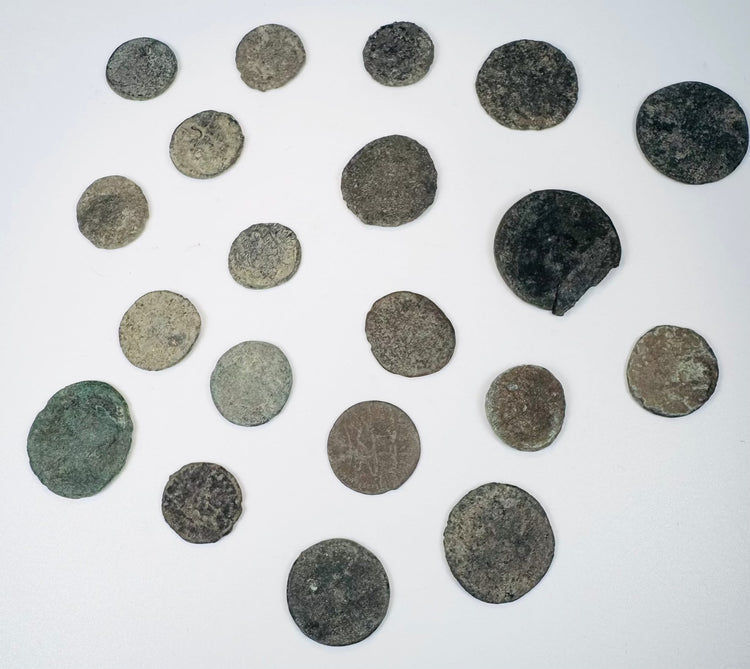
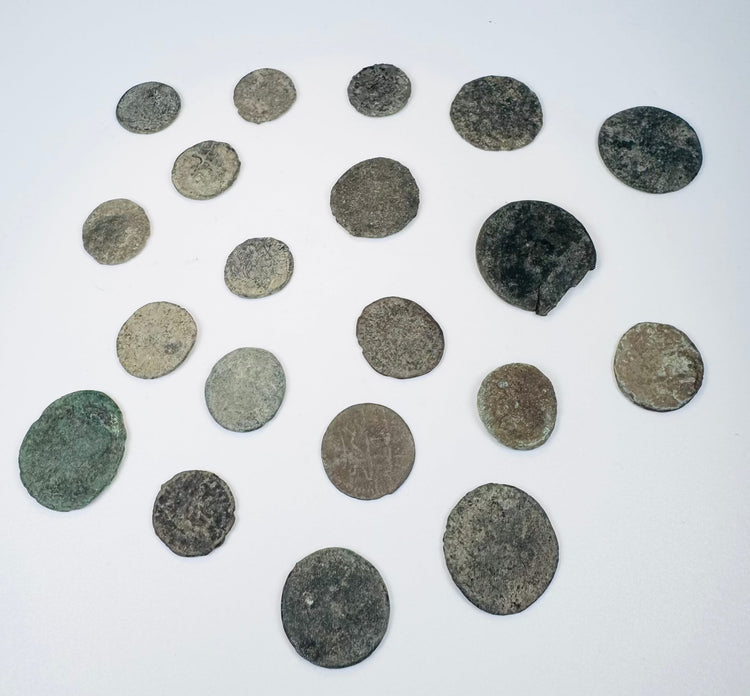
An intriguing collection of twenty ancient bronze and copper-alloy coins, preserved in varying states of archaeological patination and surface wear.
The group ranges from relatively small, compact coins to several considerably larger examples, creating a useful cross-section of ancient bronze currency. Although extensive wear and mineralization have obscured many of the original designs, traces of portraiture, inscriptions, linear devices, borders, and other struck details remain visible on selected examples.
Several coins appear to preserve remnants of right-facing imperial busts, one of the most characteristic elements of Roman Imperial coinage. Others retain indistinct reverse designs that may originally have depicted standing figures, military subjects, personifications, architectural devices, or denominational markings.
The larger modules are particularly interesting. During the transition from the Roman to Byzantine monetary systems, substantial copper denominations again became prominent. Early Byzantine folles, for example, were frequently around 29–36 mm in diameter and could carry large denominational marks, including the prominent M representing forty nummi. Examples issued under Anastasius I, Justin I, Justin II, and Heraclius are preserved in the British Museum.
Because the surfaces of this collection are heavily weathered and only partial designs remain visible, individual rulers, denominations, and mint locations should not be assigned without further examination of both sides, precise diameters, and individual weights. The group is therefore most responsibly offered as a mixed assemblage of ancient Roman and Late Antique bronze coinage, with the possibility that some examples extend into the early Byzantine period.
Features
- Predominantly bronze and copper-alloy construction
- Roman Imperial and Late Antique characteristics
- Possible early Byzantine examples within the group
- Wide variety of diameters and flan sizes
- Remnants of imperial portraiture visible on selected coins
- Surviving traces of inscriptions and reverse devices
- Hand-struck ancient construction
- Irregular ancient flans and edges
- Natural green, olive, brown, grey, and dark mineral patination
- Extensive surface encrustation and oxidation
Cultural Significance
Coins were among the most widely distributed objects produced by the Roman state. Unlike monumental sculpture or architecture, which remained fixed in a particular place, coins travelled continuously through markets, military camps, ports, farms, settlements, and provincial cities.
Imperial coinage combined practical monetary value with political messaging. Portraits identified the emperor, while reverses could celebrate military victory, prosperity, security, religious devotion, imperial anniversaries, or the protection of the Roman state. Late Roman bronze coins continued this tradition even as economic reforms altered their size and denominations. Surviving British Museum examples include coins of Constantius II, Theodosius I, Honorius, and Majorian ranging from approximately 13 to 19 mm.
The development of the Byzantine monetary system continued many Roman traditions. Large copper folles of the 6th and early 7th centuries often employed clearly marked denominations and substantial flans, illustrating the gradual transformation rather than abrupt disappearance of Roman monetary culture.
Condition
Ancient archaeological condition with substantial variation between individual coins.
The group exhibits extensive circulation wear, oxidation, mineralization, encrustation, corrosion, pitting, edge losses, irregular flans, surface deposits, and areas where the original struck designs have become partially or almost completely obscured. One of the larger coins displays a significant old edge loss or fracture.
Several pieces retain recognizable traces of portraiture, inscriptions, borders, and other design elements, while others are primarily preserved as heavily patinated ancient flans.
Patination ranges from pale grey and earthen brown to dark brown, black, olive, and pronounced green oxidation. These surfaces have been retained as part of the coins' archaeological character.
Dimensions (Approximate)
Various sizes.
The collection consists of twenty coins ranging from small bronze denominations to substantially larger ancient bronze pieces. Individual measurements and weights have not been recorded.
Age (Approximate)
1,400–1,800 years old
Provenance
Private collection, Massachusetts, USA.
Previously part of the inventory of Spartan Numismatics, Furlong, Pennsylvania, a specialist numismatic firm focused on ancient and historic coinage. Spartan Numismatics is directed by Nicholas Economopoulos, a numismatist with more than 45 years of experience and advanced academic training in Classics and Classical Archaeology, with particular expertise in ancient and Byzantine coinage.
Subsequently handled by Blackstone Valley Auctions and Estates LLC, Sutton, Massachusetts, an established auction and estate firm specializing in antiques, fine and decorative art, coins, collectibles, militaria, and historically significant material.
Learn More
View an early Byzantine follis of Anastasius I in the collection of the Smithsonian National Museum of American History, featuring the imperial portrait and prominent M denomination mark characteristic of early Byzantine copper coinage.
Browse our Collection of Roman & Greek Artifacts
Description
Historical Context & Origin
Region: Roman Empire and Late Antique Mediterranean world
Material: Bronze and copper alloy
Period: Predominantly Late Roman to Early Byzantine, circa 3rd–6th Century CE
This collection comprises twenty ancient bronze and copper-alloy coins, most consistent with Roman Imperial and Late Antique monetary traditions. The considerable variation in diameter, thickness, flan shape, and surviving imagery suggests that the group was assembled from multiple denominations and possibly several different periods or mints.
Bronze coinage circulated on an enormous scale throughout the Roman world. By the late Imperial period, denominations generally grouped today under terms such as nummus formed an essential part of everyday commerce. Museum examples demonstrate considerable variation in size: a bronze nummus of Constantius I from circa 300 CE measures approximately 29 mm, while later 4th- and 5th-century bronze issues could be substantially smaller.
Description
An intriguing collection of twenty ancient bronze and copper-alloy coins, preserved in varying states of archaeological patination and surface wear.
The group ranges from relatively small, compact coins to several considerably larger examples, creating a useful cross-section of ancient bronze currency. Although extensive wear and mineralization have obscured many of the original designs, traces of portraiture, inscriptions, linear devices, borders, and other struck details remain visible on selected examples.
Several coins appear to preserve remnants of right-facing imperial busts, one of the most characteristic elements of Roman Imperial coinage. Others retain indistinct reverse designs that may originally have depicted standing figures, military subjects, personifications, architectural devices, or denominational markings.
The larger modules are particularly interesting. During the transition from the Roman to Byzantine monetary systems, substantial copper denominations again became prominent. Early Byzantine folles, for example, were frequently around 29–36 mm in diameter and could carry large denominational marks, including the prominent M representing forty nummi. Examples issued under Anastasius I, Justin I, Justin II, and Heraclius are preserved in the British Museum.
Because the surfaces of this collection are heavily weathered and only partial designs remain visible, individual rulers, denominations, and mint locations should not be assigned without further examination of both sides, precise diameters, and individual weights. The group is therefore most responsibly offered as a mixed assemblage of ancient Roman and Late Antique bronze coinage, with the possibility that some examples extend into the early Byzantine period.
Features
- Predominantly bronze and copper-alloy construction
- Roman Imperial and Late Antique characteristics
- Possible early Byzantine examples within the group
- Wide variety of diameters and flan sizes
- Remnants of imperial portraiture visible on selected coins
- Surviving traces of inscriptions and reverse devices
- Hand-struck ancient construction
- Irregular ancient flans and edges
- Natural green, olive, brown, grey, and dark mineral patination
- Extensive surface encrustation and oxidation
Cultural Significance
Coins were among the most widely distributed objects produced by the Roman state. Unlike monumental sculpture or architecture, which remained fixed in a particular place, coins travelled continuously through markets, military camps, ports, farms, settlements, and provincial cities.
Imperial coinage combined practical monetary value with political messaging. Portraits identified the emperor, while reverses could celebrate military victory, prosperity, security, religious devotion, imperial anniversaries, or the protection of the Roman state. Late Roman bronze coins continued this tradition even as economic reforms altered their size and denominations. Surviving British Museum examples include coins of Constantius II, Theodosius I, Honorius, and Majorian ranging from approximately 13 to 19 mm.
The development of the Byzantine monetary system continued many Roman traditions. Large copper folles of the 6th and early 7th centuries often employed clearly marked denominations and substantial flans, illustrating the gradual transformation rather than abrupt disappearance of Roman monetary culture.
Condition
Ancient archaeological condition with substantial variation between individual coins.
The group exhibits extensive circulation wear, oxidation, mineralization, encrustation, corrosion, pitting, edge losses, irregular flans, surface deposits, and areas where the original struck designs have become partially or almost completely obscured. One of the larger coins displays a significant old edge loss or fracture.
Several pieces retain recognizable traces of portraiture, inscriptions, borders, and other design elements, while others are primarily preserved as heavily patinated ancient flans.
Patination ranges from pale grey and earthen brown to dark brown, black, olive, and pronounced green oxidation. These surfaces have been retained as part of the coins' archaeological character.
Dimensions (Approximate)
Various sizes.
The collection consists of twenty coins ranging from small bronze denominations to substantially larger ancient bronze pieces. Individual measurements and weights have not been recorded.
Age (Approximate)
1,400–1,800 years old
Provenance
Private collection, Massachusetts, USA.
Previously part of the inventory of Spartan Numismatics, Furlong, Pennsylvania, a specialist numismatic firm focused on ancient and historic coinage. Spartan Numismatics is directed by Nicholas Economopoulos, a numismatist with more than 45 years of experience and advanced academic training in Classics and Classical Archaeology, with particular expertise in ancient and Byzantine coinage.
Subsequently handled by Blackstone Valley Auctions and Estates LLC, Sutton, Massachusetts, an established auction and estate firm specializing in antiques, fine and decorative art, coins, collectibles, militaria, and historically significant material.
Learn More
View an early Byzantine follis of Anastasius I in the collection of the Smithsonian National Museum of American History, featuring the imperial portrait and prominent M denomination mark characteristic of early Byzantine copper coinage.
Browse our Collection of Roman & Greek Artifacts
Vous aimerez peut-être aussi
