



Ancient Eastern Mediterranean Terracotta Oil Lamp | Circa 6th–7th Century CE
- Prix habituel
- $350.00
- Prix soldé
- $350.00
- Prix habituel
Impossible de charger la disponibilité du service de retrait




Ancient Eastern Mediterranean Terracotta Oil Lamp | Circa 6th–7th Century CE
Description
Plus
Moins
Historical Context & Origin
Region: Eastern Mediterranean
Material: Mould-Made Terracotta (Fired Clay)
Period: Late Antiquity, circa 6th–7th Century CE
Description
This distinctive ancient Eastern Mediterranean terracotta oil lamp dates to the 6th–7th century CE, reflecting the established ceramic manufacturing traditions that flourished throughout the Mediterranean during Late Antiquity.
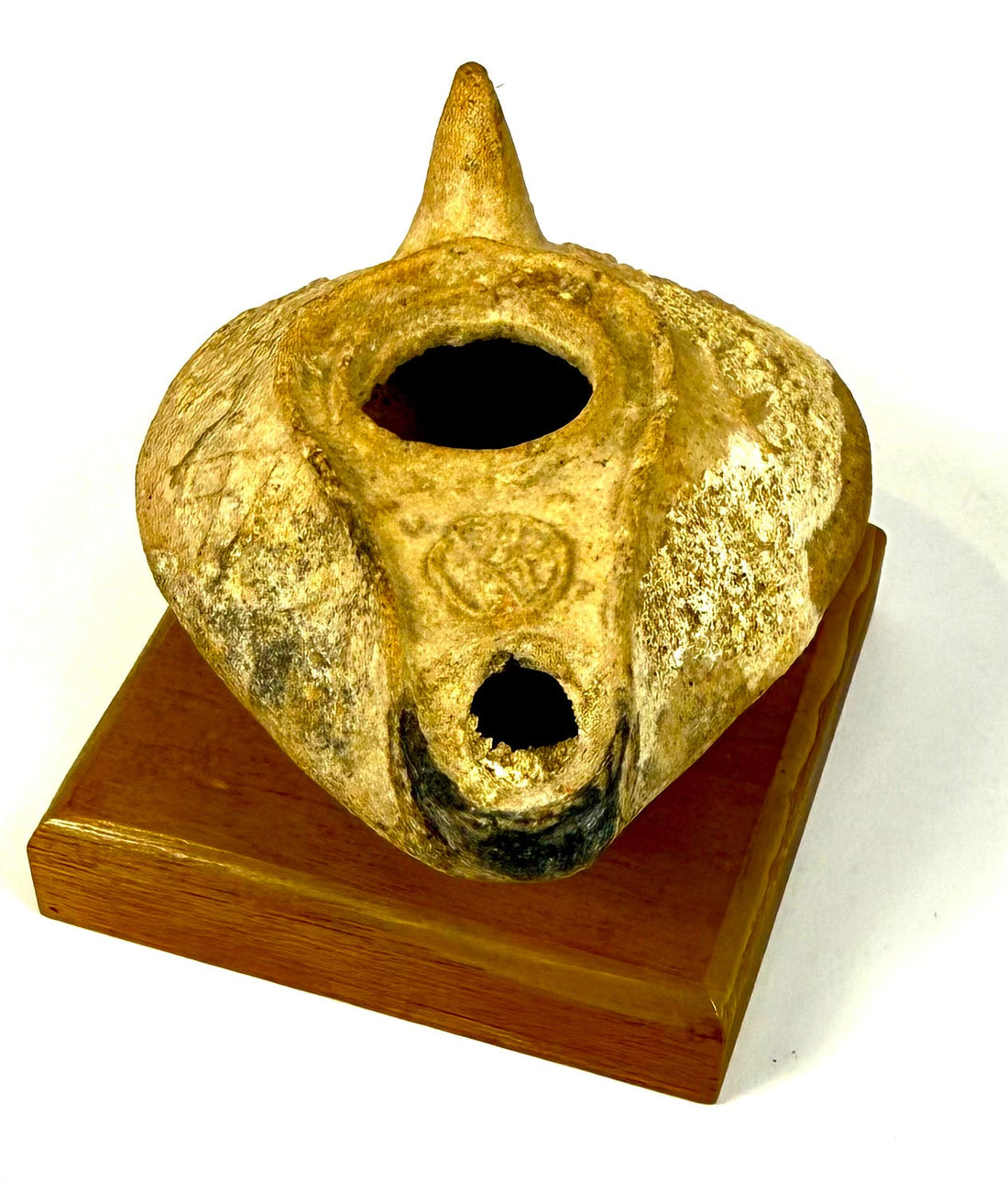
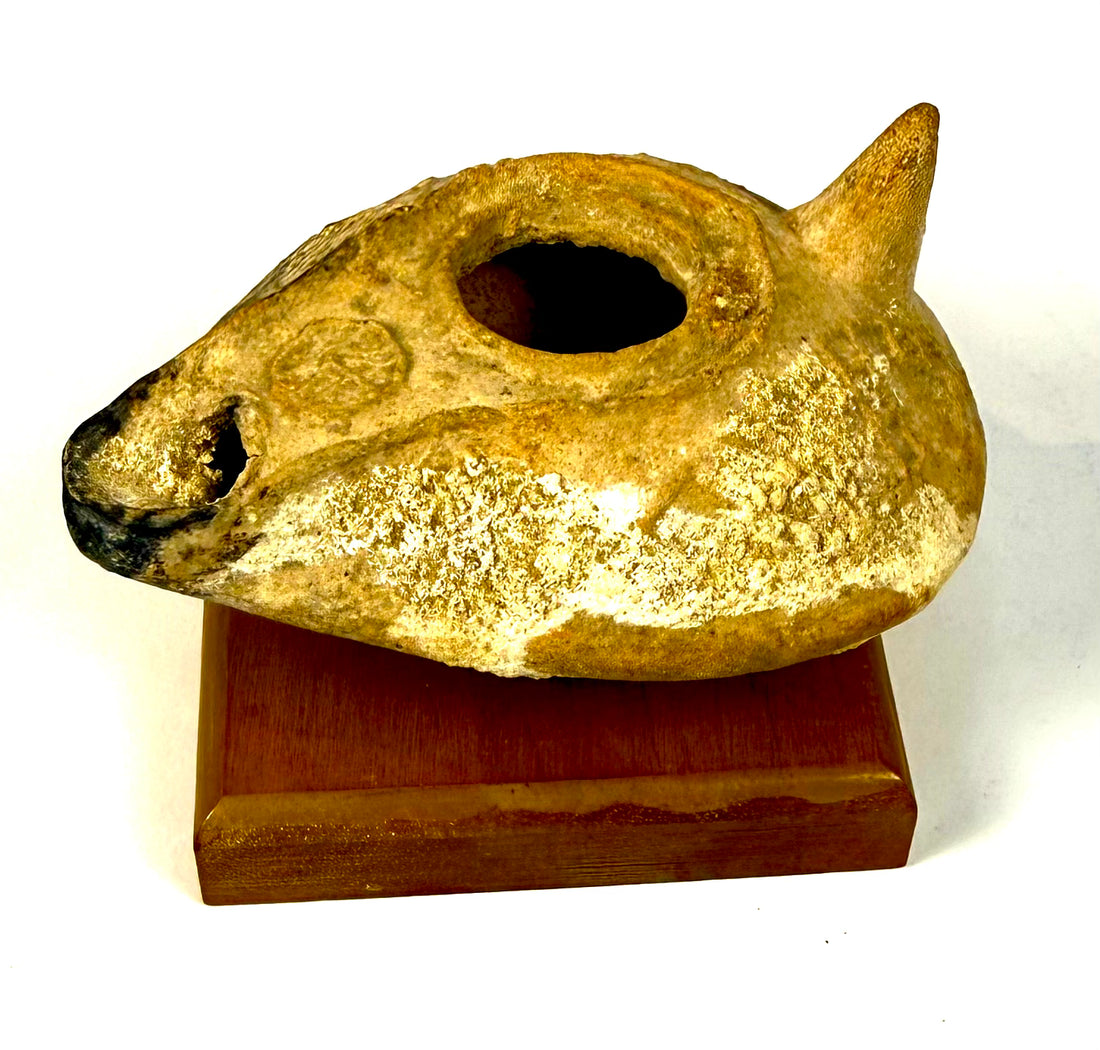
The lamp features a compact, slipper-shaped body with a short elongated nozzle and a pointed conical lug projecting from the rear. Its carefully moulded form combines practical functionality with decorative geometric ornamentation characteristic of Eastern Mediterranean lamp-making traditions.
The upper surface is dominated by a large central filling-hole surrounded by a raised circular rim. This opening would have allowed oil or another combustible fuel to be introduced into the lamp's interior. A smaller circular wick-hole is positioned at the tip of the projecting nozzle, where a wick would have been placed to provide illumination.
The sloping shoulders display an attractive arrangement of moulded geometric decoration, including diagonal lines, chevrons, and repeating linear patterns. A small wheel-like motif appears near the nozzle, contributing an additional decorative element to the composition.
These ornamental features are framed by the lamp's distinctive slipper-shaped profile, demonstrating the combination of geometric design and functional ceramic construction associated with ancient Eastern Mediterranean oil lamps.
The terracotta surface exhibits extensive weathering, including pale mineral-like encrustations, areas of erosion, discoloration, and softened decorative relief. Pronounced darkening is visible around the wick-hole, consistent in appearance with exposure to burning or accumulated combustion deposits.
Minor losses are present around the nozzle, while the pointed conical rear lug remains identifiable. Despite extensive surface wear, the lamp retains its characteristic form and principal decorative elements.
The artifact is presented on a rectangular wooden display base, providing an attractive presentation for collectors of ancient ceramics and Mediterranean antiquities.
Features
-
Ancient Eastern Mediterranean mould-made terracotta oil lamp
-
Distinctive slipper-shaped body with a short elongated nozzle
-
Large central filling-hole surrounded by a raised circular rim
-
Smaller circular wick-hole positioned at the nozzle tip
-
Pointed conical lug projecting from the rear
-
Moulded geometric shoulder decoration featuring diagonal lines and chevrons
-
Small wheel-like decorative motif near the nozzle
-
Raised and recessed decorative elements characteristic of mould-made ceramic production
-
Extensive surface weathering, pale encrustations, and discoloration
-
Pronounced darkening around the wick-hole
-
Minor losses and surface irregularities around the nozzle
Cultural Significance
Terracotta oil lamps played an essential role in everyday life throughout the ancient Mediterranean, providing an accessible and practical source of artificial illumination in homes, workshops, commercial establishments, religious buildings, and other communal spaces.
During the 6th–7th centuries CE, the Eastern Mediterranean experienced significant political, religious, and cultural transformations. The region remained an important centre of ceramic production, with established manufacturing traditions continuing alongside developments in decorative styles and regional preferences.
Mould-made terracotta lamps were produced in considerable quantities, allowing ceramic workshops to manufacture practical lighting devices featuring recognizable forms and repeated decorative patterns.
The distinctive slipper-shaped body, projecting nozzle, and pointed rear lug of this example reflect manufacturing traditions associated with Late Antique Eastern Mediterranean lamp production.
Geometric decoration was particularly prominent on many lamps of this period. Patterns incorporating diagonal lines, chevrons, concentric elements, and circular motifs provided visual ornamentation while reflecting established regional ceramic traditions.
Comparable lamp forms are known from the eastern Mediterranean and Levant, including examples associated with Byzantine-period and Samaritan ceramic traditions. However, the precise production centre and cultural affiliation of the present example have not been established.
The use of oil lamps also carried broader cultural significance. Although primarily functional, lamps could be associated with domestic activities, religious observances, and funerary customs, depending on their archaeological context.
Condition
The lamp survives in worn ancient condition, retaining its distinctive slipper-shaped body, projecting nozzle, central filling-hole, and pointed conical rear lug.
Extensive surface weathering is present throughout, including pale encrustations, erosion, discoloration, and areas of accumulated deposits.
The moulded geometric decoration remains identifiable, although the diagonal patterns, chevrons, and wheel-like motif have been softened by surface wear.
Pronounced darkening is visible around the wick-hole, together with minor losses and irregularities along the nozzle.
The raised rim surrounding the central filling-hole remains recognizable, while the surrounding terracotta exhibits areas of erosion and uneven coloration.
Dimensions (Approximate)
Length: 3.25 in
Width: 2.5 in
Height: 2 in
Age (Approximate)
Approximately 1,300–1,525 years old
Provenance
Formerly part of a private collection in Sarasota Beach, Florida, USA. Subsequently handled by Akiba Galleries, Dania Beach, Florida, USA. Akiba Galleries is an established, family-owned auction house specializing in fine art, antiques, historical artifacts, and collectible objects from around the world. Known for its diverse and carefully curated auctions, the gallery serves an international clientele of collectors, dealers, and institutions.
Expert Assessment: Examined by Luca Salvaggio, an Italian archaeologist specializing in ancient Mediterranean material, with a Postgraduate Diploma from the Italian Archaeological School at Athens (IASA) and accreditation for preventive archaeology from the Italian Ministry of Culture (MiC). He identified the artifact as an Eastern Mediterranean terracotta oil lamp dating to the 6th–7th century CE. His assessment describes its mould-made slipper-shaped body, short elongated nozzle with circular wick-hole, pointed conical rear lug, large central filling-hole with raised rim, and geometric shoulder decoration featuring diagonal lines, chevrons, and a small wheel-like motif.
Learn More
View a comparable 7th-century terracotta oil lamp at The Metropolitan Museum of Art
Browse Our Collection of Ceramics & Pottery
Description
Historical Context & Origin
Region: Eastern Mediterranean
Material: Mould-Made Terracotta (Fired Clay)
Period: Late Antiquity, circa 6th–7th Century CE
Description
This distinctive ancient Eastern Mediterranean terracotta oil lamp dates to the 6th–7th century CE, reflecting the established ceramic manufacturing traditions that flourished throughout the Mediterranean during Late Antiquity.
The lamp features a compact, slipper-shaped body with a short elongated nozzle and a pointed conical lug projecting from the rear. Its carefully moulded form combines practical functionality with decorative geometric ornamentation characteristic of Eastern Mediterranean lamp-making traditions.
The upper surface is dominated by a large central filling-hole surrounded by a raised circular rim. This opening would have allowed oil or another combustible fuel to be introduced into the lamp's interior. A smaller circular wick-hole is positioned at the tip of the projecting nozzle, where a wick would have been placed to provide illumination.
The sloping shoulders display an attractive arrangement of moulded geometric decoration, including diagonal lines, chevrons, and repeating linear patterns. A small wheel-like motif appears near the nozzle, contributing an additional decorative element to the composition.
These ornamental features are framed by the lamp's distinctive slipper-shaped profile, demonstrating the combination of geometric design and functional ceramic construction associated with ancient Eastern Mediterranean oil lamps.
The terracotta surface exhibits extensive weathering, including pale mineral-like encrustations, areas of erosion, discoloration, and softened decorative relief. Pronounced darkening is visible around the wick-hole, consistent in appearance with exposure to burning or accumulated combustion deposits.
Minor losses are present around the nozzle, while the pointed conical rear lug remains identifiable. Despite extensive surface wear, the lamp retains its characteristic form and principal decorative elements.
The artifact is presented on a rectangular wooden display base, providing an attractive presentation for collectors of ancient ceramics and Mediterranean antiquities.
Features
-
Ancient Eastern Mediterranean mould-made terracotta oil lamp
-
Distinctive slipper-shaped body with a short elongated nozzle
-
Large central filling-hole surrounded by a raised circular rim
-
Smaller circular wick-hole positioned at the nozzle tip
-
Pointed conical lug projecting from the rear
-
Moulded geometric shoulder decoration featuring diagonal lines and chevrons
-
Small wheel-like decorative motif near the nozzle
-
Raised and recessed decorative elements characteristic of mould-made ceramic production
-
Extensive surface weathering, pale encrustations, and discoloration
-
Pronounced darkening around the wick-hole
-
Minor losses and surface irregularities around the nozzle
Cultural Significance
Terracotta oil lamps played an essential role in everyday life throughout the ancient Mediterranean, providing an accessible and practical source of artificial illumination in homes, workshops, commercial establishments, religious buildings, and other communal spaces.
During the 6th–7th centuries CE, the Eastern Mediterranean experienced significant political, religious, and cultural transformations. The region remained an important centre of ceramic production, with established manufacturing traditions continuing alongside developments in decorative styles and regional preferences.
Mould-made terracotta lamps were produced in considerable quantities, allowing ceramic workshops to manufacture practical lighting devices featuring recognizable forms and repeated decorative patterns.
The distinctive slipper-shaped body, projecting nozzle, and pointed rear lug of this example reflect manufacturing traditions associated with Late Antique Eastern Mediterranean lamp production.
Geometric decoration was particularly prominent on many lamps of this period. Patterns incorporating diagonal lines, chevrons, concentric elements, and circular motifs provided visual ornamentation while reflecting established regional ceramic traditions.
Comparable lamp forms are known from the eastern Mediterranean and Levant, including examples associated with Byzantine-period and Samaritan ceramic traditions. However, the precise production centre and cultural affiliation of the present example have not been established.
The use of oil lamps also carried broader cultural significance. Although primarily functional, lamps could be associated with domestic activities, religious observances, and funerary customs, depending on their archaeological context.
Condition
The lamp survives in worn ancient condition, retaining its distinctive slipper-shaped body, projecting nozzle, central filling-hole, and pointed conical rear lug.
Extensive surface weathering is present throughout, including pale encrustations, erosion, discoloration, and areas of accumulated deposits.
The moulded geometric decoration remains identifiable, although the diagonal patterns, chevrons, and wheel-like motif have been softened by surface wear.
Pronounced darkening is visible around the wick-hole, together with minor losses and irregularities along the nozzle.
The raised rim surrounding the central filling-hole remains recognizable, while the surrounding terracotta exhibits areas of erosion and uneven coloration.
Dimensions (Approximate)
Length: 3.25 in
Width: 2.5 in
Height: 2 in
Age (Approximate)
Approximately 1,300–1,525 years old
Provenance
Formerly part of a private collection in Sarasota Beach, Florida, USA. Subsequently handled by Akiba Galleries, Dania Beach, Florida, USA. Akiba Galleries is an established, family-owned auction house specializing in fine art, antiques, historical artifacts, and collectible objects from around the world. Known for its diverse and carefully curated auctions, the gallery serves an international clientele of collectors, dealers, and institutions.
Expert Assessment: Examined by Luca Salvaggio, an Italian archaeologist specializing in ancient Mediterranean material, with a Postgraduate Diploma from the Italian Archaeological School at Athens (IASA) and accreditation for preventive archaeology from the Italian Ministry of Culture (MiC). He identified the artifact as an Eastern Mediterranean terracotta oil lamp dating to the 6th–7th century CE. His assessment describes its mould-made slipper-shaped body, short elongated nozzle with circular wick-hole, pointed conical rear lug, large central filling-hole with raised rim, and geometric shoulder decoration featuring diagonal lines, chevrons, and a small wheel-like motif.
Learn More
View a comparable 7th-century terracotta oil lamp at The Metropolitan Museum of Art
Browse Our Collection of Ceramics & Pottery
Vous aimerez peut-être aussi
