

Ancient Egyptian Faience Taweret Amulet | Late Period | Circa 664 – 332 BCE
- Prix habituel
- $600.00
- Prix soldé
- $600.00
- Prix habituel
Impossible de charger la disponibilité du service de retrait




Ancient Egyptian Faience Taweret Amulet | Late Period | Circa 664 – 332 BCE
Description
Plus
Moins
Historical Context & Origin
Region: Ancient Egypt, North Africa
Material: Mold-formed Egyptian faience with surviving blue-green glaze
Period: Late Period, circa 664–332 BCE
Description
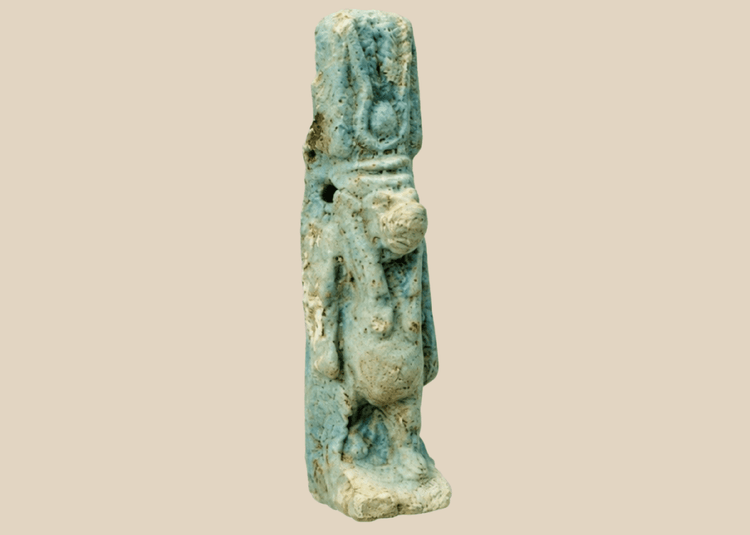
An ancient Egyptian faience amulet representing Taweret, the powerful goddess associated with childbirth, fertility, motherhood, and the protection of women and young children.
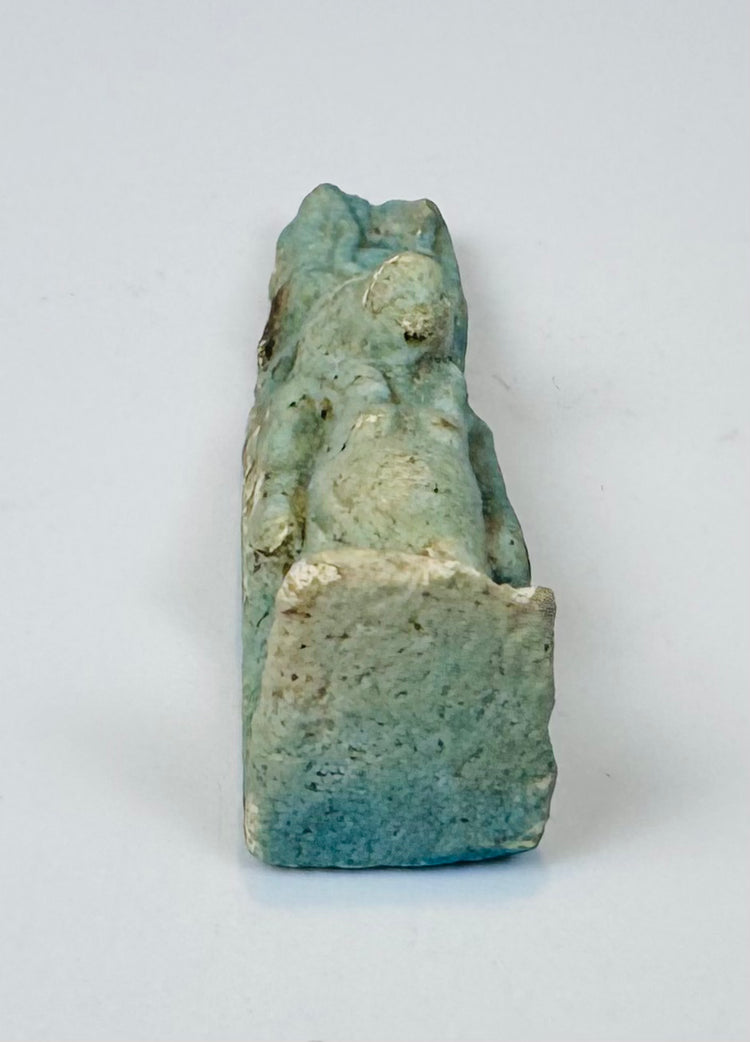
The goddess is shown standing upright upon an integral rectangular base. Her distinctive form combines a hippopotamus-like head and heavy abdomen with human breasts and limbs, reflecting the composite appearance through which ancient Egyptian artists communicated her formidable protective strength. The figure wears a tall headdress incorporating raised vertical elements and a rounded central motif, while the arms descend alongside the body and frame the prominent abdomen.
A transverse suspension hole passes through the upper portion of the figure beneath the headdress, indicating that the amulet was intended to be strung, worn, or incorporated into a larger arrangement of protective charms. Its compact size would have allowed it to be carried close to the body, where Taweret’s protective presence could accompany its owner in daily life.
The surface retains extensive traces of its original turquoise-blue and green glaze, with deeper blue coloration visible along the reverse and recessed areas. This characteristic colour was closely associated in ancient Egypt with life, regeneration, vegetation, and the restorative waters of the Nile.
Features
- Ancient Egyptian faience construction
- Mold-formed figure of the goddess Taweret
- Distinctive hippopotamus-like head and prominent abdomen
- Tall headdress with raised vertical elements
- Integral rectangular base
- Ancient transverse suspension perforation
- Substantial surviving blue-green glaze
- Deeper blue coloration within recessed areas
- Mineral deposits and burial encrustation
- Compact wearable protective amulet form
Historical & Cultural Significance
Taweret—whose name may be translated as “The Great One”—was among ancient Egypt’s most recognizable household deities. Although her appearance incorporated features of dangerous animals, particularly the hippopotamus, lion, and crocodile, these fearsome qualities were understood as sources of protective power.
Her amulets were especially associated with pregnancy and childbirth, periods considered physically and spiritually vulnerable. They were worn by women, placed within domestic settings, and carried to safeguard mothers and infants from illness or harmful supernatural forces.
Taweret also possessed an important funerary role. Amulets bearing her image could be placed among burial goods to protect the deceased and assist with regeneration and rebirth in the afterlife. Comparable faience Taweret amulets are preserved in major international museum collections and are particularly associated with the Late and Ptolemaic periods.
Condition
Good ancient condition with age-related surface wear, glaze loss, mineral deposits, encrustation, and small abrasions or losses consistent with burial and considerable antiquity. Substantial areas of the original blue-green glaze remain visible, particularly along the reverse and within recessed details. The figure remains readily identifiable, and the ancient suspension perforation is preserved.
Dimensions (Approximate)
Height: 1.6 in
Age (Approximate)
2,350–2,690 years old
Provenance
Part of the J. M. Collection, a private, family-held collection based in Fountain Hills, Arizona, USA. This amulet was acquired by the collector’s mother in 1992 and remained within the family until the collection’s later dispersal.
It was subsequently handled by Artemis Fine Arts of Louisville, Colorado, an established dealer and auction house specializing in ancient, ethnographic, and fine art since 1993.
Subsequently acquired by a well-known private collection in Toronto, Ontario, Canada.
Learn More
Discover a closely comparable blue faience Taweret amulet dating to the Late Period, circa 664–332 BCE, in the collection of The Metropolitan Museum of Art.
Explore our Collection of Ancient Egyptian Mummies & Artifacts.
Description
Historical Context & Origin
Region: Ancient Egypt, North Africa
Material: Mold-formed Egyptian faience with surviving blue-green glaze
Period: Late Period, circa 664–332 BCE
Description
An ancient Egyptian faience amulet representing Taweret, the powerful goddess associated with childbirth, fertility, motherhood, and the protection of women and young children.
The goddess is shown standing upright upon an integral rectangular base. Her distinctive form combines a hippopotamus-like head and heavy abdomen with human breasts and limbs, reflecting the composite appearance through which ancient Egyptian artists communicated her formidable protective strength. The figure wears a tall headdress incorporating raised vertical elements and a rounded central motif, while the arms descend alongside the body and frame the prominent abdomen.
A transverse suspension hole passes through the upper portion of the figure beneath the headdress, indicating that the amulet was intended to be strung, worn, or incorporated into a larger arrangement of protective charms. Its compact size would have allowed it to be carried close to the body, where Taweret’s protective presence could accompany its owner in daily life.
The surface retains extensive traces of its original turquoise-blue and green glaze, with deeper blue coloration visible along the reverse and recessed areas. This characteristic colour was closely associated in ancient Egypt with life, regeneration, vegetation, and the restorative waters of the Nile.
Features
- Ancient Egyptian faience construction
- Mold-formed figure of the goddess Taweret
- Distinctive hippopotamus-like head and prominent abdomen
- Tall headdress with raised vertical elements
- Integral rectangular base
- Ancient transverse suspension perforation
- Substantial surviving blue-green glaze
- Deeper blue coloration within recessed areas
- Mineral deposits and burial encrustation
- Compact wearable protective amulet form
Historical & Cultural Significance
Taweret—whose name may be translated as “The Great One”—was among ancient Egypt’s most recognizable household deities. Although her appearance incorporated features of dangerous animals, particularly the hippopotamus, lion, and crocodile, these fearsome qualities were understood as sources of protective power.
Her amulets were especially associated with pregnancy and childbirth, periods considered physically and spiritually vulnerable. They were worn by women, placed within domestic settings, and carried to safeguard mothers and infants from illness or harmful supernatural forces.
Taweret also possessed an important funerary role. Amulets bearing her image could be placed among burial goods to protect the deceased and assist with regeneration and rebirth in the afterlife. Comparable faience Taweret amulets are preserved in major international museum collections and are particularly associated with the Late and Ptolemaic periods.
Condition
Good ancient condition with age-related surface wear, glaze loss, mineral deposits, encrustation, and small abrasions or losses consistent with burial and considerable antiquity. Substantial areas of the original blue-green glaze remain visible, particularly along the reverse and within recessed details. The figure remains readily identifiable, and the ancient suspension perforation is preserved.
Dimensions (Approximate)
Height: 1.6 in
Age (Approximate)
2,350–2,690 years old
Provenance
Part of the J. M. Collection, a private, family-held collection based in Fountain Hills, Arizona, USA. This amulet was acquired by the collector’s mother in 1992 and remained within the family until the collection’s later dispersal.
It was subsequently handled by Artemis Fine Arts of Louisville, Colorado, an established dealer and auction house specializing in ancient, ethnographic, and fine art since 1993.
Subsequently acquired by a well-known private collection in Toronto, Ontario, Canada.
Learn More
Discover a closely comparable blue faience Taweret amulet dating to the Late Period, circa 664–332 BCE, in the collection of The Metropolitan Museum of Art.
Explore our Collection of Ancient Egyptian Mummies & Artifacts.
Vous aimerez peut-être aussi
