



Ancient Iranian Plateau | Bronze Arrowheads & Winged Projectile Points on Display Stand | Late Bronze–Early Iron Age | Circa 1400–1000 BCE
- Prix habituel
- $300.00
- Prix soldé
- $300.00
- Prix habituel
Impossible de charger la disponibilité du service de retrait



Ancient Iranian Plateau | Bronze Arrowheads & Winged Projectile Points on Display Stand | Late Bronze–Early Iron Age | Circa 1400–1000 BCE
Description
Plus
Moins
Historical Context & Origin
Region: Western Asia, attributed to the Iranian Plateau
Material: Cast bronze / copper alloy
Period: Late Bronze Age–Early Iron Age, provisionally circa 14th–10th Century BCE
Description
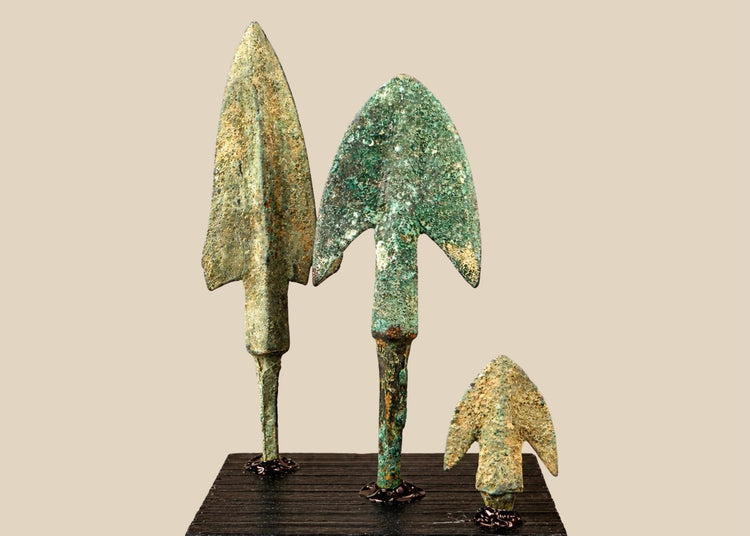
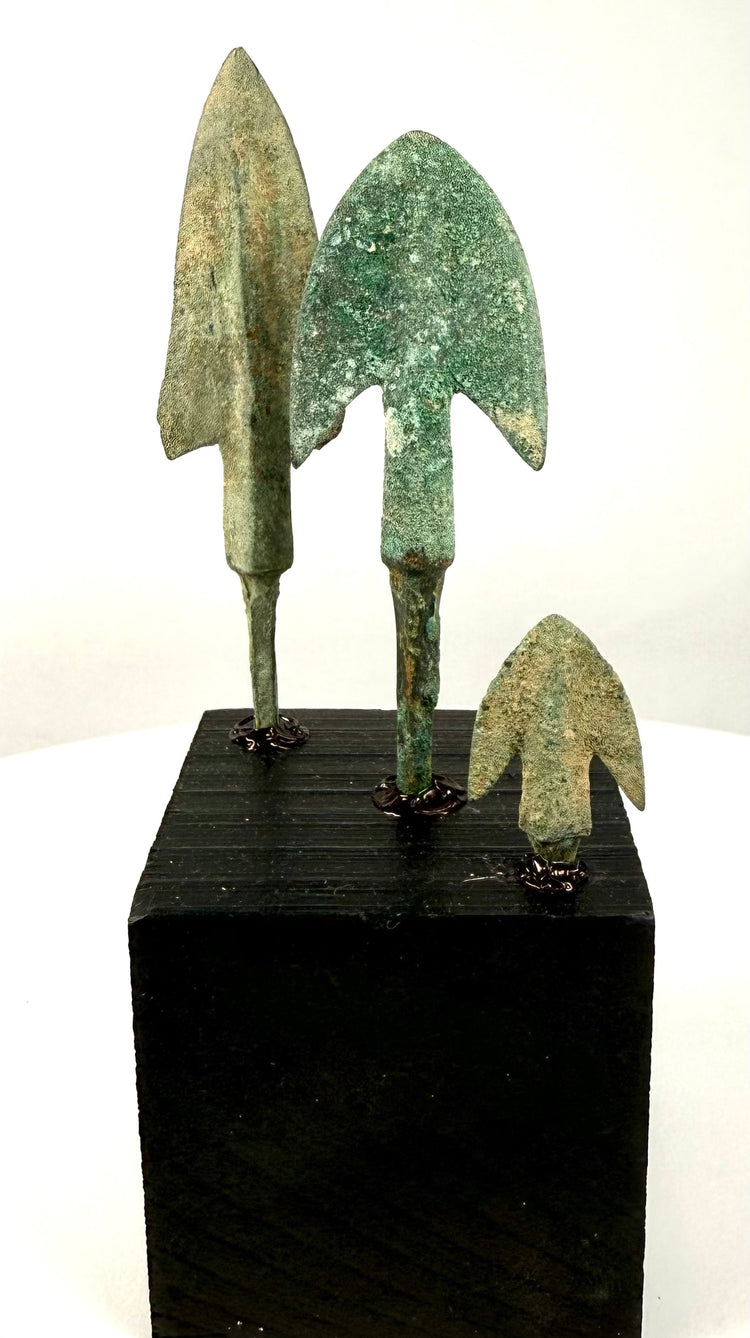
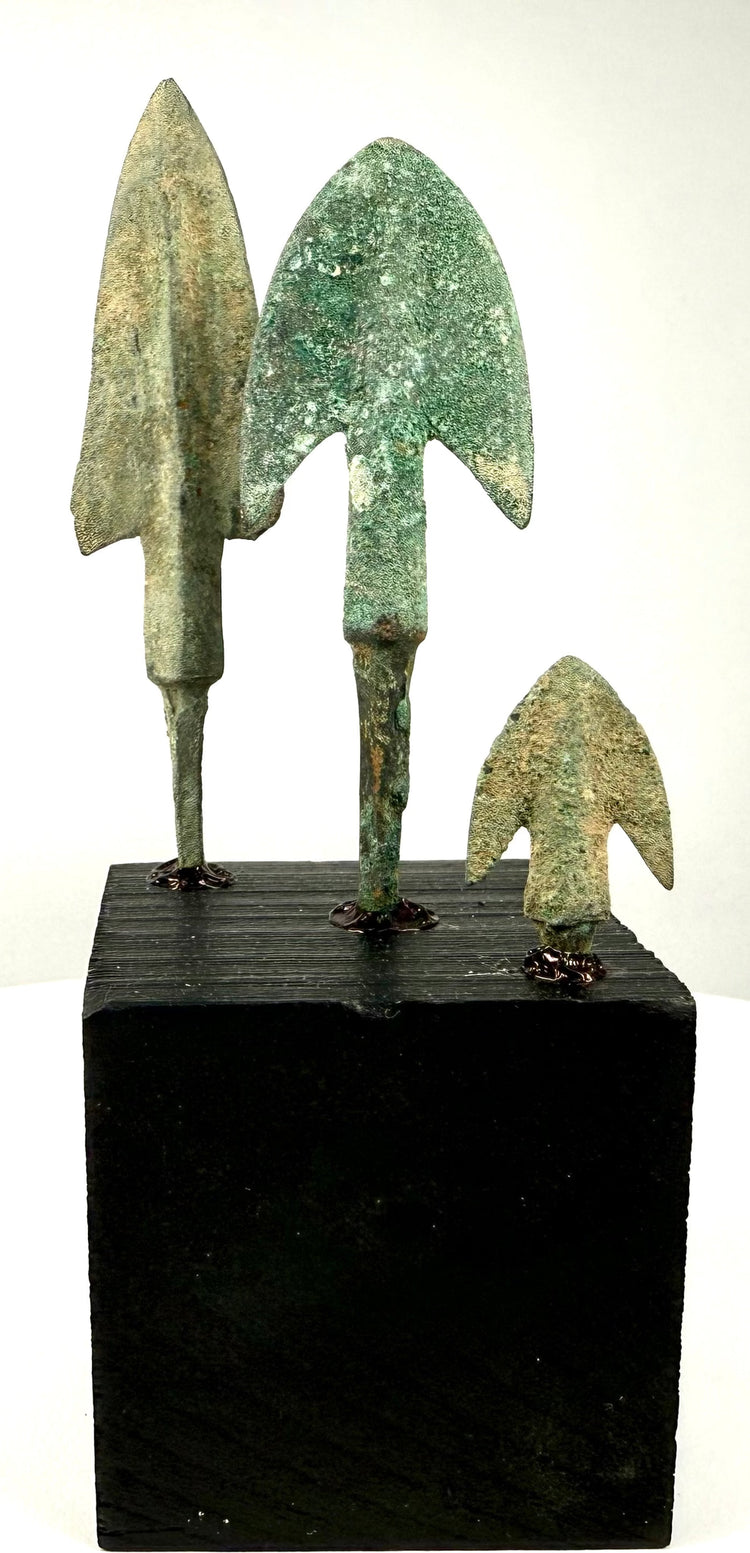
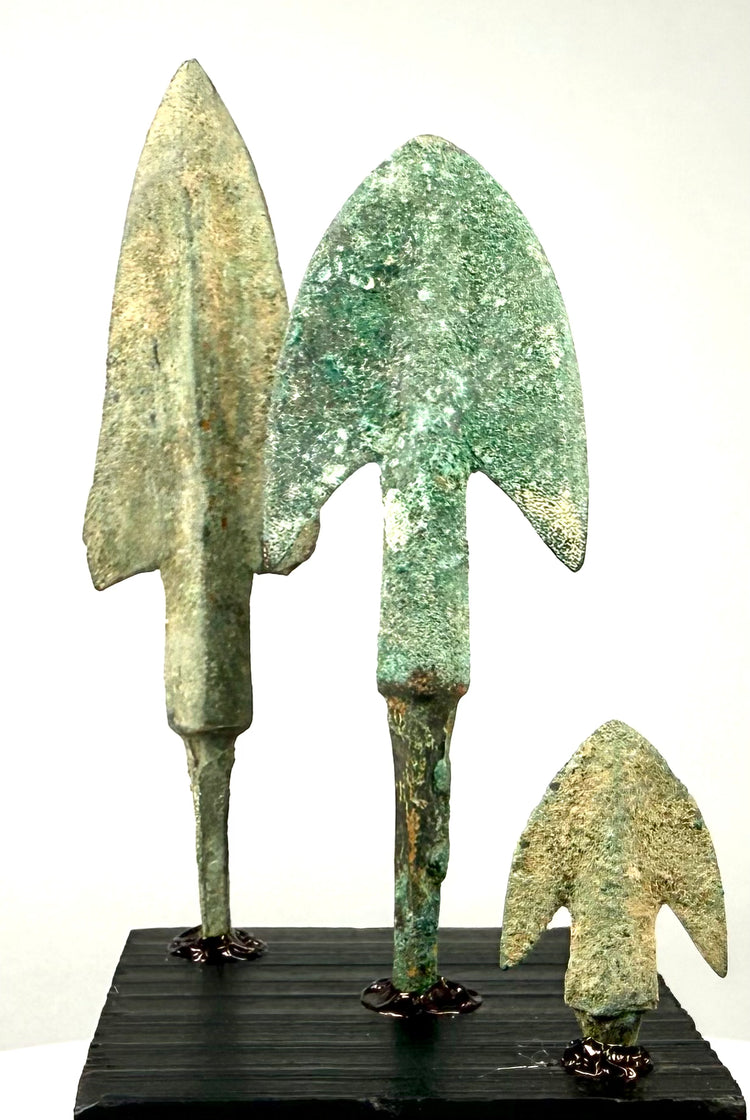
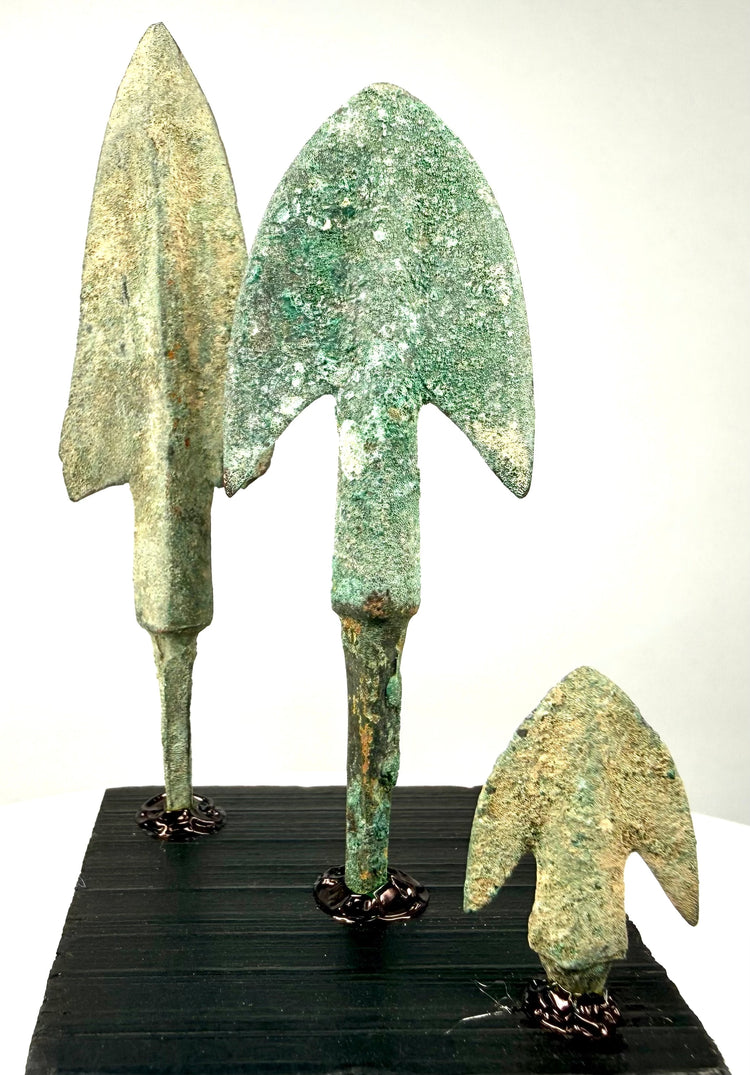
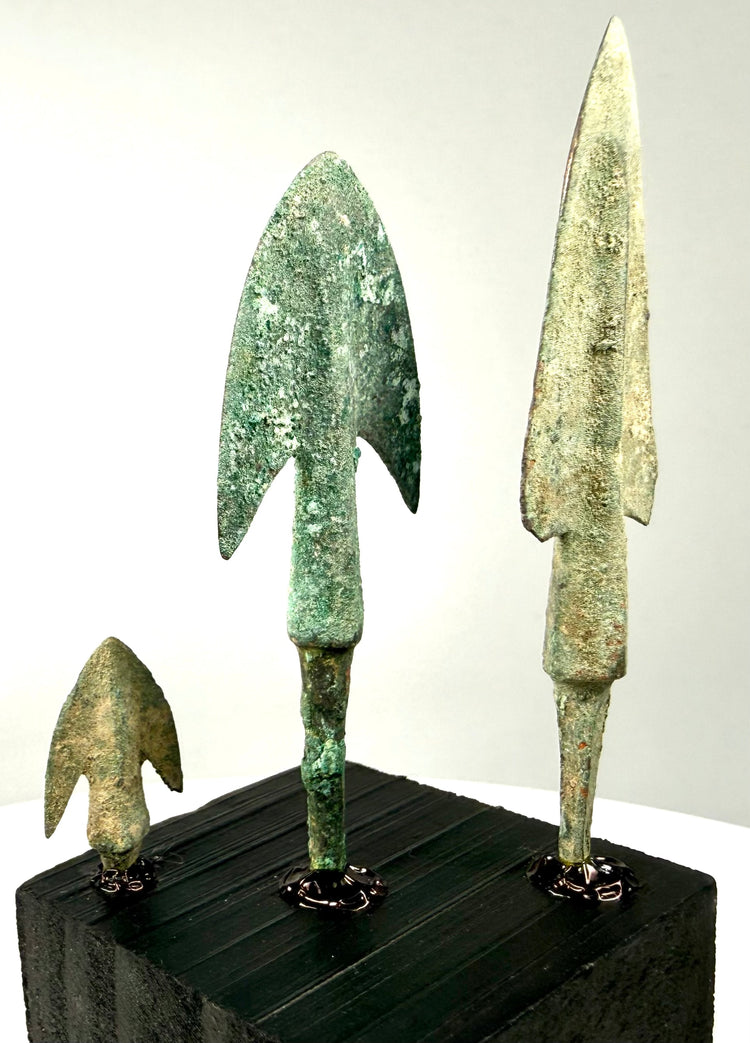
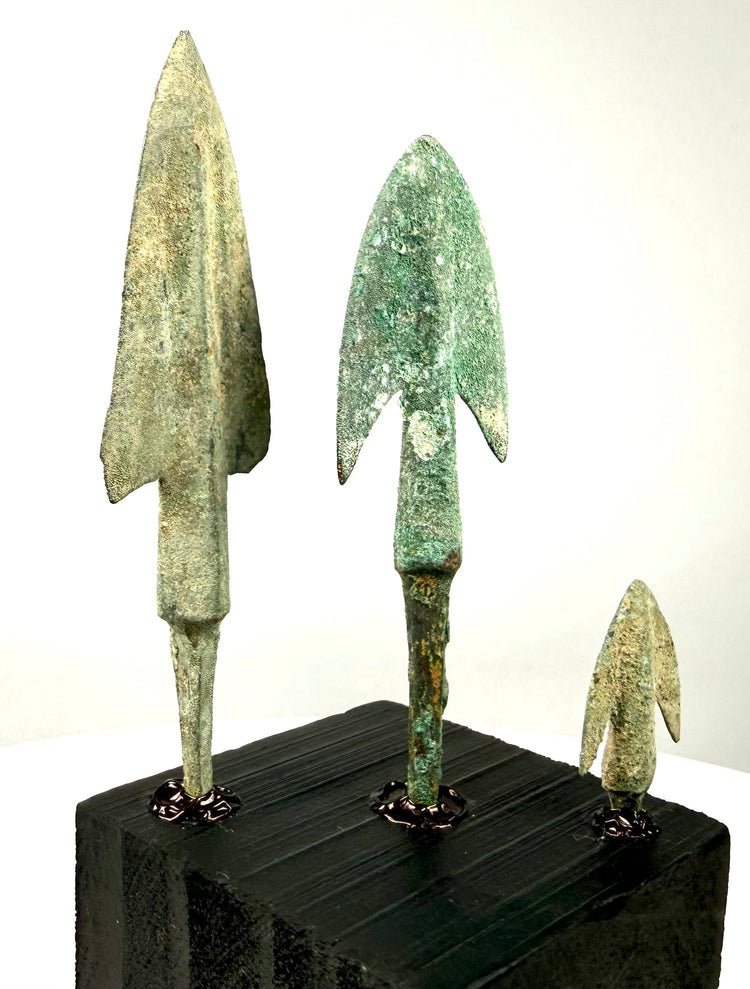
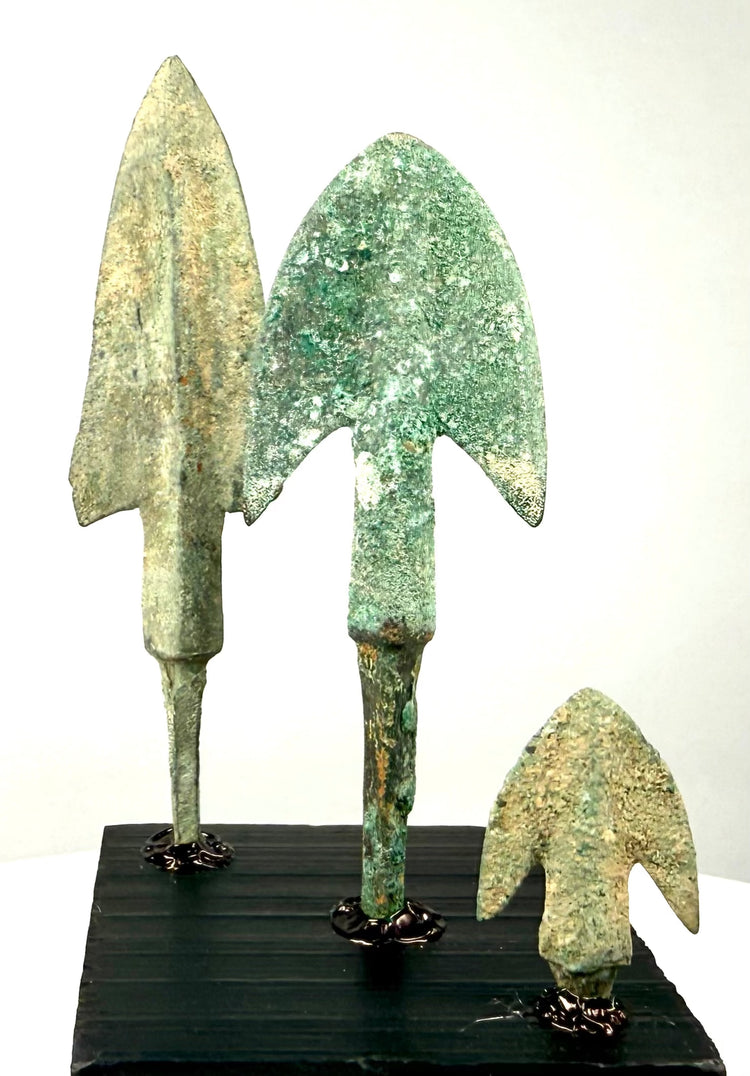
This striking mounted collection comprises three ancient-style bronze projectile points representing different blade configurations associated with the weapon-making traditions of Western Asia during the Late Bronze Age and Early Iron Age.
The group features an elongated lanceolate point with a prominent central ridge, a substantial broad-bladed example with dramatically projecting wing-like shoulders, and a smaller compact barbed arrowhead. Each retains its original attachment tang and is presented upright on a single modern black wooden display pedestal.
The contrasting silhouettes, surviving construction details, and extensive green mineral patination make this an attractive comparative grouping illustrating the diversity of bronze projectile weaponry associated with the ancient Iranian Plateau and neighbouring regions.
Left Projectile Point – Elongated Lanceolate Blade
The left-hand example is distinguished by its tall, narrow blade, which tapers gradually toward a pointed terminal. A pronounced central ridge extends longitudinally along the blade, producing a reinforced profile with gently sloping faces.
The blade broadens through its lower section before forming subtly projecting shoulders above an elongated attachment element. A narrower tang extends downward, preserving evidence of the original method of securing the point to a wooden shaft.
Its surface displays pale olive-green, tan, and brown patination, with areas of mineral accumulation, pitting, and localized discoloration. The raised central ridge remains recognizable despite extensive surface weathering.
The elongated profile is consistent with bronze projectile forms designed to concentrate impact toward a relatively narrow point, potentially serving as a substantial arrowhead, dart point, or light javelin head.
Central Projectile Point – Large Winged Broadhead
The central example is particularly distinctive, featuring an exceptionally broad, rounded triangular blade with two pronounced lateral wings extending downward on either side of the central attachment stem.
The deeply recessed shoulders create a dramatic barbed or swallow-wing silhouette, giving the weapon point a considerably different appearance from conventional lanceolate examples.
Its broad blade tapers toward a rounded apex, while the lower edges sweep outward into two prominent projecting terminals. Beneath the blade, a substantial rectangular neck transitions into a long surviving tang.
The arrangement demonstrates a design in which a comparatively wide cutting surface was combined with projecting shoulders that could resist withdrawal after penetration.
The surface exhibits extensive dark green and blue-green patination, pale mineral deposits, localized brown oxidation, and areas of roughened corrosion. The contrasting colours emphasize the blade's distinctive outline and surviving attachment features.
Broad, winged bronze projectile points are associated with several ancient Western Asiatic weapon traditions, including forms attributed to the Iranian Plateau. Their unusual construction makes them particularly recognizable within collections of ancient bronze weaponry.
Right Projectile Point – Compact Barbed Arrowhead
The smallest example features a short, broad triangular blade with a pointed apex and two downward-projecting lateral barbs.
Its pronounced notches create a compact swallowtail-like silhouette, echoing the design of the larger central example while employing considerably smaller proportions.
A broad central stem extends downward from the blade before narrowing into a short surviving attachment tang.
The surface displays predominantly pale green, sandy brown, and beige mineral patination, with visible pitting, corrosion deposits, irregular blade edges, and localized surface wear.
Its compact proportions are consistent with a bronze arrowhead intended for attachment to a relatively slender wooden shaft, although the original weapon type cannot be established conclusively from the surviving metal component alone.
Features
- Attributed to Western Asian or Iranian Plateau weapon-making traditions
- Includes elongated lanceolate, large winged broadhead, and compact barbed forms
- Prominent longitudinal strengthening ridge on the elongated example
- Large central projectile point with deeply recessed shoulders and projecting lateral wings
- Smaller arrowhead with distinctive swallowtail-like profile
- Surviving attachment tangs on all three examples
- Extensive green, blue-green, olive, and pale earthen patination
- Visible mineral encrustation, surface pitting, and age-related irregularities
- Representative of bronze weapon forms associated with hunting and ancient warfare
Cultural Significance
Bronze projectile points were important components of military and hunting equipment throughout ancient Western Asia, particularly during the second and early first millennia BCE.
Across the Iranian Plateau and neighbouring regions, bronze-working traditions produced a wide variety of weapon forms, including swords, daggers, spearheads, arrowheads, and other projectile components.
During the Late Bronze Age, the ability to cast copper alloys into carefully shaped forms allowed weaponsmiths to manufacture blades with reinforced central ridges, projecting shoulders, tapered tangs, and specialized cutting profiles.
The three examples in this grouping illustrate several approaches to projectile construction.
The elongated lanceolate form provided a relatively narrow leading profile, with its raised central ridge contributing structural rigidity while limiting the amount of metal required.
By contrast, broad winged projectile points incorporated a greater blade width and sharply recessed shoulders. Such designs potentially increased cutting action while making the head more difficult to withdraw from a target following penetration.
The smaller barbed example demonstrates how similar structural principles could be applied to more compact projectile weapons.
The projecting tangs were essential to the construction of these weapons. They were inserted into prepared wooden shafts and could be reinforced using bindings, adhesives, or friction fitting, depending on the particular weapon and manufacturing tradition.
Bronze weapon production continued during the transition into the Iron Age. Although iron eventually became increasingly important in weapon manufacture, bronze remained in use because of established casting traditions, material availability, and its suitability for producing complex shapes.
Projectile points are particularly valuable archaeological objects because their blade profiles, attachment methods, and manufacturing characteristics help researchers investigate historical weapon technology, regional traditions, and developments in warfare.
Condition
The three bronze projectile points display extensive surface patination and mineralization, with visible corrosion deposits, pitting, discoloration, irregularities, edge wear, and localized surface losses.
The elongated left-hand example retains a well-defined overall profile, including its pointed blade, central ridge, lower shoulders, and surviving tang. Its surface exhibits pale green and earthy brown deposits with scattered oxidation and mineral accumulation.
The central winged broadhead retains its distinctive sweeping blade outline and prominent projecting shoulders. Extensive green and blue-green patination covers much of the surface, accompanied by pale mineral encrustation, localized edge irregularities, and corrosion along the extended tang.
The smaller barbed example remains recognizable, retaining its pointed blade and outward-projecting wings. The surface displays substantial pale mineral accumulation, pitting, softened edges, and irregularities along the barbs and lower attachment section.
Dimensions (Approximate)
Overall Display Height: 4.5 in
Age (Approximate)
3,025–3,425 years old
Provenance
Formerly part of a private London, United Kingdom collection assembled during the 1990s.
Learn More
Explore a comparable ancient Iranian bronze arrowhead in the collection of The Metropolitan Museum of Art.
Browse our Collection of Arms, Armour & Historical Weaponry.
Description
Historical Context & Origin
Region: Western Asia, attributed to the Iranian Plateau
Material: Cast bronze / copper alloy
Period: Late Bronze Age–Early Iron Age, provisionally circa 14th–10th Century BCE
Description
This striking mounted collection comprises three ancient-style bronze projectile points representing different blade configurations associated with the weapon-making traditions of Western Asia during the Late Bronze Age and Early Iron Age.
The group features an elongated lanceolate point with a prominent central ridge, a substantial broad-bladed example with dramatically projecting wing-like shoulders, and a smaller compact barbed arrowhead. Each retains its original attachment tang and is presented upright on a single modern black wooden display pedestal.
The contrasting silhouettes, surviving construction details, and extensive green mineral patination make this an attractive comparative grouping illustrating the diversity of bronze projectile weaponry associated with the ancient Iranian Plateau and neighbouring regions.
Left Projectile Point – Elongated Lanceolate Blade
The left-hand example is distinguished by its tall, narrow blade, which tapers gradually toward a pointed terminal. A pronounced central ridge extends longitudinally along the blade, producing a reinforced profile with gently sloping faces.
The blade broadens through its lower section before forming subtly projecting shoulders above an elongated attachment element. A narrower tang extends downward, preserving evidence of the original method of securing the point to a wooden shaft.
Its surface displays pale olive-green, tan, and brown patination, with areas of mineral accumulation, pitting, and localized discoloration. The raised central ridge remains recognizable despite extensive surface weathering.
The elongated profile is consistent with bronze projectile forms designed to concentrate impact toward a relatively narrow point, potentially serving as a substantial arrowhead, dart point, or light javelin head.
Central Projectile Point – Large Winged Broadhead
The central example is particularly distinctive, featuring an exceptionally broad, rounded triangular blade with two pronounced lateral wings extending downward on either side of the central attachment stem.
The deeply recessed shoulders create a dramatic barbed or swallow-wing silhouette, giving the weapon point a considerably different appearance from conventional lanceolate examples.
Its broad blade tapers toward a rounded apex, while the lower edges sweep outward into two prominent projecting terminals. Beneath the blade, a substantial rectangular neck transitions into a long surviving tang.
The arrangement demonstrates a design in which a comparatively wide cutting surface was combined with projecting shoulders that could resist withdrawal after penetration.
The surface exhibits extensive dark green and blue-green patination, pale mineral deposits, localized brown oxidation, and areas of roughened corrosion. The contrasting colours emphasize the blade's distinctive outline and surviving attachment features.
Broad, winged bronze projectile points are associated with several ancient Western Asiatic weapon traditions, including forms attributed to the Iranian Plateau. Their unusual construction makes them particularly recognizable within collections of ancient bronze weaponry.
Right Projectile Point – Compact Barbed Arrowhead
The smallest example features a short, broad triangular blade with a pointed apex and two downward-projecting lateral barbs.
Its pronounced notches create a compact swallowtail-like silhouette, echoing the design of the larger central example while employing considerably smaller proportions.
A broad central stem extends downward from the blade before narrowing into a short surviving attachment tang.
The surface displays predominantly pale green, sandy brown, and beige mineral patination, with visible pitting, corrosion deposits, irregular blade edges, and localized surface wear.
Its compact proportions are consistent with a bronze arrowhead intended for attachment to a relatively slender wooden shaft, although the original weapon type cannot be established conclusively from the surviving metal component alone.
Features
- Attributed to Western Asian or Iranian Plateau weapon-making traditions
- Includes elongated lanceolate, large winged broadhead, and compact barbed forms
- Prominent longitudinal strengthening ridge on the elongated example
- Large central projectile point with deeply recessed shoulders and projecting lateral wings
- Smaller arrowhead with distinctive swallowtail-like profile
- Surviving attachment tangs on all three examples
- Extensive green, blue-green, olive, and pale earthen patination
- Visible mineral encrustation, surface pitting, and age-related irregularities
- Representative of bronze weapon forms associated with hunting and ancient warfare
Cultural Significance
Bronze projectile points were important components of military and hunting equipment throughout ancient Western Asia, particularly during the second and early first millennia BCE.
Across the Iranian Plateau and neighbouring regions, bronze-working traditions produced a wide variety of weapon forms, including swords, daggers, spearheads, arrowheads, and other projectile components.
During the Late Bronze Age, the ability to cast copper alloys into carefully shaped forms allowed weaponsmiths to manufacture blades with reinforced central ridges, projecting shoulders, tapered tangs, and specialized cutting profiles.
The three examples in this grouping illustrate several approaches to projectile construction.
The elongated lanceolate form provided a relatively narrow leading profile, with its raised central ridge contributing structural rigidity while limiting the amount of metal required.
By contrast, broad winged projectile points incorporated a greater blade width and sharply recessed shoulders. Such designs potentially increased cutting action while making the head more difficult to withdraw from a target following penetration.
The smaller barbed example demonstrates how similar structural principles could be applied to more compact projectile weapons.
The projecting tangs were essential to the construction of these weapons. They were inserted into prepared wooden shafts and could be reinforced using bindings, adhesives, or friction fitting, depending on the particular weapon and manufacturing tradition.
Bronze weapon production continued during the transition into the Iron Age. Although iron eventually became increasingly important in weapon manufacture, bronze remained in use because of established casting traditions, material availability, and its suitability for producing complex shapes.
Projectile points are particularly valuable archaeological objects because their blade profiles, attachment methods, and manufacturing characteristics help researchers investigate historical weapon technology, regional traditions, and developments in warfare.
Condition
The three bronze projectile points display extensive surface patination and mineralization, with visible corrosion deposits, pitting, discoloration, irregularities, edge wear, and localized surface losses.
The elongated left-hand example retains a well-defined overall profile, including its pointed blade, central ridge, lower shoulders, and surviving tang. Its surface exhibits pale green and earthy brown deposits with scattered oxidation and mineral accumulation.
The central winged broadhead retains its distinctive sweeping blade outline and prominent projecting shoulders. Extensive green and blue-green patination covers much of the surface, accompanied by pale mineral encrustation, localized edge irregularities, and corrosion along the extended tang.
The smaller barbed example remains recognizable, retaining its pointed blade and outward-projecting wings. The surface displays substantial pale mineral accumulation, pitting, softened edges, and irregularities along the barbs and lower attachment section.
Dimensions (Approximate)
Overall Display Height: 4.5 in
Age (Approximate)
3,025–3,425 years old
Provenance
Formerly part of a private London, United Kingdom collection assembled during the 1990s.
Learn More
Explore a comparable ancient Iranian bronze arrowhead in the collection of The Metropolitan Museum of Art.
Browse our Collection of Arms, Armour & Historical Weaponry.
Vous aimerez peut-être aussi
