


Collection d'étude archéologique de l'ancienne Rome et du Proche-Orient | Objets en verre, en poterie et en pierre | Encadré | Vers 1000 avant notre ère – 400 de notre ère
- Prix habituel
- $1,250.00
- Prix soldé
- $1,250.00
- Prix habituel
Impossible de charger la disponibilité du service de retrait


Collection d'étude archéologique de l'ancienne Rome et du Proche-Orient | Objets en verre, en poterie et en pierre | Encadré | Vers 1000 avant notre ère – 400 de notre ère
Description
Plus
Moins
Contexte historique et origine
Région : Méditerranée orientale et Proche-Orient antique, y compris du matériel romain et probablement chypriote.
Matériau : Verre soufflé et moulé, poterie en terra sigillata, terre cuite et pierre travaillée, montés dans un cadre en bois de type boîte muséale.
Période : Du premier millénaire avant notre ère jusqu'à la période romaine, de 1000 avant notre ère à 400 de notre ère environ.
Description
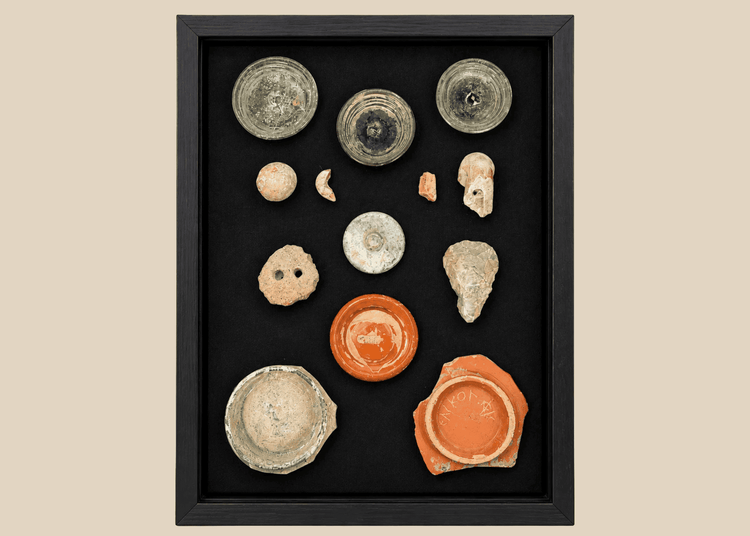
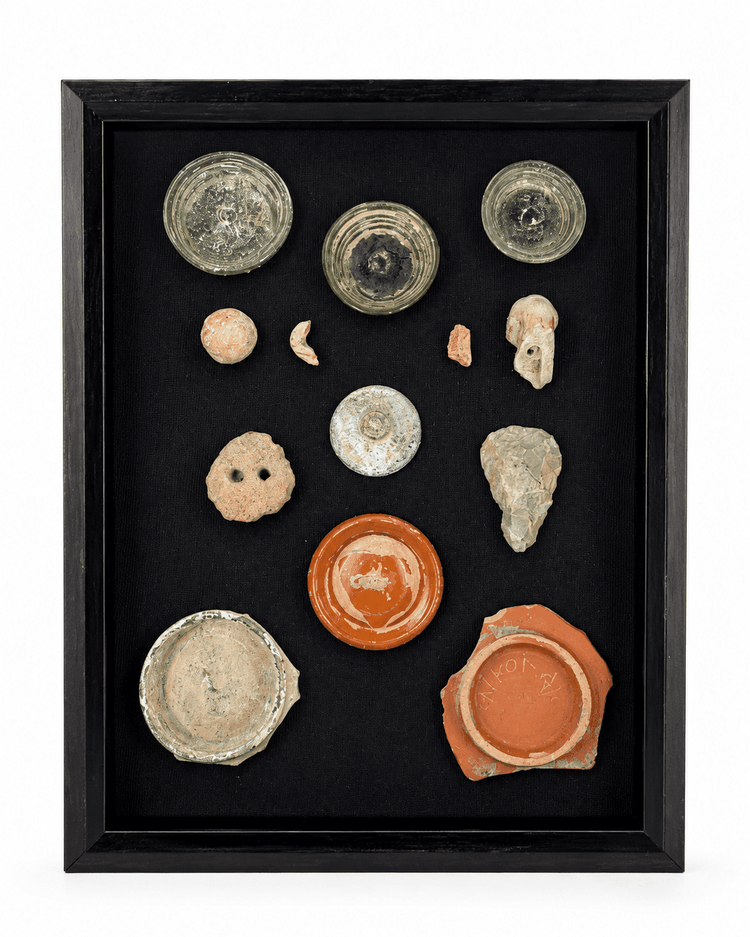
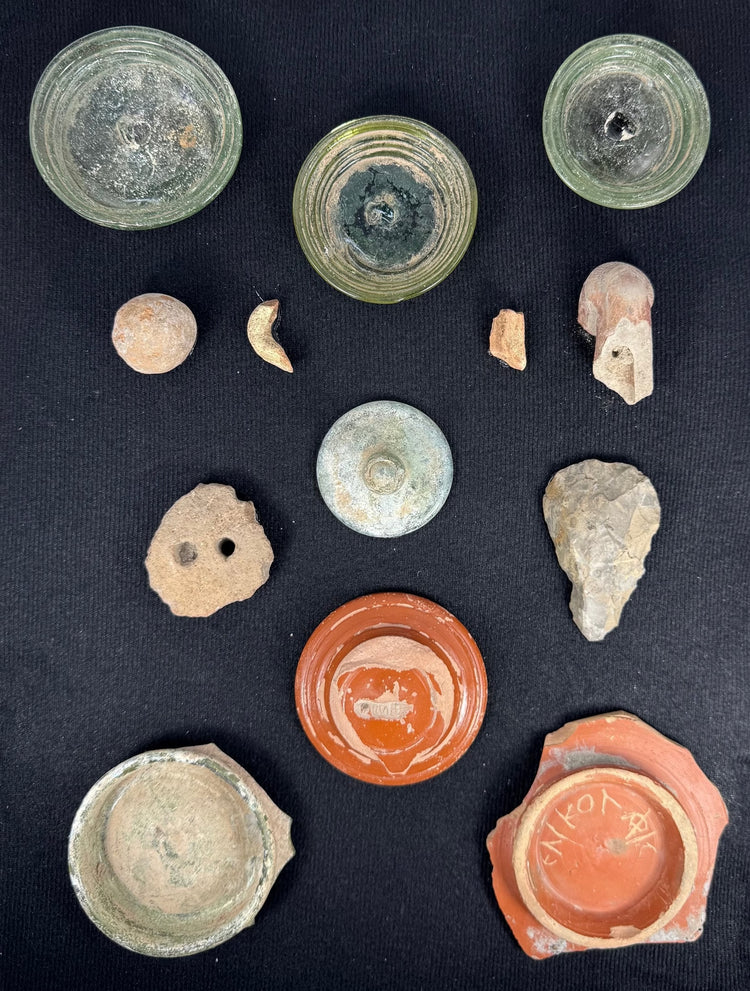
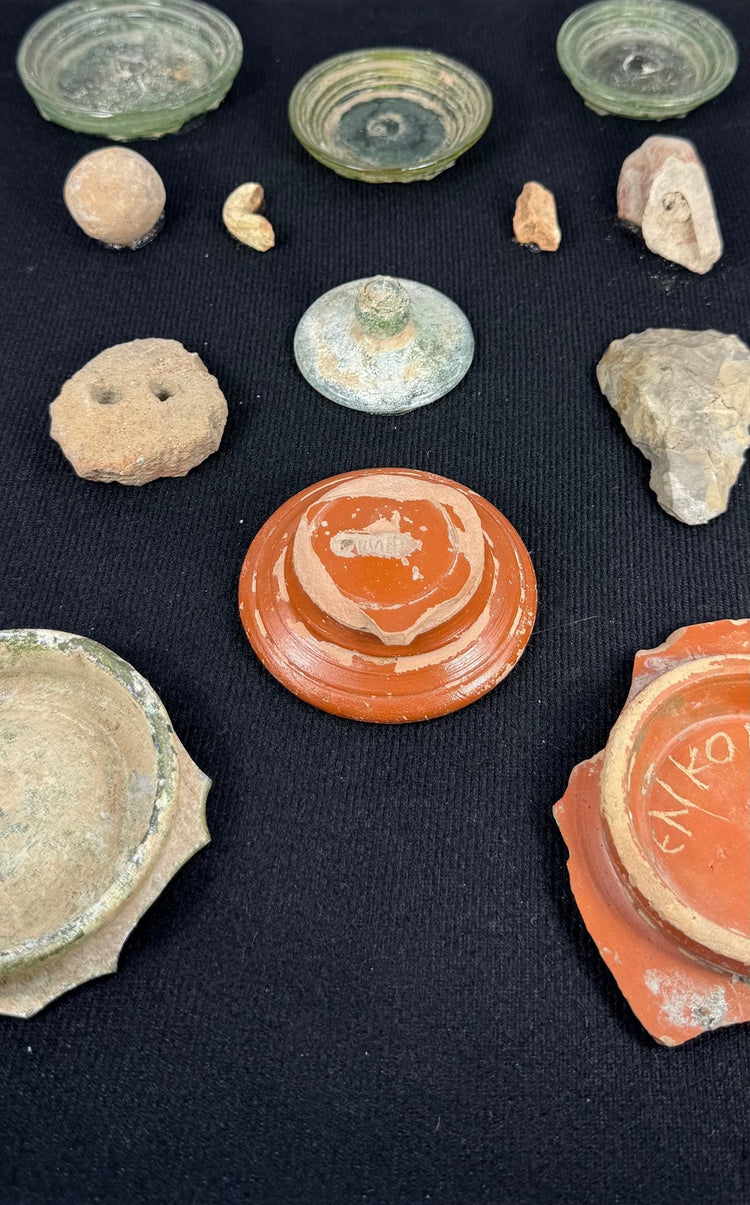
Cette collection d'étude archéologique montée de manière professionnelle réunit treize artefacts et fragments anciens en verre, poterie, terre cuite et pierre travaillée, associés à la Méditerranée orientale et au Proche-Orient antique.
Les objets sont disposés sur un fond textile noir dans un cadre profond en bois de type boîte muséale, permettant de voir ensemble les couleurs contrastées, les surfaces, les matériaux et les techniques de fabrication des pièces individuelles.
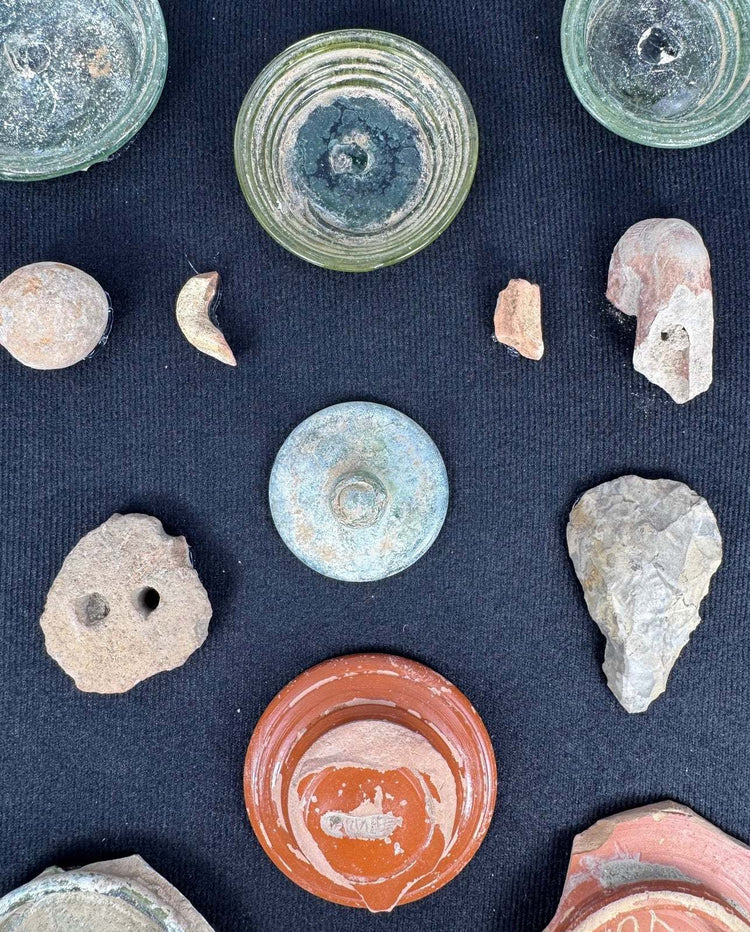
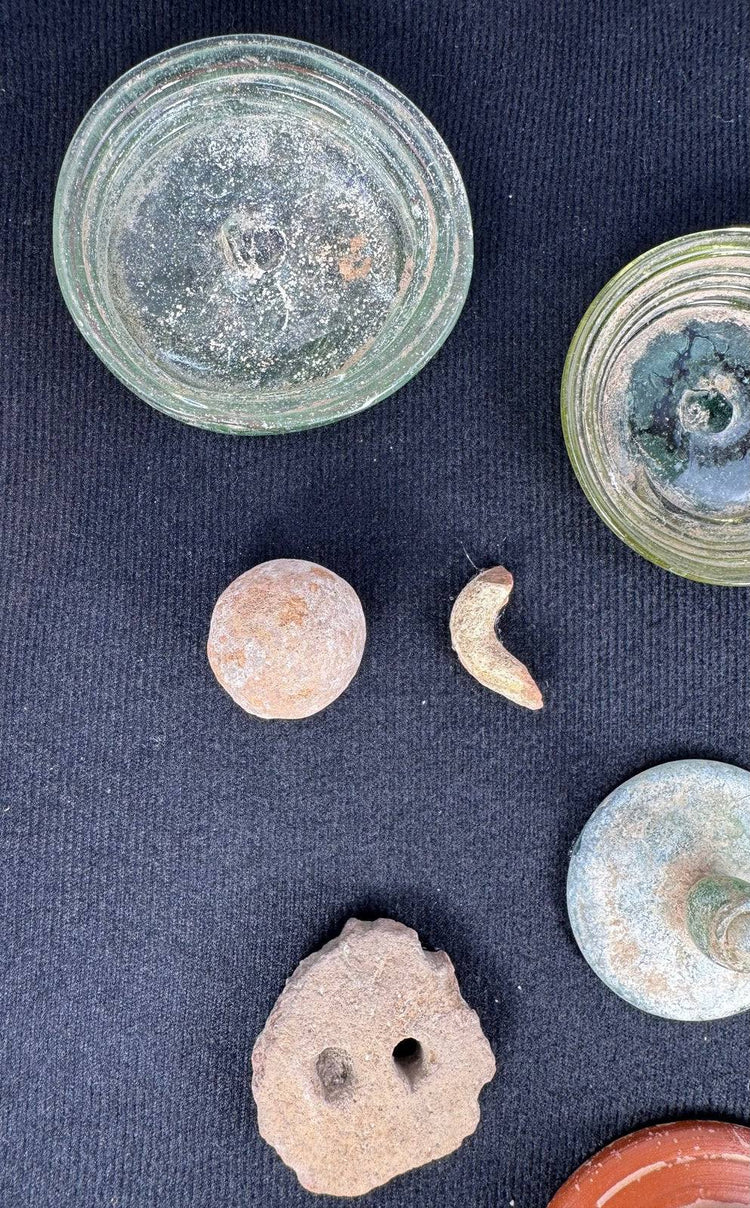
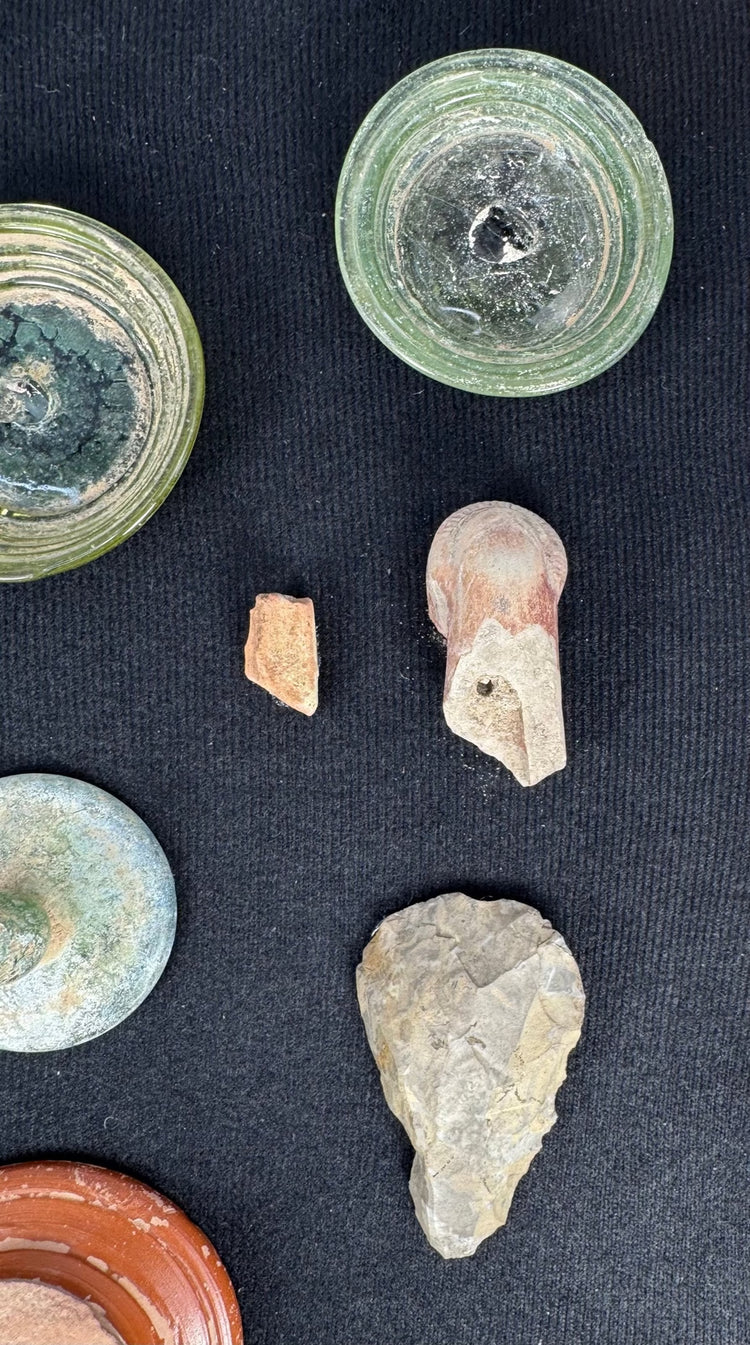
Le groupe monté comprend quatre fonds de récipients en verre romain jaune-vert, dont trois présentent des anneaux concentriques prononcés. Chacun conserve des degrés variés d'irisation, d'altération, de dépôts d'enfouissement et d'incrustations de surface produits par une exposition archéologique à long terme.
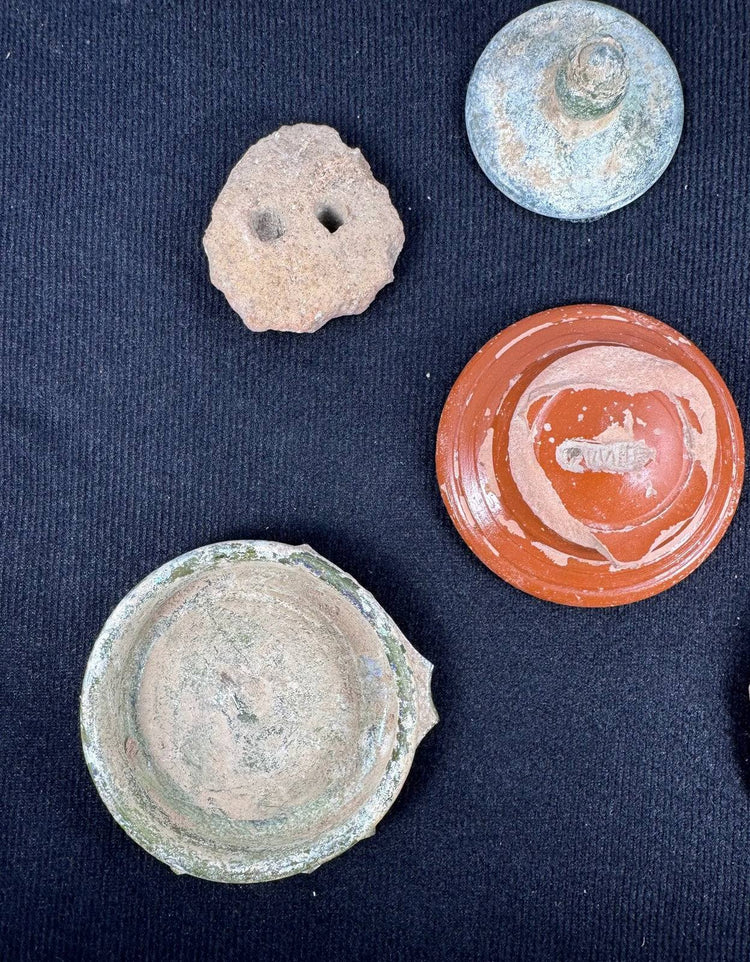
Près du centre se trouve un couvercle de jarre ou de récipient romain en verre bleu-vert avec un fleuron en forme de bouton relevé. Le couvercle conserve une belle surface bleu-vert avec une irisation étendue et des dépôts minéraux. Sa forme compacte et fonctionnelle reflète la grande variété de récipients en verre pour le stockage, les cosmétiques et l'usage domestique utilisés dans le monde romain.
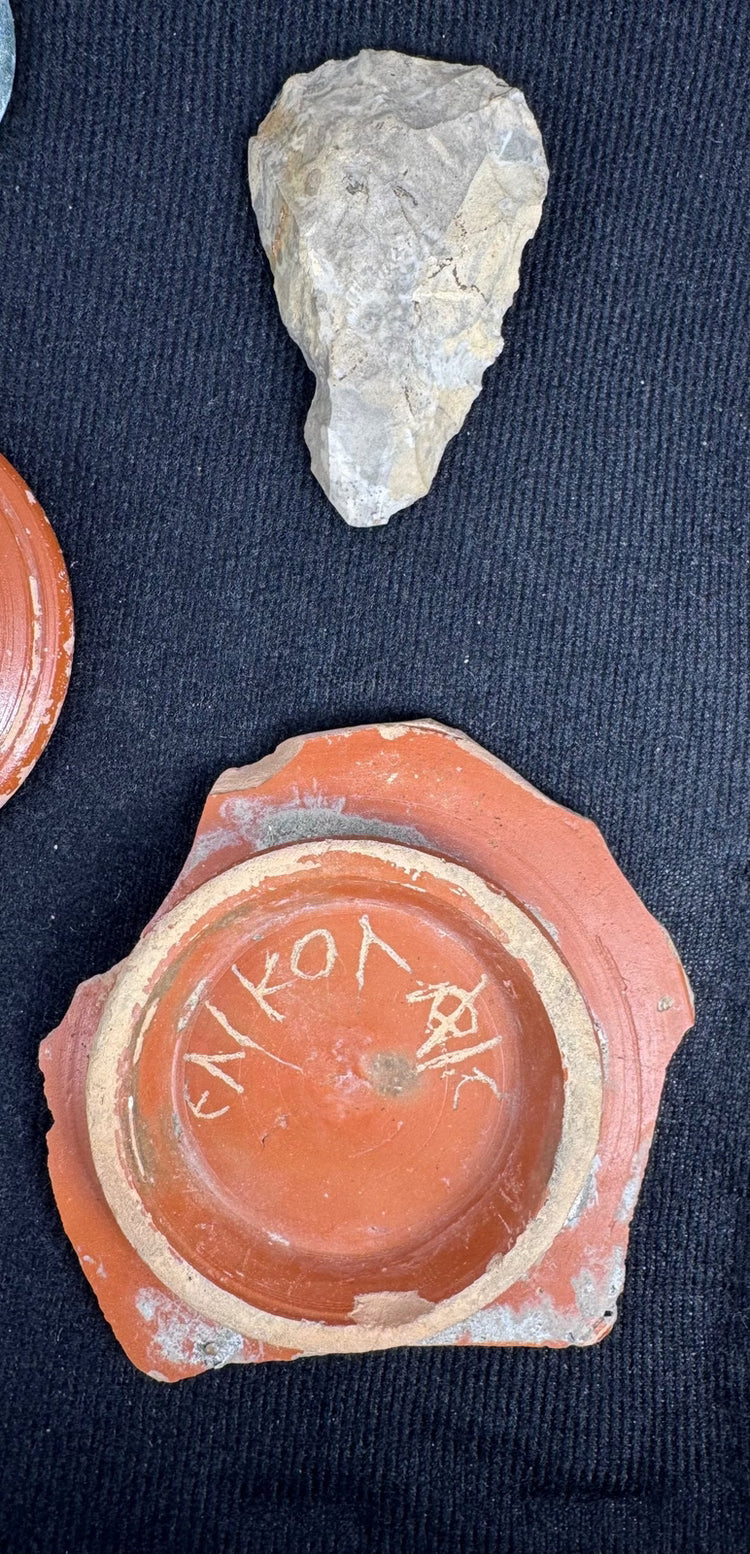
Deux fragments de fond de récipients en terra sigillata à engobe rouge apparaissent dans la partie inférieure de l'exposition. L'un conserve un long cachet de fabricant dans un cartouche en forme de pied, tandis que le second porte une inscription gravée ou un graffito de propriété sur son dessous.
La terra sigillata était une vaisselle de table de haute qualité à engobe rouge produite et largement distribuée dans tout l'Empire romain. Les cachets et inscriptions subsistants peuvent fournir des preuves précieuses concernant les ateliers anciens, la propriété, le commerce, la distribution et l'usage quotidien.
D'autres éléments en terre cuite comprennent un fragment incurvé en terre orange correspondant probablement à un repose-pouce de lampe à huile, un petit fragment de récipient en terre orange, un fragment de poterie perforée ou de pipe, et un petit fragment figuratif ou votif avec une partie supérieure arrondie.
Ces pièces témoignent de la vaste gamme d'objets utilitaires, cérémoniels et personnels fabriqués dans l'ancienne Méditerranée et au Proche-Orient.
Un outil en pierre grise travaillée ou un fragment lithique fortement façonné complète le groupe. Ses surfaces écaillées et son profil effilé suggèrent un travail délibéré, bien que son attribution culturelle précise et sa fonction originale ne puissent être établies avec certitude tant qu'il est monté dans l'exposition.
Caractéristiques
- Collection d'étude archéologique encadrée contenant treize artefacts et fragments anciens
- Quatre fonds de récipients en verre romain jaune-vert
- Trois fonds de verre avec une décoration en anneaux concentriques
- Couvercle de récipient en verre romain bleu-vert avec fleuron en forme de bouton relevé
- Deux fragments de fond de récipients romains en terra sigillata
- Un fond de terra sigillata avec un cachet de fabricant dans un cartouche en forme de pied
- Un fond de terra sigillata avec un nom ancien incisé ou un graffito de propriété
- Fragment de lampe à huile ou de récipient en poterie orangée
- Fragment de terre cuite ou de poterie perforée
- Petit fragment figuratif ou votif en terre cuite
- Outil en pierre grise travaillée ou fragment lithique
- Monté sur tissu noir dans un cadre profond en bois de type boîte muséale
Signification culturelle
Les collections d'étude de ce type démontrent la remarquable variété de matériaux et d'objets rencontrés dans l'ancienne Méditerranée orientale et au Proche-Orient. Les fonds et couvercles de récipients en verre illustrent les avancées romaines dans la fabrication du verre et l'utilisation généralisée de récipients en verre pour les cosmétiques, les médicaments, les huiles, les denrées alimentaires et le stockage domestique.
Les fragments de terra sigillata sont particulièrement instructifs. Les cachets de fabricants étaient apposés par les ateliers comme identifiants et peuvent parfois aider à l'étude des centres de fabrication, des potiers individuels, des routes de distribution et des réseaux commerciaux.
Les noms et inscriptions gravés étaient généralement ajoutés après la cuisson et peuvent représenter des marques de propriété, des annotations d'atelier, des dédicaces, des marques comptables ou une réutilisation ultérieure.
Les plus petits fragments de poterie, figuratifs et en pierre travaillée représentent des aspects plus personnels et utilitaires de la vie ancienne. Bien que fragmentaires individuellement, leur inclusion dans une seule exposition comparative permet d'apprécier clairement les différences de matériau, d'artisanat, de traitement de surface, de fonction et de conservation.
État
La collection contient des artefacts et fragments archéologiques à divers stades de conservation. L'altération liée à l'âge, les dépôts minéraux, les incrustations de sol, l'irisation, l'oxydation, les rayures, les abrasions, les éclats, les fractures, les pertes et l'érosion de surface attendus sont présents partout.
Les pièces de verre romaines conservent des portions substantielles de leurs formes circulaires, bien que certaines présentent des pertes centrales, des fissures, des piqûres et des zones d'incrustation importantes.
Les deux fonds de terra sigillata sont fragmentaires, avec des pertes autour de leurs anneaux de pied subsistants. Le cachet de fabricant et le graffito incisé restent visibles.
Les plus petites pièces en terre cuite et en pierre présentent des éclats, des bords incomplets, une usure de surface et des dépôts d'enfouissement conformes à leur âge et à leur caractère archéologique.
Les artefacts sont solidement montés et n'ont pas été retirés du cadre pour une inspection individuelle. L'état des surfaces cachées et des points de fixation est donc inconnu.
Le cadre en bois de type boîte muséale présente une usure mineure conforme à l'exposition et à la manipulation.
Dimensions (approximatives)
Largeur encadrée : 13,25 po
Hauteur encadrée : 17,25 po
Profondeur : 2,5 po
Âge (approximatif)
Les artefacts ont entre environ 1 600 et 3 000 ans.
Provenance
Anciennement dans la collection de Jack Guevrekian, Manhasset, New York, numismate et collectionneur new-yorkais renommé, particulièrement intéressé par la numismatique arménienne, les antiquités et le matériel ancien. Guevrekian a constitué une vaste collection sur plusieurs décennies, dont une partie importante a été publiquement proposée sous le nom de The Jack Guevrekian Collection par la Numismatic & Antiquarian Service Corporation of America à New York en 1977.
Par la suite, conservée dans une collection privée de New York.
Ensuite, traitée par la Howard S. Rose Gallery / Arte Primitivo à New York, une galerie et maison de ventes aux enchères spécialisée de longue date dans les antiquités et œuvres d'art précolombiennes, classiques, égyptiennes, asiatiques et ethnographiques. La galerie a organisé des ventes aux enchères spécialisées, des expositions et des ventes privées depuis ses locaux de New York.
Ensuite, traitée par Artemis Fine Arts / Artemis Gallery, un spécialiste basé au Colorado dans les antiquités, l'art ancien, le matériel ethnographique et les beaux-arts, actif dans le domaine depuis 1993.
Puis entrée dans une collection privée à Toronto, Ontario, Canada.
En savoir plus
Découvrez un groupe comparable de fragments de verre romain ancien conservé par The Metropolitan Museum of Art
Parcourez notre collection d'artefacts romains et grecs et de reliques anciennes
Description
Contexte historique et origine
Région : Méditerranée orientale et Proche-Orient antique, y compris du matériel romain et probablement chypriote.
Matériau : Verre soufflé et moulé, poterie en terra sigillata, terre cuite et pierre travaillée, montés dans un cadre en bois de type boîte muséale.
Période : Du premier millénaire avant notre ère jusqu'à la période romaine, de 1000 avant notre ère à 400 de notre ère environ.
Description
Cette collection d'étude archéologique montée de manière professionnelle réunit treize artefacts et fragments anciens en verre, poterie, terre cuite et pierre travaillée, associés à la Méditerranée orientale et au Proche-Orient antique.
Les objets sont disposés sur un fond textile noir dans un cadre profond en bois de type boîte muséale, permettant de voir ensemble les couleurs contrastées, les surfaces, les matériaux et les techniques de fabrication des pièces individuelles.
Le groupe monté comprend quatre fonds de récipients en verre romain jaune-vert, dont trois présentent des anneaux concentriques prononcés. Chacun conserve des degrés variés d'irisation, d'altération, de dépôts d'enfouissement et d'incrustations de surface produits par une exposition archéologique à long terme.
Près du centre se trouve un couvercle de jarre ou de récipient romain en verre bleu-vert avec un fleuron en forme de bouton relevé. Le couvercle conserve une belle surface bleu-vert avec une irisation étendue et des dépôts minéraux. Sa forme compacte et fonctionnelle reflète la grande variété de récipients en verre pour le stockage, les cosmétiques et l'usage domestique utilisés dans le monde romain.
Deux fragments de fond de récipients en terra sigillata à engobe rouge apparaissent dans la partie inférieure de l'exposition. L'un conserve un long cachet de fabricant dans un cartouche en forme de pied, tandis que le second porte une inscription gravée ou un graffito de propriété sur son dessous.
La terra sigillata était une vaisselle de table de haute qualité à engobe rouge produite et largement distribuée dans tout l'Empire romain. Les cachets et inscriptions subsistants peuvent fournir des preuves précieuses concernant les ateliers anciens, la propriété, le commerce, la distribution et l'usage quotidien.
D'autres éléments en terre cuite comprennent un fragment incurvé en terre orange correspondant probablement à un repose-pouce de lampe à huile, un petit fragment de récipient en terre orange, un fragment de poterie perforée ou de pipe, et un petit fragment figuratif ou votif avec une partie supérieure arrondie.
Ces pièces témoignent de la vaste gamme d'objets utilitaires, cérémoniels et personnels fabriqués dans l'ancienne Méditerranée et au Proche-Orient.
Un outil en pierre grise travaillée ou un fragment lithique fortement façonné complète le groupe. Ses surfaces écaillées et son profil effilé suggèrent un travail délibéré, bien que son attribution culturelle précise et sa fonction originale ne puissent être établies avec certitude tant qu'il est monté dans l'exposition.
Caractéristiques
- Collection d'étude archéologique encadrée contenant treize artefacts et fragments anciens
- Quatre fonds de récipients en verre romain jaune-vert
- Trois fonds de verre avec une décoration en anneaux concentriques
- Couvercle de récipient en verre romain bleu-vert avec fleuron en forme de bouton relevé
- Deux fragments de fond de récipients romains en terra sigillata
- Un fond de terra sigillata avec un cachet de fabricant dans un cartouche en forme de pied
- Un fond de terra sigillata avec un nom ancien incisé ou un graffito de propriété
- Fragment de lampe à huile ou de récipient en poterie orangée
- Fragment de terre cuite ou de poterie perforée
- Petit fragment figuratif ou votif en terre cuite
- Outil en pierre grise travaillée ou fragment lithique
- Monté sur tissu noir dans un cadre profond en bois de type boîte muséale
Signification culturelle
Les collections d'étude de ce type démontrent la remarquable variété de matériaux et d'objets rencontrés dans l'ancienne Méditerranée orientale et au Proche-Orient. Les fonds et couvercles de récipients en verre illustrent les avancées romaines dans la fabrication du verre et l'utilisation généralisée de récipients en verre pour les cosmétiques, les médicaments, les huiles, les denrées alimentaires et le stockage domestique.
Les fragments de terra sigillata sont particulièrement instructifs. Les cachets de fabricants étaient apposés par les ateliers comme identifiants et peuvent parfois aider à l'étude des centres de fabrication, des potiers individuels, des routes de distribution et des réseaux commerciaux.
Les noms et inscriptions gravés étaient généralement ajoutés après la cuisson et peuvent représenter des marques de propriété, des annotations d'atelier, des dédicaces, des marques comptables ou une réutilisation ultérieure.
Les plus petits fragments de poterie, figuratifs et en pierre travaillée représentent des aspects plus personnels et utilitaires de la vie ancienne. Bien que fragmentaires individuellement, leur inclusion dans une seule exposition comparative permet d'apprécier clairement les différences de matériau, d'artisanat, de traitement de surface, de fonction et de conservation.
État
La collection contient des artefacts et fragments archéologiques à divers stades de conservation. L'altération liée à l'âge, les dépôts minéraux, les incrustations de sol, l'irisation, l'oxydation, les rayures, les abrasions, les éclats, les fractures, les pertes et l'érosion de surface attendus sont présents partout.
Les pièces de verre romaines conservent des portions substantielles de leurs formes circulaires, bien que certaines présentent des pertes centrales, des fissures, des piqûres et des zones d'incrustation importantes.
Les deux fonds de terra sigillata sont fragmentaires, avec des pertes autour de leurs anneaux de pied subsistants. Le cachet de fabricant et le graffito incisé restent visibles.
Les plus petites pièces en terre cuite et en pierre présentent des éclats, des bords incomplets, une usure de surface et des dépôts d'enfouissement conformes à leur âge et à leur caractère archéologique.
Les artefacts sont solidement montés et n'ont pas été retirés du cadre pour une inspection individuelle. L'état des surfaces cachées et des points de fixation est donc inconnu.
Le cadre en bois de type boîte muséale présente une usure mineure conforme à l'exposition et à la manipulation.
Dimensions (approximatives)
Largeur encadrée : 13,25 po
Hauteur encadrée : 17,25 po
Profondeur : 2,5 po
Âge (approximatif)
Les artefacts ont entre environ 1 600 et 3 000 ans.
Provenance
Anciennement dans la collection de Jack Guevrekian, Manhasset, New York, numismate et collectionneur new-yorkais renommé, particulièrement intéressé par la numismatique arménienne, les antiquités et le matériel ancien. Guevrekian a constitué une vaste collection sur plusieurs décennies, dont une partie importante a été publiquement proposée sous le nom de The Jack Guevrekian Collection par la Numismatic & Antiquarian Service Corporation of America à New York en 1977.
Par la suite, conservée dans une collection privée de New York.
Ensuite, traitée par la Howard S. Rose Gallery / Arte Primitivo à New York, une galerie et maison de ventes aux enchères spécialisée de longue date dans les antiquités et œuvres d'art précolombiennes, classiques, égyptiennes, asiatiques et ethnographiques. La galerie a organisé des ventes aux enchères spécialisées, des expositions et des ventes privées depuis ses locaux de New York.
Ensuite, traitée par Artemis Fine Arts / Artemis Gallery, un spécialiste basé au Colorado dans les antiquités, l'art ancien, le matériel ethnographique et les beaux-arts, actif dans le domaine depuis 1993.
Puis entrée dans une collection privée à Toronto, Ontario, Canada.
En savoir plus
Découvrez un groupe comparable de fragments de verre romain ancien conservé par The Metropolitan Museum of Art
Parcourez notre collection d'artefacts romains et grecs et de reliques anciennes
Vous aimerez peut-être aussi
