

Ancient Roman Bronze Finger Ring with Broad Plain Oval Bezel | Circa 2nd–4th Century CE
- Prix habituel
- $225.00
- Prix soldé
- $225.00
- Prix habituel
Impossible de charger la disponibilité du service de retrait





Ancient Roman Bronze Finger Ring with Broad Plain Oval Bezel | Circa 2nd–4th Century CE
Description
Plus
Moins
Historical Context & Origin
Region: Roman Empire, Mediterranean World
Material: Bronze (copper alloy)
Period: Roman Imperial to Late Roman Period, circa 2nd–4th century CE
Description
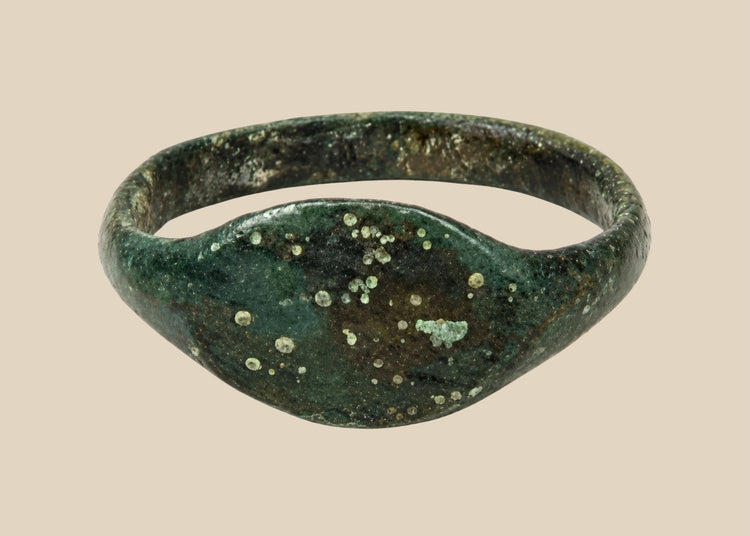
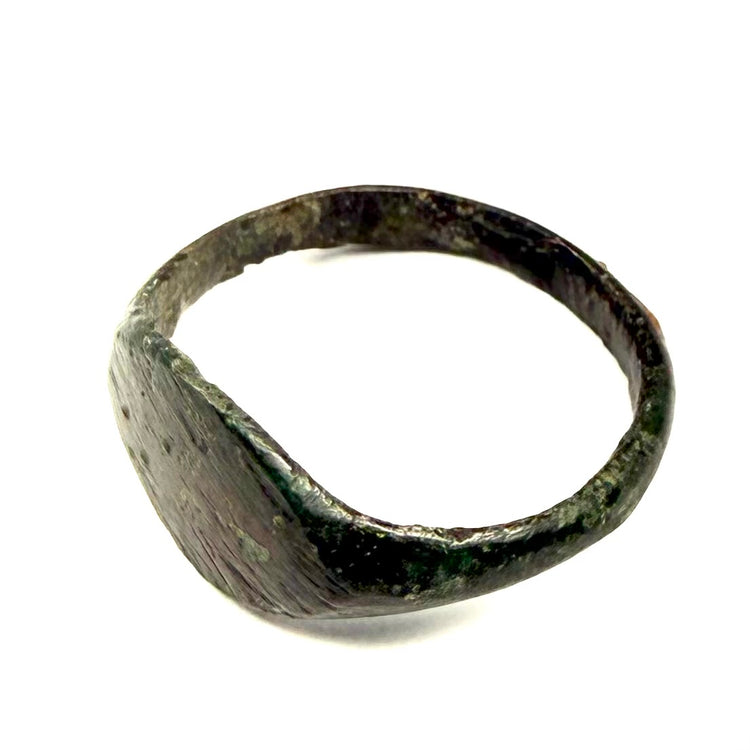
An ancient Roman bronze finger ring distinguished by its broad, smoothly formed oval bezel and substantial integral hoop. The design belongs to a widespread tradition of Roman personal rings in which the band expands gradually toward a prominent flattened face, creating a restrained but visually strong signet-style profile.
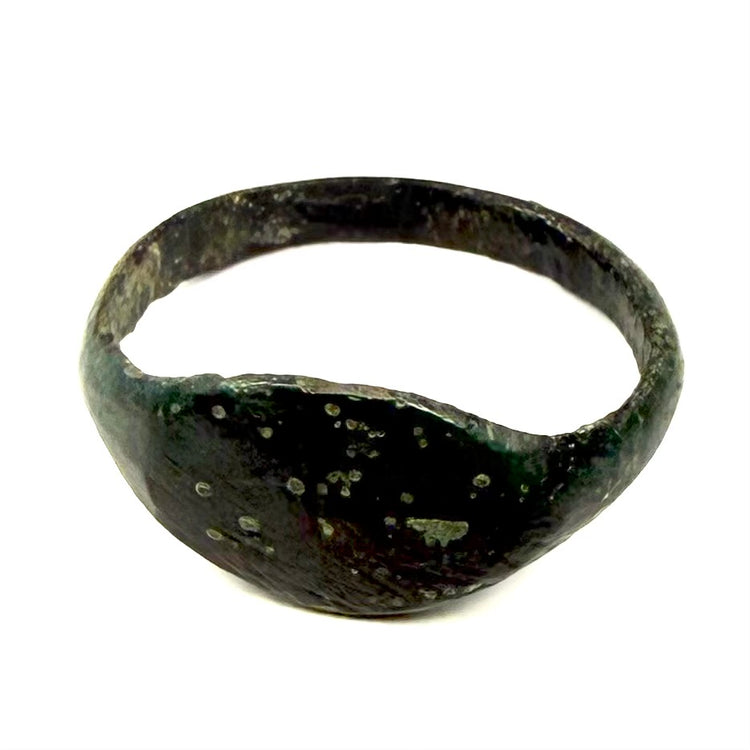
The bezel is broad and gently convex, with a dark green-black archaeological surface displaying scattered pale mineral deposits and areas of lighter oxidation. The subtle surface striations, localized pitting, and irregular mineral accretions appear consistent with long-term age, wear, and burial rather than deliberate ornamentation.
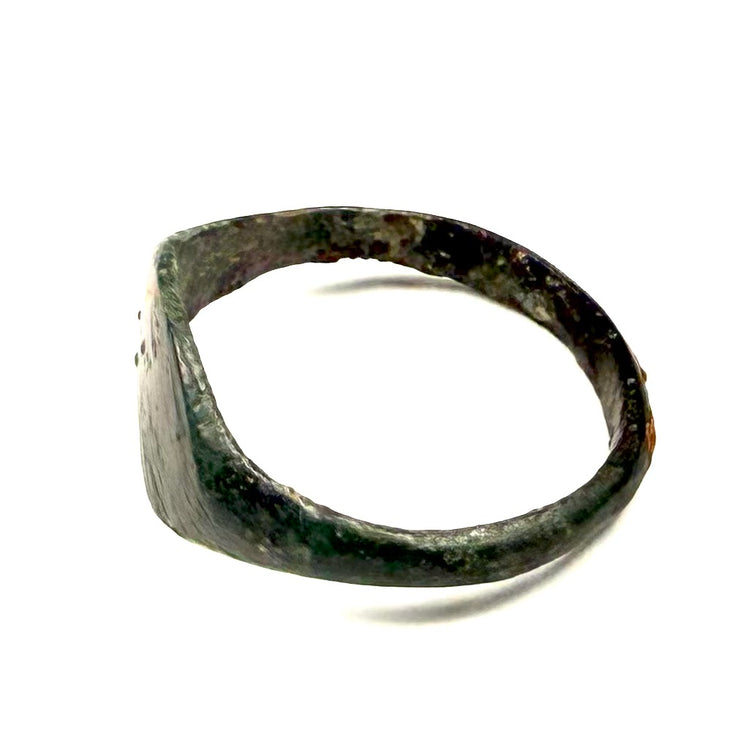
Viewed from the side, the hoop rises gradually into the bezel through broad tapering shoulders. The band narrows toward the rear and retains a slightly irregular ancient profile rather than the uniform geometry expected of modern manufacture. Dark green patination continues around the exterior and interior, accompanied by isolated reddish-brown earthen deposits and exposed areas of the underlying copper-alloy surface.
The understated design gives the ring a particularly intimate character. Rather than relying on elaborate gemstones or surviving figural engraving, its appeal lies in the strong Roman form, substantial bezel, preserved archaeological surface, and evidence of considerable age.
Features
- Solid cast copper-alloy construction
- Plain or extensively worn signet-style face
- Broad shoulders tapering gradually into the hoop
- Deep green-black archaeological patina
- Scattered pale mineral accretions across the bezel and band
- Localized reddish-brown earthen deposits visible on the hoop
- Natural surface pitting, wear, and minor irregularities consistent with antiquity
- Complete finger hoop with slightly irregular ancient form
Cultural Significance
Finger rings were among the most personal forms of adornment in the Roman world and were worn across a wide spectrum of society. They could communicate taste, identity, occupation, social position, religious affiliation, or personal relationships, while certain bezel forms also belonged to the long tradition of rings used as personal seals.
Broad-bezel bronze rings were considerably more accessible than examples made from gold or silver, yet they retained many of the same visual forms. The restrained construction of this example reflects the practical character of everyday Roman jewelry and provides a direct connection to personal adornment within the ancient Mediterranean world.
Condition
Good ancient condition consistent with age and archaeological preservation. The ring remains complete, with the broad bezel and full hoop intact. The surface displays extensive dark green-black patination, scattered pale mineral accretions, localized oxidation, minor pitting, superficial scratches, and natural age-related wear. Small reddish-brown deposits are visible along portions of the band.
Dimensions (Approximate)
Ring Size: US 7.5
Age (Approximate)
1,625–1,925 years old
Provenance
Acquired in London during the 1970s. The artifact later entered the collection of Dr. Arnold Saslow, a noted numismatist and antiquarian who handled ancient coins, antiquities, and other historic objects over several decades, and was associated with Ye Olde Curiosity Shoppe in New Jersey. It was subsequently handled by Artemis Fine Arts, a U.S.-based gallery specializing in ancient, Classical, Pre-Columbian, and ethnographic art.
Learn More
Discover a related Roman bronze finger ring dated to the 2nd–4th century AD in the collection of the British Museum
Browse our collection of Roman & Greek Artifacts
Description
Historical Context & Origin
Region: Roman Empire, Mediterranean World
Material: Bronze (copper alloy)
Period: Roman Imperial to Late Roman Period, circa 2nd–4th century CE
Description
An ancient Roman bronze finger ring distinguished by its broad, smoothly formed oval bezel and substantial integral hoop. The design belongs to a widespread tradition of Roman personal rings in which the band expands gradually toward a prominent flattened face, creating a restrained but visually strong signet-style profile.
The bezel is broad and gently convex, with a dark green-black archaeological surface displaying scattered pale mineral deposits and areas of lighter oxidation. The subtle surface striations, localized pitting, and irregular mineral accretions appear consistent with long-term age, wear, and burial rather than deliberate ornamentation.
Viewed from the side, the hoop rises gradually into the bezel through broad tapering shoulders. The band narrows toward the rear and retains a slightly irregular ancient profile rather than the uniform geometry expected of modern manufacture. Dark green patination continues around the exterior and interior, accompanied by isolated reddish-brown earthen deposits and exposed areas of the underlying copper-alloy surface.
The understated design gives the ring a particularly intimate character. Rather than relying on elaborate gemstones or surviving figural engraving, its appeal lies in the strong Roman form, substantial bezel, preserved archaeological surface, and evidence of considerable age.
Features
- Solid cast copper-alloy construction
- Plain or extensively worn signet-style face
- Broad shoulders tapering gradually into the hoop
- Deep green-black archaeological patina
- Scattered pale mineral accretions across the bezel and band
- Localized reddish-brown earthen deposits visible on the hoop
- Natural surface pitting, wear, and minor irregularities consistent with antiquity
- Complete finger hoop with slightly irregular ancient form
Cultural Significance
Finger rings were among the most personal forms of adornment in the Roman world and were worn across a wide spectrum of society. They could communicate taste, identity, occupation, social position, religious affiliation, or personal relationships, while certain bezel forms also belonged to the long tradition of rings used as personal seals.
Broad-bezel bronze rings were considerably more accessible than examples made from gold or silver, yet they retained many of the same visual forms. The restrained construction of this example reflects the practical character of everyday Roman jewelry and provides a direct connection to personal adornment within the ancient Mediterranean world.
Condition
Good ancient condition consistent with age and archaeological preservation. The ring remains complete, with the broad bezel and full hoop intact. The surface displays extensive dark green-black patination, scattered pale mineral accretions, localized oxidation, minor pitting, superficial scratches, and natural age-related wear. Small reddish-brown deposits are visible along portions of the band.
Dimensions (Approximate)
Ring Size: US 7.5
Age (Approximate)
1,625–1,925 years old
Provenance
Acquired in London during the 1970s. The artifact later entered the collection of Dr. Arnold Saslow, a noted numismatist and antiquarian who handled ancient coins, antiquities, and other historic objects over several decades, and was associated with Ye Olde Curiosity Shoppe in New Jersey. It was subsequently handled by Artemis Fine Arts, a U.S.-based gallery specializing in ancient, Classical, Pre-Columbian, and ethnographic art.
Learn More
Discover a related Roman bronze finger ring dated to the 2nd–4th century AD in the collection of the British Museum
Browse our collection of Roman & Greek Artifacts
Vous aimerez peut-être aussi
