

Ancient Roman Glass Burial Bracelet | Circa 2nd – 4th Century CE
- Prix habituel
- $650.00
- Prix soldé
- $650.00
- Prix habituel
Impossible de charger la disponibilité du service de retrait




Ancient Roman Glass Burial Bracelet | Circa 2nd – 4th Century CE
Description
Plus
Moins
Historical Context & Origin
Region: Roman Empire, exact find location unknown
Material: Dark glass, likely deep blue, blue-green, or near-black glass with extensive iridescent weathering
Period: Roman Imperial Period, circa 2nd–4th Century CE
Description
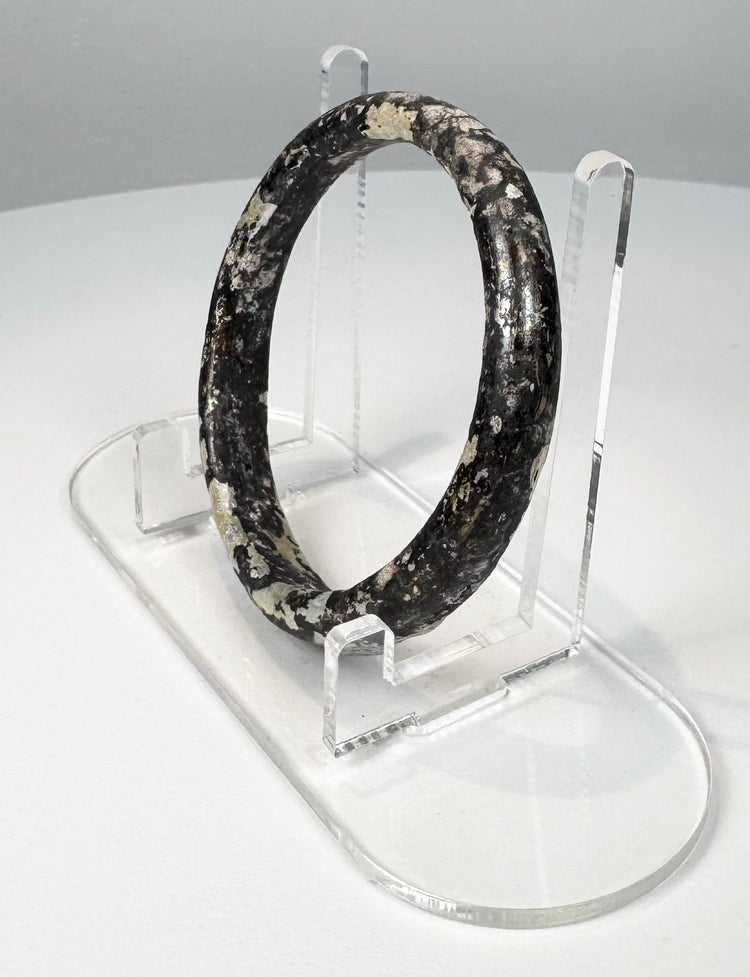
A substantial ancient Roman glass bracelet or bangle of simple circular form, reportedly recovered from a burial context.
The bracelet is formed as a continuous thick hoop with a smoothly rounded outer profile and comparatively plain interior. Its restrained design places emphasis on the material itself rather than applied decoration, producing the strong geometric form characteristic of many Roman glass bangles.
The underlying glass presently appears extremely dark—almost black—while the surface is covered by extensive areas of pale silver, cream, grey, and subtly iridescent weathering. This mottled appearance is highly characteristic of ancient buried glass. Over many centuries, chemical interaction between the glass surface, moisture, and surrounding soil can produce thin weathered layers that separate, flake, and refract light, creating the distinctive silvery or rainbow-like appearance often associated with excavated Roman glass.
The Metropolitan Museum records Roman glass bracelets with precisely these characteristics, including dark cobalt glass that appears black and survives with dulling and iridescent weathering. Comparable examples measure approximately 2¼ to 2½ inches in diameter, closely corresponding to the present bracelet.
The remarkably simple form makes this an especially evocative survivor of everyday Roman personal adornment.
Features
- Thick continuous circular form
- Dark glass appearing black in reflected light
- Likely deep blue, cobalt, blue-green, or similarly dark glass composition
- Rounded exterior profile
- Approximately 2.25-inch diameter
- Extensive silver-white and cream surface weathering
- Areas of iridescence characteristic of ancient glass deterioration
- Naturally mottled archaeological surface
- Reportedly excavated from a burial context
- Complete circular form with no major loss
Cultural Significance
Bracelets were worn throughout Roman society and could be manufactured from gold, silver, copper alloy, bone, ivory, jet, shale, and glass. Glass provided Roman craftspeople with an especially versatile material because it could imitate more costly stones while also producing colors unavailable in many natural materials.
Dark glass bracelets became particularly widespread during Late Antiquity. Archaeological research has documented glass and black-glass bracelets in significant numbers from the 3rd and 4th centuries CE.
Bracelets also have an established connection with Roman funerary archaeology. Studies of Late Roman cemeteries show that bracelets were sometimes recovered directly from the wrist area of the deceased, indicating that they were worn during burial rather than merely deposited separately as offerings. Grave assemblages from the 4th and 5th centuries include bracelets of glass as well as metal, bone, shale, and other materials.
Condition
Ancient archaeological condition with extensive weathering consistent with prolonged burial.
The bracelet remains substantially complete and retains its original circular form. The surface exhibits heavy mineralization, pitting, dulling, exfoliation, and widespread silver-white, cream, grey, and iridescent weathering. Numerous small areas of the weathered outer layer have naturally flaked away, revealing darker glass beneath.
These surface effects should not be confused with painted decoration; they are consistent with the natural deterioration and alteration of archaeological glass.
Dimensions (Approximate)
Overall Diameter: 2.25 in
Age (Approximate)
1,600–1,900 years old
Provenance
Reportedly excavated from an ancient burial or grave context.
Formerly held in a private collection in New York, New York, USA.
Subsequently handled by Captain Ahab’s Antiques, a longstanding New York antiques and auction business established in the late 1970s in Port Jefferson, Long Island. The business handled antiques, fine art, jewelry, coins, fossils, mineral specimens, and unusual collectibles.
Learn More
Compare this piece with a related Roman glass bracelet in the collection of the Metropolitan Museum of Art
Browse more from our collection of Roman & Greek Artifacts
Description
Historical Context & Origin
Region: Roman Empire, exact find location unknown
Material: Dark glass, likely deep blue, blue-green, or near-black glass with extensive iridescent weathering
Period: Roman Imperial Period, circa 2nd–4th Century CE
Description
A substantial ancient Roman glass bracelet or bangle of simple circular form, reportedly recovered from a burial context.
The bracelet is formed as a continuous thick hoop with a smoothly rounded outer profile and comparatively plain interior. Its restrained design places emphasis on the material itself rather than applied decoration, producing the strong geometric form characteristic of many Roman glass bangles.
The underlying glass presently appears extremely dark—almost black—while the surface is covered by extensive areas of pale silver, cream, grey, and subtly iridescent weathering. This mottled appearance is highly characteristic of ancient buried glass. Over many centuries, chemical interaction between the glass surface, moisture, and surrounding soil can produce thin weathered layers that separate, flake, and refract light, creating the distinctive silvery or rainbow-like appearance often associated with excavated Roman glass.
The Metropolitan Museum records Roman glass bracelets with precisely these characteristics, including dark cobalt glass that appears black and survives with dulling and iridescent weathering. Comparable examples measure approximately 2¼ to 2½ inches in diameter, closely corresponding to the present bracelet.
The remarkably simple form makes this an especially evocative survivor of everyday Roman personal adornment.
Features
- Thick continuous circular form
- Dark glass appearing black in reflected light
- Likely deep blue, cobalt, blue-green, or similarly dark glass composition
- Rounded exterior profile
- Approximately 2.25-inch diameter
- Extensive silver-white and cream surface weathering
- Areas of iridescence characteristic of ancient glass deterioration
- Naturally mottled archaeological surface
- Reportedly excavated from a burial context
- Complete circular form with no major loss
Cultural Significance
Bracelets were worn throughout Roman society and could be manufactured from gold, silver, copper alloy, bone, ivory, jet, shale, and glass. Glass provided Roman craftspeople with an especially versatile material because it could imitate more costly stones while also producing colors unavailable in many natural materials.
Dark glass bracelets became particularly widespread during Late Antiquity. Archaeological research has documented glass and black-glass bracelets in significant numbers from the 3rd and 4th centuries CE.
Bracelets also have an established connection with Roman funerary archaeology. Studies of Late Roman cemeteries show that bracelets were sometimes recovered directly from the wrist area of the deceased, indicating that they were worn during burial rather than merely deposited separately as offerings. Grave assemblages from the 4th and 5th centuries include bracelets of glass as well as metal, bone, shale, and other materials.
Condition
Ancient archaeological condition with extensive weathering consistent with prolonged burial.
The bracelet remains substantially complete and retains its original circular form. The surface exhibits heavy mineralization, pitting, dulling, exfoliation, and widespread silver-white, cream, grey, and iridescent weathering. Numerous small areas of the weathered outer layer have naturally flaked away, revealing darker glass beneath.
These surface effects should not be confused with painted decoration; they are consistent with the natural deterioration and alteration of archaeological glass.
Dimensions (Approximate)
Overall Diameter: 2.25 in
Age (Approximate)
1,600–1,900 years old
Provenance
Reportedly excavated from an ancient burial or grave context.
Formerly held in a private collection in New York, New York, USA.
Subsequently handled by Captain Ahab’s Antiques, a longstanding New York antiques and auction business established in the late 1970s in Port Jefferson, Long Island. The business handled antiques, fine art, jewelry, coins, fossils, mineral specimens, and unusual collectibles.
Learn More
Compare this piece with a related Roman glass bracelet in the collection of the Metropolitan Museum of Art
Browse more from our collection of Roman & Greek Artifacts
Vous aimerez peut-être aussi
