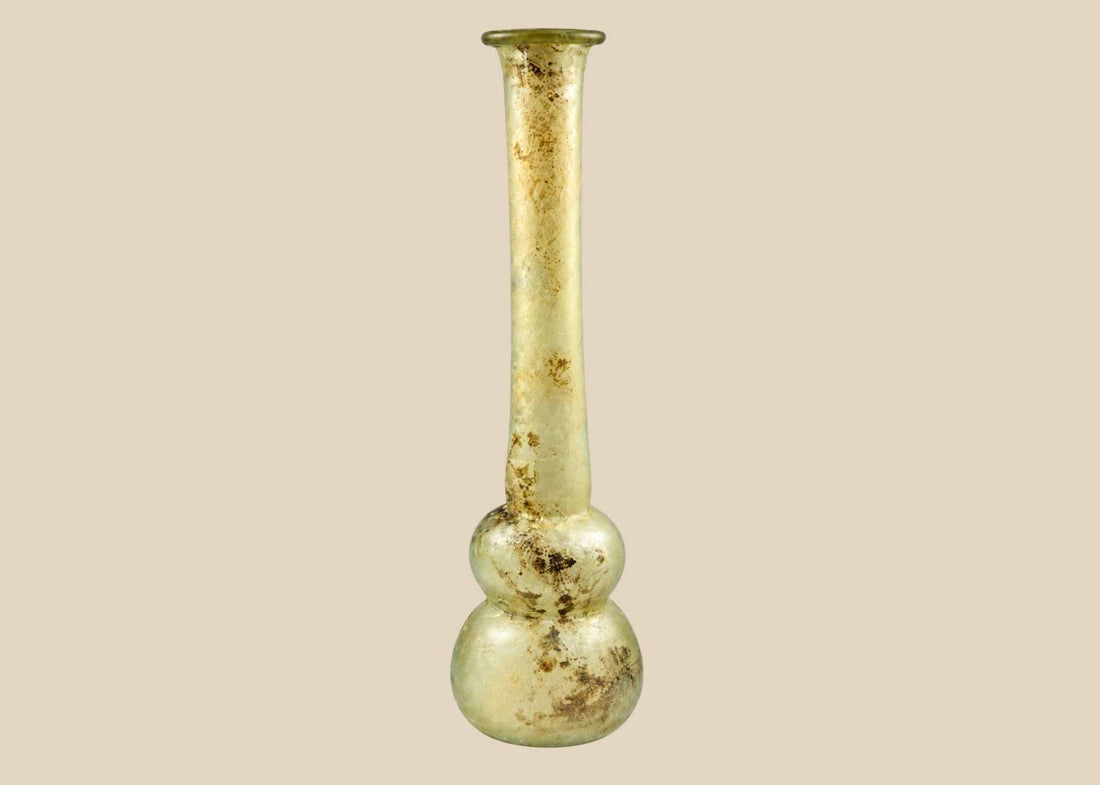
Chandelier romain à double calebasse en verre transparent, Balsamarium | Vers le IIe-IIIe siècle après J.-C.

Historique de provenance et de propriété

Proposée par Waddington’s Auctioneers & Appraisers, Toronto, Ontario, dans sa vente aux enchères Cabinet de curiositésdu 14 décembre 2023, sous le lot 642. Après la vente aux enchères, la pièce est entrée dans une importante collection privée à Toronto, Ontario, Canada.

Prix habituel
$600.00
Prix soldé
$600.00
Prix habituel
Frais de port calculés à la caisse.
Customers rate us 4.97/5 based on 121 reviews.

This is a one-of-a-kind historical object. Once sold, this exact piece will not be restocked.

Questions before acquiring? Additional photographs, condition details, documentation, shipping information or a private viewing are available upon request.
Ancient Roman pale green blown-glass tear bottle from the Israel region, 2nd century CE, with a double-bulb body and golden iridescence.
360-degree video showcasing an ancient Roman pale green blown-glass tear bottle from the Israel region, dating to the 2nd century CE. Features an elongated cylindrical neck, folded flared rim, distinctive double-bulb body, natural golden iridescence, and centuries-old mineral deposits and surface patina.
Ancient Roman blown-glass tear bottle from the Israel region, dating to the 2nd century CE, featuring a tall cylindrical neck and distinctive double-bulb body.
Roman blown-glass tear bottle with an elongated cylindrical neck, folded flared rim, and two rounded bulbs connected by a narrow waist.
Ancient Roman glass unguentarium dating to circa 100–200 CE, displaying naturally developed golden iridescence and scattered brown burial deposits.
Eastern Mediterranean Roman blown-glass tear bottle featuring a smaller upper bulb, larger rounded lower bulb, and slender cylindrical neck.
Ancient Roman cosmetic or perfume bottle crafted from pale green glass, preserving its distinctive double-bulb silhouette and delicate flared opening.
Archaeological Roman glass vessel from the 2nd century CE, displaying shimmering golden iridescence, mineral encrustations, and natural surface weathering.
Roman blown-glass tear bottle featuring a folded rim and exceptionally tall cylindrical neck, reflecting ancient Eastern Mediterranean glassmaking traditions.
Ancient Roman double-bulb glass bottle with a narrow central waist, pale green translucent surfaces, and golden iridescent patina from centuries of burial.
Ancient Roman glass tear bottle attributed to the Israel region, featuring a tall neck and two rounded chambers of differing sizes.
Second-century Roman blown-glass tear bottle with scattered brown mineral deposits, golden iridescence, and archaeological surface weathering.
Ancient Roman pale green glass unguentarium measuring approximately 9.5 inches tall, featuring a double-bulb body and naturally weathered iridescent surface.
Ancient Roman double-bulb blown-glass tear bottle from the Israel region, presented in an acrylic display case with golden iridescence and archaeological patina.
  • Ancient Roman pale green blown-glass tear bottle from the Israel region, 2nd century CE, with a double-bulb body and golden iridescence.
  • 360-degree video showcasing an ancient Roman pale green blown-glass tear bottle from the Israel region, dating to the 2nd century CE. Features an elongated cylindrical neck, folded flared rim, distinctive double-bulb body, natural golden iridescence, and centuries-old mineral deposits and surface patina.
  • Ancient Roman blown-glass tear bottle from the Israel region, dating to the 2nd century CE, featuring a tall cylindrical neck and distinctive double-bulb body.
  • Roman blown-glass tear bottle with an elongated cylindrical neck, folded flared rim, and two rounded bulbs connected by a narrow waist.
  • Ancient Roman glass unguentarium dating to circa 100–200 CE, displaying naturally developed golden iridescence and scattered brown burial deposits.
  • Eastern Mediterranean Roman blown-glass tear bottle featuring a smaller upper bulb, larger rounded lower bulb, and slender cylindrical neck.
  • Ancient Roman cosmetic or perfume bottle crafted from pale green glass, preserving its distinctive double-bulb silhouette and delicate flared opening.
  • Archaeological Roman glass vessel from the 2nd century CE, displaying shimmering golden iridescence, mineral encrustations, and natural surface weathering.
  • Roman blown-glass tear bottle featuring a folded rim and exceptionally tall cylindrical neck, reflecting ancient Eastern Mediterranean glassmaking traditions.
  • Ancient Roman double-bulb glass bottle with a narrow central waist, pale green translucent surfaces, and golden iridescent patina from centuries of burial.
  • Ancient Roman glass tear bottle attributed to the Israel region, featuring a tall neck and two rounded chambers of differing sizes.
  • Second-century Roman blown-glass tear bottle with scattered brown mineral deposits, golden iridescence, and archaeological surface weathering.
  • Ancient Roman pale green glass unguentarium measuring approximately 9.5 inches tall, featuring a double-bulb body and naturally weathered iridescent surface.
  • Ancient Roman double-bulb blown-glass tear bottle from the Israel region, presented in an acrylic display case with golden iridescence and archaeological patina.
Ancient Roman pale green blown-glass tear bottle from the Israel region, 2nd century CE, with a double-bulb body and golden iridescence.
360-degree video showcasing an ancient Roman pale green blown-glass tear bottle from the Israel region, dating to the 2nd century CE. Features an elongated cylindrical neck, folded flared rim, distinctive double-bulb body, natural golden iridescence, and centuries-old mineral deposits and surface patina.
Ancient Roman blown-glass tear bottle from the Israel region, dating to the 2nd century CE, featuring a tall cylindrical neck and distinctive double-bulb body.
Roman blown-glass tear bottle with an elongated cylindrical neck, folded flared rim, and two rounded bulbs connected by a narrow waist.
Ancient Roman glass unguentarium dating to circa 100–200 CE, displaying naturally developed golden iridescence and scattered brown burial deposits.
Eastern Mediterranean Roman blown-glass tear bottle featuring a smaller upper bulb, larger rounded lower bulb, and slender cylindrical neck.
Ancient Roman cosmetic or perfume bottle crafted from pale green glass, preserving its distinctive double-bulb silhouette and delicate flared opening.
Archaeological Roman glass vessel from the 2nd century CE, displaying shimmering golden iridescence, mineral encrustations, and natural surface weathering.
Roman blown-glass tear bottle featuring a folded rim and exceptionally tall cylindrical neck, reflecting ancient Eastern Mediterranean glassmaking traditions.
Ancient Roman double-bulb glass bottle with a narrow central waist, pale green translucent surfaces, and golden iridescent patina from centuries of burial.
Ancient Roman glass tear bottle attributed to the Israel region, featuring a tall neck and two rounded chambers of differing sizes.
Second-century Roman blown-glass tear bottle with scattered brown mineral deposits, golden iridescence, and archaeological surface weathering.
Ancient Roman pale green glass unguentarium measuring approximately 9.5 inches tall, featuring a double-bulb body and naturally weathered iridescent surface.
Ancient Roman double-bulb blown-glass tear bottle from the Israel region, presented in an acrylic display case with golden iridescence and archaeological patina.
Authenticity and secure checkout guarantee

Chandelier romain à double calebasse en verre transparent, Balsamarium | Vers le IIe-IIIe siècle après J.-C.

Description

Contexte historique et origine

Région : Empire romain (probablement Méditerranée orientale)
Matériau : Verre clair avec patine irisée naturelle
Période : IIe-IIIe siècle de notre ère

Description

Ce balsamarium double gourde en verre clair romain témoigne de l'élégance et de l'aspect pratique de la verrerie romaine. Fabriqué avec deux sections globulaires jointes par un col mince, le récipient a été conçu pour minimiser l'évaporation et préserver des contenus précieux tels que des parfums, des baumes ou des onguents. Au fil des siècles, la surface a développé une iridescence chatoyante, rehaussant sa beauté et soulignant son antiquité.

Caractéristiques

- Forme de double gourde avec col étroit pour la conservation des liquides

- Construction en verre clair, prisée à Rome pour le stockage non poreux

- Patine irisée développée naturellement après des siècles d'enfouissement

- Taille substantielle, conçue à la fois pour la fonction et le raffinement

- Présenté dans une vitrine en acrylique pour un affichage sécurisé

Signification culturelle

Les balsamariums étaient essentiels dans la vie quotidienne romaine, en particulier dans la culture des thermes où les parfums et les huiles symbolisaient le raffinement, le luxe et les soins personnels. Utilisés par l'élite, ces récipients incarnaient la maîtrise romaine de la verrerie et son accent sur la beauté, l'utilité et le statut. Leur forme pratique combinée à l'esthétique reflète la sophistication culturelle de la société romaine à son apogée.

État

Le récipient est en excellent état, avec une riche surface irisée qui rehausse sa valeur visuelle et historique. Aucune réparation moderne n'est visible. Présenté dans une vitrine en acrylique, il reste à la fois protégé et prêt à être exposé.

Dimensions (approximatives)

Hauteur : 9,5 po
Largeur : 4 po

Âge (approximatif)

1 725–1 825 ans

Provenance

Proposé par Waddington’s Auctioneers & Appraisers, Toronto, Ontario, lors de sa vente aux enchères Cabinet of Curiosities du 14 décembre 2023, en tant que lot 642. Après la vente aux enchères, la pièce est entrée dans une importante collection privée à Toronto, Ontario, Canada.

En savoir plus

Étudiez l'utilisation des vases cosmétiques romains en verre et des rituels de beauté antiques

Parcourez notre collection d'artefacts romains et grecs

Description

Contexte historique et origine

Région : Empire romain (probablement Méditerranée orientale)
Matériau : Verre clair avec patine irisée naturelle
Période : IIe-IIIe siècle de notre ère

Description

Ce balsamarium double gourde en verre clair romain témoigne de l'élégance et de l'aspect pratique de la verrerie romaine. Fabriqué avec deux sections globulaires jointes par un col mince, le récipient a été conçu pour minimiser l'évaporation et préserver des contenus précieux tels que des parfums, des baumes ou des onguents. Au fil des siècles, la surface a développé une iridescence chatoyante, rehaussant sa beauté et soulignant son antiquité.

Caractéristiques

- Forme de double gourde avec col étroit pour la conservation des liquides

- Construction en verre clair, prisée à Rome pour le stockage non poreux

- Patine irisée développée naturellement après des siècles d'enfouissement

- Taille substantielle, conçue à la fois pour la fonction et le raffinement

- Présenté dans une vitrine en acrylique pour un affichage sécurisé

Signification culturelle

Les balsamariums étaient essentiels dans la vie quotidienne romaine, en particulier dans la culture des thermes où les parfums et les huiles symbolisaient le raffinement, le luxe et les soins personnels. Utilisés par l'élite, ces récipients incarnaient la maîtrise romaine de la verrerie et son accent sur la beauté, l'utilité et le statut. Leur forme pratique combinée à l'esthétique reflète la sophistication culturelle de la société romaine à son apogée.

État

Le récipient est en excellent état, avec une riche surface irisée qui rehausse sa valeur visuelle et historique. Aucune réparation moderne n'est visible. Présenté dans une vitrine en acrylique, il reste à la fois protégé et prêt à être exposé.

Dimensions (approximatives)

Hauteur : 9,5 po
Largeur : 4 po

Âge (approximatif)

1 725–1 825 ans

Provenance

Proposé par Waddington’s Auctioneers & Appraisers, Toronto, Ontario, lors de sa vente aux enchères Cabinet of Curiosities du 14 décembre 2023, en tant que lot 642. Après la vente aux enchères, la pièce est entrée dans une importante collection privée à Toronto, Ontario, Canada.

En savoir plus

Étudiez l'utilisation des vases cosmétiques romains en verre et des rituels de beauté antiques

Parcourez notre collection d'artefacts romains et grecs

Vous aimerez peut-être aussi