


Antique Baroque Carved Wood Relief of the Virgin & Christ Child Crowned by Angels | Circa 1650 – 1750
- Prix habituel
- $600.00
- Prix soldé
- $600.00
- Prix habituel
Impossible de charger la disponibilité du service de retrait


Antique Baroque Carved Wood Relief of the Virgin & Christ Child Crowned by Angels | Circa 1650 – 1750
Description
Plus
Moins
Historical Context & Origin
Region: Southern Europe or the Spanish Colonial world, probably within the Iberian artistic tradition
Material: Hand-carved wood with prepared ground, polychrome pigments, and traces of gilding or gold-colored decoration
Period: Baroque Period, likely circa 1650–1750
Description
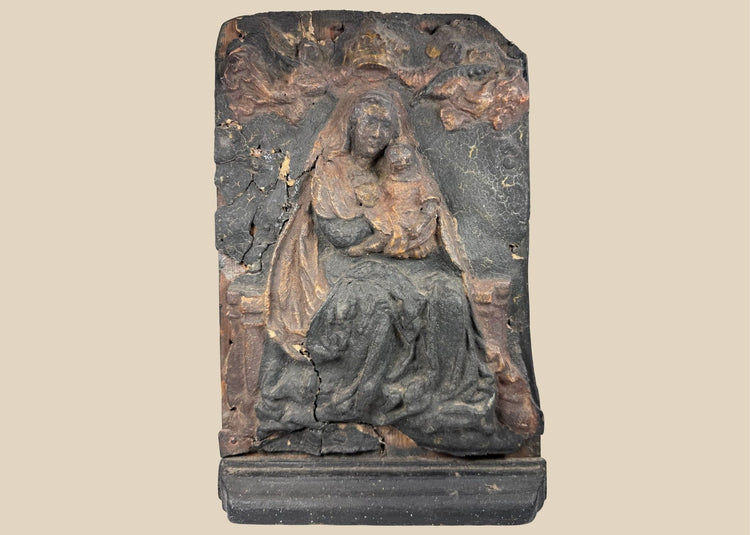
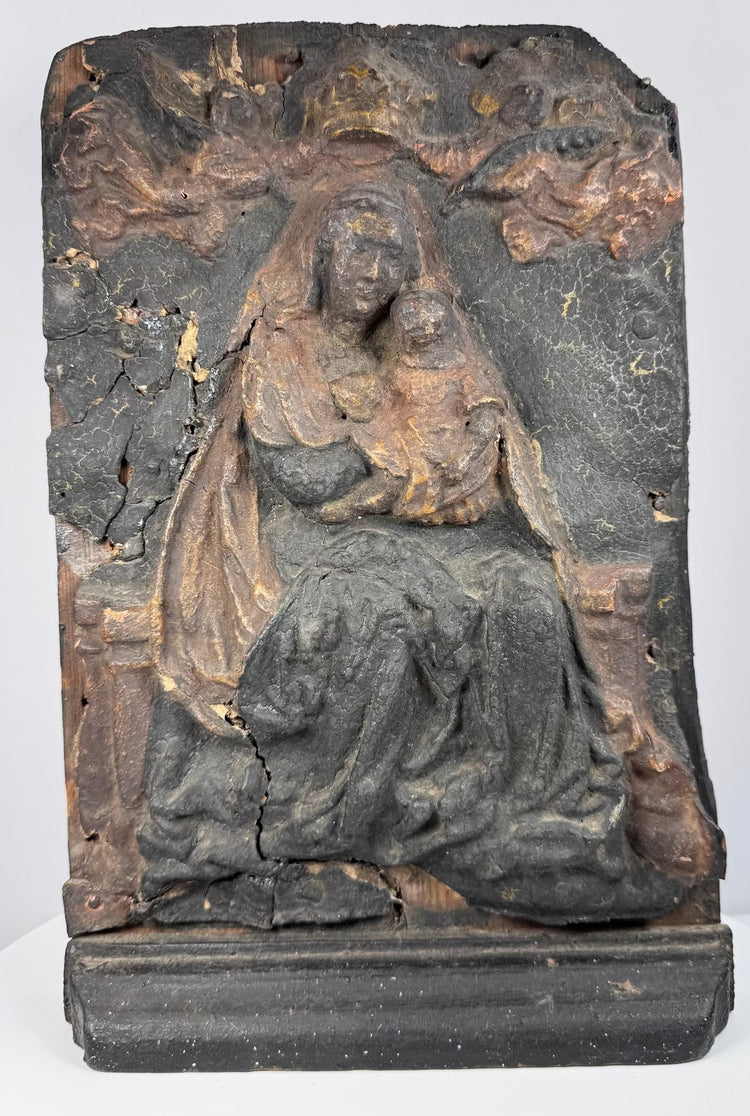
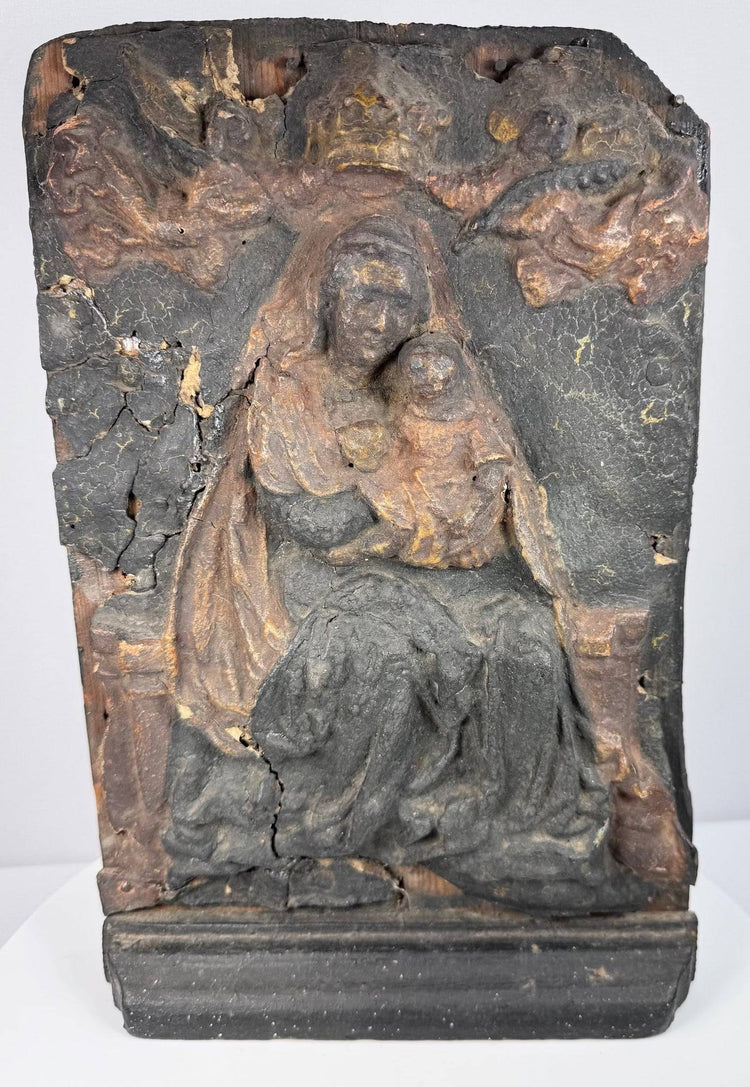
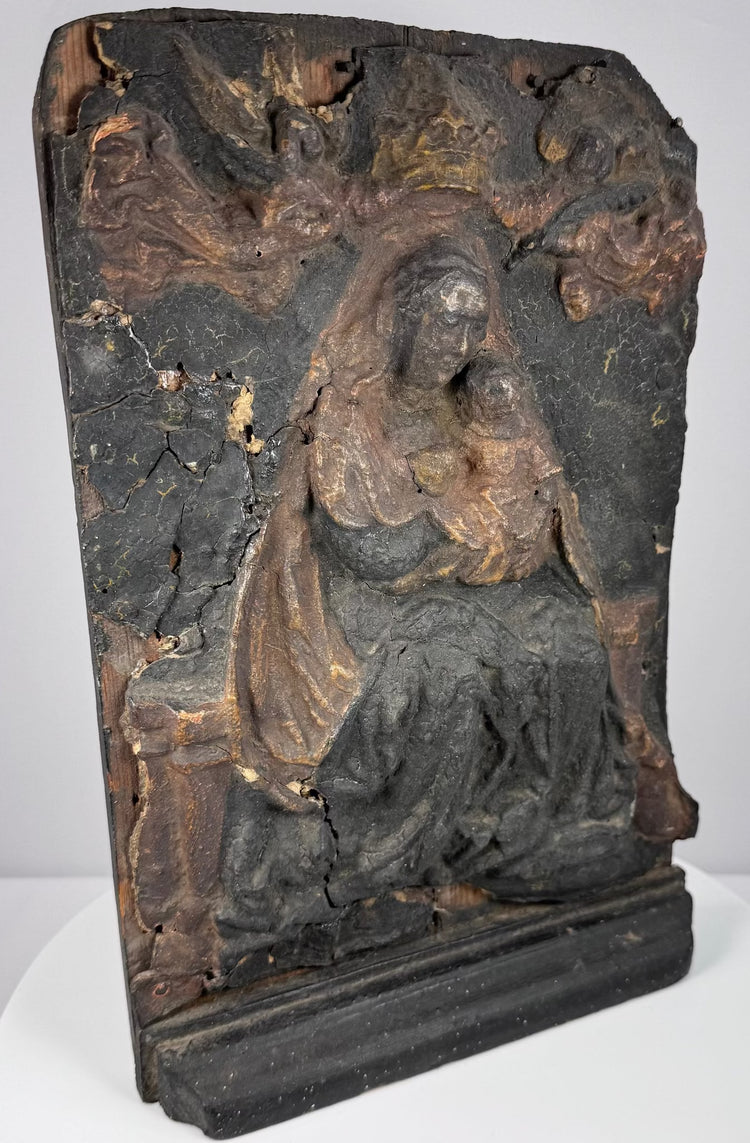
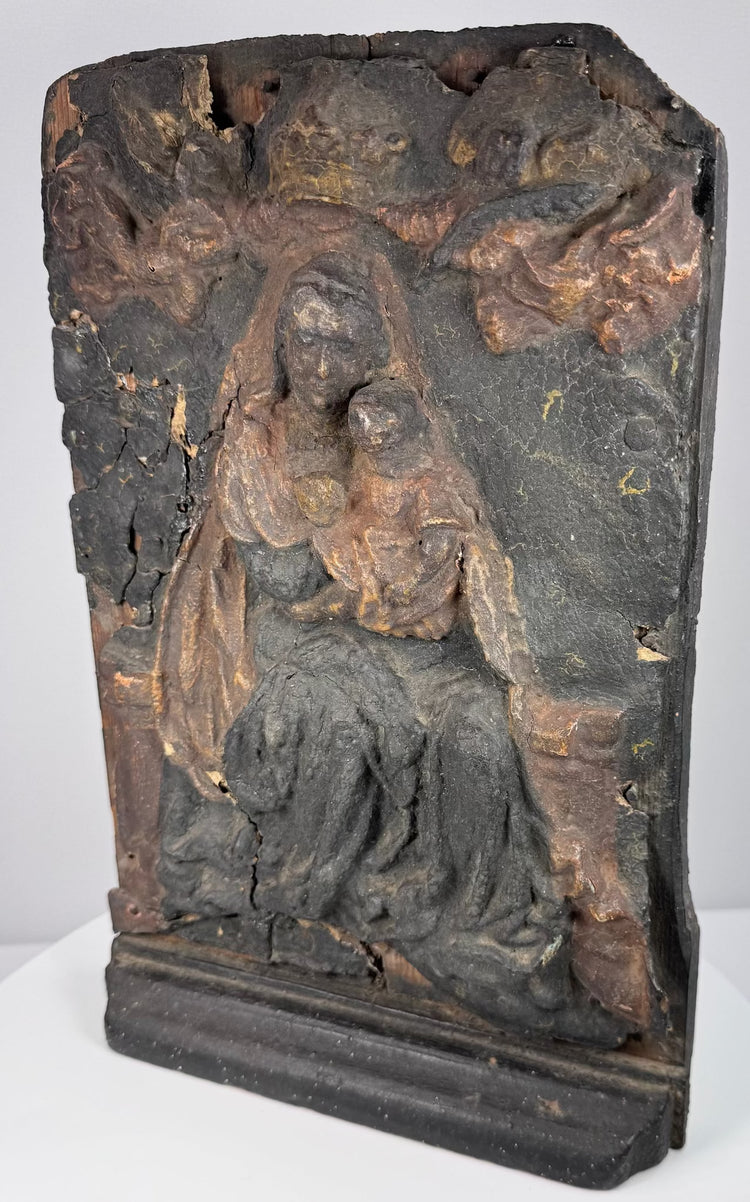
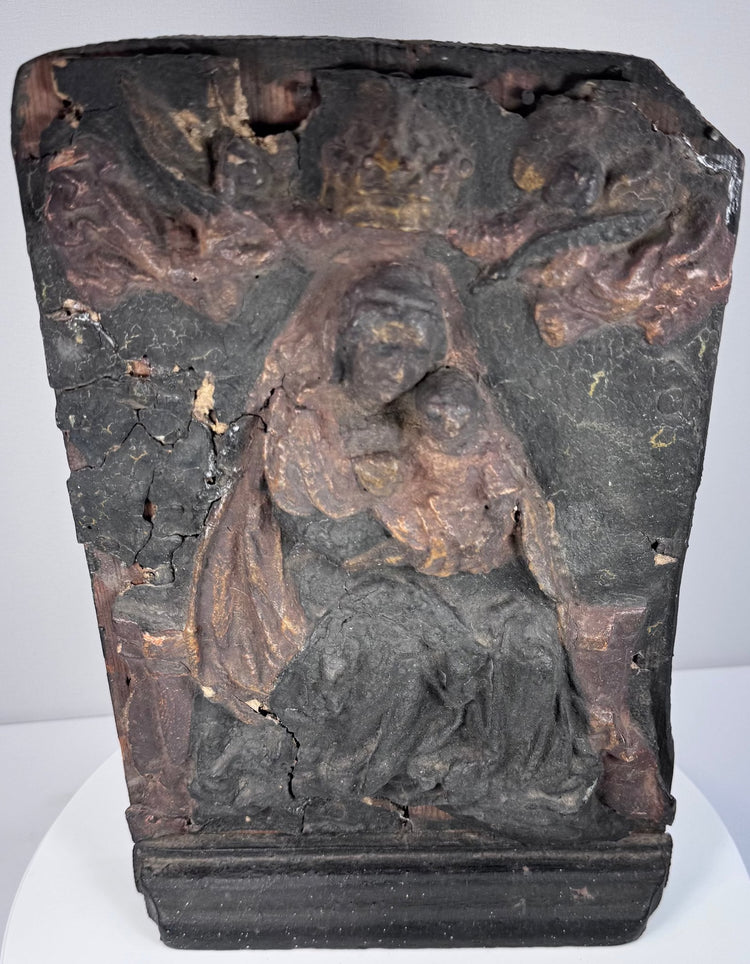
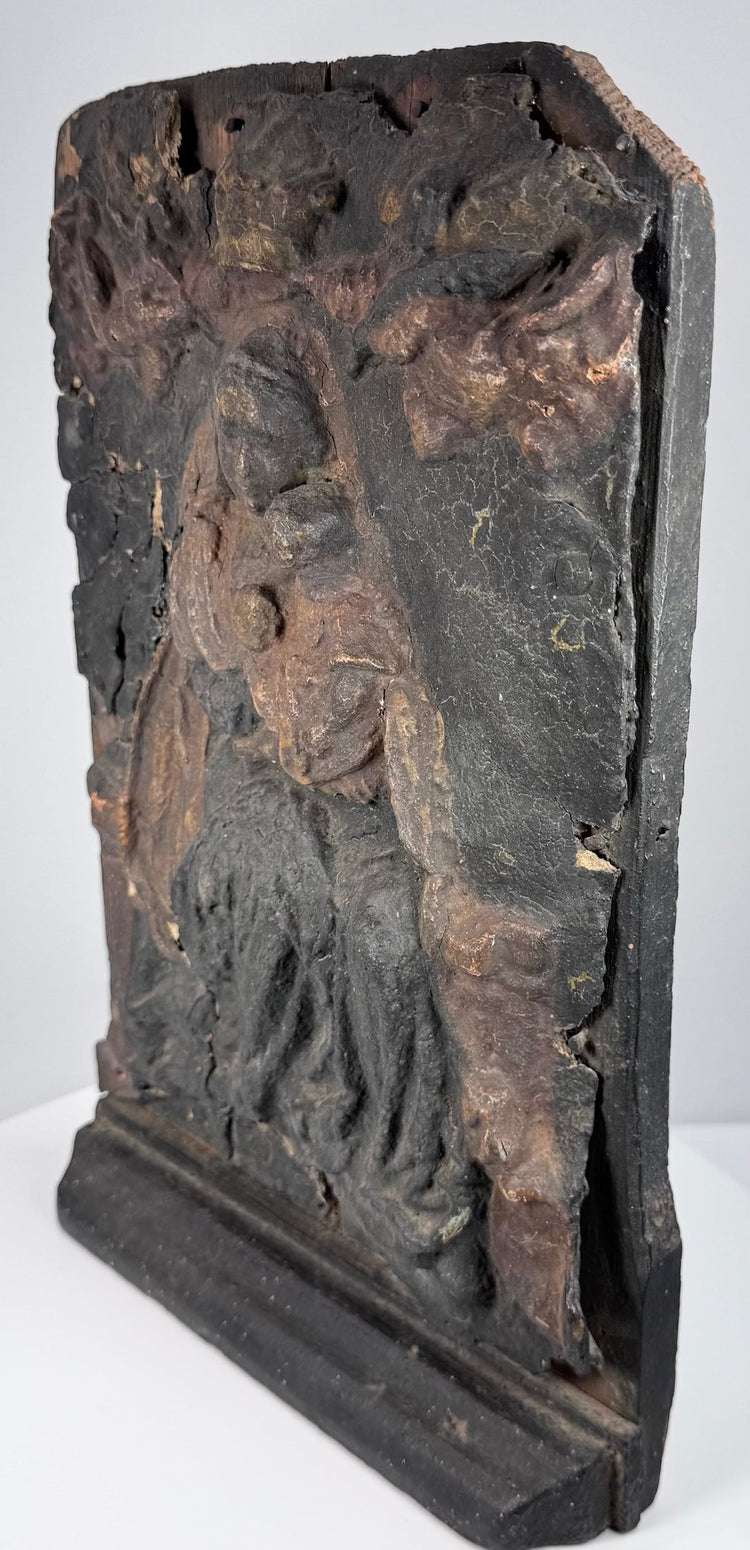
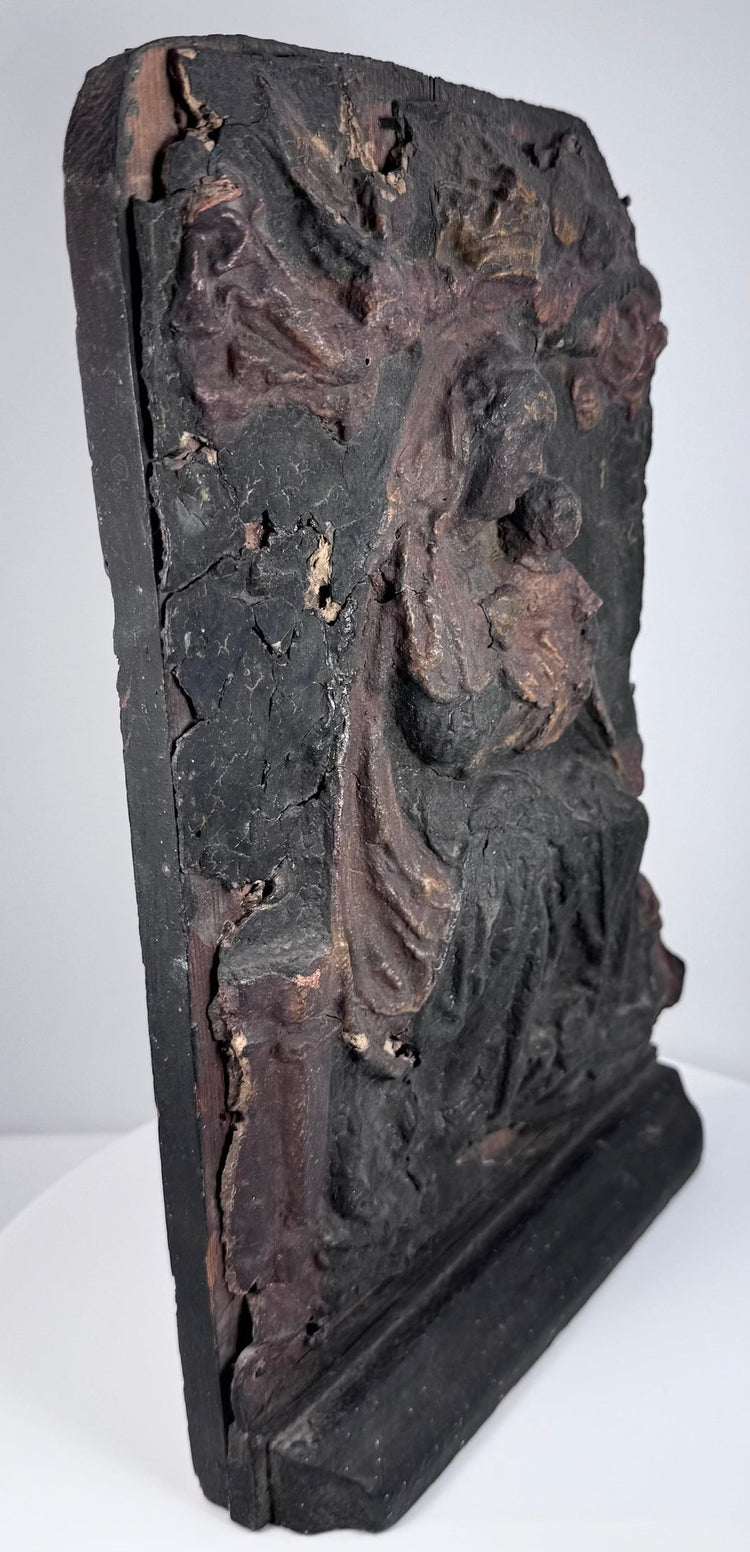
An antique Baroque devotional relief depicting the Virgin Mary enthroned with the Christ Child beneath a crown supported by angels.
The Virgin occupies the center of the composition, seated frontally and enveloped in long, deeply folded robes. She supports the Christ Child upon her left side, with the two figures presented closely together to emphasize their maternal relationship. Despite extensive surface deterioration, Mary’s elongated veil, layered garments, and gently inclined head remain visible.
Two winged angels descend from the upper corners of the panel, presenting a crown above the Virgin’s head. This iconography identifies Mary as the Queen of Heaven and is more accurately described as the Virgin and Child Crowned by Angels rather than the formal Coronation of the Virgin, which traditionally depicts Christ and God the Father crowning Mary.
The scene is carved in high relief against a recessed background and framed by architectural or throne-like elements along either side. A projecting molded ledge forms the lower edge, suggesting that the panel may originally have been incorporated into a larger church altarpiece, devotional shrine, architectural furnishing, or private household altar.
Areas of muted red, brown, ochre, black, and gold-colored decoration remain across the figures and surrounding relief. The present dark appearance results from extensive pigment loss, oxidation, accumulated surface material, and possibly historic overpainting or other later coatings.
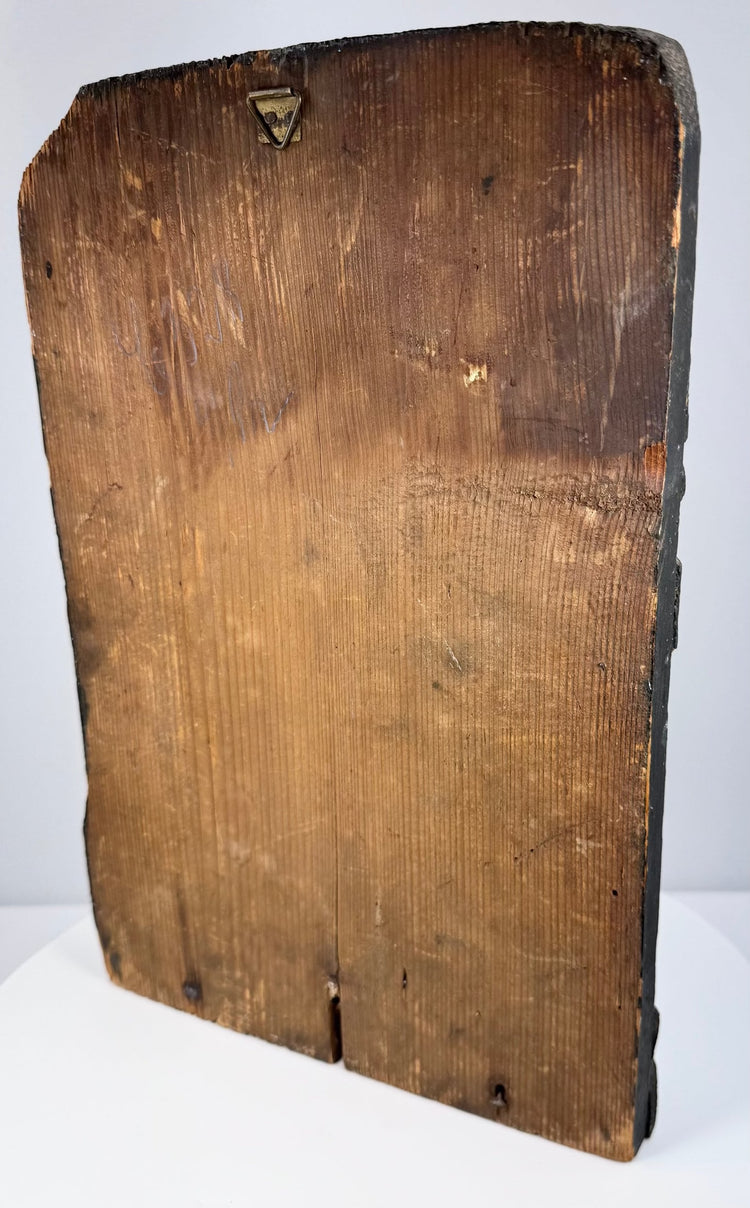
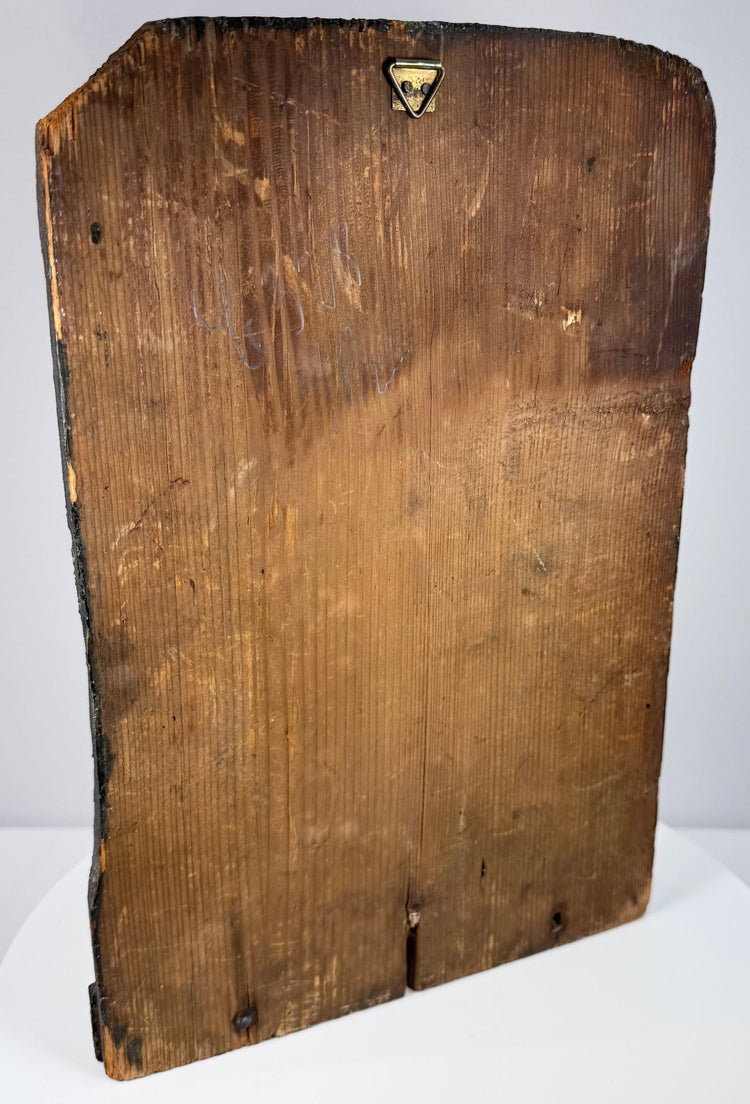
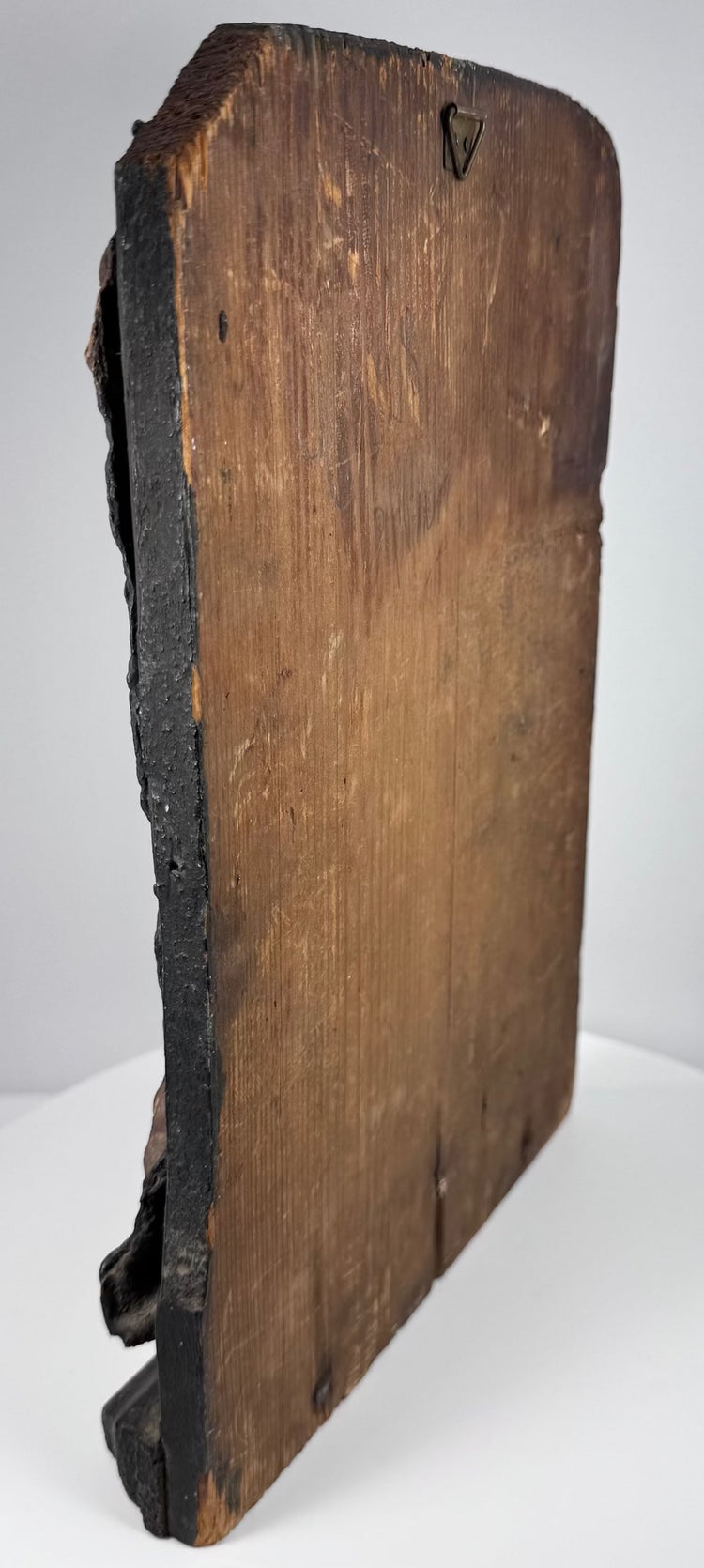
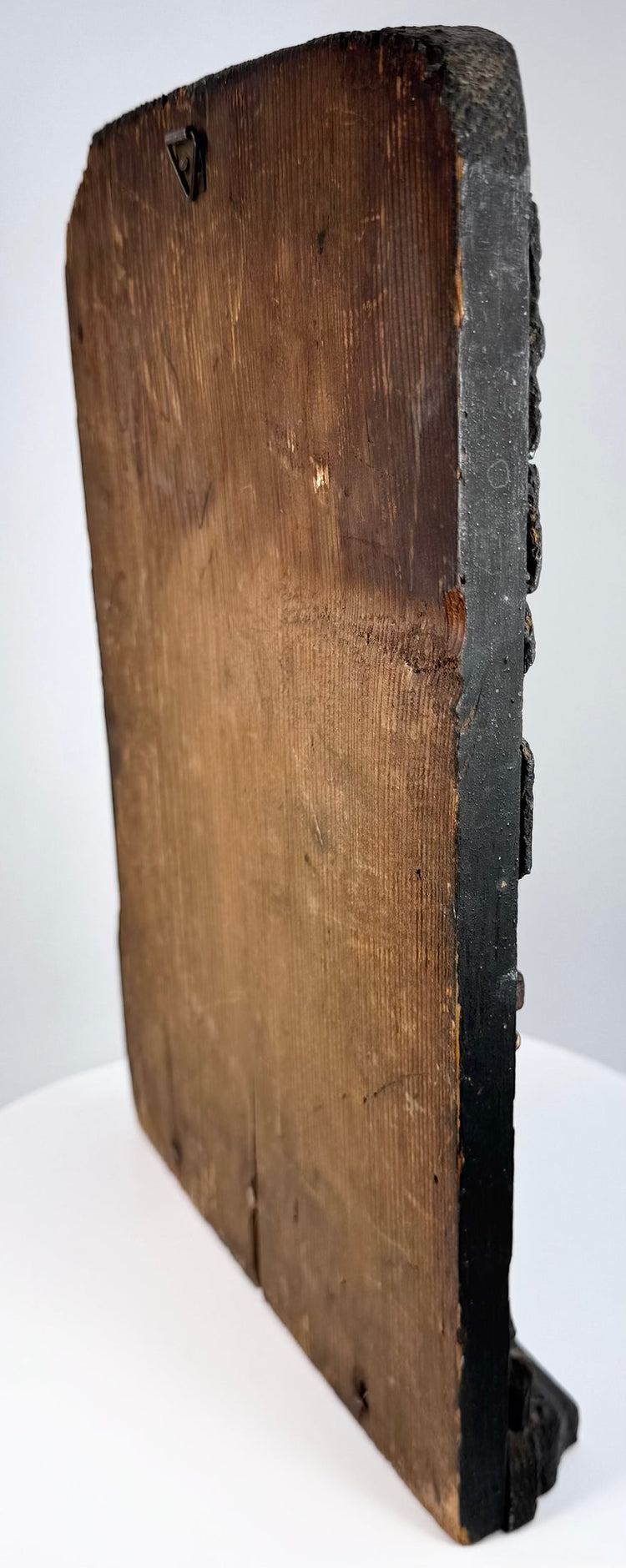
The reverse has been left comparatively plain, revealing the vertical grain and tool marks of the wooden support. A later metal hanging fixture has been attached near the upper edge, allowing the relief to be displayed as an independent wall-mounted devotional object.
Features
- Depiction of the Virgin Mary and Christ Child
- Two winged angels supporting a crown
- Queen of Heaven iconography
- Hand-carved wooden construction
- Figures carved in substantial high relief
- Recessed background and architectural framing elements
- Deeply folded robes and veil
- Surviving red, brown, ochre, and black pigments
- Traces of gilding or gold-colored decoration
- Projecting molded lower ledge
- Historic wooden pegs, nails, and repair elements
- Heavily weathered devotional surface
Cultural Significance
Images of the Virgin and Child were central to Roman Catholic worship throughout Baroque Europe and the Spanish Colonial world. Such works were displayed in churches, chapels, monasteries, processional shrines, and private homes, where they served as visual focuses for prayer and contemplation.
The Christ Child emphasizes the Christian doctrine of the Incarnation—the belief that Christ assumed human form—while Mary’s protective embrace presents her as both the Mother of God and an intercessor for the faithful.
The angels lowering a crown toward Mary identify her as the Queen of Heaven. This form of Marian imagery became particularly popular in Catholic regions, where elaborate sculpture, gilding, color, and dramatic movement were employed to make sacred narratives immediate and emotionally powerful.
The survival of substantial carving beneath the distressed surface provides evidence of the panel’s original composition and devotional purpose. Its extensive wear, repairs, exposed wood, and pigment loss also illustrate the long working lives of religious objects, which were frequently handled, repainted, relocated, repaired, and adapted as devotional settings changed.
Condition
Distressed and fragile historic condition with extensive age-related deterioration, losses, repairs, and surface instability.
The prepared ground and polychrome decoration exhibit severe cracking, lifting, flaking, and widespread loss. Large areas of the underlying wood are exposed, particularly along the left side, upper edge, lower center, and around the figures. Further pigment or surface loss may occur during handling.
The wooden panel displays numerous shrinkage cracks, structural splits, open seams, chips, holes, edge losses, and missing carved elements. A prominent crack extends through the lower portion of the composition, with additional separation around the Virgin’s robes, surrounding background, and lower molding.
The upper section is incomplete, with losses affecting the crown, angels, background, and outer edges. Remaining carved details are softened by wear, accumulated deposits, degraded surface coatings, and previous restoration.
Small holes and channels are consistent with historic wood-boring insect activity. No specialized testing has been undertaken to determine whether any activity remains. Historic nails, pegs, and metal repair or stabilization elements are visible in several areas.
The dark surface may include old overpainting, soot, oxidized varnish, consolidants, or other historic coatings.
Dimensions (Approximate)
Height: 13 in
Width: 8.5 in
Depth: 2 in
Age (Approximate)
275–375 years old
Provenance
Formerly in a private collection in Chevy Chase, Maryland, United States, specializing in Asian art and related religious objects.
Subsequently handled by Sloans & Kenyon Auctioneers and Appraisers, a longstanding Maryland auction house serving the greater Washington, D.C., region. Tracing its history to Sloan & Co., established in 1853, the firm conducts professionally catalogued auctions featuring fine art, antiques, and historical collectibles.
Lastly acquired by a private collection in Toronto, Ontario, Canada.
Learn More
View a related carved religious relief in the collection of Brussels Heritage Collections
Browse our Collection of Religious & Spiritual Relics
Description
Historical Context & Origin
Region: Southern Europe or the Spanish Colonial world, probably within the Iberian artistic tradition
Material: Hand-carved wood with prepared ground, polychrome pigments, and traces of gilding or gold-colored decoration
Period: Baroque Period, likely circa 1650–1750
Description
An antique Baroque devotional relief depicting the Virgin Mary enthroned with the Christ Child beneath a crown supported by angels.
The Virgin occupies the center of the composition, seated frontally and enveloped in long, deeply folded robes. She supports the Christ Child upon her left side, with the two figures presented closely together to emphasize their maternal relationship. Despite extensive surface deterioration, Mary’s elongated veil, layered garments, and gently inclined head remain visible.
Two winged angels descend from the upper corners of the panel, presenting a crown above the Virgin’s head. This iconography identifies Mary as the Queen of Heaven and is more accurately described as the Virgin and Child Crowned by Angels rather than the formal Coronation of the Virgin, which traditionally depicts Christ and God the Father crowning Mary.
The scene is carved in high relief against a recessed background and framed by architectural or throne-like elements along either side. A projecting molded ledge forms the lower edge, suggesting that the panel may originally have been incorporated into a larger church altarpiece, devotional shrine, architectural furnishing, or private household altar.
Areas of muted red, brown, ochre, black, and gold-colored decoration remain across the figures and surrounding relief. The present dark appearance results from extensive pigment loss, oxidation, accumulated surface material, and possibly historic overpainting or other later coatings.
The reverse has been left comparatively plain, revealing the vertical grain and tool marks of the wooden support. A later metal hanging fixture has been attached near the upper edge, allowing the relief to be displayed as an independent wall-mounted devotional object.
Features
- Depiction of the Virgin Mary and Christ Child
- Two winged angels supporting a crown
- Queen of Heaven iconography
- Hand-carved wooden construction
- Figures carved in substantial high relief
- Recessed background and architectural framing elements
- Deeply folded robes and veil
- Surviving red, brown, ochre, and black pigments
- Traces of gilding or gold-colored decoration
- Projecting molded lower ledge
- Historic wooden pegs, nails, and repair elements
- Heavily weathered devotional surface
Cultural Significance
Images of the Virgin and Child were central to Roman Catholic worship throughout Baroque Europe and the Spanish Colonial world. Such works were displayed in churches, chapels, monasteries, processional shrines, and private homes, where they served as visual focuses for prayer and contemplation.
The Christ Child emphasizes the Christian doctrine of the Incarnation—the belief that Christ assumed human form—while Mary’s protective embrace presents her as both the Mother of God and an intercessor for the faithful.
The angels lowering a crown toward Mary identify her as the Queen of Heaven. This form of Marian imagery became particularly popular in Catholic regions, where elaborate sculpture, gilding, color, and dramatic movement were employed to make sacred narratives immediate and emotionally powerful.
The survival of substantial carving beneath the distressed surface provides evidence of the panel’s original composition and devotional purpose. Its extensive wear, repairs, exposed wood, and pigment loss also illustrate the long working lives of religious objects, which were frequently handled, repainted, relocated, repaired, and adapted as devotional settings changed.
Condition
Distressed and fragile historic condition with extensive age-related deterioration, losses, repairs, and surface instability.
The prepared ground and polychrome decoration exhibit severe cracking, lifting, flaking, and widespread loss. Large areas of the underlying wood are exposed, particularly along the left side, upper edge, lower center, and around the figures. Further pigment or surface loss may occur during handling.
The wooden panel displays numerous shrinkage cracks, structural splits, open seams, chips, holes, edge losses, and missing carved elements. A prominent crack extends through the lower portion of the composition, with additional separation around the Virgin’s robes, surrounding background, and lower molding.
The upper section is incomplete, with losses affecting the crown, angels, background, and outer edges. Remaining carved details are softened by wear, accumulated deposits, degraded surface coatings, and previous restoration.
Small holes and channels are consistent with historic wood-boring insect activity. No specialized testing has been undertaken to determine whether any activity remains. Historic nails, pegs, and metal repair or stabilization elements are visible in several areas.
The dark surface may include old overpainting, soot, oxidized varnish, consolidants, or other historic coatings.
Dimensions (Approximate)
Height: 13 in
Width: 8.5 in
Depth: 2 in
Age (Approximate)
275–375 years old
Provenance
Formerly in a private collection in Chevy Chase, Maryland, United States, specializing in Asian art and related religious objects.
Subsequently handled by Sloans & Kenyon Auctioneers and Appraisers, a longstanding Maryland auction house serving the greater Washington, D.C., region. Tracing its history to Sloan & Co., established in 1853, the firm conducts professionally catalogued auctions featuring fine art, antiques, and historical collectibles.
Lastly acquired by a private collection in Toronto, Ontario, Canada.
Learn More
View a related carved religious relief in the collection of Brussels Heritage Collections
Browse our Collection of Religious & Spiritual Relics
Vous aimerez peut-être aussi
