


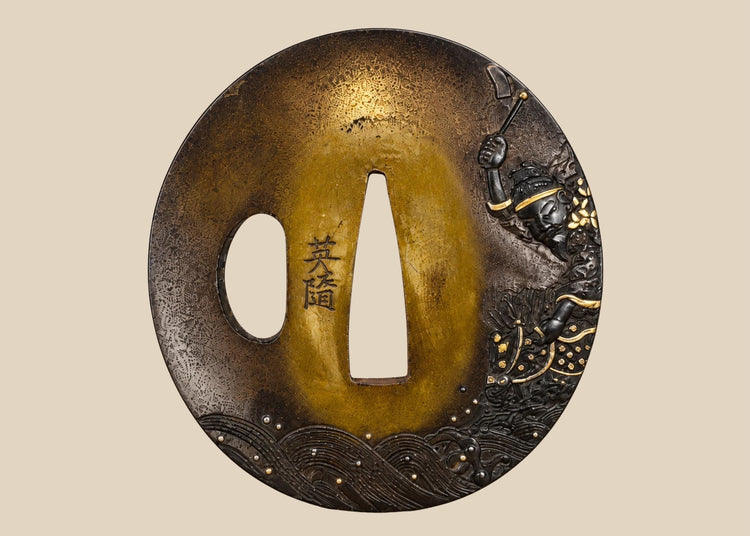
Antique Japanese Eizui Signed Mixed-Metal Tsuba Depicting Liu Bei Crossing the Tan Stream | Edo Period, Circa 1840
- Prix habituel
- $2,750.00
- Prix soldé
- $2,750.00
- Prix habituel
Impossible de charger la disponibilité du service de retrait


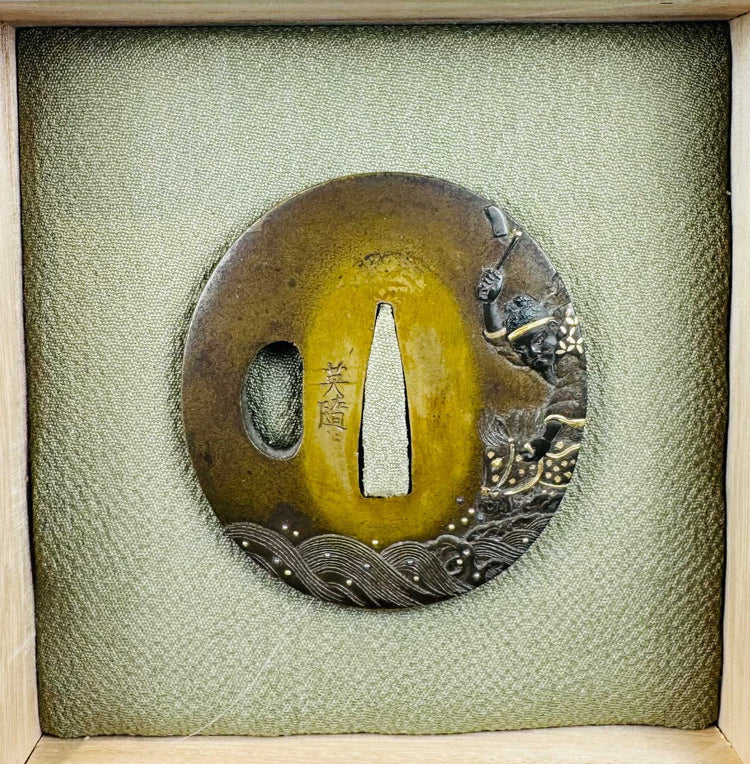
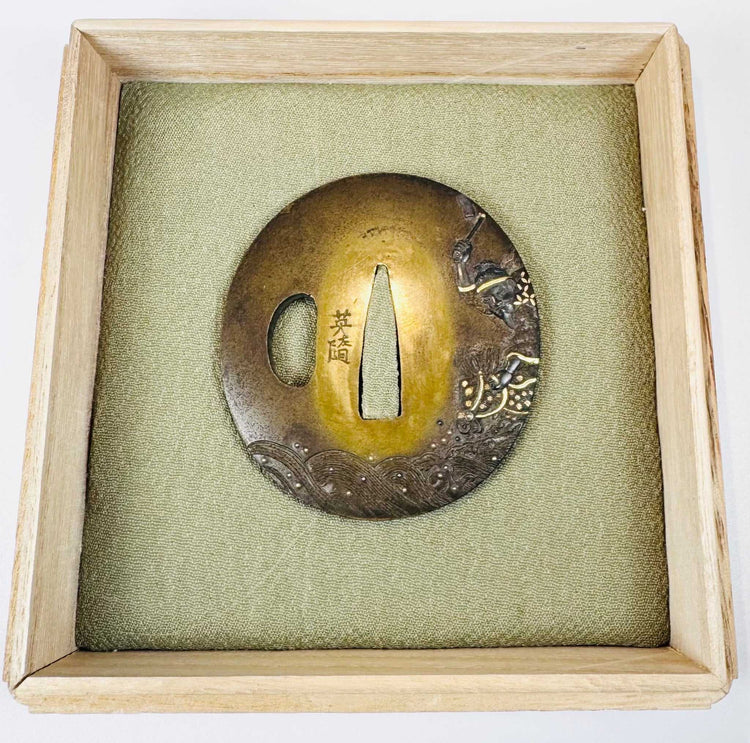
Antique Japanese Eizui Signed Mixed-Metal Tsuba Depicting Liu Bei Crossing the Tan Stream | Edo Period, Circa 1840
Description
Plus
Moins
Historical Context & Origin
Region: Japan
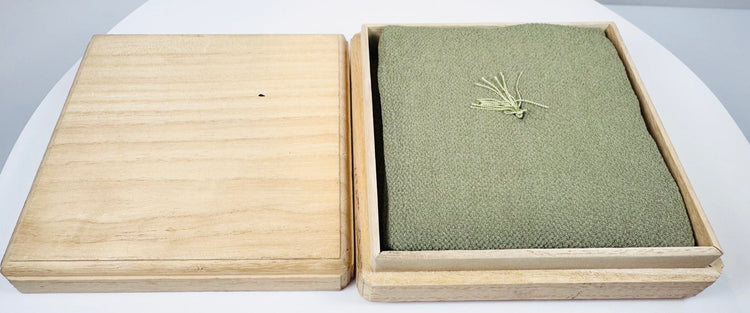
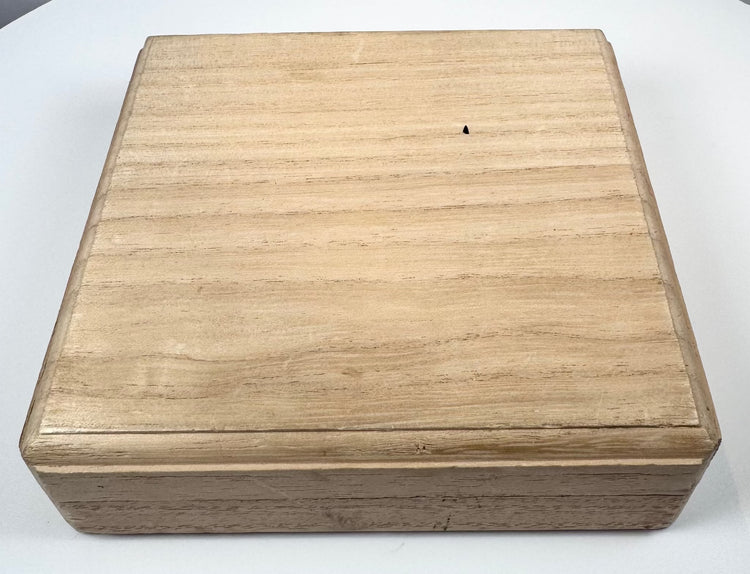
Material: Patinated copper alloy, likely sentoku or brass, with dark mixed-metal relief and gold and silver inlay; fitted wooden storage box with textile-covered cushion
Period: Late Edo period, circa 1840
Description
A finely decorated antique Japanese sword guard, or tsuba, signed Eizui (英随) and accompanied by original documentation from the Fine Arts Department of Mitsukoshi’s Nihombashi flagship store in Tokyo.
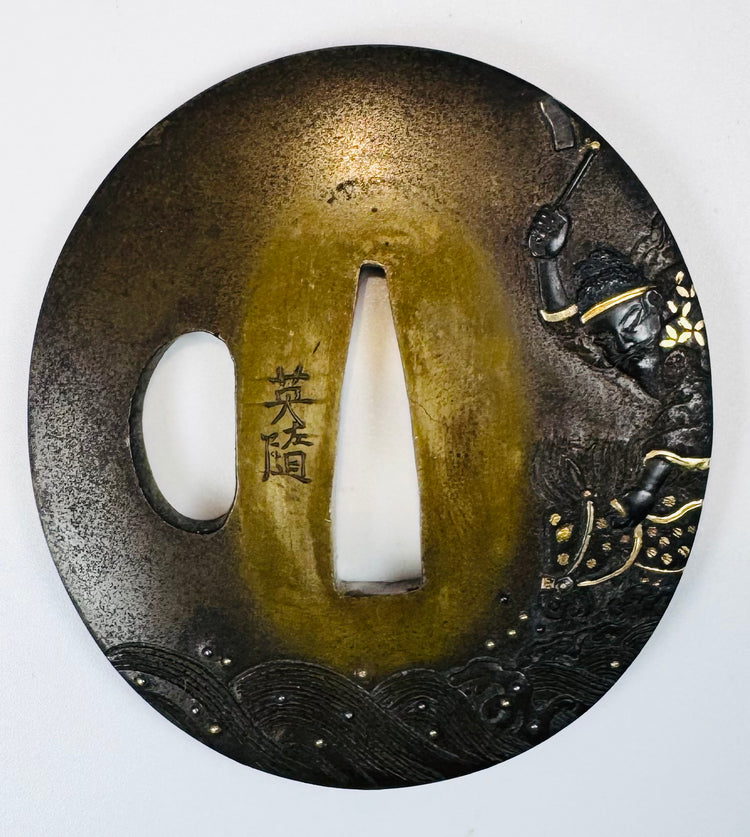
The rounded oval guard is formed from a warm golden-brown copper alloy and decorated on its principal surface with a mounted warrior riding through turbulent waves. The figure raises a riding crop or similar implement in his right hand while attempting to guide his horse through the rushing water. His armour, clothing, equipment, and facial features are rendered in dark sculptural relief and accented with gold and silver inlay.
The composition appears to represent the celebrated Chinese warlord Liu Bei, also known as Xuande, escaping his pursuers by crossing the dangerous Tan Stream on his horse Dilu. This dramatic episode from Chinese historical tradition, later incorporated into the Romance of the Three Kingdoms, became a popular subject in Japanese Edo-period art, where it symbolized courage, providential escape, perseverance, and triumph over seemingly impossible circumstances.
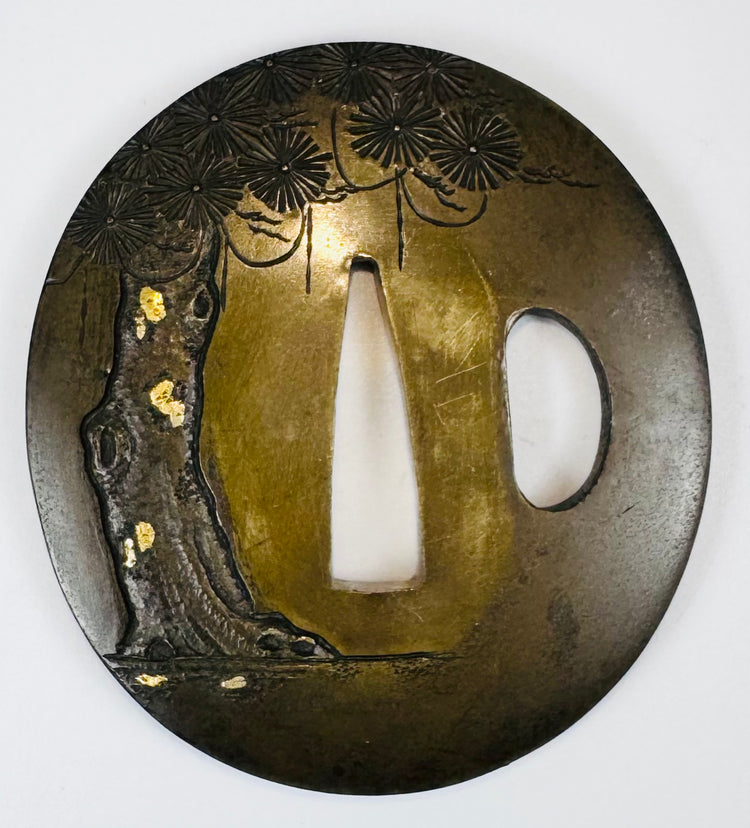
The reverse depicts a mature pine tree extending across the upper portion of the guard. Its deeply worked trunk and radiating clusters of pine needles are highlighted with scattered gold accents. The restrained landscape creates a symbolic counterpoint to the energetic waves and mounted warrior on the principal surface.
The guard retains its elongated central nakago-ana, through which the sword’s tang would have passed, together with a smaller kozuka-hitsu-ana for the handle of a utility knife carried within the sword’s scabbard. The inscription 英随, read as Eizui, appears beside the central opening.
Features
- Signed Eizui in Japanese characters: 英随
- Late Edo-period attribution, circa 1840
- Warm golden-brown copper-alloy plate
- Mounted warrior rendered in sculptural relief
- Likely depiction of Liu Bei crossing the Tan Stream
- Horse shown advancing through turbulent waves
- Raised riding crop or implement held in the warrior’s right hand
- Gold and silver mixed-metal accenting
- Reverse decorated with a mature pine tree
- Central nakago-ana for the sword tang
- Smaller kozuka-hitsu-ana for a utility knife
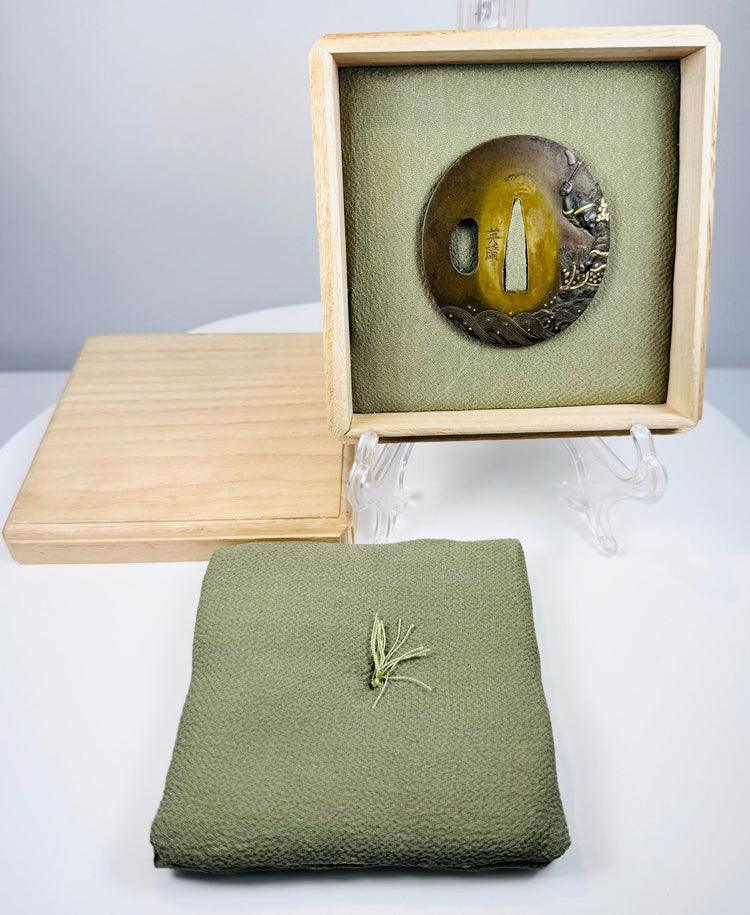
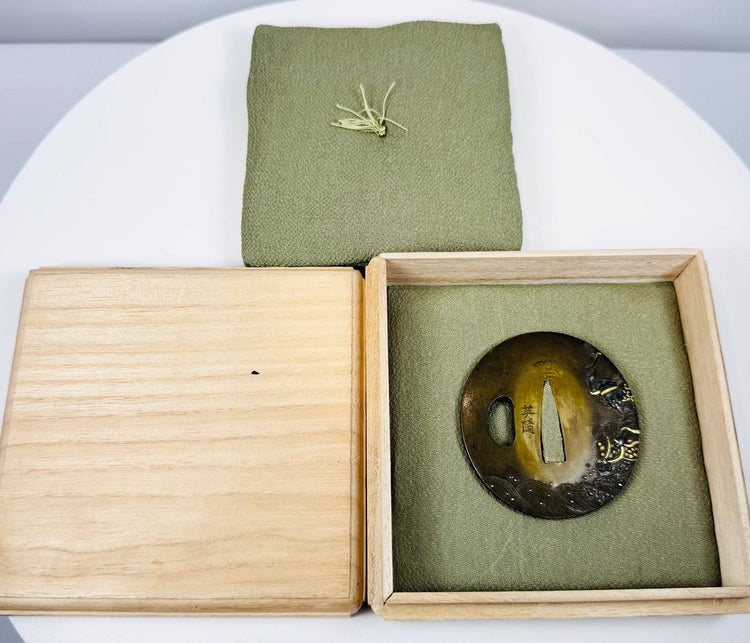
- Fitted wooden collector’s box with textile-covered cushion
- Original Mitsukoshi Fine Arts documentation dating to 1990
Cultural Significance
During the Edo period, tsuba developed beyond their practical role as protective sword guards into miniature works of metal art. Their imagery frequently drew upon Japanese history, Chinese literature, Buddhist and Daoist traditions, military epics, natural symbolism, and stories selected to reflect the sword owner’s education and personal ideals.
The scene of Liu Bei crossing the Tan Stream recounts his escape from an assassination attempt. Pursued to the edge of the swollen stream, Liu Bei urged his horse Dilu forward. The horse made an extraordinary leap across the water, allowing its rider to escape. The episode became a powerful image of perseverance, loyalty, destiny, and miraculous deliverance.
The pine tree on the reverse traditionally symbolizes longevity, endurance, steadfastness, and resilience. Because pine trees remain green throughout winter, they became enduring symbols of strength in the face of adversity, an especially appropriate complement to the dramatic escape depicted on the opposite surface.
Condition
Good antique condition consistent with age and use. The tsuba displays age-related patination, oxidation, surface rubbing, fine scratches, small abrasions, and localized wear or loss to the gold and silver decorative accents. The relief decoration remains clearly defined, the signature is legible, and the central and secondary apertures remain intact.
The fitted wooden box and textile-covered cushion exhibit minor rubbing, small marks, fraying, and general wear consistent with storage and use. The accompanying Mitsukoshi receipt, identification card, and business card display folds, creases, small tears, adhesive residue, staining, and handling wear consistent with their age.
Dimensions (Approximate)
Tsuba
Diameter: 2.5 in
Storage Box
Length: 4.5 in
Width: 4.5 in
Height: 1.6 in
Age (Approximate)
185–190 years old
Provenance
Acquired from the Fine Arts Department of Mitsukoshi Ltd., Nihombashi Store, Tokyo, Japan, on June 14, 1990. Mitsukoshi’s Nihombashi flagship is one of Japan’s most prestigious historic department stores, with longstanding departments devoted to Japanese fine art, traditional crafts, and decorative objects.
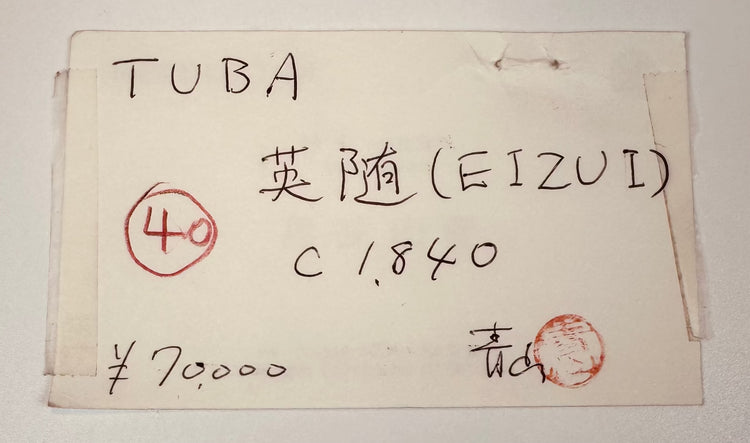
The accompanying Mitsukoshi identification card records the object as “Tsuba — Eizui (英随) — circa 1840 — ¥70,000.”
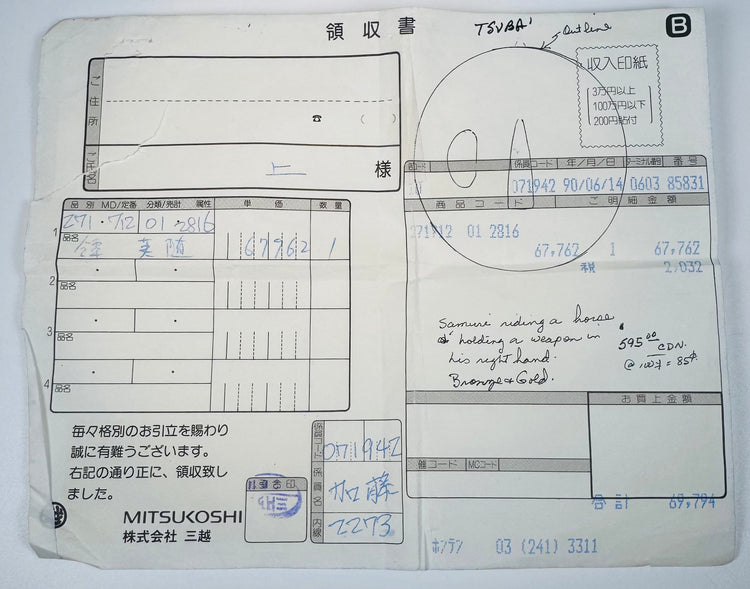
The original Mitsukoshi receipt records a pre-tax price of ¥67,762, consumption tax of ¥2,032, and a total purchase price of ¥69,794. A handwritten Canadian conversion identifies the purchase as approximately $595 CAD, calculated at ¥100 to $0.85 CAD.
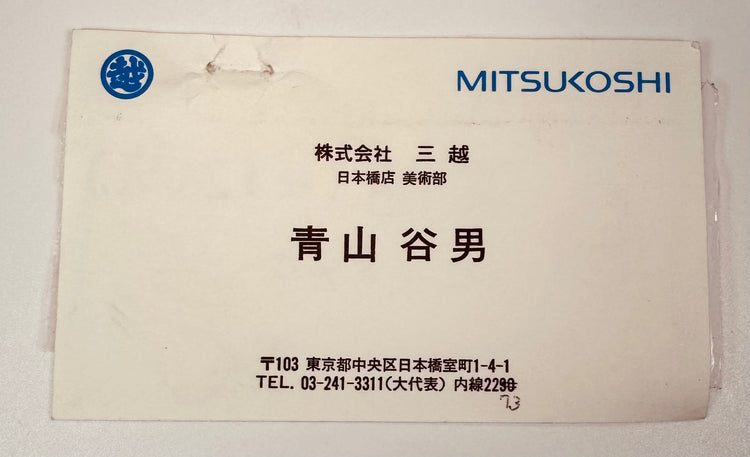
The accompanying business card identifies Aoyama Tanio (青山谷男) of the Mitsukoshi Nihombashi Fine Arts Department at 1-4-1 Nihombashi Muromachi, Chuo-ku, Tokyo.
The paperwork additionally describes the object in English as a “Samurai riding a horse and holding a weapon in his right hand — Bronze & Gold.” This early documentation preserves the attribution to Eizui and the circa 1840 date supplied by Mitsukoshi at the time of purchase.
Subsequently sold through Waddington’s Auctioneers & Appraisers, Toronto, Ontario, Canada. Established in 1850, Waddington’s is a longstanding Canadian auction house with specialist departments devoted to Asian and international art.
Learn More
View a related 19th-century Japanese mixed-metal sword guard in the collection of The Metropolitan Museum of Art
Explore another Antique Japanese Iron Tsuba Sword Guard with Sage and Spider
Explore our Collection of Eastern Antiquities & Cultural Relics
Description
Historical Context & Origin
Region: Japan
Material: Patinated copper alloy, likely sentoku or brass, with dark mixed-metal relief and gold and silver inlay; fitted wooden storage box with textile-covered cushion
Period: Late Edo period, circa 1840
Description
A finely decorated antique Japanese sword guard, or tsuba, signed Eizui (英随) and accompanied by original documentation from the Fine Arts Department of Mitsukoshi’s Nihombashi flagship store in Tokyo.
The rounded oval guard is formed from a warm golden-brown copper alloy and decorated on its principal surface with a mounted warrior riding through turbulent waves. The figure raises a riding crop or similar implement in his right hand while attempting to guide his horse through the rushing water. His armour, clothing, equipment, and facial features are rendered in dark sculptural relief and accented with gold and silver inlay.
The composition appears to represent the celebrated Chinese warlord Liu Bei, also known as Xuande, escaping his pursuers by crossing the dangerous Tan Stream on his horse Dilu. This dramatic episode from Chinese historical tradition, later incorporated into the Romance of the Three Kingdoms, became a popular subject in Japanese Edo-period art, where it symbolized courage, providential escape, perseverance, and triumph over seemingly impossible circumstances.
The reverse depicts a mature pine tree extending across the upper portion of the guard. Its deeply worked trunk and radiating clusters of pine needles are highlighted with scattered gold accents. The restrained landscape creates a symbolic counterpoint to the energetic waves and mounted warrior on the principal surface.
The guard retains its elongated central nakago-ana, through which the sword’s tang would have passed, together with a smaller kozuka-hitsu-ana for the handle of a utility knife carried within the sword’s scabbard. The inscription 英随, read as Eizui, appears beside the central opening.
Features
- Signed Eizui in Japanese characters: 英随
- Late Edo-period attribution, circa 1840
- Warm golden-brown copper-alloy plate
- Mounted warrior rendered in sculptural relief
- Likely depiction of Liu Bei crossing the Tan Stream
- Horse shown advancing through turbulent waves
- Raised riding crop or implement held in the warrior’s right hand
- Gold and silver mixed-metal accenting
- Reverse decorated with a mature pine tree
- Central nakago-ana for the sword tang
- Smaller kozuka-hitsu-ana for a utility knife
- Fitted wooden collector’s box with textile-covered cushion
- Original Mitsukoshi Fine Arts documentation dating to 1990
Cultural Significance
During the Edo period, tsuba developed beyond their practical role as protective sword guards into miniature works of metal art. Their imagery frequently drew upon Japanese history, Chinese literature, Buddhist and Daoist traditions, military epics, natural symbolism, and stories selected to reflect the sword owner’s education and personal ideals.
The scene of Liu Bei crossing the Tan Stream recounts his escape from an assassination attempt. Pursued to the edge of the swollen stream, Liu Bei urged his horse Dilu forward. The horse made an extraordinary leap across the water, allowing its rider to escape. The episode became a powerful image of perseverance, loyalty, destiny, and miraculous deliverance.
The pine tree on the reverse traditionally symbolizes longevity, endurance, steadfastness, and resilience. Because pine trees remain green throughout winter, they became enduring symbols of strength in the face of adversity, an especially appropriate complement to the dramatic escape depicted on the opposite surface.
Condition
Good antique condition consistent with age and use. The tsuba displays age-related patination, oxidation, surface rubbing, fine scratches, small abrasions, and localized wear or loss to the gold and silver decorative accents. The relief decoration remains clearly defined, the signature is legible, and the central and secondary apertures remain intact.
The fitted wooden box and textile-covered cushion exhibit minor rubbing, small marks, fraying, and general wear consistent with storage and use. The accompanying Mitsukoshi receipt, identification card, and business card display folds, creases, small tears, adhesive residue, staining, and handling wear consistent with their age.
Dimensions (Approximate)
Tsuba
Diameter: 2.5 in
Storage Box
Length: 4.5 in
Width: 4.5 in
Height: 1.6 in
Age (Approximate)
185–190 years old
Provenance
Acquired from the Fine Arts Department of Mitsukoshi Ltd., Nihombashi Store, Tokyo, Japan, on June 14, 1990. Mitsukoshi’s Nihombashi flagship is one of Japan’s most prestigious historic department stores, with longstanding departments devoted to Japanese fine art, traditional crafts, and decorative objects.
The accompanying Mitsukoshi identification card records the object as “Tsuba — Eizui (英随) — circa 1840 — ¥70,000.”
The original Mitsukoshi receipt records a pre-tax price of ¥67,762, consumption tax of ¥2,032, and a total purchase price of ¥69,794. A handwritten Canadian conversion identifies the purchase as approximately $595 CAD, calculated at ¥100 to $0.85 CAD.
The accompanying business card identifies Aoyama Tanio (青山谷男) of the Mitsukoshi Nihombashi Fine Arts Department at 1-4-1 Nihombashi Muromachi, Chuo-ku, Tokyo.
The paperwork additionally describes the object in English as a “Samurai riding a horse and holding a weapon in his right hand — Bronze & Gold.” This early documentation preserves the attribution to Eizui and the circa 1840 date supplied by Mitsukoshi at the time of purchase.
Subsequently sold through Waddington’s Auctioneers & Appraisers, Toronto, Ontario, Canada. Established in 1850, Waddington’s is a longstanding Canadian auction house with specialist departments devoted to Asian and international art.
Learn More
View a related 19th-century Japanese mixed-metal sword guard in the collection of The Metropolitan Museum of Art
Explore another Antique Japanese Iron Tsuba Sword Guard with Sage and Spider
Explore our Collection of Eastern Antiquities & Cultural Relics
Vous aimerez peut-être aussi
