

Antique Japanese Iron Tsuba Depicting an Elderly Sage and Spider | Circa 19th Century
Couldn't load pickup availability




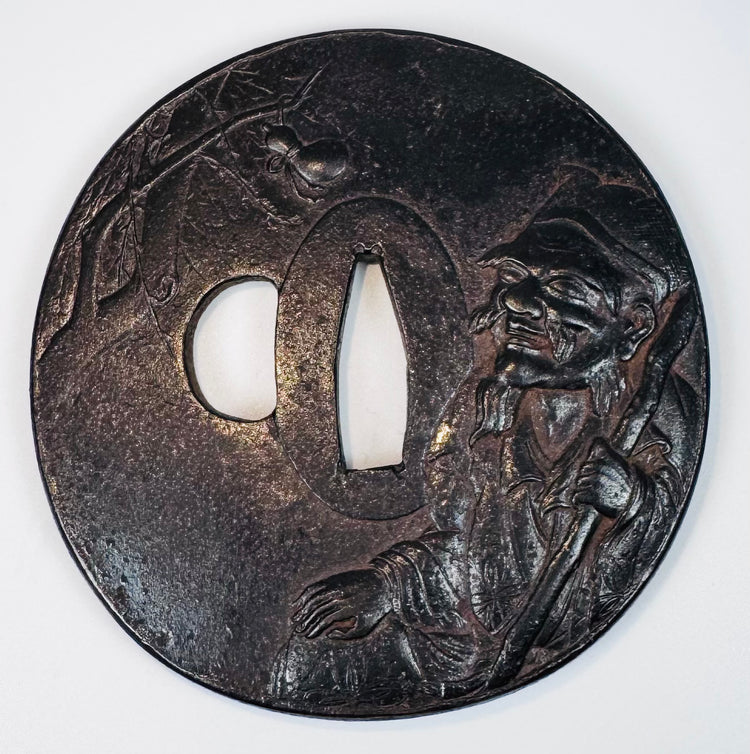


Antique Japanese Iron Tsuba Depicting an Elderly Sage and Spider | Circa 19th Century
Description
More
Less
Historical Context & Origin
Region: Japan
Material: Patinated iron with contrasting mixed-metal relief decoration; fitted wooden storage box with purple textile lining
Period: Late Edo to Meiji period, circa 1800–1900
Description
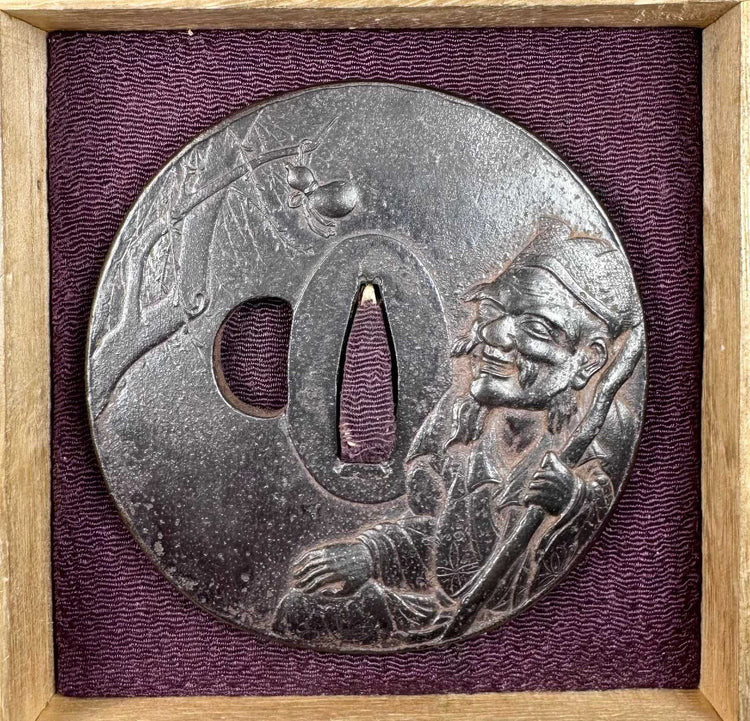
An antique Japanese circular sword guard, or maru-gata tsuba, fashioned from patinated iron and decorated with an expressive figural scene in raised relief.
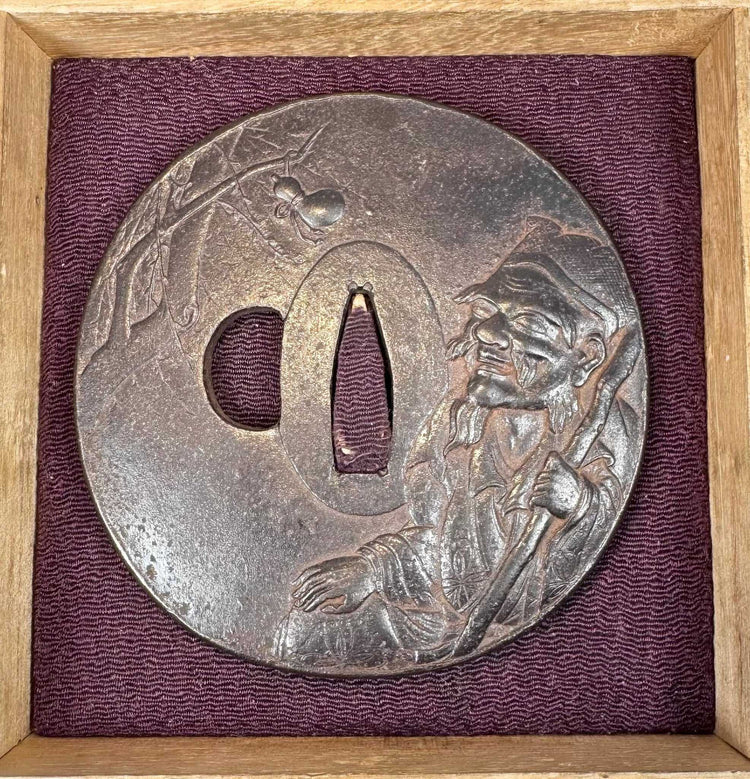
The principal surface depicts an elderly bearded sage or hermit seated beneath the branches of a tree. Dressed in flowing robes and a folded cap, the figure holds a long staff in his right hand. Above him appears a prominently rendered spider suspended among the branches. Contrasting reddish-brown and silver-toned metal accents highlight the figure, staff, spider, and surrounding details against the darker iron ground.
At the centre is the elongated nakago-ana, through which the tang of the sword blade would have passed. Beside it is a smaller kozuka-hitsu-ana, intended to accommodate the handle of a small utility knife carried within the sword’s scabbard. Small surviving metal adjustments along the central opening suggest that the guard may once have been fitted to a particular sword tang.
The reverse is more restrained, retaining a dark, textured surface with faint incised and relief details. The tsuba is housed within a fitted wooden collector’s box lined with deep purple textile, allowing it to be safely stored and attractively displayed.
Features
- Circular maru-gata form
- Elderly bearded sage or hermit rendered in relief
- Figure holding a long staff in his right hand
- Spider depicted among the tree branches
- Contrasting mixed-metal decorative accents
- Central nakago-ana for the sword tang
- Smaller kozuka-hitsu-ana for a utility knife
- Dark, naturally developed iron patina
- Fitted wooden collector’s box
- Purple textile-lined interior
Historical & Cultural Significance
The tsuba was mounted between the blade and handle of a Japanese sword, helping to protect the wielder’s hand while contributing balance and visual distinction to the complete sword mounting.
During the comparatively peaceful Edo period, tsuba developed beyond their practical purpose into highly personal miniature works of metal art. Their decoration frequently drew upon Japanese and Chinese legends, religious traditions, celebrated historical figures, natural subjects, and symbols chosen to communicate the owner’s education, interests, or personal values.
The elderly sage traditionally evokes wisdom, longevity, perseverance, and spiritual contemplation. Spiders in Japanese decorative art may carry several meanings, including patience, careful workmanship, fate, and the arrival of good fortune or a welcome visitor.
Condition
Good antique condition with age-related patination, oxidation, surface rubbing, fine scratches, pitting, small edge marks, and localized losses to the contrasting metal decoration. Linear surface marks and areas of reddish-brown coloration are visible across the composition. The central and secondary apertures remain intact.
The fitted wooden box exhibits scratches, rubbing, minor separations along its constructed joins, and general wear consistent with age and use.
Dimensions (Approximate)
Tsuba
Diameter: 3.25 in
Storage Box
Length: 4.75 in
Width: 4.7 in
Height: 1.25 in
Age (Approximate)
125–225 years old
Provenance
Acquired in Japan by a collector identified as Hawkins, as documented by the accompanying Japanese receipt. The receipt records an amount of ¥50,000 and identifies the object as a sword guard under the apparent reference or inventory number C7790.
The date is written as “Year 2, May 26,” without the Japanese era name being clearly stated. A handwritten Canadian currency-conversion notation on the document strongly suggests that this represents Heisei 2, corresponding to May 26, 1990. The document additionally bears the handwritten name K. Butler and the English description “Tsuba — Old Man with Staff in Right Hand.”
Subsequently sold through Waddington’s Auctioneers & Appraisers, Toronto, Ontario, Canada. Established in 1850, Waddington’s describes itself as Canada’s original auction house and has long maintained specialist departments devoted to Asian and international art.
Learn More
Discover a related Japanese sword guard, or tsuba, in the collection of The Metropolitan Museum of Art
Explore another Antique Japanese Eizui Tsuba with Liu Bei
Explore our Collection of Eastern Antiquities & Cultural Relics
Description
Historical Context & Origin
Region: Japan
Material: Patinated iron with contrasting mixed-metal relief decoration; fitted wooden storage box with purple textile lining
Period: Late Edo to Meiji period, circa 1800–1900
Description
An antique Japanese circular sword guard, or maru-gata tsuba, fashioned from patinated iron and decorated with an expressive figural scene in raised relief.
The principal surface depicts an elderly bearded sage or hermit seated beneath the branches of a tree. Dressed in flowing robes and a folded cap, the figure holds a long staff in his right hand. Above him appears a prominently rendered spider suspended among the branches. Contrasting reddish-brown and silver-toned metal accents highlight the figure, staff, spider, and surrounding details against the darker iron ground.
At the centre is the elongated nakago-ana, through which the tang of the sword blade would have passed. Beside it is a smaller kozuka-hitsu-ana, intended to accommodate the handle of a small utility knife carried within the sword’s scabbard. Small surviving metal adjustments along the central opening suggest that the guard may once have been fitted to a particular sword tang.
The reverse is more restrained, retaining a dark, textured surface with faint incised and relief details. The tsuba is housed within a fitted wooden collector’s box lined with deep purple textile, allowing it to be safely stored and attractively displayed.
Features
- Circular maru-gata form
- Elderly bearded sage or hermit rendered in relief
- Figure holding a long staff in his right hand
- Spider depicted among the tree branches
- Contrasting mixed-metal decorative accents
- Central nakago-ana for the sword tang
- Smaller kozuka-hitsu-ana for a utility knife
- Dark, naturally developed iron patina
- Fitted wooden collector’s box
- Purple textile-lined interior
Historical & Cultural Significance
The tsuba was mounted between the blade and handle of a Japanese sword, helping to protect the wielder’s hand while contributing balance and visual distinction to the complete sword mounting.
During the comparatively peaceful Edo period, tsuba developed beyond their practical purpose into highly personal miniature works of metal art. Their decoration frequently drew upon Japanese and Chinese legends, religious traditions, celebrated historical figures, natural subjects, and symbols chosen to communicate the owner’s education, interests, or personal values.
The elderly sage traditionally evokes wisdom, longevity, perseverance, and spiritual contemplation. Spiders in Japanese decorative art may carry several meanings, including patience, careful workmanship, fate, and the arrival of good fortune or a welcome visitor.
Condition
Good antique condition with age-related patination, oxidation, surface rubbing, fine scratches, pitting, small edge marks, and localized losses to the contrasting metal decoration. Linear surface marks and areas of reddish-brown coloration are visible across the composition. The central and secondary apertures remain intact.
The fitted wooden box exhibits scratches, rubbing, minor separations along its constructed joins, and general wear consistent with age and use.
Dimensions (Approximate)
Tsuba
Diameter: 3.25 in
Storage Box
Length: 4.75 in
Width: 4.7 in
Height: 1.25 in
Age (Approximate)
125–225 years old
Provenance
Acquired in Japan by a collector identified as Hawkins, as documented by the accompanying Japanese receipt. The receipt records an amount of ¥50,000 and identifies the object as a sword guard under the apparent reference or inventory number C7790.
The date is written as “Year 2, May 26,” without the Japanese era name being clearly stated. A handwritten Canadian currency-conversion notation on the document strongly suggests that this represents Heisei 2, corresponding to May 26, 1990. The document additionally bears the handwritten name K. Butler and the English description “Tsuba — Old Man with Staff in Right Hand.”
Subsequently sold through Waddington’s Auctioneers & Appraisers, Toronto, Ontario, Canada. Established in 1850, Waddington’s describes itself as Canada’s original auction house and has long maintained specialist departments devoted to Asian and international art.
Learn More
Discover a related Japanese sword guard, or tsuba, in the collection of The Metropolitan Museum of Art
Explore another Antique Japanese Eizui Tsuba with Liu Bei
Explore our Collection of Eastern Antiquities & Cultural Relics
You May Also Like
