
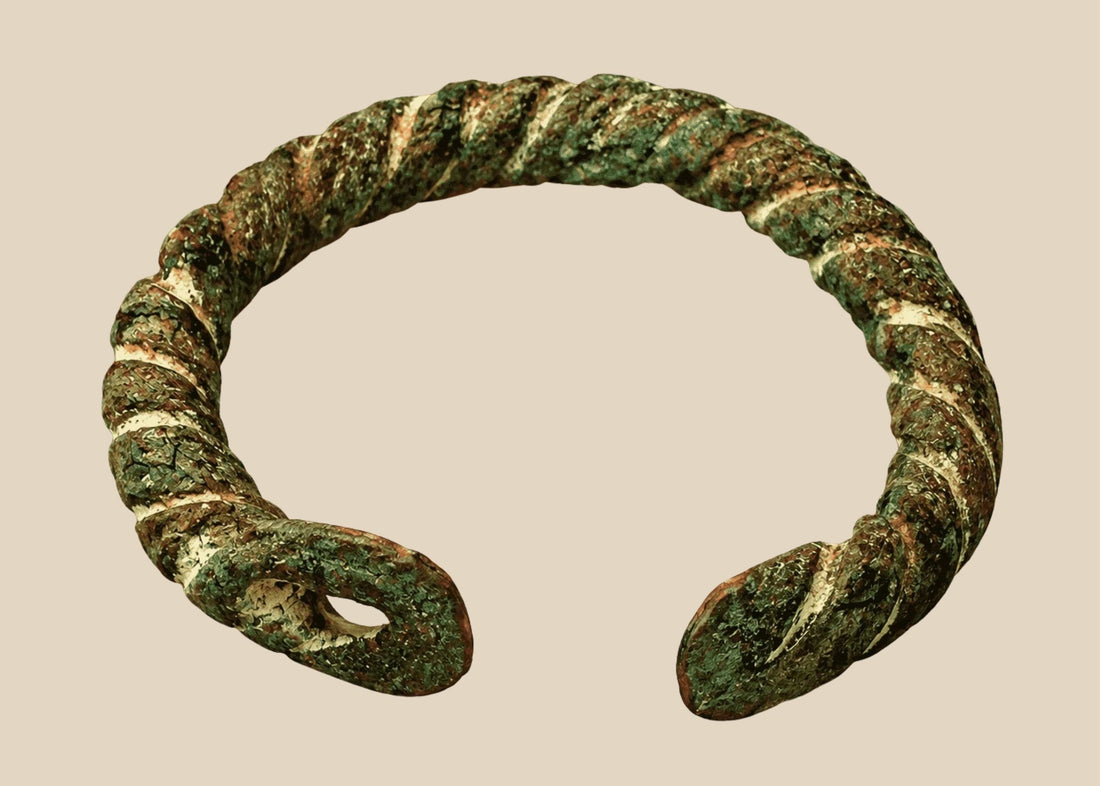
Celtic Twisted Bronze Bracelet with Pierced Terminal | Iron Age–Roman Period | Circa 300 BCE–200 CE
- Prix habituel
- $450.00
- Prix soldé
- $450.00
- Prix habituel
Impossible de charger la disponibilité du service de retrait





Celtic Twisted Bronze Bracelet with Pierced Terminal | Iron Age–Roman Period | Circa 300 BCE–200 CE
Description
Plus
Moins
Historical Context & Origin
Region: Celtic Europe, exact geographical origin undetermined
Material: Copper alloy, traditionally identified as bronze, with green and brown surface patination
Period: Iron Age to Early Roman Period, circa 300 BCE–200 CE (attributed)
Description
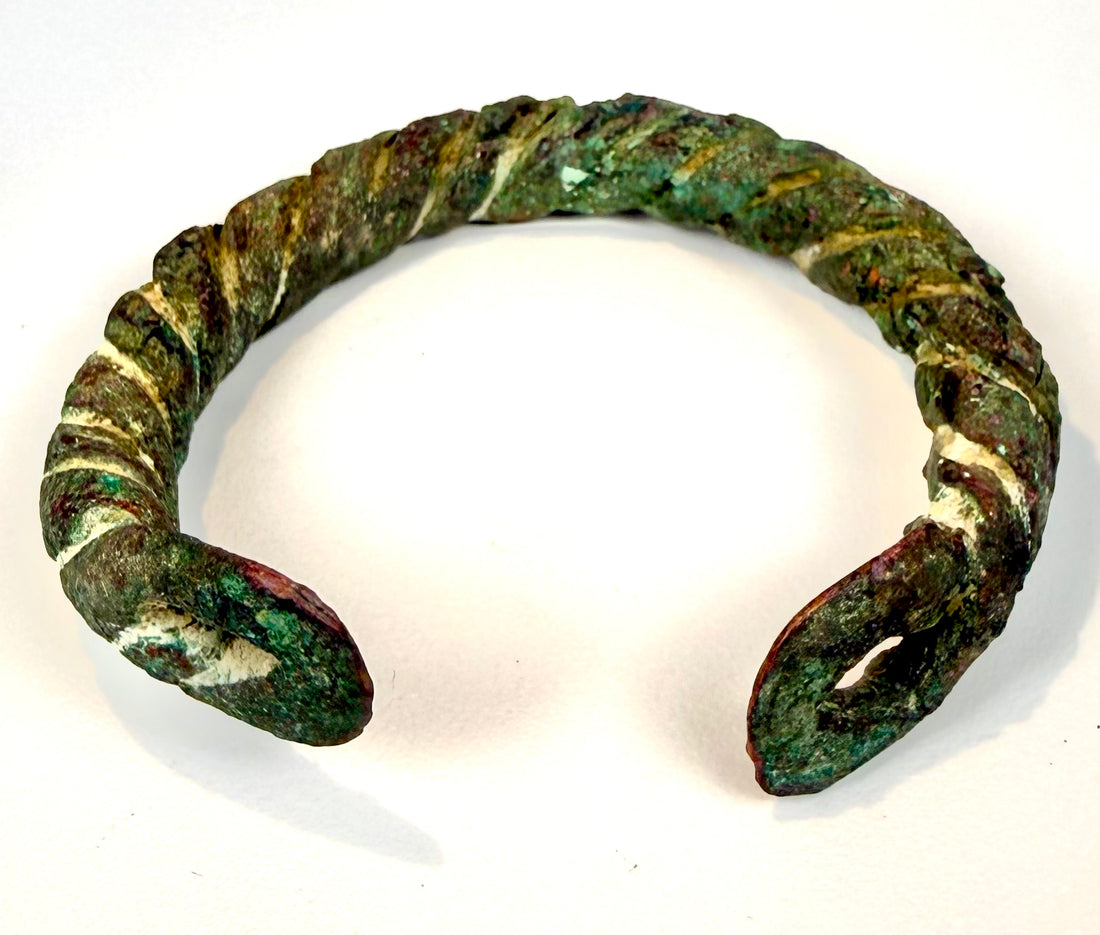
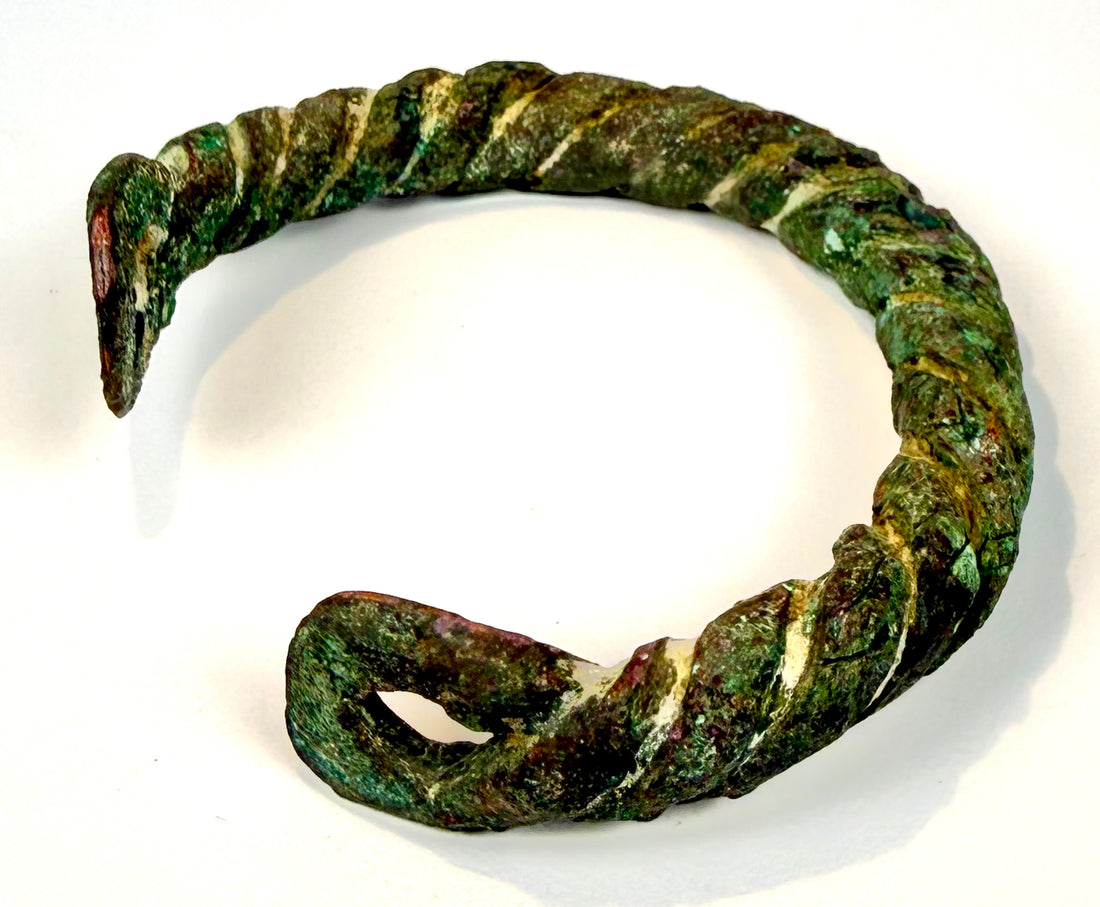
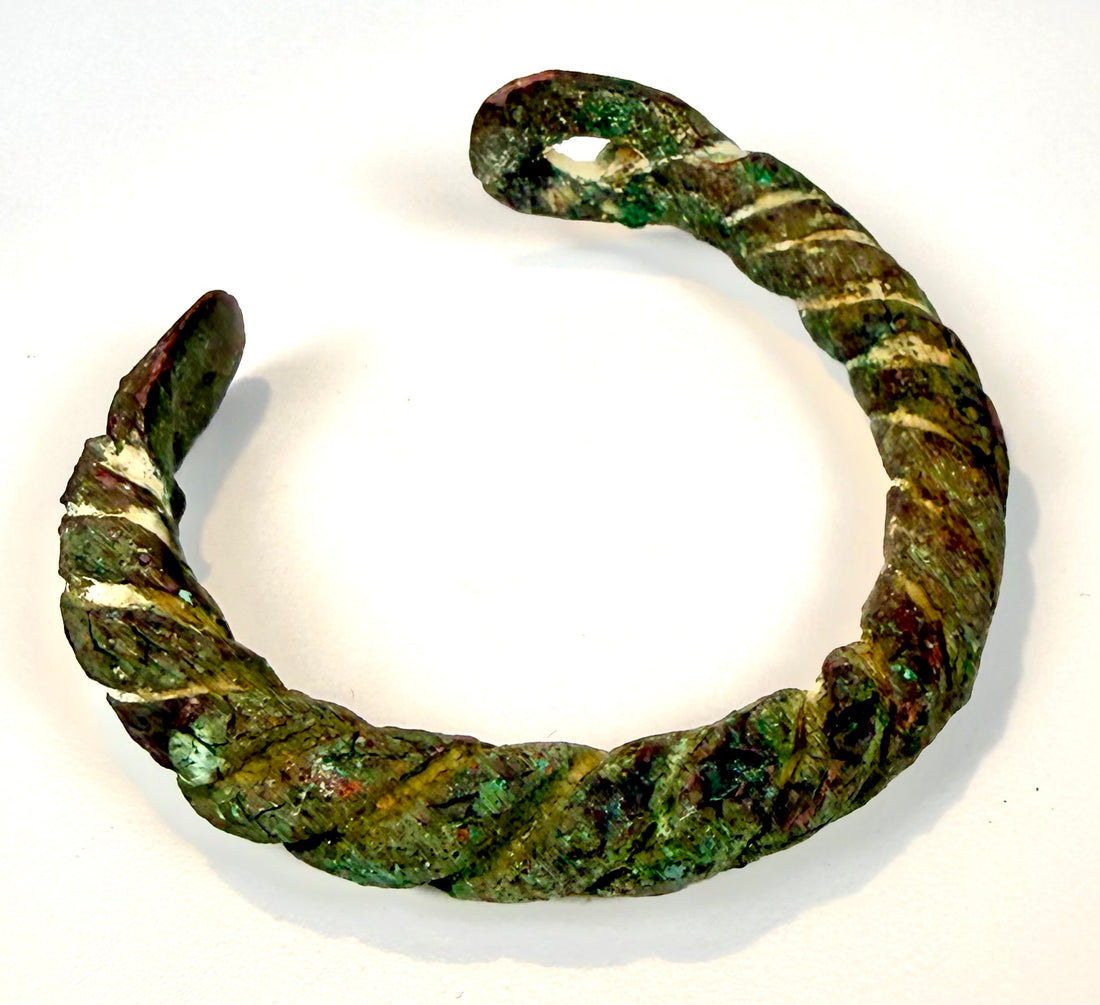
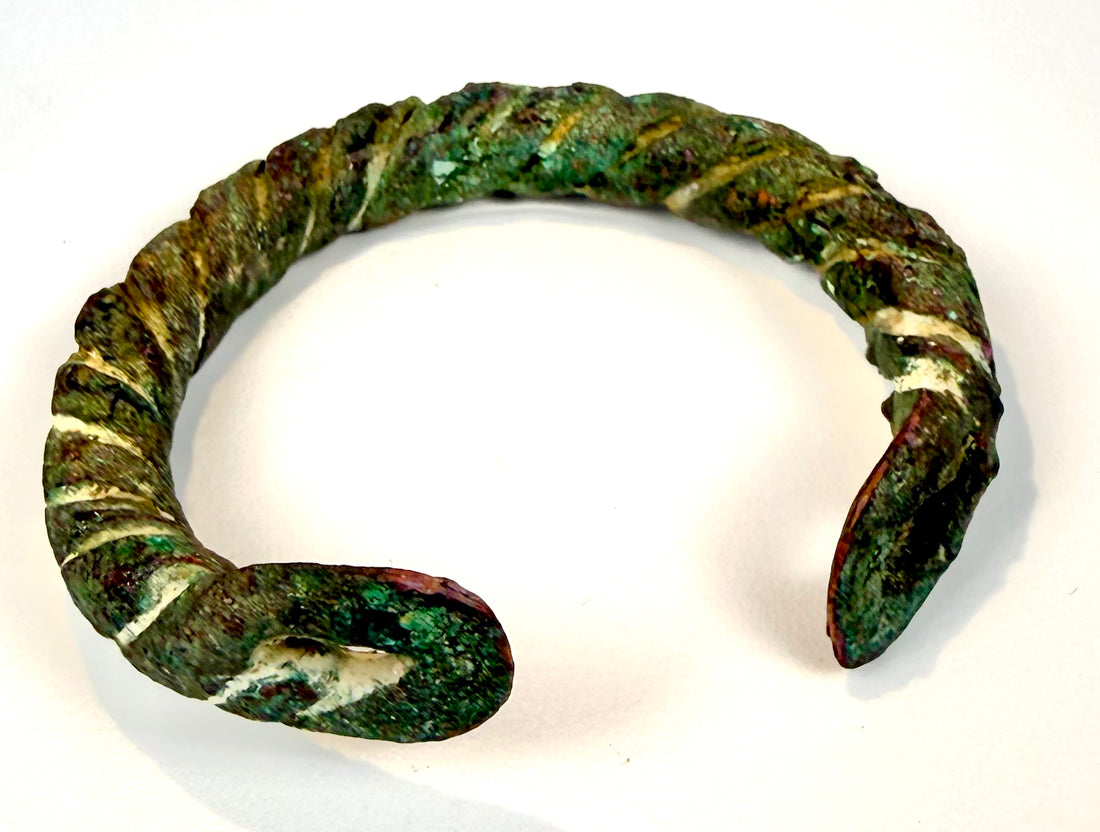
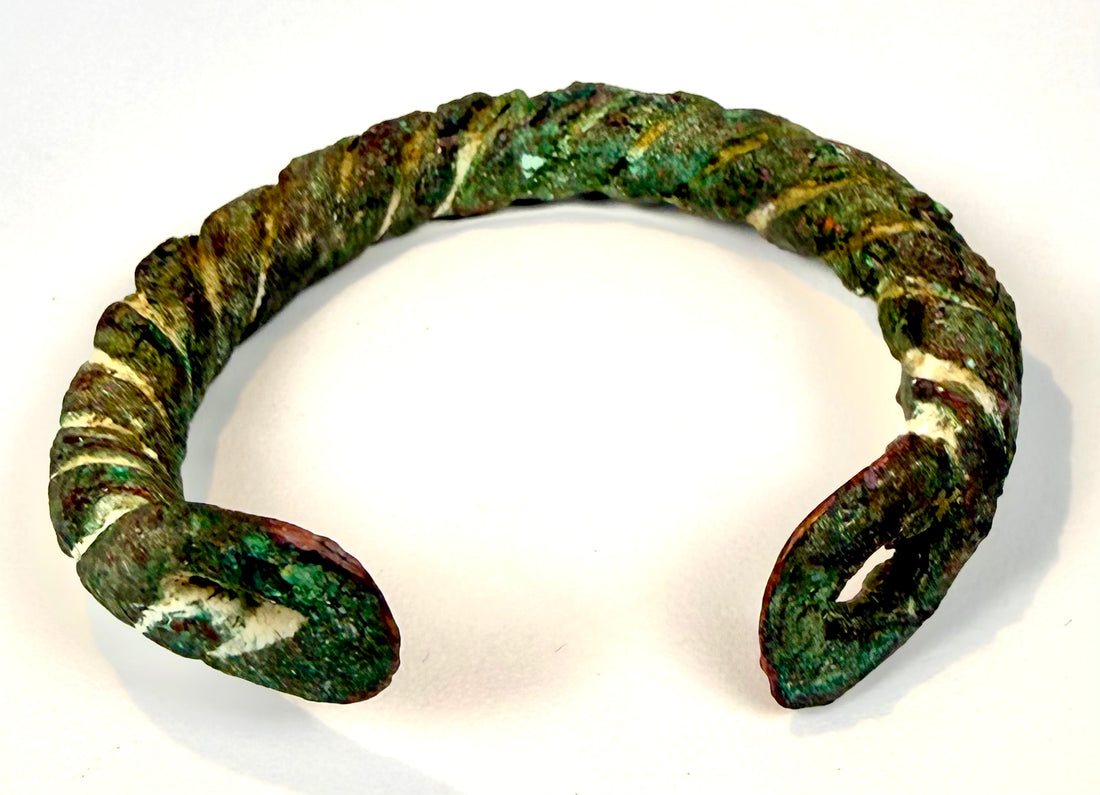
This Celtic-style copper-alloy bracelet features a substantial twisted body, open circular construction, and distinctive flattened terminals. Traditionally attributed to the European Iron Age, the ornament displays a penannular, or open-ended, configuration with a thick, gently curved body decorated by continuous diagonal, spiral-like ridges. These pronounced alternating bands create the appearance of twisted rope, a decorative treatment associated with ancient European metalworking traditions.
The two terminals are flattened and curve inward toward the opening. One retains an elongated perforation, while the opposing terminal is comparatively solid and paddle-shaped. Similar perforated terminals are documented on ancient European bracelets and may have been associated with fastening arrangements, although the original closure mechanism of this example remains undetermined.
The bracelet exhibits a richly varied surface combining dark green, olive, turquoise-green, and reddish-brown patination. Pale cream-coloured mineral-like deposits accentuate portions of the recessed spiral decoration, creating a striking contrast against the darker metal. Despite extensive oxidation, encrustation, and surface wear, the raised decorative ridges remain visible throughout much of the curved body, preserving the ornament's distinctive twisted appearance and sculptural character.
Features
- Open-ended penannular copper-alloy bracelet of Celtic-style construction
- Substantial curved body with continuous diagonal, rope-like spiral decoration
- One flattened terminal featuring an elongated pierced opening
- Opposing flattened terminal with a solid, inward-curving profile
- Rich green, olive, turquoise, and reddish-brown surface patination
- Pale mineral-like deposits visible within portions of the spiral recesses
- Pronounced surface texture with surviving raised decorative ridges
Cultural Significance
Bracelets, armlets, and torcs were important forms of personal adornment among many communities of ancient Europe. During the Iron Age, jewellery produced from bronze, iron, silver, and gold served both decorative and symbolic purposes, reflecting regional metalworking traditions, individual preferences, and, in certain contexts, social standing.
Celtic metalworkers became particularly accomplished in creating ornaments incorporating twisting, spirals, repeating geometric patterns, and elaborate terminals. These decorative techniques were employed in personal accessories and prestige jewellery, demonstrating considerable skill in metalworking and ornamental design. The twisted-rope appearance of this bracelet reflects a broader ancient European tradition of creating visual movement through repeated linear and spiral decoration.
Open-ended penannular bracelets were produced in numerous variations throughout ancient Europe, sometimes incorporating loops, hooks, or other fastening arrangements. The perforated terminal of this example is particularly interesting, suggesting a possible functional element associated with securing or wearing the ornament. Its distinctive construction and decorative treatment provide insight into the craftsmanship and personal adornment traditions of the Iron Age and Early Roman periods.
Condition
The bracelet exhibits extensive surface patination, oxidation, localized pitting, encrustation, and irregular surface wear. The copper-alloy surface displays contrasting shades of green, brown, and reddish oxidation, with pale deposits visible within several of the spiral recesses. The raised decorative pattern remains recognizable throughout much of the bracelet's circumference despite areas of corrosion and surface deterioration. Both flattened terminals survive, including the elongated opening through one terminal. Minor irregularities, localized edge losses, and surface abrasions are visible.
Dimensions (Approximate)
Diameter: 2.5 in
Age (Approximate)
1,800–2,300 years old
Provenance
Formerly handled by Gallery Elder, Ottawa, Ontario, Canada, an established Canadian antiques and decorative arts gallery specializing in carefully selected historical objects, antiquities, fine art, and collectible pieces from diverse cultural traditions.
Subsequently acquired into a private collection in Ottawa, Ontario, Canada, where the bracelet was preserved alongside other historical and collectible artifacts.
Learn More
Explore a comparable historical copper-alloy bracelet featuring twisted metalwork and flattened terminals through the University of Cambridge Museum of Archaeology and Anthropology
Discover additional historical bracelets and decorative metalwork in our Ancient Rings & Jewelry Collection
Description
Historical Context & Origin
Region: Celtic Europe, exact geographical origin undetermined
Material: Copper alloy, traditionally identified as bronze, with green and brown surface patination
Period: Iron Age to Early Roman Period, circa 300 BCE–200 CE (attributed)
Description
This Celtic-style copper-alloy bracelet features a substantial twisted body, open circular construction, and distinctive flattened terminals. Traditionally attributed to the European Iron Age, the ornament displays a penannular, or open-ended, configuration with a thick, gently curved body decorated by continuous diagonal, spiral-like ridges. These pronounced alternating bands create the appearance of twisted rope, a decorative treatment associated with ancient European metalworking traditions.
The two terminals are flattened and curve inward toward the opening. One retains an elongated perforation, while the opposing terminal is comparatively solid and paddle-shaped. Similar perforated terminals are documented on ancient European bracelets and may have been associated with fastening arrangements, although the original closure mechanism of this example remains undetermined.
The bracelet exhibits a richly varied surface combining dark green, olive, turquoise-green, and reddish-brown patination. Pale cream-coloured mineral-like deposits accentuate portions of the recessed spiral decoration, creating a striking contrast against the darker metal. Despite extensive oxidation, encrustation, and surface wear, the raised decorative ridges remain visible throughout much of the curved body, preserving the ornament's distinctive twisted appearance and sculptural character.
Features
- Open-ended penannular copper-alloy bracelet of Celtic-style construction
- Substantial curved body with continuous diagonal, rope-like spiral decoration
- One flattened terminal featuring an elongated pierced opening
- Opposing flattened terminal with a solid, inward-curving profile
- Rich green, olive, turquoise, and reddish-brown surface patination
- Pale mineral-like deposits visible within portions of the spiral recesses
- Pronounced surface texture with surviving raised decorative ridges
Cultural Significance
Bracelets, armlets, and torcs were important forms of personal adornment among many communities of ancient Europe. During the Iron Age, jewellery produced from bronze, iron, silver, and gold served both decorative and symbolic purposes, reflecting regional metalworking traditions, individual preferences, and, in certain contexts, social standing.
Celtic metalworkers became particularly accomplished in creating ornaments incorporating twisting, spirals, repeating geometric patterns, and elaborate terminals. These decorative techniques were employed in personal accessories and prestige jewellery, demonstrating considerable skill in metalworking and ornamental design. The twisted-rope appearance of this bracelet reflects a broader ancient European tradition of creating visual movement through repeated linear and spiral decoration.
Open-ended penannular bracelets were produced in numerous variations throughout ancient Europe, sometimes incorporating loops, hooks, or other fastening arrangements. The perforated terminal of this example is particularly interesting, suggesting a possible functional element associated with securing or wearing the ornament. Its distinctive construction and decorative treatment provide insight into the craftsmanship and personal adornment traditions of the Iron Age and Early Roman periods.
Condition
The bracelet exhibits extensive surface patination, oxidation, localized pitting, encrustation, and irregular surface wear. The copper-alloy surface displays contrasting shades of green, brown, and reddish oxidation, with pale deposits visible within several of the spiral recesses. The raised decorative pattern remains recognizable throughout much of the bracelet's circumference despite areas of corrosion and surface deterioration. Both flattened terminals survive, including the elongated opening through one terminal. Minor irregularities, localized edge losses, and surface abrasions are visible.
Dimensions (Approximate)
Diameter: 2.5 in
Age (Approximate)
1,800–2,300 years old
Provenance
Formerly handled by Gallery Elder, Ottawa, Ontario, Canada, an established Canadian antiques and decorative arts gallery specializing in carefully selected historical objects, antiquities, fine art, and collectible pieces from diverse cultural traditions.
Subsequently acquired into a private collection in Ottawa, Ontario, Canada, where the bracelet was preserved alongside other historical and collectible artifacts.
Learn More
Explore a comparable historical copper-alloy bracelet featuring twisted metalwork and flattened terminals through the University of Cambridge Museum of Archaeology and Anthropology
Discover additional historical bracelets and decorative metalwork in our Ancient Rings & Jewelry Collection
Vous aimerez peut-être aussi
