
Commande d'armes de la milice historique de Géorgie signée par le colonel George Bomford | Département d'ordonnance des États-Unis | 1826
- Prix habituel
- $1,500.00
- Prix soldé
- $1,500.00
- Prix habituel
Impossible de charger la disponibilité du service de retrait



Commande d'armes de la milice historique de Géorgie signée par le colonel George Bomford | Département d'ordonnance des États-Unis | 1826
Description
Plus
Moins
Contexte historique et origine
Région : Washington, D.C., États-Unis
Matériau : Encre manuscrite sur papier vergé ou papier à lettre, montée pour la conservation sous verre filtrant les UV dans un cadre doré et noir
Période : Début de la République américaine, daté du 18 décembre 1826
Description
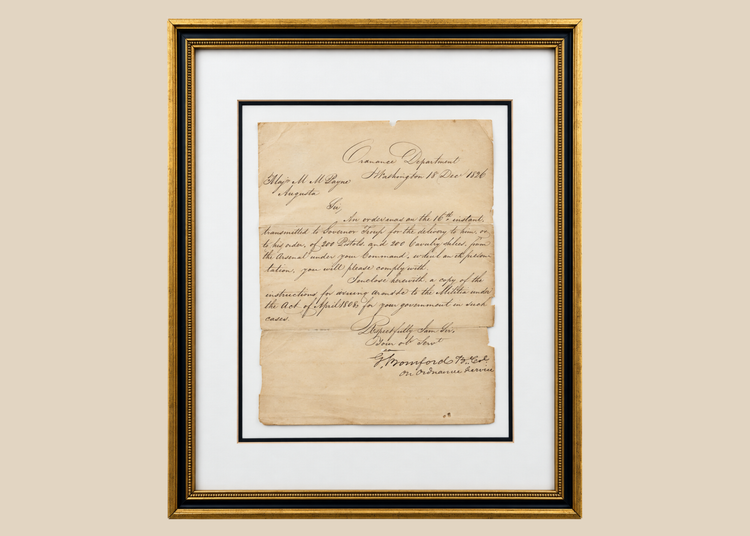
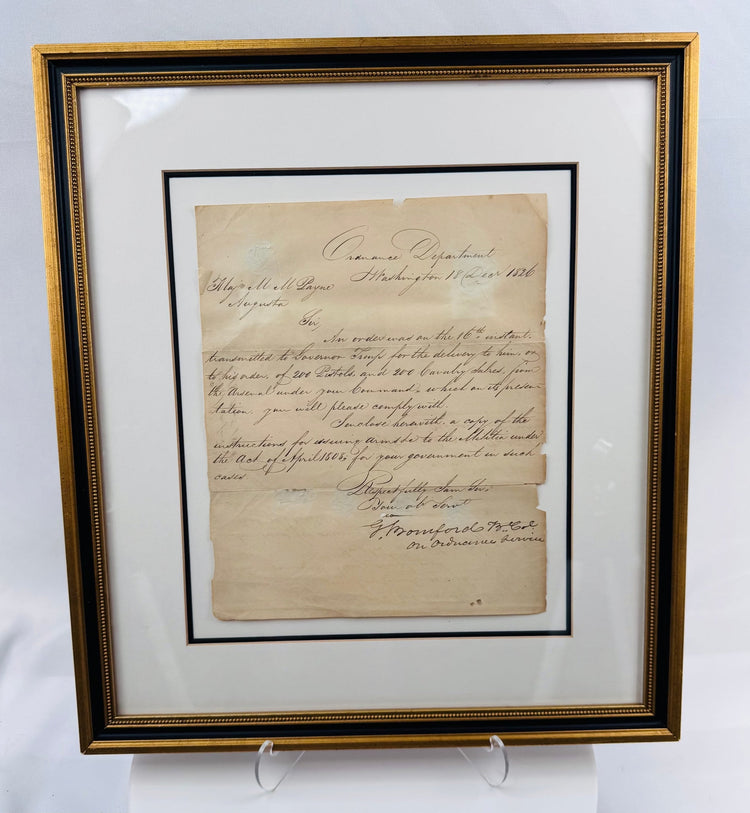
Ce document militaire des États-Unis, d'une importance historique, est une lettre originale d'une page émise par le Département de l'Artillerie à Washington, D.C., le 18 décembre 1826. Elle était adressée au Major Mathew Mountjoy Payne, commandant de l'Arsenal des États-Unis à Augusta, Géorgie, et signée par le Colonel George Bomford au nom du Service de l'Artillerie.
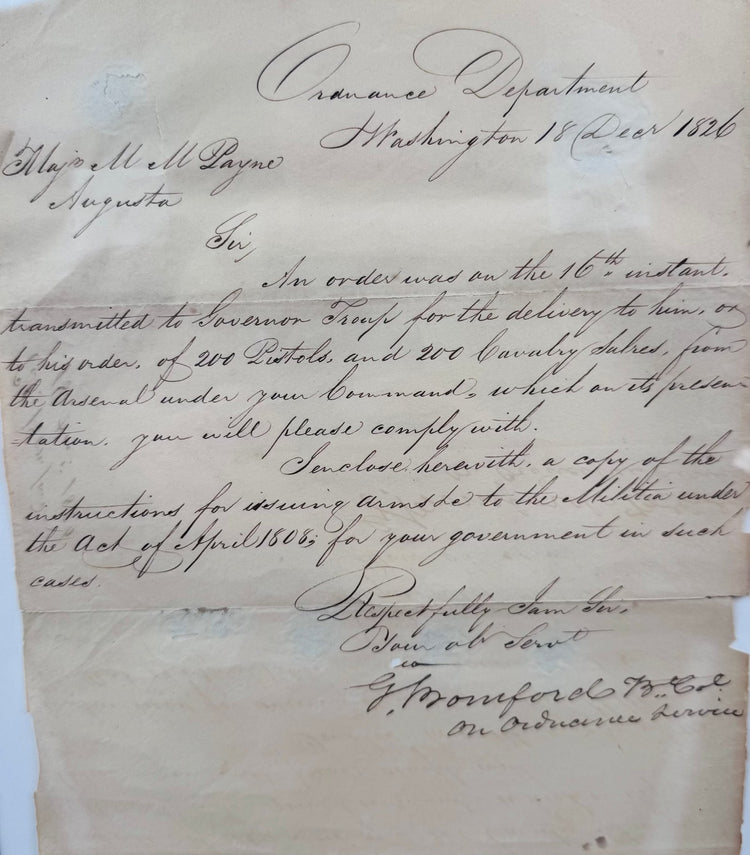
Écrite d'une main claire de l'époque, la lettre enjoint à Payne de se conformer à un ordre transmis au gouverneur de Géorgie, George Troup, pour la livraison de 200 pistolets et 200 sabres de cavalerie de l'arsenal fédéral sous le commandement de Payne. Bomford note en outre que des instructions régissant la délivrance d'armes aux milices d'État en vertu de la Loi fédérale d'avril 1808 étaient jointes pour guider Payne.
Le document stipule :
« Un ordre a été transmis le 16 courant au Gouverneur Troup pour la livraison à lui, ou à son ordre, de 200 Pistolets, et 200 Sabres de Cavalerie, de l'Arsenal sous votre Commandement, auquel vous voudrez bien vous conformer dès sa présentation. Je joins ci-joint, une copie des instructions pour la délivrance d'Armes &c à la Milice en vertu de la Loi d'avril 1808, pour votre gouverne dans de tels cas. »
Il conclut :
« Respectueusement je suis, Monsieur, Votre très humble Serviteur, G. Bomford Bt. Col., au Service de l'Artillerie. »
George Bomford était un éminent ingénieur militaire américain et officier d'artillerie qui a servi pendant la guerre de 1812 et est devenu plus tard le deuxième chef de l'artillerie de l'armée des États-Unis en 1832. Il a également été associé au développement du Columbiad, un canon lourd de défense côtière utilisé dans les fortifications américaines du XIXe siècle.
Le major Mathew Mountjoy Payne a été l'un des premiers commandants de l'arsenal d'Augusta. L'arsenal avait été créé pour stocker et distribuer des armes fédérales dans toute la région, et Payne a été étroitement impliqué dans son administration et sa délocalisation en dehors du centre d'Augusta.
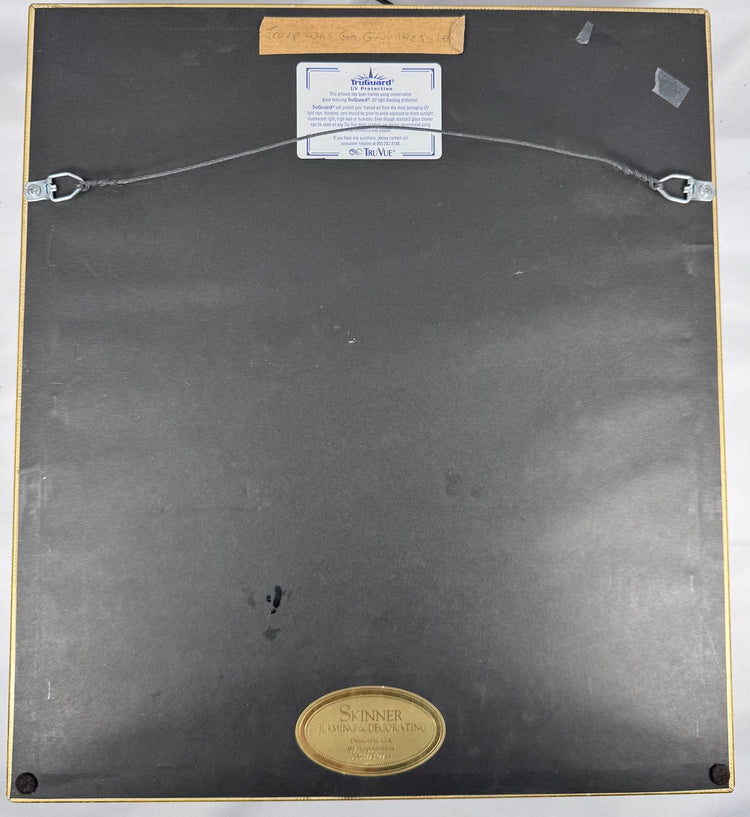
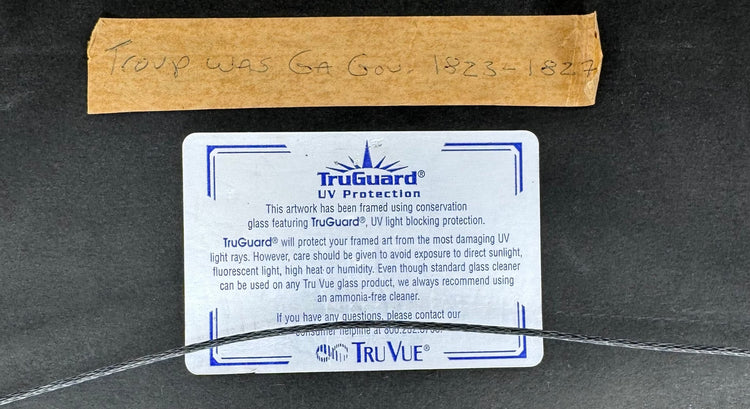
La lettre a été professionnellement montée dans un large passe-partout de style archivistique et placée dans un cadre décoratif noir et doré. Une étiquette au dos identifie Skinner Framing & Decorating de Demorest, Géorgie, tandis qu'une étiquette TruGuard confirme l'utilisation de verre de conservation offrant une protection contre les rayons UV.
Caractéristiques
- Lettre originale du Département de l'Artillerie des États-Unis
- Datée du 18 décembre 1826
- Signée par le colonel George Bomford
- Adressée au major Mathew Mountjoy Payne
- Émise depuis Washington, D.C.
- Ordonne la livraison de 200 pistolets et 200 sabres de cavalerie
- Armes destinées au gouverneur de Géorgie, George Troup, ou à son représentant autorisé
- Référence aux instructions fédérales sur les armes de milice en vertu de la Loi d'avril 1808
- Lié à l'historique arsenal d'Augusta
- Une page manuscrite à l'encre de l'époque
- Encadrement de conservation professionnel sous verre filtrant les UV
Importance culturelle
Ce document fournit un compte rendu direct de la façon dont le gouvernement des premiers États-Unis distribuait les armes militaires des arsenaux fédéraux aux milices d'État. La loi sur la milice de 1808 a établi des crédits fédéraux continus pour fournir des armes et des équipements aux États, et cette lettre illustre ce système en fonctionnement actif moins de deux décennies après la promulgation de la législation.
Sa date et ses destinataires le placent également dans une période controversée de l'histoire de la Géorgie. Le gouverneur George Troup était engagé dans une confrontation croissante avec le gouvernement fédéral et la nation Muscogee, ou Creek, suite au traité contesté d'Indian Springs de 1825 et au traité de Washington de remplacement en 1826. Troup a rejeté les efforts fédéraux pour restreindre les revendications territoriales de la Géorgie, a ordonné des levés de terres Creek et a mobilisé la milice d'État pendant la crise qui en a résulté.
La lettre n'identifie pas de campagne spécifique prévue ni ne déclare que les pistolets et les sabres étaient destinés au déplacement forcé du peuple Creek. Néanmoins, elle documente le transfert d'un armement fédéral substantiel au gouvernement de Géorgie de Troup pendant la même période de mobilisation de la milice, de levés de terres contestés et de conflit croissant sur la souveraineté autochtone.
En tant que document signé par George Bomford et enregistrant la distribution d'armes fédérales aux États, la lettre a une importance pour les collectionneurs de manuscrits américains anciens, d'histoire militaire, d'histoire de la Géorgie, de matériel d'arsenal fédéral et de documents associés à l'histoire plus large de l'expansion des États-Unis et de la dépossession des autochtones.
État
Le document reste lisible et se présente bien dans son encadrement de conservation professionnel. Un vieillissement attendu, des taches éparses, des plis, des lignes de pliage, des abrasions superficielles mineures, de petites pertes sur les bords, de courtes déchirures et des zones de vieux papier ou de réparation adhésive sont visibles partout.
Un pli horizontal prononcé ou une ligne de séparation traverse le centre de la feuille, avec des pertes et des irrégularités supplémentaires le long du bord droit et de la marge supérieure. L'encre reste foncée et facilement lisible, y compris la signature de Bomford.
Le cadre présente une légère usure superficielle correspondant à son âge et à sa manipulation. Le document n'a pas été retiré de son cadre pour inspection, et l'état des marges cachées et du verso n'a donc pas été évalué.
Dimensions (approximatives)
Hauteur encadrée : 16 po
Largeur encadrée : 14,25 po
Profondeur : 0,75 po
Âge (approximatif)
200 ans
Provenance
Faisait autrefois partie d'une collection privée à Columbus, Ohio, États-Unis, constituée sur plusieurs décennies avec un accent particulier sur les militaria américains anciens, les documents historiques et les artefacts de l'armée des États-Unis du XIXe siècle. La collection comprenait de la correspondance militaire, des armes blanches, des uniformes et des documents d'archives relatifs aux années de formation de la République américaine et à l'expansion de l'établissement militaire des États-Unis.
Le présent document a été conservé dans cette collection et professionnellement encadré pour la conservation par Skinner Framing & Decorating de Demorest, Géorgie, en utilisant du verre de protection UV TruGuard pour protéger le manuscrit de l'exposition à la lumière et des dommages environnementaux.
En savoir plus
En savoir plus sur la vie et la carrière militaire de George Bomford, l'officier d'artillerie américain qui a signé cette lettre de 1826.
Explorez notre Collection d'artefacts du XIXe siècle
Description
Contexte historique et origine
Région : Washington, D.C., États-Unis
Matériau : Encre manuscrite sur papier vergé ou papier à lettre, montée pour la conservation sous verre filtrant les UV dans un cadre doré et noir
Période : Début de la République américaine, daté du 18 décembre 1826
Description
Ce document militaire des États-Unis, d'une importance historique, est une lettre originale d'une page émise par le Département de l'Artillerie à Washington, D.C., le 18 décembre 1826. Elle était adressée au Major Mathew Mountjoy Payne, commandant de l'Arsenal des États-Unis à Augusta, Géorgie, et signée par le Colonel George Bomford au nom du Service de l'Artillerie.
Écrite d'une main claire de l'époque, la lettre enjoint à Payne de se conformer à un ordre transmis au gouverneur de Géorgie, George Troup, pour la livraison de 200 pistolets et 200 sabres de cavalerie de l'arsenal fédéral sous le commandement de Payne. Bomford note en outre que des instructions régissant la délivrance d'armes aux milices d'État en vertu de la Loi fédérale d'avril 1808 étaient jointes pour guider Payne.
Le document stipule :
« Un ordre a été transmis le 16 courant au Gouverneur Troup pour la livraison à lui, ou à son ordre, de 200 Pistolets, et 200 Sabres de Cavalerie, de l'Arsenal sous votre Commandement, auquel vous voudrez bien vous conformer dès sa présentation. Je joins ci-joint, une copie des instructions pour la délivrance d'Armes &c à la Milice en vertu de la Loi d'avril 1808, pour votre gouverne dans de tels cas. »
Il conclut :
« Respectueusement je suis, Monsieur, Votre très humble Serviteur, G. Bomford Bt. Col., au Service de l'Artillerie. »
George Bomford était un éminent ingénieur militaire américain et officier d'artillerie qui a servi pendant la guerre de 1812 et est devenu plus tard le deuxième chef de l'artillerie de l'armée des États-Unis en 1832. Il a également été associé au développement du Columbiad, un canon lourd de défense côtière utilisé dans les fortifications américaines du XIXe siècle.
Le major Mathew Mountjoy Payne a été l'un des premiers commandants de l'arsenal d'Augusta. L'arsenal avait été créé pour stocker et distribuer des armes fédérales dans toute la région, et Payne a été étroitement impliqué dans son administration et sa délocalisation en dehors du centre d'Augusta.
La lettre a été professionnellement montée dans un large passe-partout de style archivistique et placée dans un cadre décoratif noir et doré. Une étiquette au dos identifie Skinner Framing & Decorating de Demorest, Géorgie, tandis qu'une étiquette TruGuard confirme l'utilisation de verre de conservation offrant une protection contre les rayons UV.
Caractéristiques
- Lettre originale du Département de l'Artillerie des États-Unis
- Datée du 18 décembre 1826
- Signée par le colonel George Bomford
- Adressée au major Mathew Mountjoy Payne
- Émise depuis Washington, D.C.
- Ordonne la livraison de 200 pistolets et 200 sabres de cavalerie
- Armes destinées au gouverneur de Géorgie, George Troup, ou à son représentant autorisé
- Référence aux instructions fédérales sur les armes de milice en vertu de la Loi d'avril 1808
- Lié à l'historique arsenal d'Augusta
- Une page manuscrite à l'encre de l'époque
- Encadrement de conservation professionnel sous verre filtrant les UV
Importance culturelle
Ce document fournit un compte rendu direct de la façon dont le gouvernement des premiers États-Unis distribuait les armes militaires des arsenaux fédéraux aux milices d'État. La loi sur la milice de 1808 a établi des crédits fédéraux continus pour fournir des armes et des équipements aux États, et cette lettre illustre ce système en fonctionnement actif moins de deux décennies après la promulgation de la législation.
Sa date et ses destinataires le placent également dans une période controversée de l'histoire de la Géorgie. Le gouverneur George Troup était engagé dans une confrontation croissante avec le gouvernement fédéral et la nation Muscogee, ou Creek, suite au traité contesté d'Indian Springs de 1825 et au traité de Washington de remplacement en 1826. Troup a rejeté les efforts fédéraux pour restreindre les revendications territoriales de la Géorgie, a ordonné des levés de terres Creek et a mobilisé la milice d'État pendant la crise qui en a résulté.
La lettre n'identifie pas de campagne spécifique prévue ni ne déclare que les pistolets et les sabres étaient destinés au déplacement forcé du peuple Creek. Néanmoins, elle documente le transfert d'un armement fédéral substantiel au gouvernement de Géorgie de Troup pendant la même période de mobilisation de la milice, de levés de terres contestés et de conflit croissant sur la souveraineté autochtone.
En tant que document signé par George Bomford et enregistrant la distribution d'armes fédérales aux États, la lettre a une importance pour les collectionneurs de manuscrits américains anciens, d'histoire militaire, d'histoire de la Géorgie, de matériel d'arsenal fédéral et de documents associés à l'histoire plus large de l'expansion des États-Unis et de la dépossession des autochtones.
État
Le document reste lisible et se présente bien dans son encadrement de conservation professionnel. Un vieillissement attendu, des taches éparses, des plis, des lignes de pliage, des abrasions superficielles mineures, de petites pertes sur les bords, de courtes déchirures et des zones de vieux papier ou de réparation adhésive sont visibles partout.
Un pli horizontal prononcé ou une ligne de séparation traverse le centre de la feuille, avec des pertes et des irrégularités supplémentaires le long du bord droit et de la marge supérieure. L'encre reste foncée et facilement lisible, y compris la signature de Bomford.
Le cadre présente une légère usure superficielle correspondant à son âge et à sa manipulation. Le document n'a pas été retiré de son cadre pour inspection, et l'état des marges cachées et du verso n'a donc pas été évalué.
Dimensions (approximatives)
Hauteur encadrée : 16 po
Largeur encadrée : 14,25 po
Profondeur : 0,75 po
Âge (approximatif)
200 ans
Provenance
Faisait autrefois partie d'une collection privée à Columbus, Ohio, États-Unis, constituée sur plusieurs décennies avec un accent particulier sur les militaria américains anciens, les documents historiques et les artefacts de l'armée des États-Unis du XIXe siècle. La collection comprenait de la correspondance militaire, des armes blanches, des uniformes et des documents d'archives relatifs aux années de formation de la République américaine et à l'expansion de l'établissement militaire des États-Unis.
Le présent document a été conservé dans cette collection et professionnellement encadré pour la conservation par Skinner Framing & Decorating de Demorest, Géorgie, en utilisant du verre de protection UV TruGuard pour protéger le manuscrit de l'exposition à la lumière et des dommages environnementaux.
En savoir plus
En savoir plus sur la vie et la carrière militaire de George Bomford, l'officier d'artillerie américain qui a signé cette lettre de 1826.
Explorez notre Collection d'artefacts du XIXe siècle
Vous aimerez peut-être aussi
