

Pre-Columbian Guerrero-Style Volcanic Stone Anthropomorphic Effigy | Mezcala Tradition | Circa 500 BCE – 1000 CE
- Prix habituel
- $1,500.00
- Prix soldé
- $1,500.00
- Prix habituel
Impossible de charger la disponibilité du service de retrait




Pre-Columbian Guerrero-Style Volcanic Stone Anthropomorphic Effigy | Mezcala Tradition | Circa 500 BCE – 1000 CE
Description
Plus
Moins
Historical Context & Origin
Region: Mesoamerica, likely Guerrero, Mexico
Culture: Attributed to the Guerrero / Mezcala sculptural tradition
Material: Hand-carved dark volcanic stone, likely basalt or related igneous stone
Period: Pre-Columbian Period, circa 500 BCE–1000 CE
Description
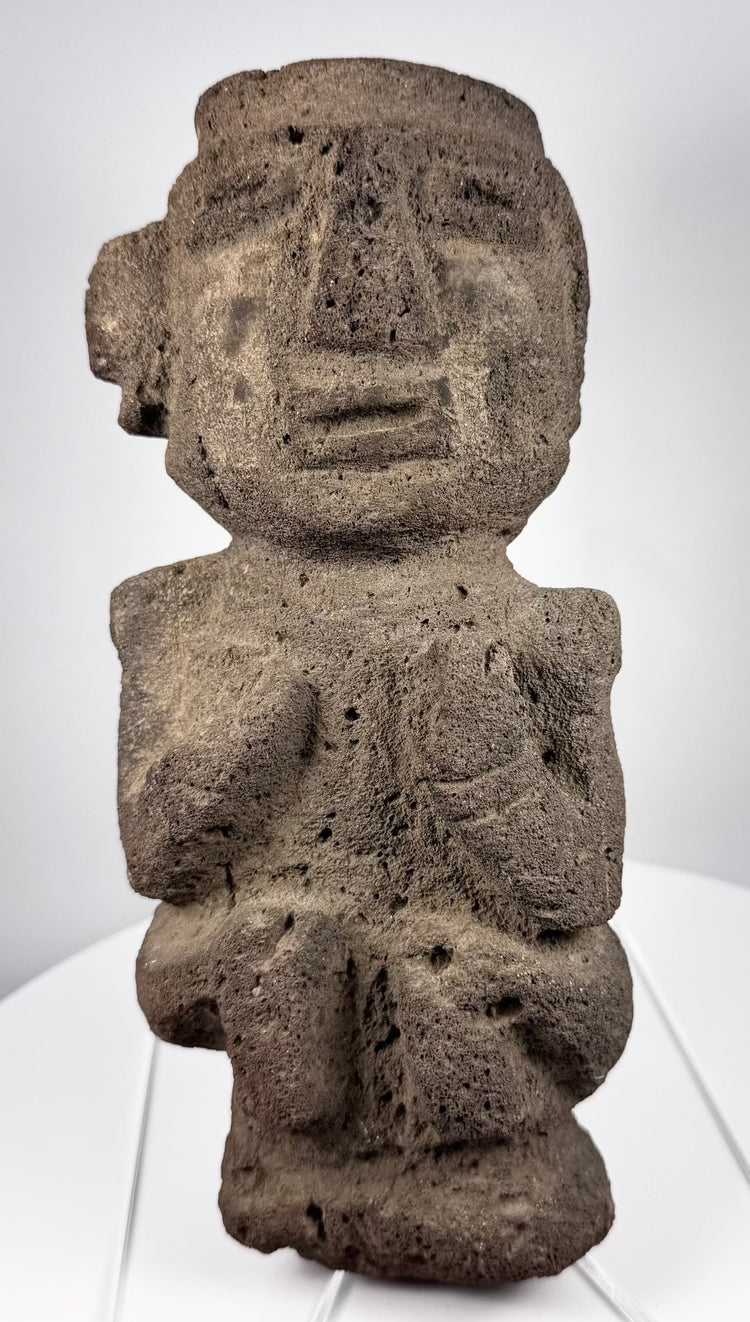
An imposing hand-carved stone anthropomorphic effigy depicting a seated or compactly posed human figure, worked from a single piece of dark, naturally porous volcanic stone.
The sculpture is dominated by an oversized rectangular head with a broad forehead, deeply defined horizontal eyes, a long projecting nose, prominent cheeks, and a carefully delineated mouth. Large lateral projections at the sides of the head may represent stylized ears, ear ornaments, or elements of a headdress.
Below, the figure's shoulders and torso are rendered in the characteristic highly simplified manner associated with ancient Guerrero stone sculpture. The arms bend inward toward the body, with incised horizontal details suggesting fingers, bracelets, or anatomical divisions. The lower body is similarly compact, with raised knees or thighs and separately indicated lower limbs forming a solid, monumental silhouette.
The reverse has been left substantially flatter and less elaborately worked than the front, concentrating the sculptural emphasis on the frontal presentation. This frontal, architectonic treatment has parallels among documented Guerrero and Mezcala stone figures, many of which were conceived as powerful, highly abstract representations of the human form.
The naturally vesicular stone creates a heavily textured surface, with numerous small cavities and mineral inclusions throughout. Areas of lighter surface coloration and wear accentuate the facial features and raised portions of the body, giving the sculpture considerable visual depth and archaeological character.
Features
- Hand-carved anthropomorphic figure fashioned from a single block of stone
- Dark porous volcanic material, likely basalt or a related igneous stone
- Large geometric head with prominent brow, elongated nose, recessed eyes, and defined mouth
- Lateral ear or headdress-like projections
- Bent arms positioned against the torso
- Incised linear detailing to the arms and lower extremities
- Compact seated or flexed-leg posture
- Predominantly frontal carving with a comparatively plain reverse
- Naturally pitted and weathered surface
- Substantial size at approximately 10 in tall
Cultural Significance
Ancient Guerrero stone sculpture is particularly noted for reducing the human form to its essential components. Mezcala artists frequently used incisions, recesses, projecting noses, simplified limbs, and strong geometric silhouettes rather than naturalistic anatomy. Archaeological and museum evidence indicates that figures of this broader tradition could have funerary, ritual, votive, or ancestral associations, although the exact purpose of an individual figure cannot normally be established without an archaeological context.
The restrained abstraction of Guerrero sculpture became especially admired in the modern era because its bold geometry can appear strikingly contemporary despite its Pre-Columbian origins.
Condition
Good overall condition with age-related surface wear, natural pitting, mineral deposits, small abrasions, edge losses, and weathering throughout. The naturally porous character of the stone is particularly evident across the face and body. Some areas exhibit lighter coloration associated with surface wear and deposits.
Dimensions (Approximate)
Height: 10 in
Width: 4.5 in
Depth: 2.5 in
Age (Approximate)
1,000–2,500 years old
Provenance
Formerly held in a private collection in Boston, Massachusetts, USA.
Learn More
Explore a documented Mezcala stone figure from Guerrero at Los Angeles County Museum of Art
Discover our Collection of Ancient Pre-Columbian Artifacts & Relics
Description
Historical Context & Origin
Region: Mesoamerica, likely Guerrero, Mexico
Culture: Attributed to the Guerrero / Mezcala sculptural tradition
Material: Hand-carved dark volcanic stone, likely basalt or related igneous stone
Period: Pre-Columbian Period, circa 500 BCE–1000 CE
Description
An imposing hand-carved stone anthropomorphic effigy depicting a seated or compactly posed human figure, worked from a single piece of dark, naturally porous volcanic stone.
The sculpture is dominated by an oversized rectangular head with a broad forehead, deeply defined horizontal eyes, a long projecting nose, prominent cheeks, and a carefully delineated mouth. Large lateral projections at the sides of the head may represent stylized ears, ear ornaments, or elements of a headdress.
Below, the figure's shoulders and torso are rendered in the characteristic highly simplified manner associated with ancient Guerrero stone sculpture. The arms bend inward toward the body, with incised horizontal details suggesting fingers, bracelets, or anatomical divisions. The lower body is similarly compact, with raised knees or thighs and separately indicated lower limbs forming a solid, monumental silhouette.
The reverse has been left substantially flatter and less elaborately worked than the front, concentrating the sculptural emphasis on the frontal presentation. This frontal, architectonic treatment has parallels among documented Guerrero and Mezcala stone figures, many of which were conceived as powerful, highly abstract representations of the human form.
The naturally vesicular stone creates a heavily textured surface, with numerous small cavities and mineral inclusions throughout. Areas of lighter surface coloration and wear accentuate the facial features and raised portions of the body, giving the sculpture considerable visual depth and archaeological character.
Features
- Hand-carved anthropomorphic figure fashioned from a single block of stone
- Dark porous volcanic material, likely basalt or a related igneous stone
- Large geometric head with prominent brow, elongated nose, recessed eyes, and defined mouth
- Lateral ear or headdress-like projections
- Bent arms positioned against the torso
- Incised linear detailing to the arms and lower extremities
- Compact seated or flexed-leg posture
- Predominantly frontal carving with a comparatively plain reverse
- Naturally pitted and weathered surface
- Substantial size at approximately 10 in tall
Cultural Significance
Ancient Guerrero stone sculpture is particularly noted for reducing the human form to its essential components. Mezcala artists frequently used incisions, recesses, projecting noses, simplified limbs, and strong geometric silhouettes rather than naturalistic anatomy. Archaeological and museum evidence indicates that figures of this broader tradition could have funerary, ritual, votive, or ancestral associations, although the exact purpose of an individual figure cannot normally be established without an archaeological context.
The restrained abstraction of Guerrero sculpture became especially admired in the modern era because its bold geometry can appear strikingly contemporary despite its Pre-Columbian origins.
Condition
Good overall condition with age-related surface wear, natural pitting, mineral deposits, small abrasions, edge losses, and weathering throughout. The naturally porous character of the stone is particularly evident across the face and body. Some areas exhibit lighter coloration associated with surface wear and deposits.
Dimensions (Approximate)
Height: 10 in
Width: 4.5 in
Depth: 2.5 in
Age (Approximate)
1,000–2,500 years old
Provenance
Formerly held in a private collection in Boston, Massachusetts, USA.
Learn More
Explore a documented Mezcala stone figure from Guerrero at Los Angeles County Museum of Art
Discover our Collection of Ancient Pre-Columbian Artifacts & Relics
Vous aimerez peut-être aussi
