


Ancient Roman Miniature Bronze Winged Figure | Possibly Cupid (Eros) | Circa 1st–3rd century CE
- Prix habituel
- $225.00
- Prix soldé
- $225.00
- Prix habituel
Impossible de charger la disponibilité du service de retrait


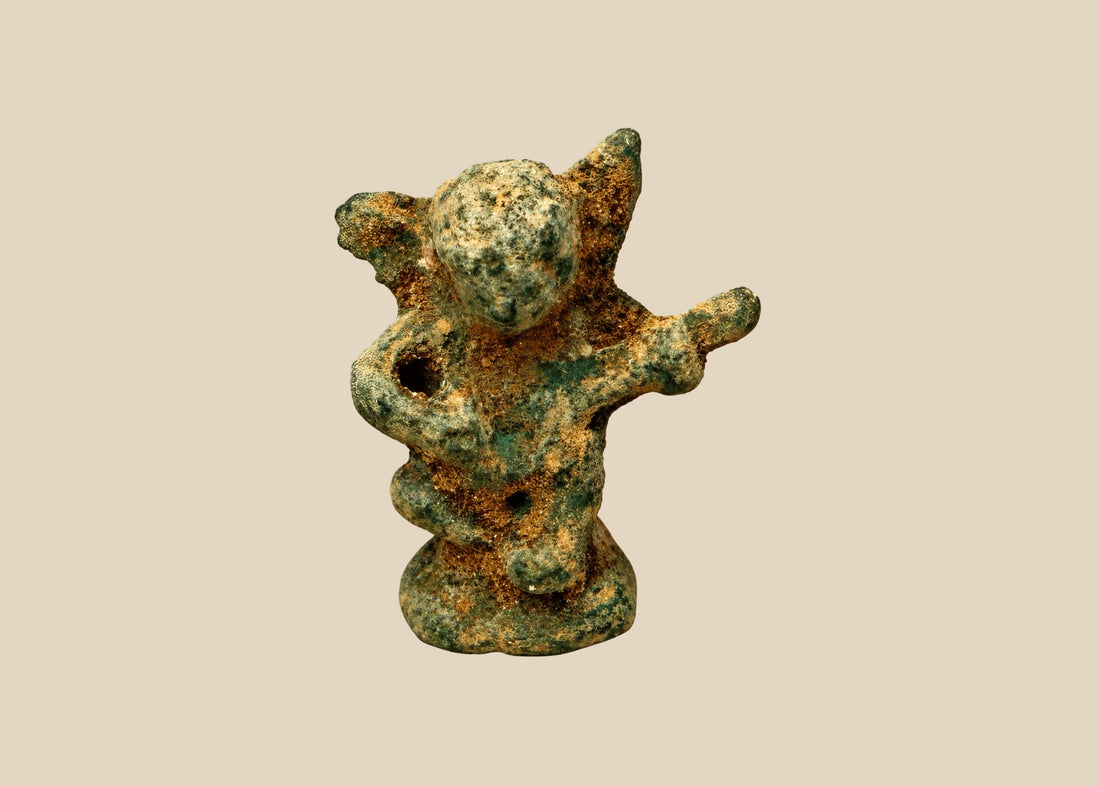


Ancient Roman Miniature Bronze Winged Figure | Possibly Cupid (Eros) | Circa 1st–3rd century CE
Description
Plus
Moins
Historical Context & Origin
Region: Roman Empire, Mediterranean region
Material: Copper alloy, possibly bronze
Period: Possibly Roman Imperial, circa 1st–3rd century CE
Description
This intriguing miniature cast copper-alloy figurine is tentatively identified as a representation of Cupid (Eros), the winged deity associated with love and desire in ancient Roman and Greek mythology. Its compact proportions and stylized appearance reflect the small-scale figurative traditions associated with the ancient Mediterranean world.
The figure displays a distinctive anthropomorphic form, featuring a rounded head, outstretched arms, and two raised wing-like projections behind the upper body. One arm extends outward, while the opposite arm curves inward, creating a small opening between the arm and torso. The simplified facial features and animated posture give the miniature a recognizable figurative character despite its substantial surface weathering.
The figure rests upon an integrated, slightly flared base, supporting its compact anthropomorphic form. Its small proportions and simplified anatomical details are reminiscent of miniature bronze representations produced throughout the ancient Mediterranean world.
The surface exhibits extensive green, dark brown, and earthy reddish patination, with irregular mineral-like deposits and encrustations obscuring much of the original detail. These characteristics give the figure a heavily weathered appearance while preserving its overall sculptural form.
Features
- Miniature cast copper-alloy construction
- Stylized anthropomorphic figure associated with Cupid (Eros) imagery
- Rounded head with simplified facial features
- Two raised wing-like projections behind the upper body
- One extended arm and one inward-curving arm
- Integrated, slightly flared base
- Variegated green, brown, and reddish surface patination
- Extensive surface encrustation and wear
Cultural Significance
Cupid, known to the ancient Greeks as Eros, was the divine personification of love, attraction, and desire. In Roman mythology, he was closely associated with Venus, the goddess of love and beauty.
Throughout the Roman Imperial period, images of Cupid appeared in sculpture, jewellery, household decoration, funerary art, and small bronze figurines. Frequently represented as a winged child or youthful male, Cupid symbolized the powerful and sometimes unpredictable nature of love.
Small bronze figures depicting deities were produced throughout the Roman world, sometimes serving as personal devotional objects, domestic shrine figures, or decorative attachments. Their compact dimensions allowed mythological and religious imagery to be incorporated into both personal and domestic settings.
The wing-like projections and animated arm positions of this miniature provide stylistic parallels with Roman representations of Cupid, reflecting the broader tradition of small-scale figurative metalwork in the ancient Mediterranean world.
Condition
The figure retains its overall recognizable form, including the rounded head, extended limbs, raised projections, and integrated base. Extensive surface corrosion, pitting, encrustation, and loss of fine detail are visible throughout. The original facial and anatomical features are significantly obscured, with irregularities to several projecting elements. The surface exhibits mottled green and earthy brown coloration.
Dimensions (Approximate)
Height: 1 in
Length: 1 in
Depth: 0.5 in
Age (Approximate)
1,700–2,000 years old
Provenance
Previously held in a private collection in Indianapolis, Indiana, United States.
Learn More
Explore a comparable Roman bronze representation of Cupid from the Imperial period through The Metropolitan Museum of Art
Discover additional ancient Roman and Greek sculptures, bronze figures, and historical artifacts in our Roman & Greek Artifacts Collection
Description
Historical Context & Origin
Region: Roman Empire, Mediterranean region
Material: Copper alloy, possibly bronze
Period: Possibly Roman Imperial, circa 1st–3rd century CE
Description
This intriguing miniature cast copper-alloy figurine is tentatively identified as a representation of Cupid (Eros), the winged deity associated with love and desire in ancient Roman and Greek mythology. Its compact proportions and stylized appearance reflect the small-scale figurative traditions associated with the ancient Mediterranean world.
The figure displays a distinctive anthropomorphic form, featuring a rounded head, outstretched arms, and two raised wing-like projections behind the upper body. One arm extends outward, while the opposite arm curves inward, creating a small opening between the arm and torso. The simplified facial features and animated posture give the miniature a recognizable figurative character despite its substantial surface weathering.
The figure rests upon an integrated, slightly flared base, supporting its compact anthropomorphic form. Its small proportions and simplified anatomical details are reminiscent of miniature bronze representations produced throughout the ancient Mediterranean world.
The surface exhibits extensive green, dark brown, and earthy reddish patination, with irregular mineral-like deposits and encrustations obscuring much of the original detail. These characteristics give the figure a heavily weathered appearance while preserving its overall sculptural form.
Features
- Miniature cast copper-alloy construction
- Stylized anthropomorphic figure associated with Cupid (Eros) imagery
- Rounded head with simplified facial features
- Two raised wing-like projections behind the upper body
- One extended arm and one inward-curving arm
- Integrated, slightly flared base
- Variegated green, brown, and reddish surface patination
- Extensive surface encrustation and wear
Cultural Significance
Cupid, known to the ancient Greeks as Eros, was the divine personification of love, attraction, and desire. In Roman mythology, he was closely associated with Venus, the goddess of love and beauty.
Throughout the Roman Imperial period, images of Cupid appeared in sculpture, jewellery, household decoration, funerary art, and small bronze figurines. Frequently represented as a winged child or youthful male, Cupid symbolized the powerful and sometimes unpredictable nature of love.
Small bronze figures depicting deities were produced throughout the Roman world, sometimes serving as personal devotional objects, domestic shrine figures, or decorative attachments. Their compact dimensions allowed mythological and religious imagery to be incorporated into both personal and domestic settings.
The wing-like projections and animated arm positions of this miniature provide stylistic parallels with Roman representations of Cupid, reflecting the broader tradition of small-scale figurative metalwork in the ancient Mediterranean world.
Condition
The figure retains its overall recognizable form, including the rounded head, extended limbs, raised projections, and integrated base. Extensive surface corrosion, pitting, encrustation, and loss of fine detail are visible throughout. The original facial and anatomical features are significantly obscured, with irregularities to several projecting elements. The surface exhibits mottled green and earthy brown coloration.
Dimensions (Approximate)
Height: 1 in
Length: 1 in
Depth: 0.5 in
Age (Approximate)
1,700–2,000 years old
Provenance
Previously held in a private collection in Indianapolis, Indiana, United States.
Learn More
Explore a comparable Roman bronze representation of Cupid from the Imperial period through The Metropolitan Museum of Art
Discover additional ancient Roman and Greek sculptures, bronze figures, and historical artifacts in our Roman & Greek Artifacts Collection
Vous aimerez peut-être aussi
