


Thai Sawankhalok Glazed Stoneware Covered Jar with Architectural Lid | Circa 15th–16th Century
- Prix habituel
- $1,000.00
- Prix soldé
- $1,000.00
- Prix habituel
Impossible de charger la disponibilité du service de retrait


Thai Sawankhalok Glazed Stoneware Covered Jar with Architectural Lid | Circa 15th–16th Century
Description
Plus
Moins
Historical Context & Origin
Region: Thailand, attributed to Si Satchanalai (Sawankhalok) kilns
Material: Glazed stoneware with pale gray-white to gray-green crackled glaze
Period: 15th–16th Century, probably 16th Century, Ayutthaya Period
Description
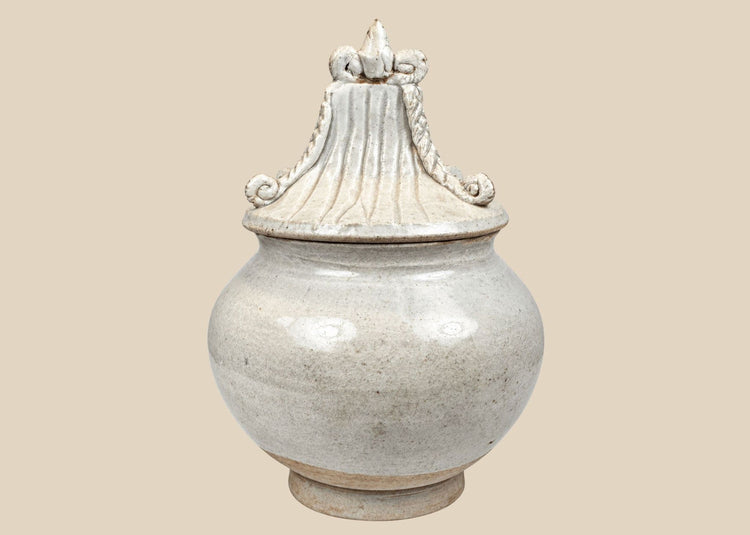
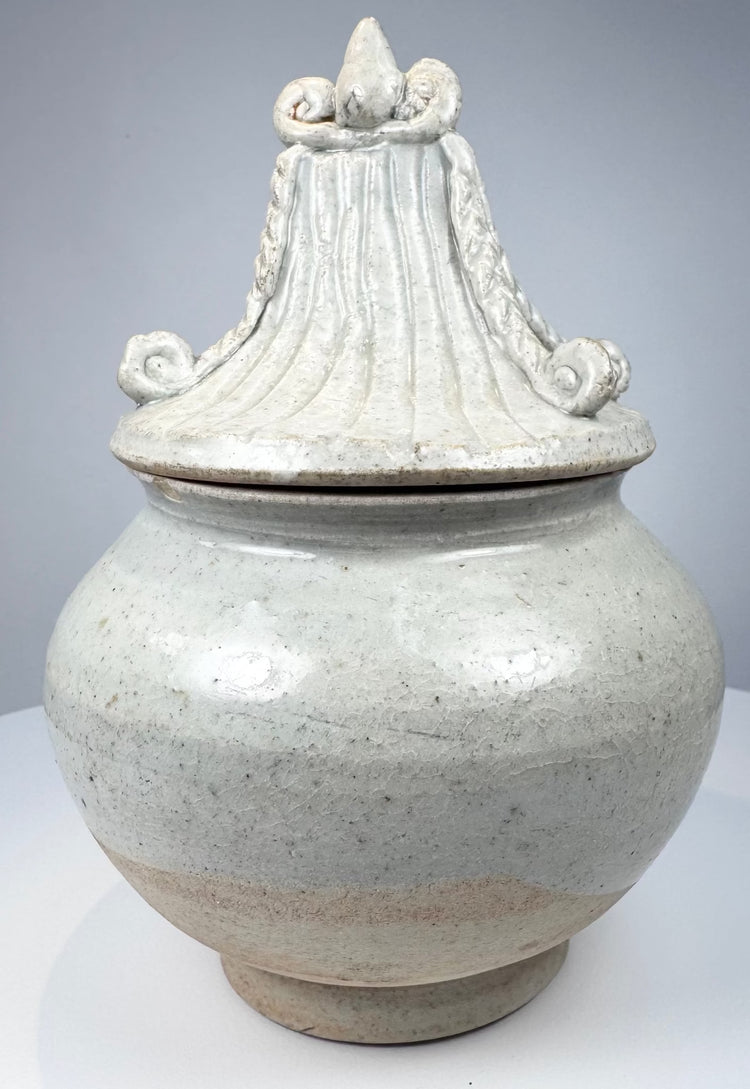
An unusual and highly decorative antique Thai covered stoneware jar, attributed to the celebrated Si Satchanalai, or Sawankhalok, ceramic tradition and likely dating to the 15th–16th century.
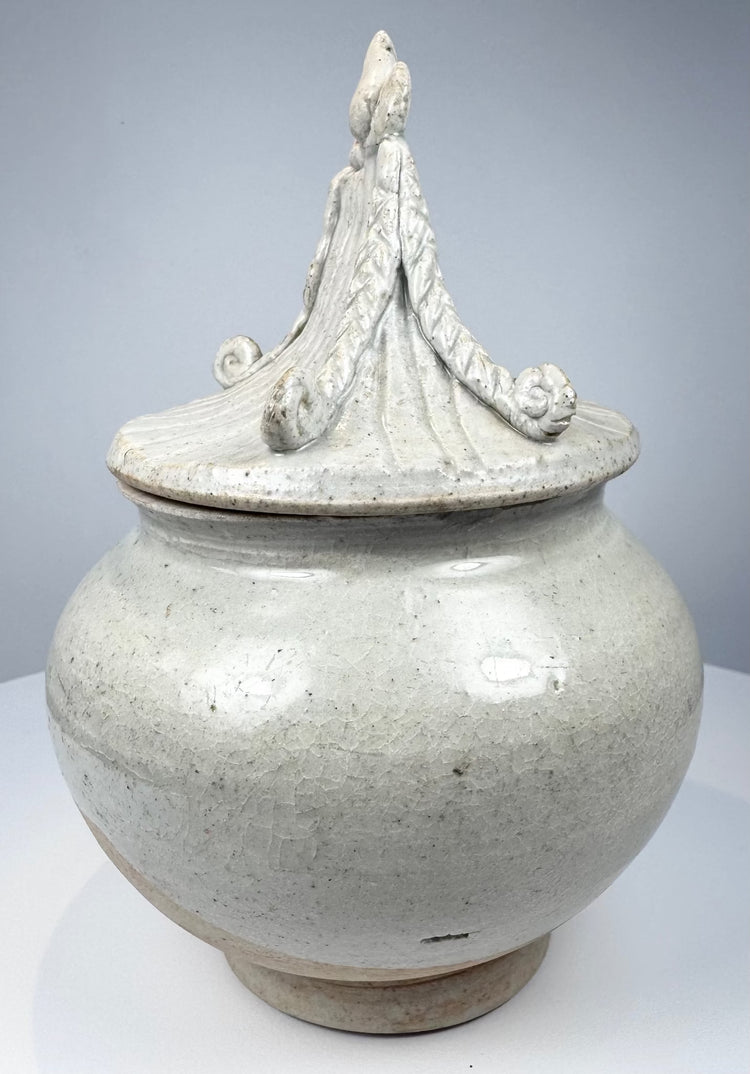
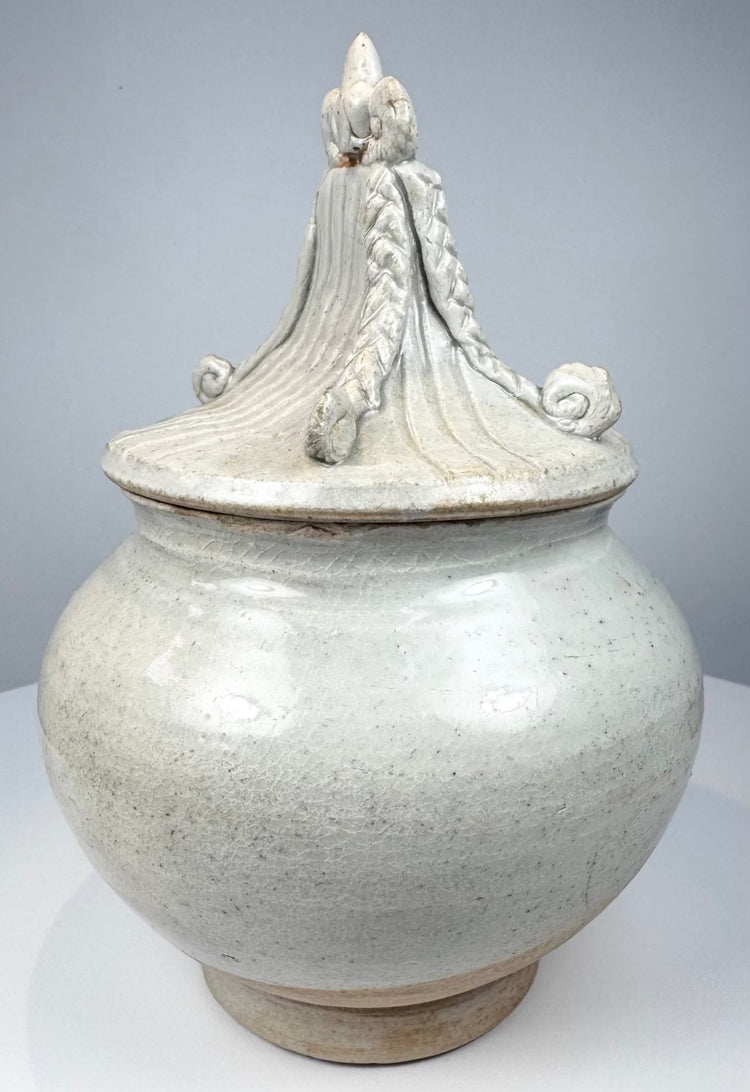
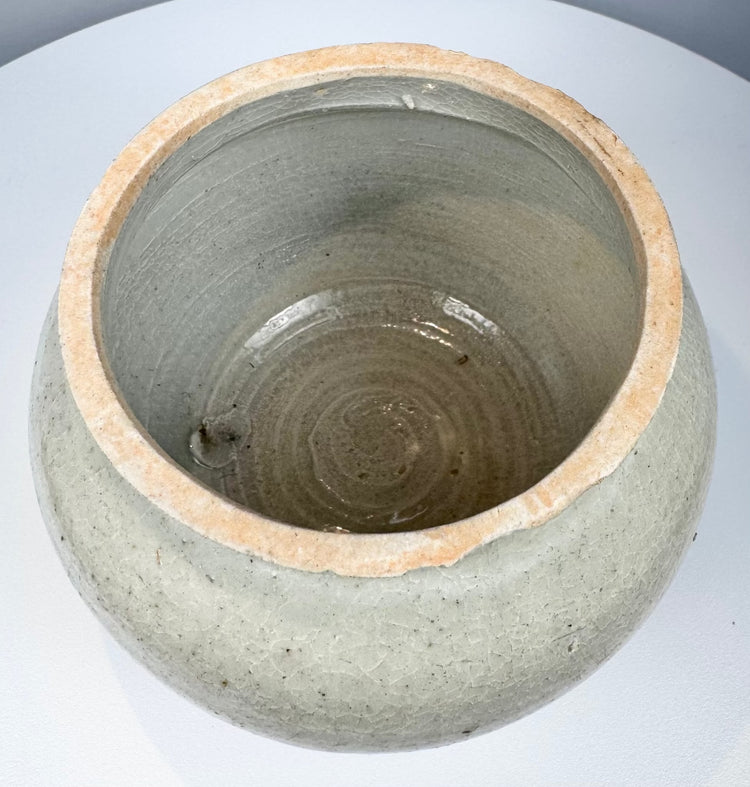
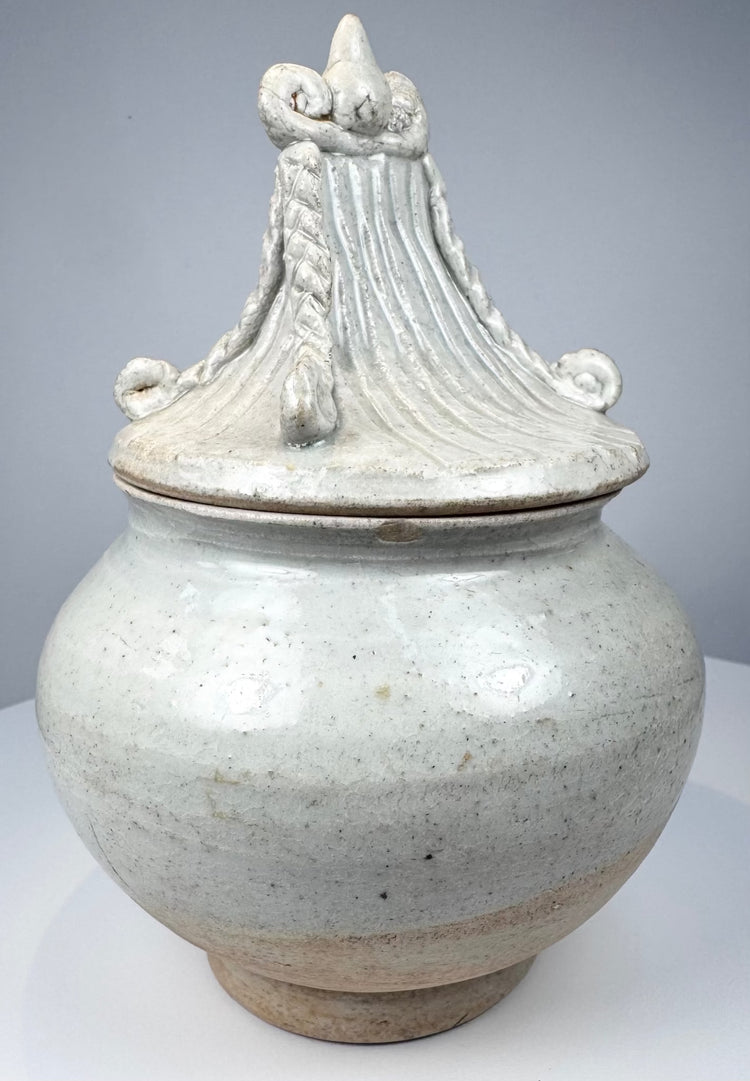
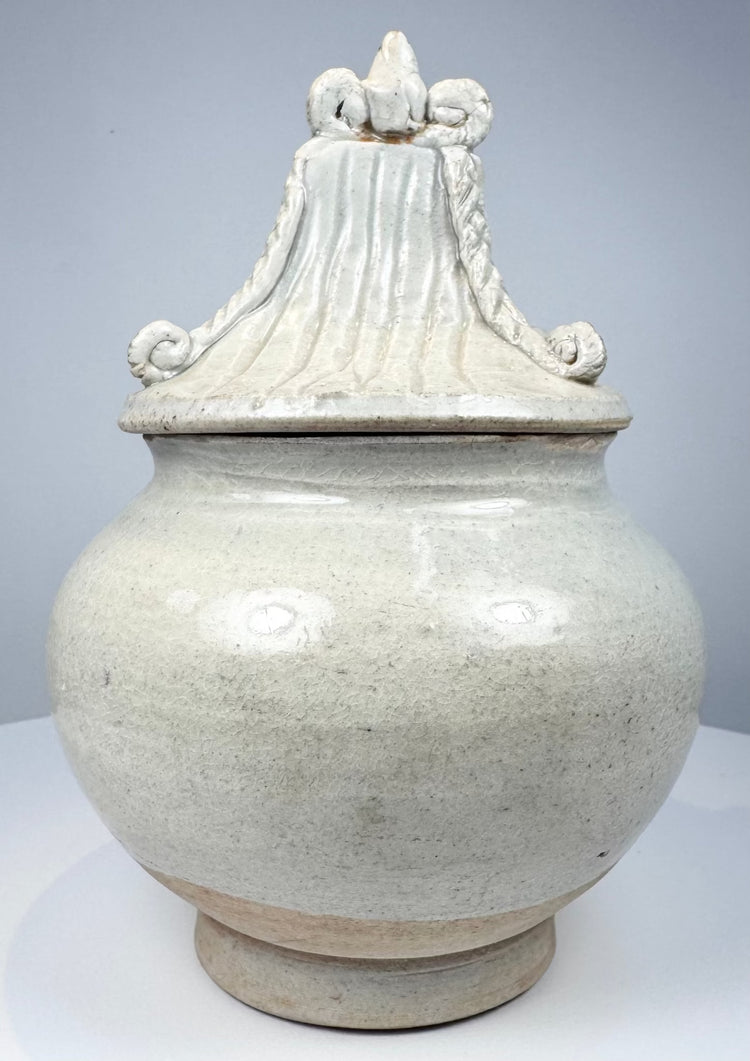
The vessel is wheel-thrown with a generously rounded globular body rising from a defined circular foot and narrowing toward a short recessed neck. The exterior is covered in a soft pale gray-white to subtly gray-green glaze exhibiting an extensive network of fine crackling. Because glaze color can vary according to firing conditions, lighting, and surface alteration, the present finish is best described broadly rather than classified definitively as celadon.
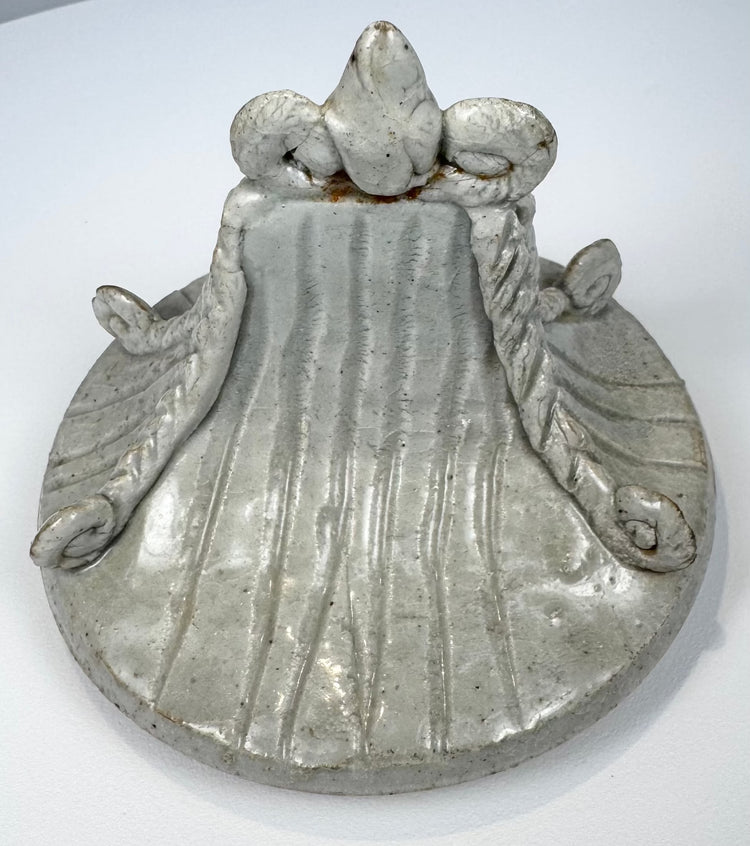
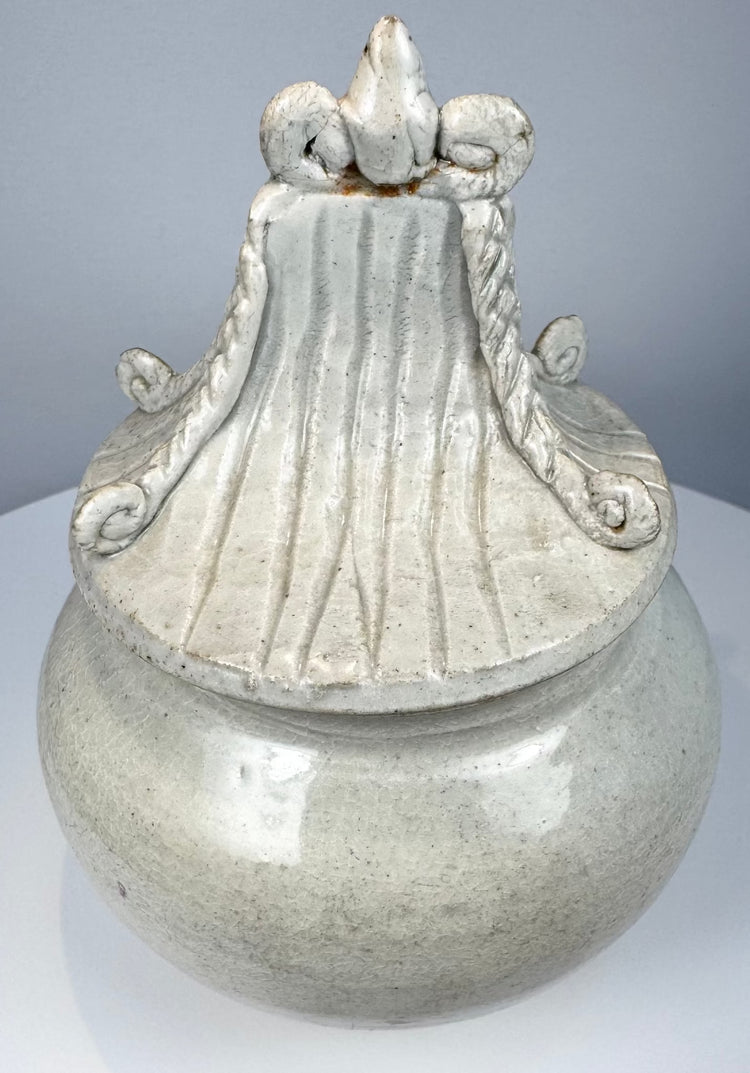
The jar is accompanied by a separately made fitted cover with an unusually elaborate sculptural profile. Deep vertical ribs rise toward a tall pointed finial, while applied rope-like bands and curling scroll elements descend along the sides and terminate in pronounced spiral ornaments around the lower perimeter.
The cover has a strongly architectural appearance and may reflect decorative vocabulary associated with Buddhist reliquaries, stupas, lotus forms, or related sacred architecture. Comparable Sawankhalok covered vessels are known to incorporate lotus-bud finials and forms influenced by Buddhist reliquary traditions; however, the precise symbolic meaning of this particularly elaborate lid cannot presently be established with certainty.
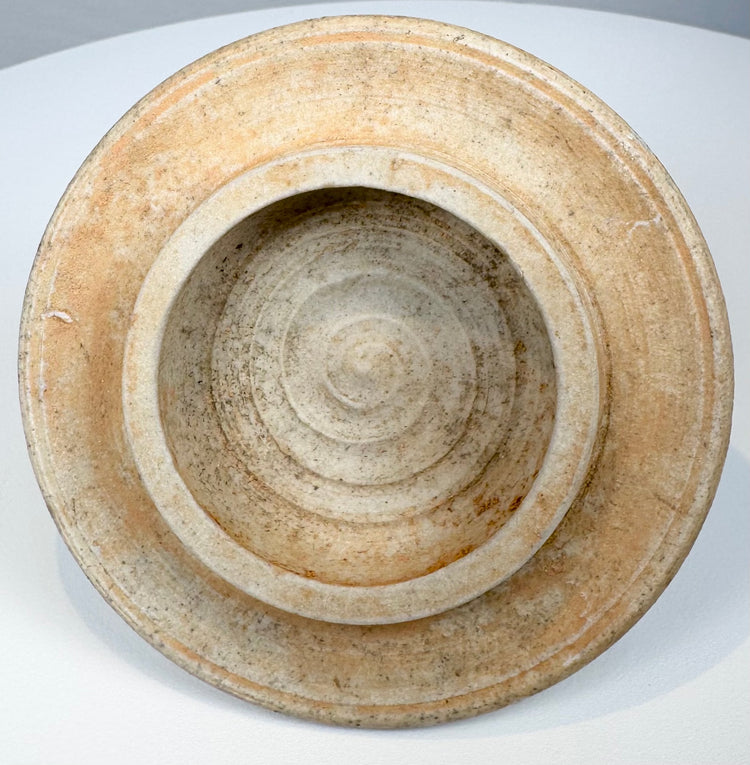
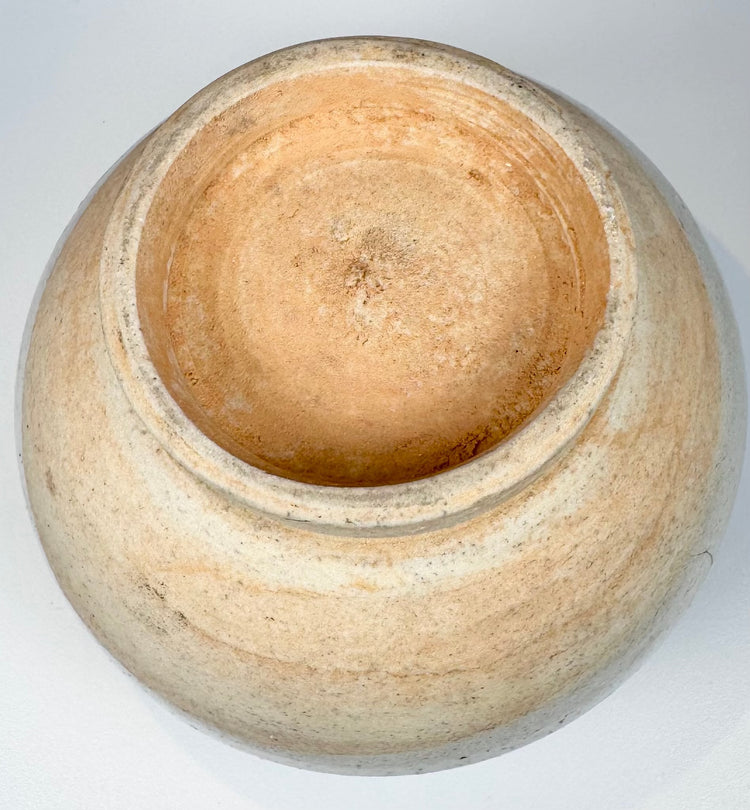
The underside and foot remain substantially unglazed, revealing a warm buff-to-reddish stoneware body with visible wheel-turning and firing traces. The recessed underside displays a circular firing-related mark consistent with the type of tubular kiln supports documented at the Si Satchanalai kilns. Such features provide useful support for the Sawankhalok attribution, although they should be considered together with the vessel's clay body, glaze, construction, and overall form rather than as independent proof of age or origin.
The lid and vessel display closely related glaze tone, crazing, surface character, and ceramic fabric, making them visually compatible as an ensemble. Without scientific analysis or documented early provenance, however, their original pairing cannot be established with absolute certainty.
The vessel's original function is likewise uncertain. Its elaborate cover distinguishes it from more simply formed storage jars and covered boxes and gives the piece an unusually sculptural and possibly prestigious character, but a specifically ceremonial or devotional use cannot be confirmed.
Features
- Wheel-thrown Thai stoneware construction
- Rounded globular jar body
- Pale gray-white to subtly gray-green glazed surface
- Extensive fine crackling throughout the glaze
- Separately made fitted sculptural cover
- Tall pointed finial with architectural profile
- Deep vertical ribbing across the lid
- Applied rope-like ornamental bands
- Multiple sculpted spiral and curling decorative elements
- Unglazed foot and recessed underside revealing buff-to-reddish stoneware
- Visible wheel-turning and firing traces
- Circular firing-support mark consistent with documented Si Satchanalai kiln practices
- Overall form consistent with historic Sawankhalok covered stoneware
- Architectural lid possibly influenced by Buddhist or reliquary-related decorative traditions
Cultural Significance
The kilns at Si Satchanalai, historically associated with the name Sawankhalok, formed one of the most important ceramic-producing centers of premodern Thailand. From approximately the 14th through 16th centuries, ceramics from these kilns circulated widely within the region and were exported throughout maritime Southeast Asia and to markets as distant as Japan.
Sawankhalok potters produced a broad range of stoneware vessels with celadon, pale, white, brown, and underglaze-painted surfaces. Covered jars and boxes formed an important part of this production, and many examples incorporated lotus-bud finials, molded ornament, and sculptural elements.
Some historic Sawankhalok covered vessels show formal relationships to Indian and Southeast Asian Buddhist reliquary traditions. The unusually elaborate cover of the present example may belong to this wider architectural and religious design vocabulary, although it is best regarded as a possible influence rather than a definitive identification of the vessel's original purpose.
The exposed stoneware body, crackled glaze, wheel-thrown construction, and apparent firing-support trace are all consistent with features documented on ceramics associated with the Si Satchanalai kiln tradition.
Condition
Good antique condition consistent with substantial age and historic use.
The glaze displays widespread fine crazing, minor discoloration, scattered firing irregularities, surface deposits, light abrasions, and areas of wear. Small irregularities, losses, and age-related imperfections are visible around portions of the applied decorative elements on the lid.
The rim, foot, and underside show expected wear and exposed stoneware associated with manufacture, firing, and use. The decorative relief and architectural form of the cover remain clearly defined.
The fitted cover and vessel display well together and appear visually consistent in glaze and surface character, although their original pairing has not been independently verified.
Dimensions (Approximate)
Height with lid: 6 in
Diameter: 4.25 in
Age (Approximate)
425–625 years old
Provenance
Formerly part of a private collection in New Jersey, United States; subsequently handled by Eternity Gallery, Tampa, Florida.
Eternity Gallery is a Tampa-based art and antiques dealer and auction house handling a broad range of historic material, including Asian and European art, ceramics, bronzes, archaeological objects, Islamic art, Pre-Columbian antiquities, and other works of cultural and historical interest.
Learn More
View a related Sawankhalok covered stoneware box in the collection of the Powerhouse Collection
Browse our Collection of Ceramics & Pottery: Ancient Heritage Art
Description
Historical Context & Origin
Region: Thailand, attributed to Si Satchanalai (Sawankhalok) kilns
Material: Glazed stoneware with pale gray-white to gray-green crackled glaze
Period: 15th–16th Century, probably 16th Century, Ayutthaya Period
Description
An unusual and highly decorative antique Thai covered stoneware jar, attributed to the celebrated Si Satchanalai, or Sawankhalok, ceramic tradition and likely dating to the 15th–16th century.
The vessel is wheel-thrown with a generously rounded globular body rising from a defined circular foot and narrowing toward a short recessed neck. The exterior is covered in a soft pale gray-white to subtly gray-green glaze exhibiting an extensive network of fine crackling. Because glaze color can vary according to firing conditions, lighting, and surface alteration, the present finish is best described broadly rather than classified definitively as celadon.
The jar is accompanied by a separately made fitted cover with an unusually elaborate sculptural profile. Deep vertical ribs rise toward a tall pointed finial, while applied rope-like bands and curling scroll elements descend along the sides and terminate in pronounced spiral ornaments around the lower perimeter.
The cover has a strongly architectural appearance and may reflect decorative vocabulary associated with Buddhist reliquaries, stupas, lotus forms, or related sacred architecture. Comparable Sawankhalok covered vessels are known to incorporate lotus-bud finials and forms influenced by Buddhist reliquary traditions; however, the precise symbolic meaning of this particularly elaborate lid cannot presently be established with certainty.
The underside and foot remain substantially unglazed, revealing a warm buff-to-reddish stoneware body with visible wheel-turning and firing traces. The recessed underside displays a circular firing-related mark consistent with the type of tubular kiln supports documented at the Si Satchanalai kilns. Such features provide useful support for the Sawankhalok attribution, although they should be considered together with the vessel's clay body, glaze, construction, and overall form rather than as independent proof of age or origin.
The lid and vessel display closely related glaze tone, crazing, surface character, and ceramic fabric, making them visually compatible as an ensemble. Without scientific analysis or documented early provenance, however, their original pairing cannot be established with absolute certainty.
The vessel's original function is likewise uncertain. Its elaborate cover distinguishes it from more simply formed storage jars and covered boxes and gives the piece an unusually sculptural and possibly prestigious character, but a specifically ceremonial or devotional use cannot be confirmed.
Features
- Wheel-thrown Thai stoneware construction
- Rounded globular jar body
- Pale gray-white to subtly gray-green glazed surface
- Extensive fine crackling throughout the glaze
- Separately made fitted sculptural cover
- Tall pointed finial with architectural profile
- Deep vertical ribbing across the lid
- Applied rope-like ornamental bands
- Multiple sculpted spiral and curling decorative elements
- Unglazed foot and recessed underside revealing buff-to-reddish stoneware
- Visible wheel-turning and firing traces
- Circular firing-support mark consistent with documented Si Satchanalai kiln practices
- Overall form consistent with historic Sawankhalok covered stoneware
- Architectural lid possibly influenced by Buddhist or reliquary-related decorative traditions
Cultural Significance
The kilns at Si Satchanalai, historically associated with the name Sawankhalok, formed one of the most important ceramic-producing centers of premodern Thailand. From approximately the 14th through 16th centuries, ceramics from these kilns circulated widely within the region and were exported throughout maritime Southeast Asia and to markets as distant as Japan.
Sawankhalok potters produced a broad range of stoneware vessels with celadon, pale, white, brown, and underglaze-painted surfaces. Covered jars and boxes formed an important part of this production, and many examples incorporated lotus-bud finials, molded ornament, and sculptural elements.
Some historic Sawankhalok covered vessels show formal relationships to Indian and Southeast Asian Buddhist reliquary traditions. The unusually elaborate cover of the present example may belong to this wider architectural and religious design vocabulary, although it is best regarded as a possible influence rather than a definitive identification of the vessel's original purpose.
The exposed stoneware body, crackled glaze, wheel-thrown construction, and apparent firing-support trace are all consistent with features documented on ceramics associated with the Si Satchanalai kiln tradition.
Condition
Good antique condition consistent with substantial age and historic use.
The glaze displays widespread fine crazing, minor discoloration, scattered firing irregularities, surface deposits, light abrasions, and areas of wear. Small irregularities, losses, and age-related imperfections are visible around portions of the applied decorative elements on the lid.
The rim, foot, and underside show expected wear and exposed stoneware associated with manufacture, firing, and use. The decorative relief and architectural form of the cover remain clearly defined.
The fitted cover and vessel display well together and appear visually consistent in glaze and surface character, although their original pairing has not been independently verified.
Dimensions (Approximate)
Height with lid: 6 in
Diameter: 4.25 in
Age (Approximate)
425–625 years old
Provenance
Formerly part of a private collection in New Jersey, United States; subsequently handled by Eternity Gallery, Tampa, Florida.
Eternity Gallery is a Tampa-based art and antiques dealer and auction house handling a broad range of historic material, including Asian and European art, ceramics, bronzes, archaeological objects, Islamic art, Pre-Columbian antiquities, and other works of cultural and historical interest.
Learn More
View a related Sawankhalok covered stoneware box in the collection of the Powerhouse Collection
Browse our Collection of Ceramics & Pottery: Ancient Heritage Art
Vous aimerez peut-être aussi
