



Antique Italian Carved Wood Table Snuff Box | Hunting & Mythological Scenes | Late 19th Century
- Prix habituel
- $950.00
- Prix soldé
- $950.00
- Prix habituel
Impossible de charger la disponibilité du service de retrait


Antique Italian Carved Wood Table Snuff Box | Hunting & Mythological Scenes | Late 19th Century
Description
Plus
Moins
Historical Context & Origin
Region: Italy
Material: Hand-carved hardwood with metal hinge
Period: Late 19th Century, likely circa 1870–1900
During the 19th century, carved wooden boxes formed an important category of European decorative and functional art. Unlike the smaller pocket snuff boxes intended to be carried personally, larger table snuff boxes were designed to remain on a table, desk, sideboard, or in a social setting where their contents could be shared. Surviving 19th-century examples demonstrate that boxes measuring approximately six inches across were made specifically for this purpose.
This remarkable Italian example combines that practical form with exuberant figurative carving. Its decoration reflects the 19th-century European fascination with historical, mythological, hunting, and fantastical imagery, giving the box the character of both a functional tobacco accessory and a piece of sculptural folk or decorative art.
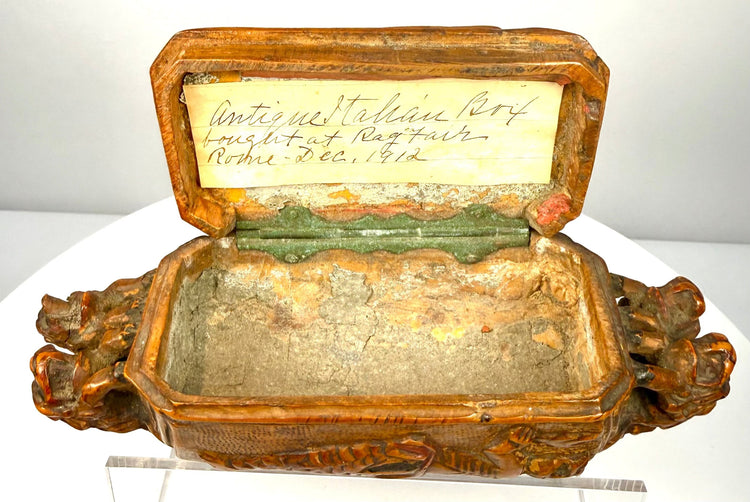
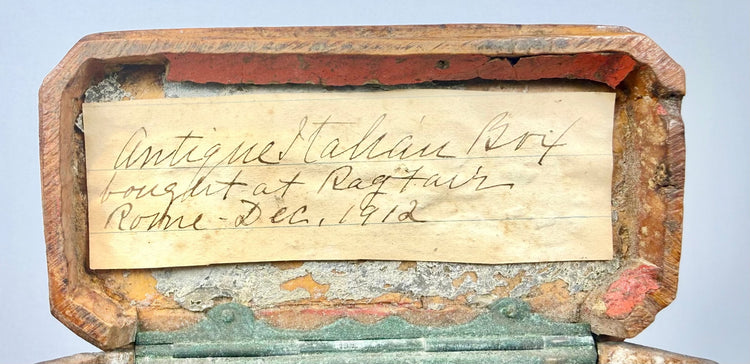
Most importantly, a handwritten label preserved inside the lid records the box as an "Antique Italian Box" acquired in Rome in December 1912. This provides an unusually useful early provenance marker, documenting the object's presence in the antiques market by the beginning of the 20th century.
Description
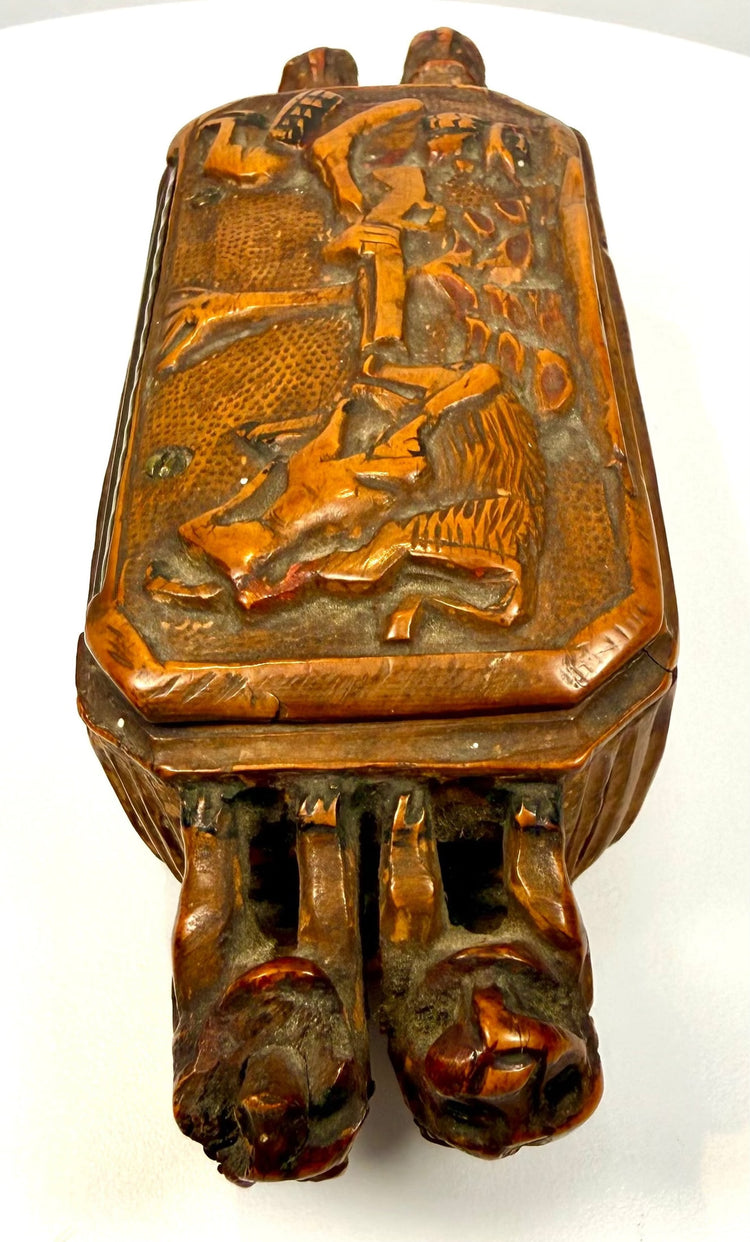
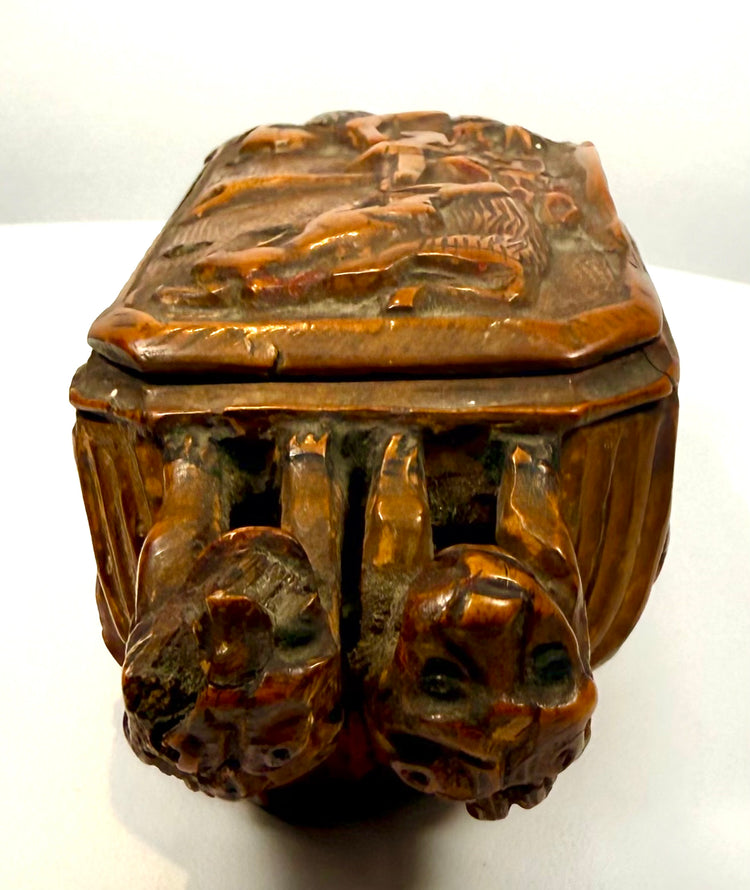
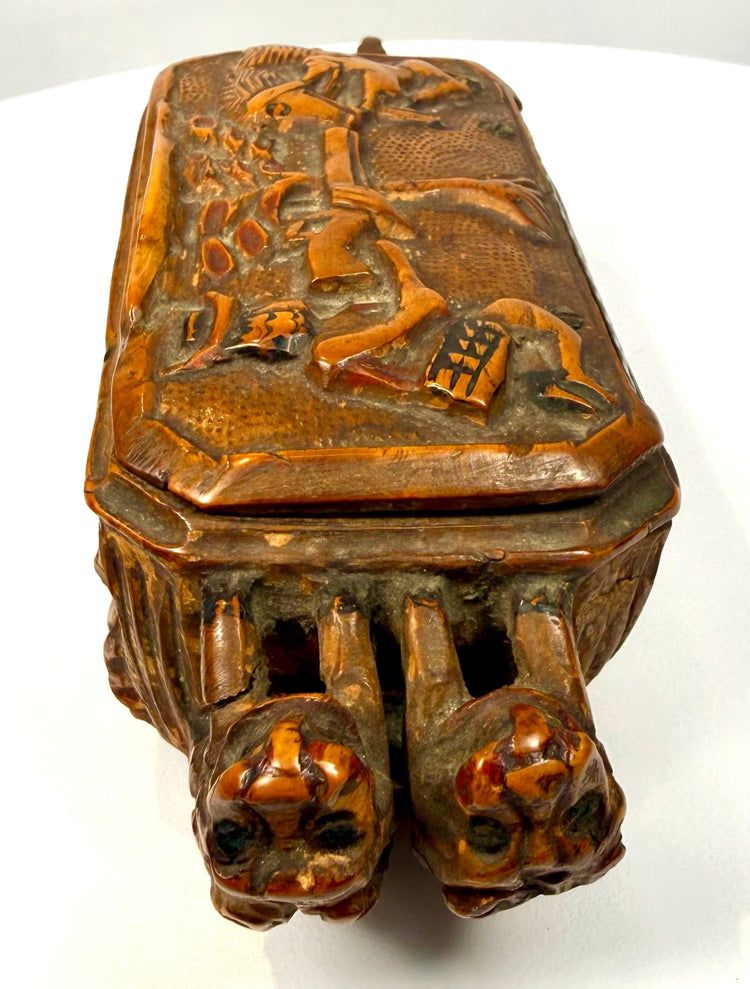
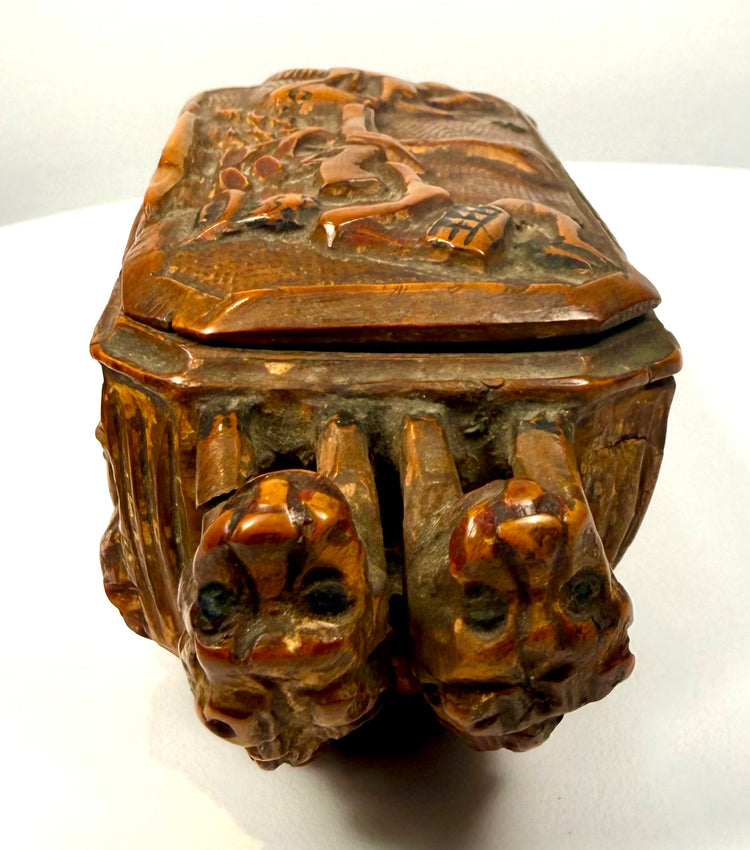
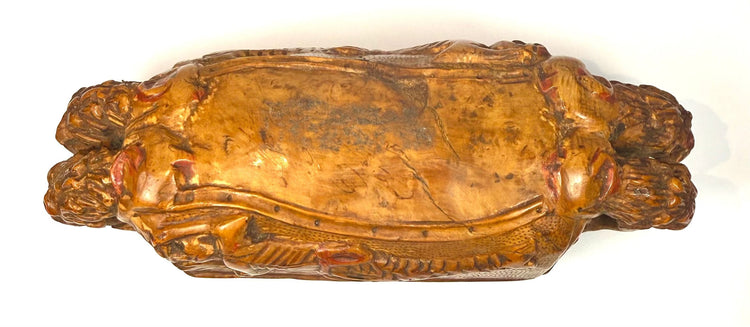
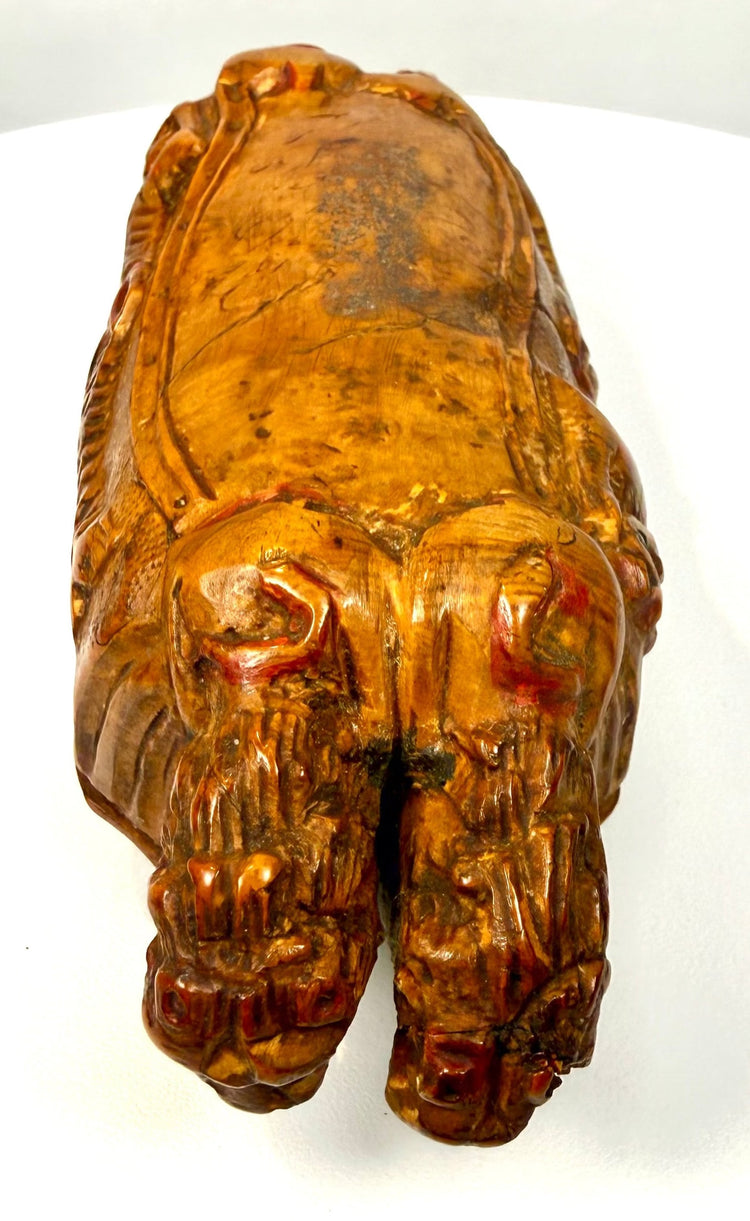
This highly distinctive Italian carved wood table snuff box is fashioned in an elongated rectangular form with a hinged lid and projecting sculptural terminals at either end.
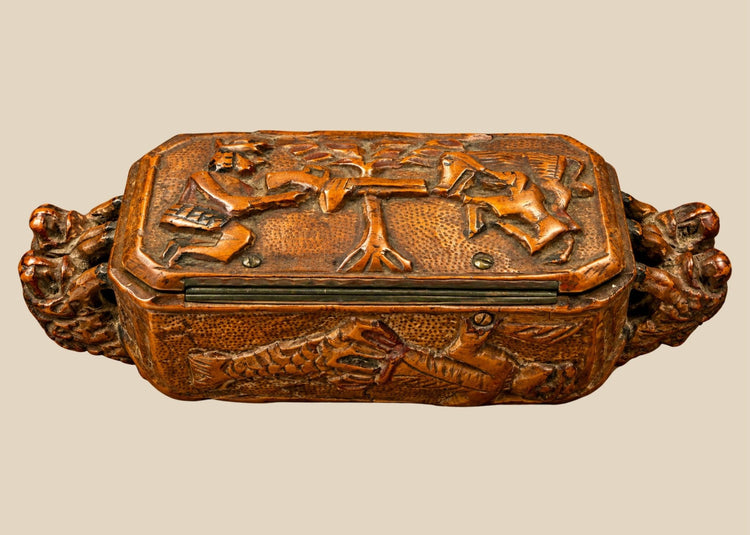
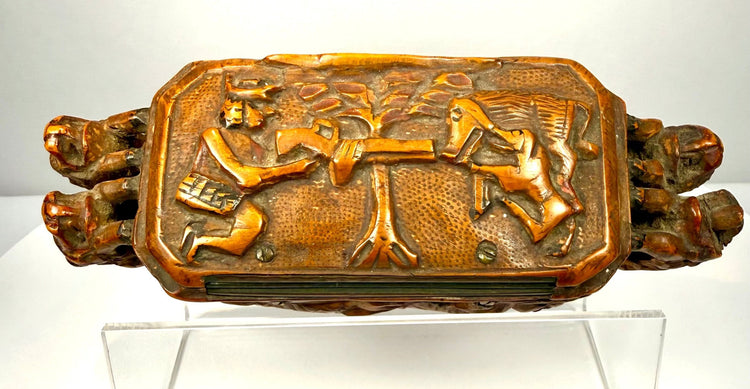
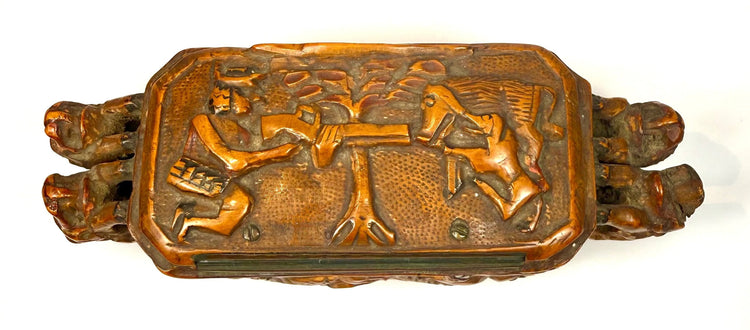
The lid is carved in deep relief with a lively hunting composition, incorporating human figures, a long firearm, animals and vegetation against a densely textured stippled ground. The figures and landscape elements are rendered with an energetic, almost narrative quality, giving the lid considerable depth and movement.
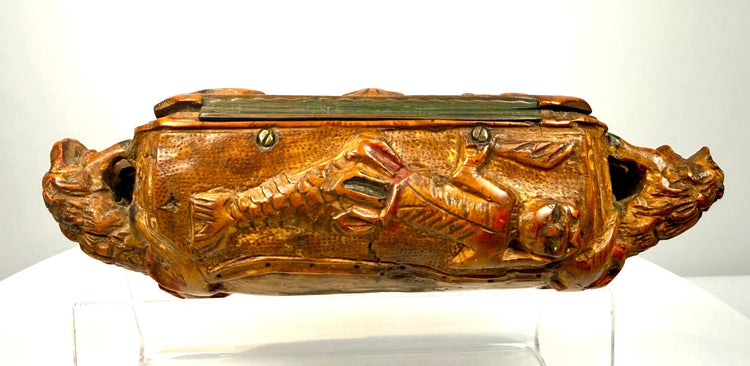
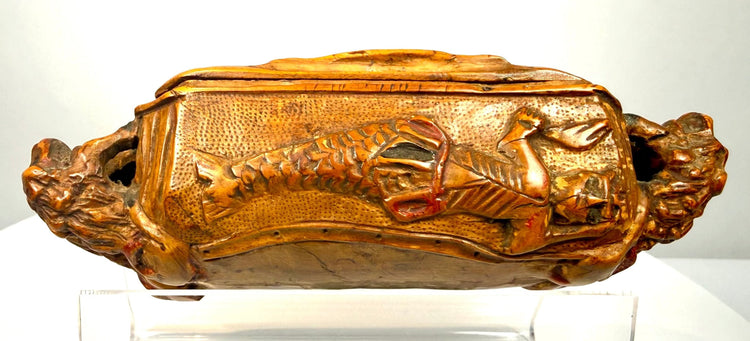
The sides continue the decoration with an unusual mixture of marine and mythological imagery, including a prominent fish and stylized figures identified in the earlier auction catalogue as mermaids. The ends are among the most striking elements of the piece, formed with paired projecting beast-like heads or masks, creating dramatic sculptural terminals that also function visually as handles.
Small incised and dark-painted details accent portions of the carving, while the aged warm honey-to-deep-brown surface has developed an attractive patina through handling and age. The lid is secured by a substantial metal hinge.
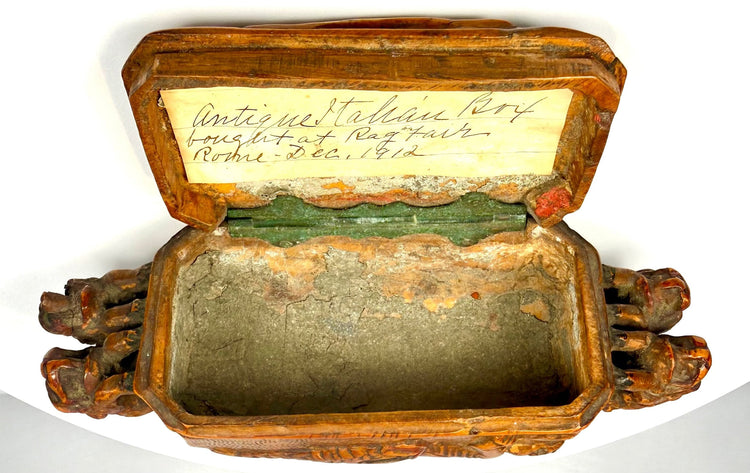
Opening the box reveals the surviving remains of its old interior surface together with an important handwritten collector's label. The inscription reads substantially:
"Antique Italian Box Bought at Rag Fair Rome – Dec. 1912"
The Rag Fair, held at Campo de’ Fiori, was a well-known Roman market where dealers offered second-hand objects, antiques, books, jewellery, curiosities and decorative arts, and was a popular destination for foreign collectors and travellers during the late 19th and early 20th centuries. Contemporary accounts describe visitors purchasing antique and decorative objects there.
Features
- Deep-relief hunting scene across the hinged lid
- Human figures, animals, firearm and foliage incorporated into the principal scene
- Stippled and incised background decoration
- Marine and mythological imagery carved along the sides
- Large fish motif and stylized mermaid or fish-tailed figures
- Four projecting sculptural beast-form heads at the ends
- Darkened incised and painted details surviving within portions of the carving
- Original-style aged metal hinge with visible fasteners
- Rich naturally developed surface patina
- Handwritten provenance label preserved beneath the lid, recording acquisition in Rome in December 1912
Cultural Significance
Snuff became an important part of European social culture from the 18th century onward, and the containers made to hold it ranged from precious gold and enamel pocket boxes to much larger carved wooden examples intended for communal or household use. The Metropolitan Museum of Art highlights the considerable importance of the snuff box as both a practical object and a social accessory within European material culture.
This example is particularly interesting because the utilitarian form has been transformed into an elaborate piece of narrative carving. Hunting imagery was frequently employed on European tobacco accessories and carved boxes; surviving 19th-century examples with relief-carved hunting compositions provide useful parallels for this decorative tradition.
Condition
Good antique condition consistent with considerable age and use. The box displays surface wear, rubbing, small chips and losses, age-related cracking and areas of separation, particularly around portions of the relief carving and edges. Some of the projecting carved elements show wear and small losses.
The metal hinge exhibits oxidation and age-related surface patination. The interior shows substantial deterioration and loss of its original lining or preparation layer, with surviving aged material visible throughout.
These age-related characteristics have been retained and contribute to the object's historical appearance and character.
Dimensions (Approximate)
Length: 6.25 inches
Width: 2.25 inches
Height: 1.8 inches
Age (Approximate)
125–155 years old
Provenance
Formerly from a private collection in Richmond, Virginia, USA.
Subsequently handled by Quinn’s Auction Galleries, Falls Church, Virginia. Quinn’s is an established family-operated auction house serving the greater Washington, D.C. region. Founded in 1995 as the Auction House of Falls Church, the firm later developed into Quinn’s Auction Galleries and today specializes in fine and decorative arts, antiques, rare books, and maps.
The box retains its important handwritten period label recording its earlier acquisition at Rag Fair, Rome, in December 1912.
Learn More
Explore a similar 19th-century carved wooden snuff box in the Science Museum Group Collection
Browse our collection of Victorian Artifacts & Historic Relics
Description
Historical Context & Origin
Region: Italy
Material: Hand-carved hardwood with metal hinge
Period: Late 19th Century, likely circa 1870–1900
During the 19th century, carved wooden boxes formed an important category of European decorative and functional art. Unlike the smaller pocket snuff boxes intended to be carried personally, larger table snuff boxes were designed to remain on a table, desk, sideboard, or in a social setting where their contents could be shared. Surviving 19th-century examples demonstrate that boxes measuring approximately six inches across were made specifically for this purpose.
This remarkable Italian example combines that practical form with exuberant figurative carving. Its decoration reflects the 19th-century European fascination with historical, mythological, hunting, and fantastical imagery, giving the box the character of both a functional tobacco accessory and a piece of sculptural folk or decorative art.
Most importantly, a handwritten label preserved inside the lid records the box as an "Antique Italian Box" acquired in Rome in December 1912. This provides an unusually useful early provenance marker, documenting the object's presence in the antiques market by the beginning of the 20th century.
Description
This highly distinctive Italian carved wood table snuff box is fashioned in an elongated rectangular form with a hinged lid and projecting sculptural terminals at either end.
The lid is carved in deep relief with a lively hunting composition, incorporating human figures, a long firearm, animals and vegetation against a densely textured stippled ground. The figures and landscape elements are rendered with an energetic, almost narrative quality, giving the lid considerable depth and movement.
The sides continue the decoration with an unusual mixture of marine and mythological imagery, including a prominent fish and stylized figures identified in the earlier auction catalogue as mermaids. The ends are among the most striking elements of the piece, formed with paired projecting beast-like heads or masks, creating dramatic sculptural terminals that also function visually as handles.
Small incised and dark-painted details accent portions of the carving, while the aged warm honey-to-deep-brown surface has developed an attractive patina through handling and age. The lid is secured by a substantial metal hinge.
Opening the box reveals the surviving remains of its old interior surface together with an important handwritten collector's label. The inscription reads substantially:
"Antique Italian Box Bought at Rag Fair Rome – Dec. 1912"
The Rag Fair, held at Campo de’ Fiori, was a well-known Roman market where dealers offered second-hand objects, antiques, books, jewellery, curiosities and decorative arts, and was a popular destination for foreign collectors and travellers during the late 19th and early 20th centuries. Contemporary accounts describe visitors purchasing antique and decorative objects there.
Features
- Deep-relief hunting scene across the hinged lid
- Human figures, animals, firearm and foliage incorporated into the principal scene
- Stippled and incised background decoration
- Marine and mythological imagery carved along the sides
- Large fish motif and stylized mermaid or fish-tailed figures
- Four projecting sculptural beast-form heads at the ends
- Darkened incised and painted details surviving within portions of the carving
- Original-style aged metal hinge with visible fasteners
- Rich naturally developed surface patina
- Handwritten provenance label preserved beneath the lid, recording acquisition in Rome in December 1912
Cultural Significance
Snuff became an important part of European social culture from the 18th century onward, and the containers made to hold it ranged from precious gold and enamel pocket boxes to much larger carved wooden examples intended for communal or household use. The Metropolitan Museum of Art highlights the considerable importance of the snuff box as both a practical object and a social accessory within European material culture.
This example is particularly interesting because the utilitarian form has been transformed into an elaborate piece of narrative carving. Hunting imagery was frequently employed on European tobacco accessories and carved boxes; surviving 19th-century examples with relief-carved hunting compositions provide useful parallels for this decorative tradition.
Condition
Good antique condition consistent with considerable age and use. The box displays surface wear, rubbing, small chips and losses, age-related cracking and areas of separation, particularly around portions of the relief carving and edges. Some of the projecting carved elements show wear and small losses.
The metal hinge exhibits oxidation and age-related surface patination. The interior shows substantial deterioration and loss of its original lining or preparation layer, with surviving aged material visible throughout.
These age-related characteristics have been retained and contribute to the object's historical appearance and character.
Dimensions (Approximate)
Length: 6.25 inches
Width: 2.25 inches
Height: 1.8 inches
Age (Approximate)
125–155 years old
Provenance
Formerly from a private collection in Richmond, Virginia, USA.
Subsequently handled by Quinn’s Auction Galleries, Falls Church, Virginia. Quinn’s is an established family-operated auction house serving the greater Washington, D.C. region. Founded in 1995 as the Auction House of Falls Church, the firm later developed into Quinn’s Auction Galleries and today specializes in fine and decorative arts, antiques, rare books, and maps.
The box retains its important handwritten period label recording its earlier acquisition at Rag Fair, Rome, in December 1912.
Learn More
Explore a similar 19th-century carved wooden snuff box in the Science Museum Group Collection
Browse our collection of Victorian Artifacts & Historic Relics
Vous aimerez peut-être aussi
