

Antique Japanese Carved Bone Fisherman Okimono with Fish Basket | Circa 1890 – 1920
- Prix habituel
- $450.00
- Prix soldé
- $450.00
- Prix habituel
Impossible de charger la disponibilité du service de retrait


Antique Japanese Carved Bone Fisherman Okimono with Fish Basket | Circa 1890 – 1920
Description
Plus
Moins
Historical Context & Origin
Region: Japan, attributed
Material: Hand-carved natural material, likely bone, with incised and stained decoration
Period: Late Meiji to Early Taishō Period, circa 1890–1920
Description
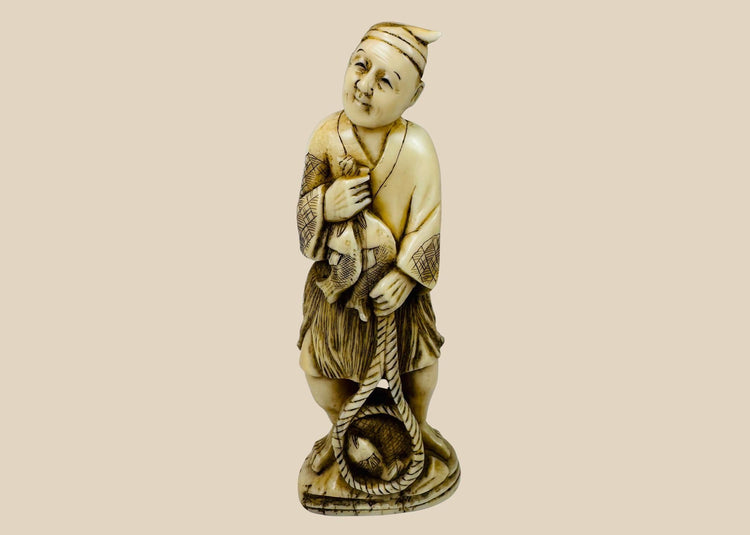
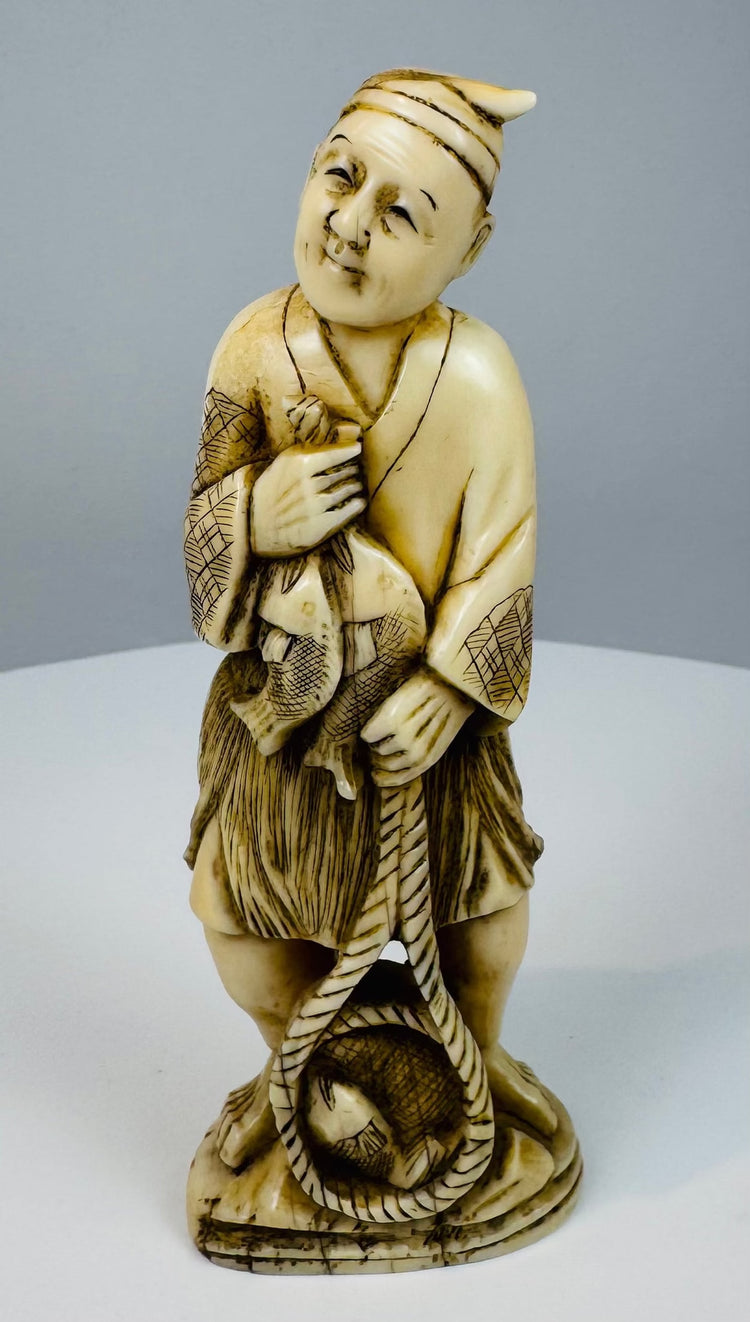
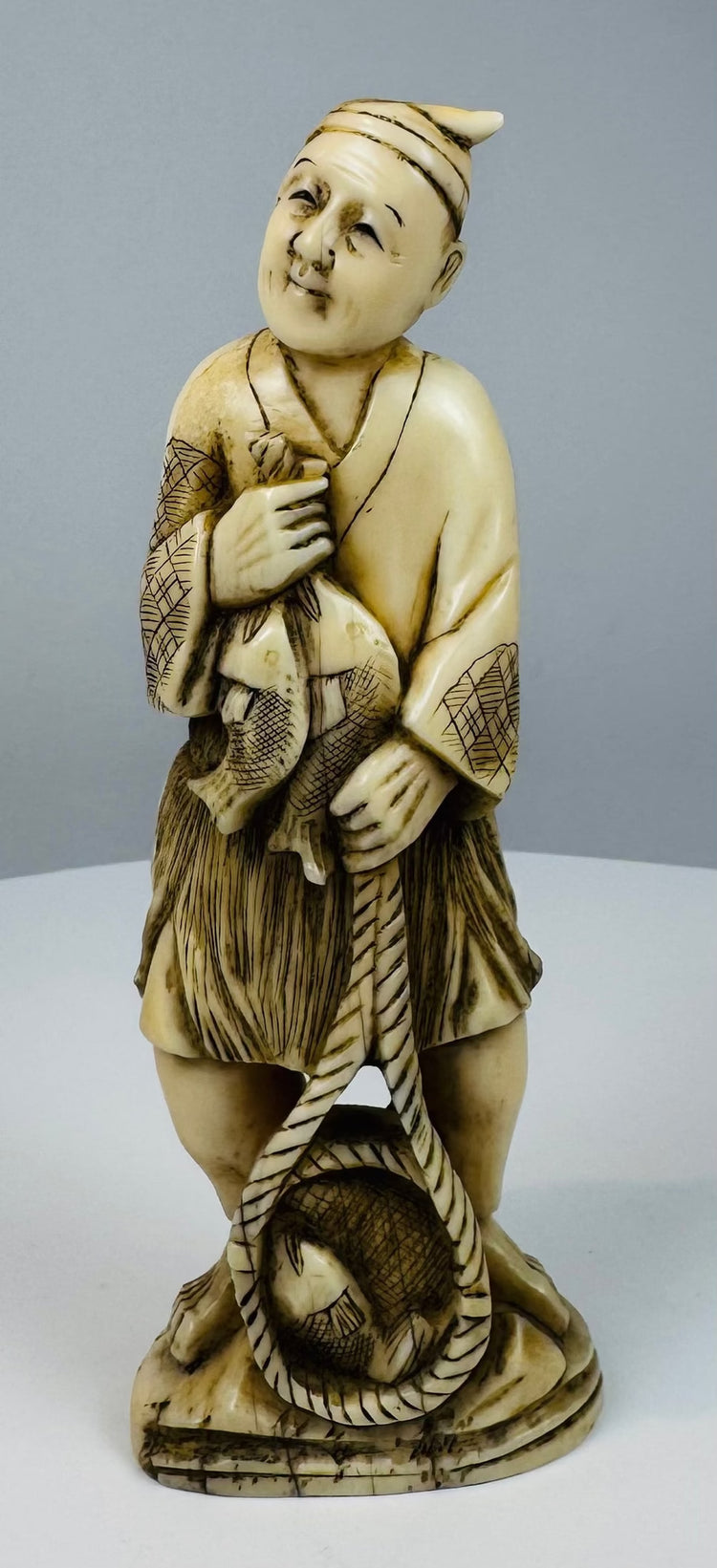
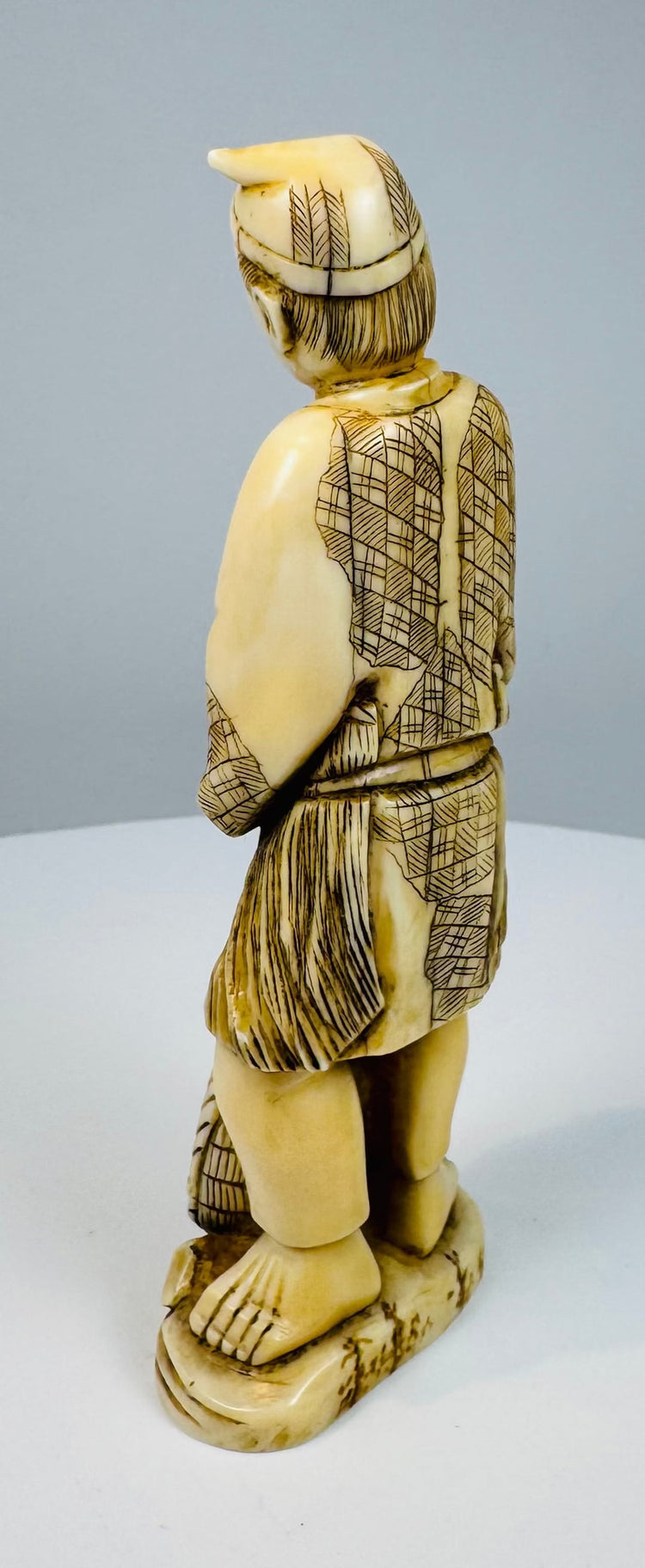
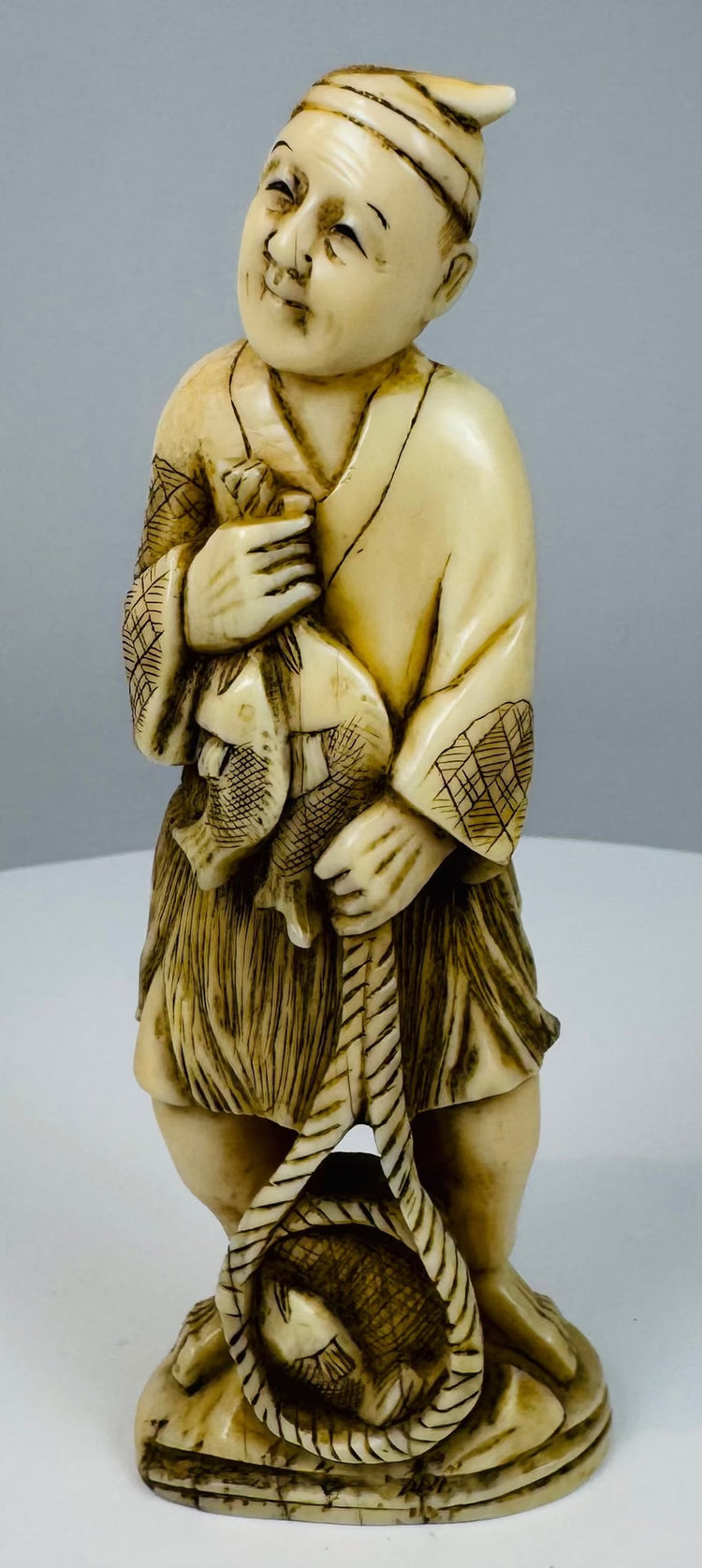
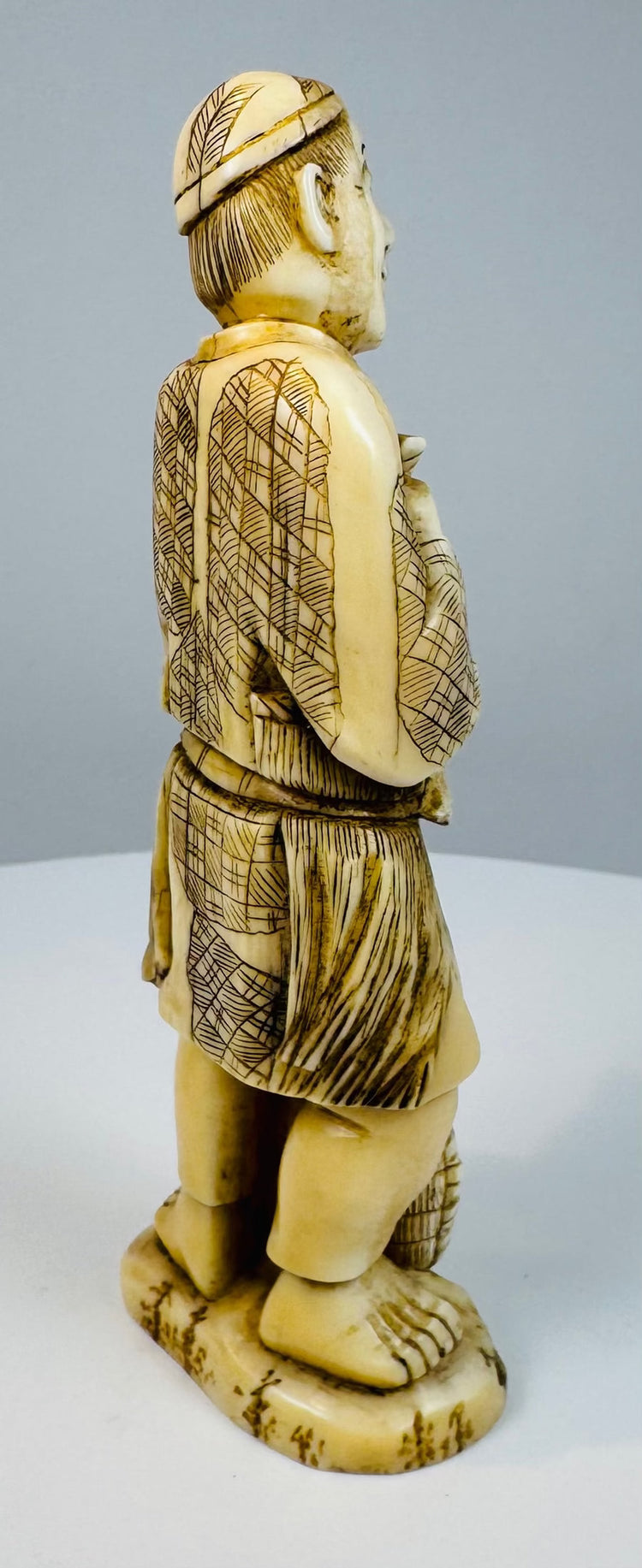
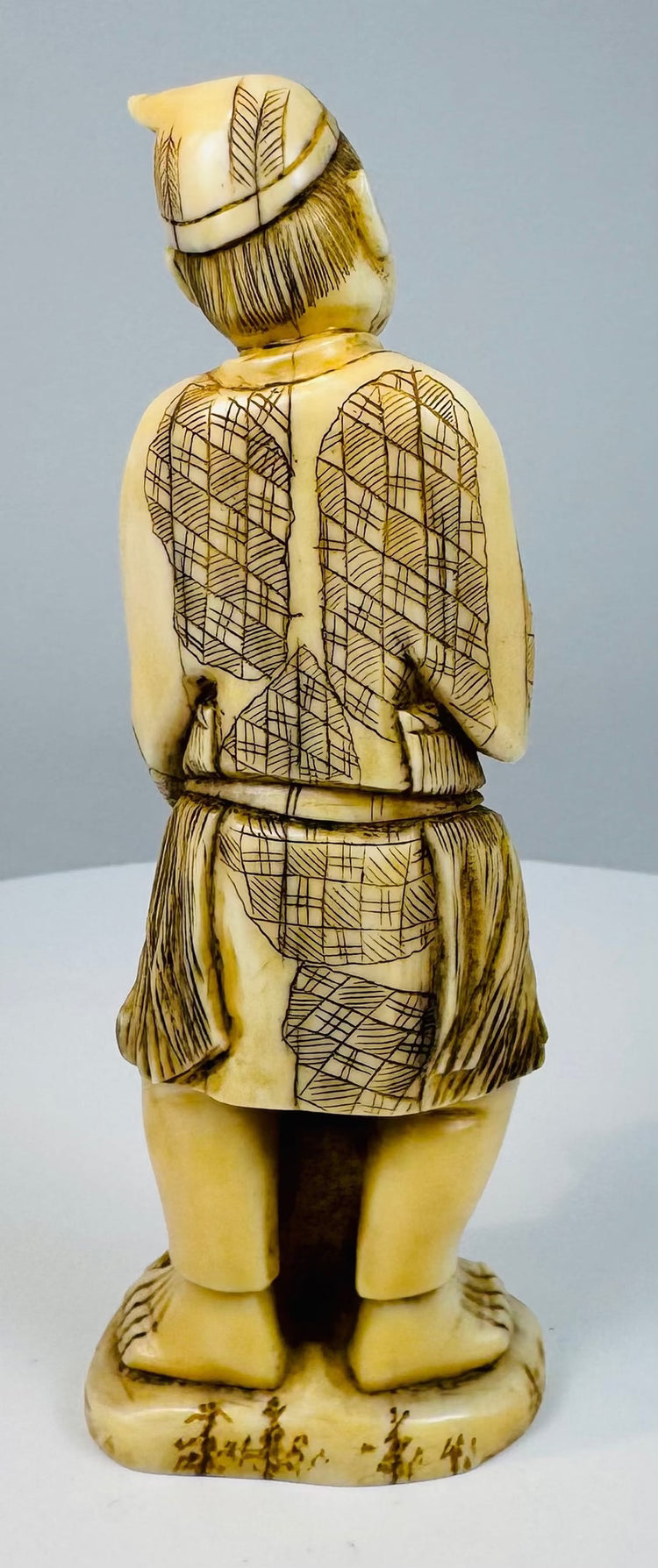
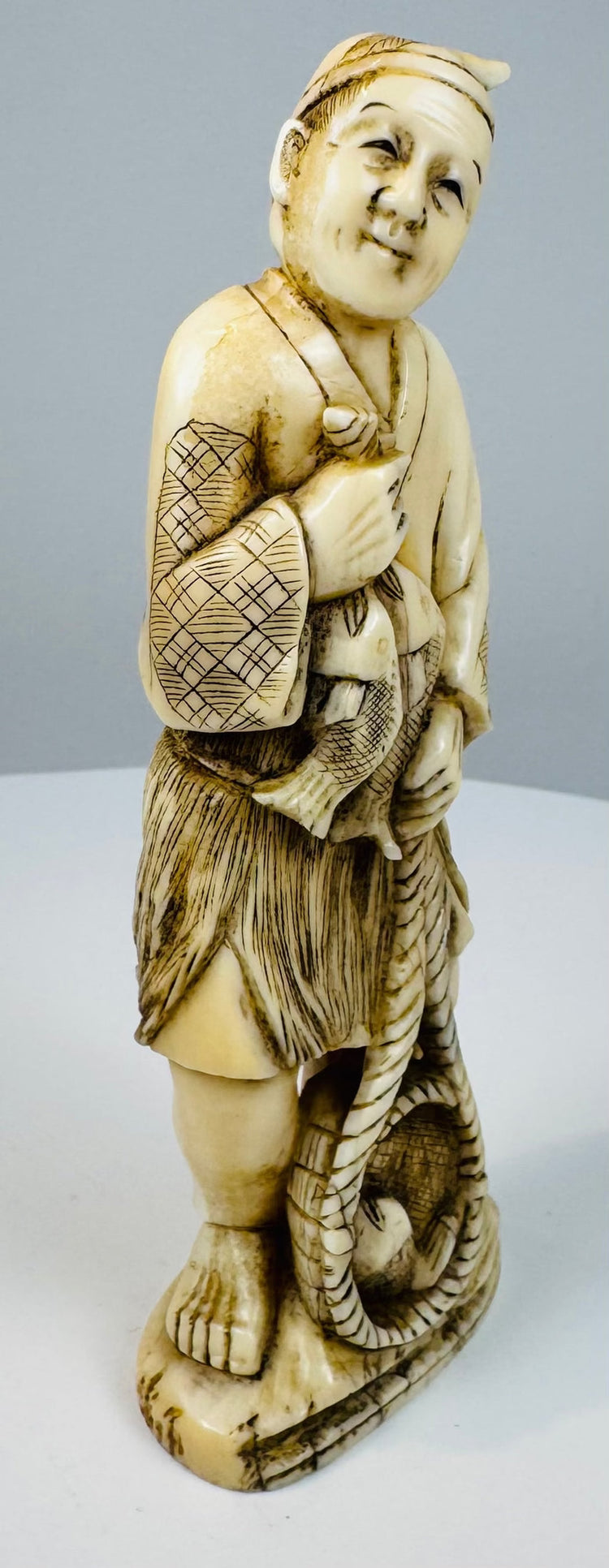
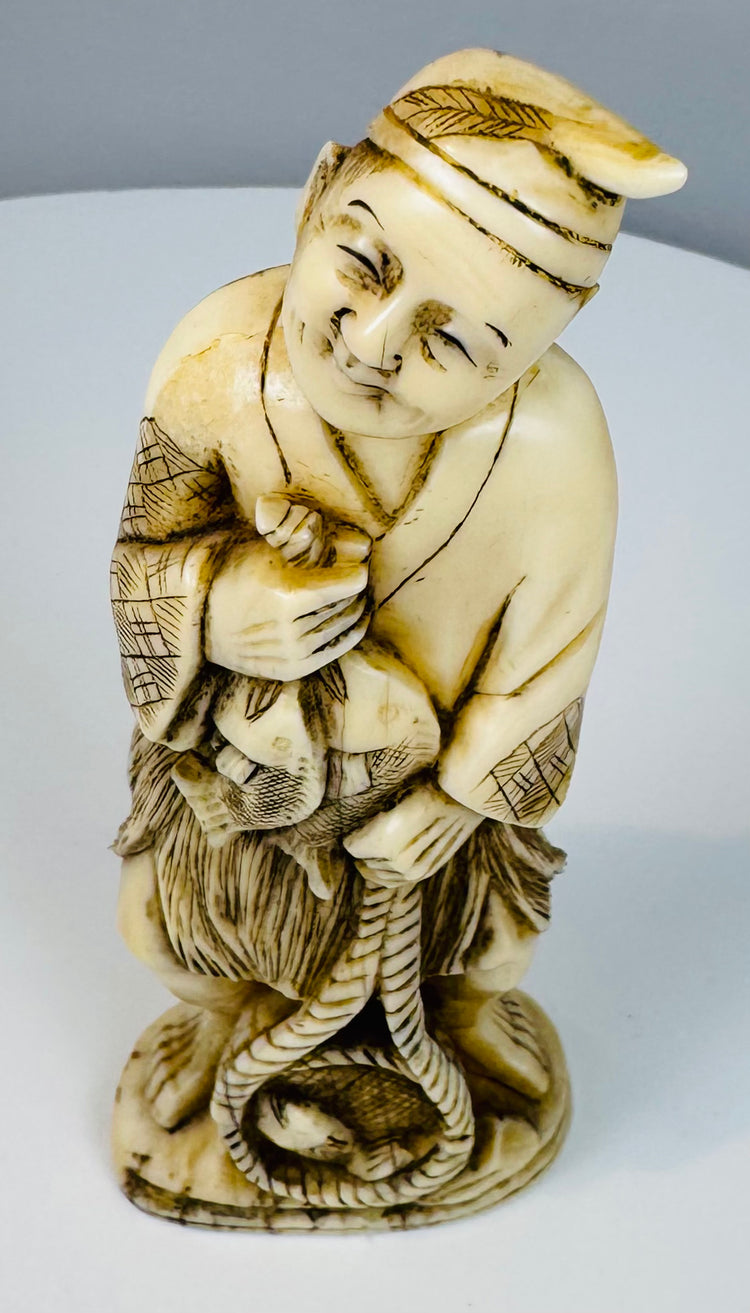
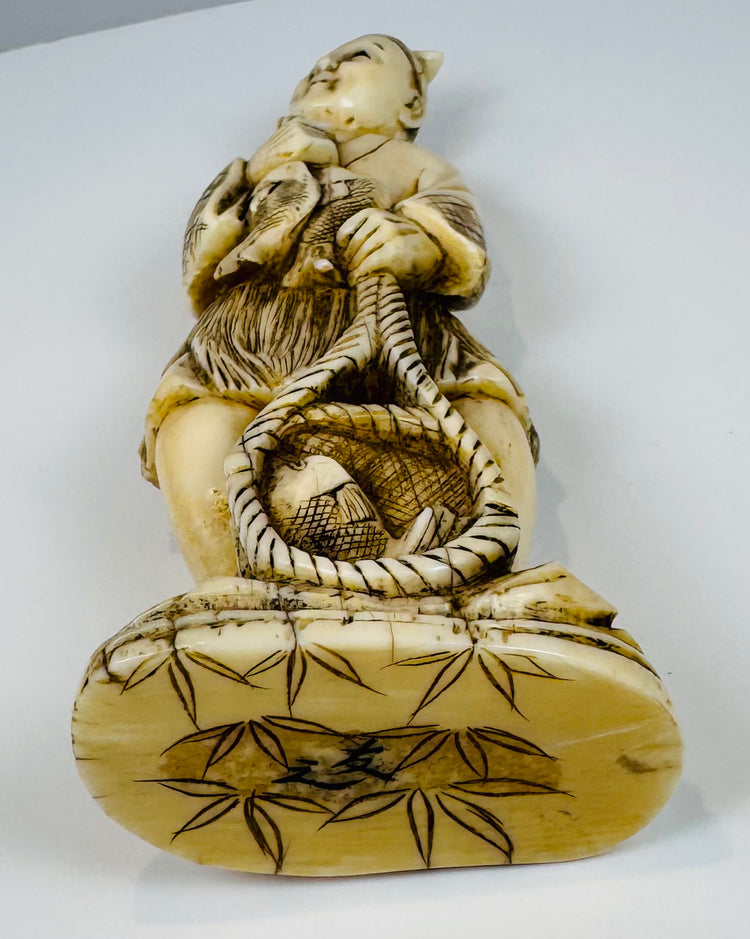
This expressive Japanese okimono depicts a traditional fisherman proudly carrying the day’s catch. He stands barefoot upon an integrated oval base, wearing a close-fitting cloth cap, short trousers, and a loosely wrapped outer garment decorated with finely incised geometric patterns.
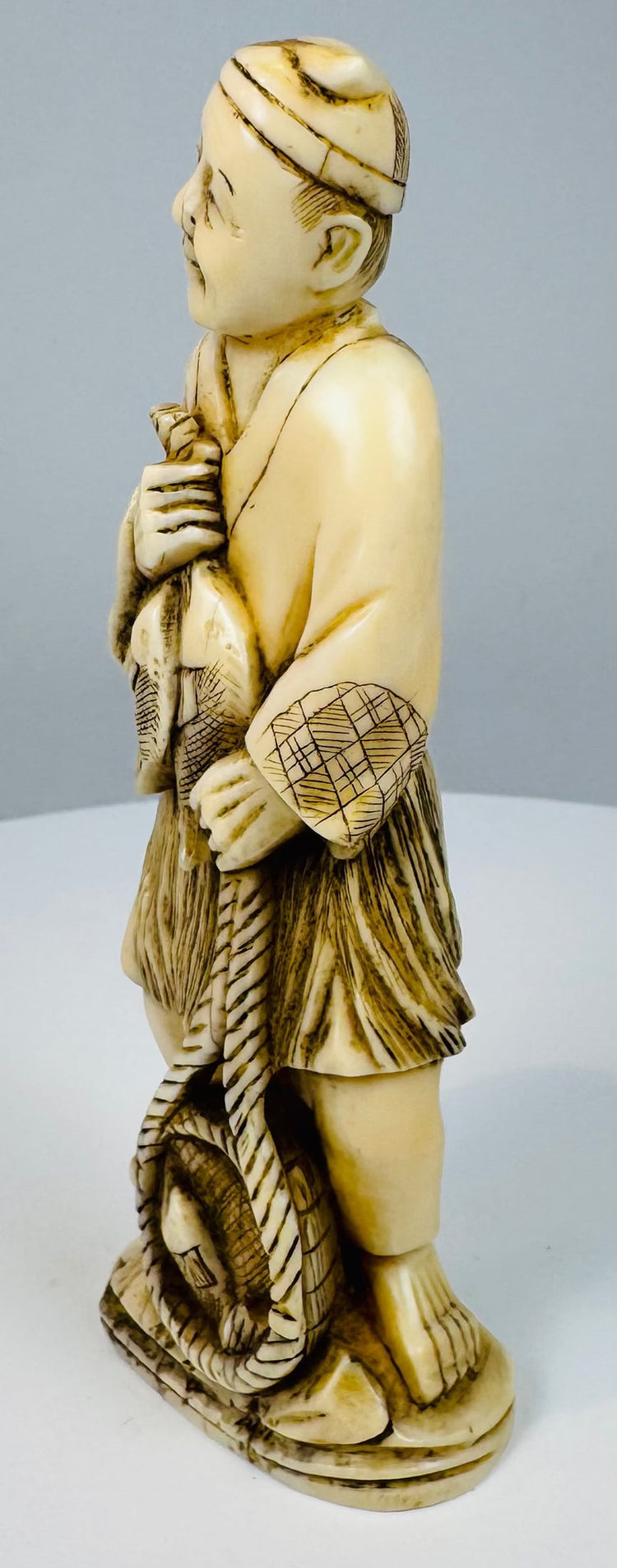
The fisherman cradles several fish against his chest while gripping the thick rope of a large woven net or catch basket positioned between his feet. Additional fish are visible within the basket, their overlapping bodies, scales, fins, and tails carefully articulated through carved and crosshatched details. The figure’s tilted head, upward gaze, softly smiling expression, and slightly uneven stance create a lively sense of movement and personality.
Particular attention has been given to the contrasting surface textures. Closely spaced lines suggest the woven fibres of the basket, the twisting strands of the rope, the scales of the fish, and the folds of the fisherman’s clothing. Repeating geometric motifs decorate the sleeves and back of his garment, while darker staining has been worked into the recessed lines to strengthen the overall definition.
The underside is decorated with incised bamboo leaves surrounding a character signature or workshop mark. The identity of the carver has not been established, and the inscription is recorded without a specific artist attribution.
Okimono of fishermen, farmers, craftsmen, and other figures from everyday life became especially popular during the Meiji period. Japanese carvers combined traditional techniques with increasingly naturalistic modelling, producing highly detailed sculptures for domestic display and the growing European and North American export markets.
Features
- Multiple carved fish held against the chest
- Large woven net or catch basket containing additional fish
- Thick carved rope extending through the fisherman’s hands
- Expressive upward gaze and smiling facial features
- Traditional cap, short trousers, and layered outer garment
- Finely incised geometric textile patterns
- Detailed crosshatching defining fish scales and woven fibres
- Dark staining applied within the recessed decoration
- Integrated oval base with bamboo-leaf decoration beneath
- Incised character signature or workshop mark
- Warm naturally aged surface and patina
Cultural Significance
Fishing has played an essential role in Japanese coastal and river communities for centuries, supplying food, sustaining local economies, and shaping regional traditions. During the Meiji period, fishermen became a particularly popular subject for okimono because their nets, baskets, ropes, clothing, and catches allowed carvers to demonstrate remarkable technical skill.
These sculptures combined portraiture with scenes of ordinary working life. Rather than representing a deity or formal historical figure, this okimono celebrates the fisherman’s occupation through an animated and carefully observed depiction of daily labour.
Comparable Meiji-period carvings of fishermen with baskets and nets were created largely for decorative display and became highly sought after among Western collectors during the rise of Japonisme and Japan’s participation in international exhibitions.
Condition
Good antique condition with wear consistent with age and handling. The surface displays natural toning, staining, fine age lines, minor scratches, abrasions, and small edge nicks. Construction joins and natural variations in the carved material are visible. Minor wear is present around the fish, rope, basket, and base. No major structural damage observed.
Dimensions (Approximate)
Height: 5 in
Width: 1.8 in
Depth: 1 in
Age (Approximate)
105–135 years old
Provenance
From a private collection in Toronto, Ontario, Canada, assembled with a particular focus on Chinese and broader Asian sculpture and traditional decorative arts.
Subsequently sold through Waddington’s Auctioneers & Appraisers, Toronto, Ontario, Canada. Established in 1850, Waddington’s describes itself as Canada’s original auction house and has long maintained specialist departments devoted to Asian and international art.
Learn More
Explore a comparable Meiji-period Japanese fisherman with a basket and net in the collection of the Herbert F. Johnson Museum of Art
View two similar carvings: Zhang Guolao and Falconer with Bird of Prey
Explore our Collection of Eastern Antiquities & Cultural Relics
Description
Historical Context & Origin
Region: Japan, attributed
Material: Hand-carved natural material, likely bone, with incised and stained decoration
Period: Late Meiji to Early Taishō Period, circa 1890–1920
Description
This expressive Japanese okimono depicts a traditional fisherman proudly carrying the day’s catch. He stands barefoot upon an integrated oval base, wearing a close-fitting cloth cap, short trousers, and a loosely wrapped outer garment decorated with finely incised geometric patterns.
The fisherman cradles several fish against his chest while gripping the thick rope of a large woven net or catch basket positioned between his feet. Additional fish are visible within the basket, their overlapping bodies, scales, fins, and tails carefully articulated through carved and crosshatched details. The figure’s tilted head, upward gaze, softly smiling expression, and slightly uneven stance create a lively sense of movement and personality.
Particular attention has been given to the contrasting surface textures. Closely spaced lines suggest the woven fibres of the basket, the twisting strands of the rope, the scales of the fish, and the folds of the fisherman’s clothing. Repeating geometric motifs decorate the sleeves and back of his garment, while darker staining has been worked into the recessed lines to strengthen the overall definition.
The underside is decorated with incised bamboo leaves surrounding a character signature or workshop mark. The identity of the carver has not been established, and the inscription is recorded without a specific artist attribution.
Okimono of fishermen, farmers, craftsmen, and other figures from everyday life became especially popular during the Meiji period. Japanese carvers combined traditional techniques with increasingly naturalistic modelling, producing highly detailed sculptures for domestic display and the growing European and North American export markets.
Features
- Multiple carved fish held against the chest
- Large woven net or catch basket containing additional fish
- Thick carved rope extending through the fisherman’s hands
- Expressive upward gaze and smiling facial features
- Traditional cap, short trousers, and layered outer garment
- Finely incised geometric textile patterns
- Detailed crosshatching defining fish scales and woven fibres
- Dark staining applied within the recessed decoration
- Integrated oval base with bamboo-leaf decoration beneath
- Incised character signature or workshop mark
- Warm naturally aged surface and patina
Cultural Significance
Fishing has played an essential role in Japanese coastal and river communities for centuries, supplying food, sustaining local economies, and shaping regional traditions. During the Meiji period, fishermen became a particularly popular subject for okimono because their nets, baskets, ropes, clothing, and catches allowed carvers to demonstrate remarkable technical skill.
These sculptures combined portraiture with scenes of ordinary working life. Rather than representing a deity or formal historical figure, this okimono celebrates the fisherman’s occupation through an animated and carefully observed depiction of daily labour.
Comparable Meiji-period carvings of fishermen with baskets and nets were created largely for decorative display and became highly sought after among Western collectors during the rise of Japonisme and Japan’s participation in international exhibitions.
Condition
Good antique condition with wear consistent with age and handling. The surface displays natural toning, staining, fine age lines, minor scratches, abrasions, and small edge nicks. Construction joins and natural variations in the carved material are visible. Minor wear is present around the fish, rope, basket, and base. No major structural damage observed.
Dimensions (Approximate)
Height: 5 in
Width: 1.8 in
Depth: 1 in
Age (Approximate)
105–135 years old
Provenance
From a private collection in Toronto, Ontario, Canada, assembled with a particular focus on Chinese and broader Asian sculpture and traditional decorative arts.
Subsequently sold through Waddington’s Auctioneers & Appraisers, Toronto, Ontario, Canada. Established in 1850, Waddington’s describes itself as Canada’s original auction house and has long maintained specialist departments devoted to Asian and international art.
Learn More
Explore a comparable Meiji-period Japanese fisherman with a basket and net in the collection of the Herbert F. Johnson Museum of Art
View two similar carvings: Zhang Guolao and Falconer with Bird of Prey
Explore our Collection of Eastern Antiquities & Cultural Relics
Vous aimerez peut-être aussi
