
King Philip II of Spain Signed Royal Manuscript | 16th Century
- Prix habituel
- $6,000.00
- Prix soldé
- $6,000.00
- Prix habituel
Impossible de charger la disponibilité du service de retrait







King Philip II of Spain Signed Royal Manuscript | 16th Century
Description
Plus
Moins
Historical Context & Origin
Region: Madrid, Spain; Spanish Habsburg monarchy
Material: Brown manuscript ink on historic paper, engraved portrait on paper, presentation matting, and gilt-finished wooden frame
Period: 16th century, reign of King Philip II (1556–1598); catalogued as May 2, 1574, although historical references suggest a possible earlier date. Accompanying portrait engraving attributed to the 19th century.
Description
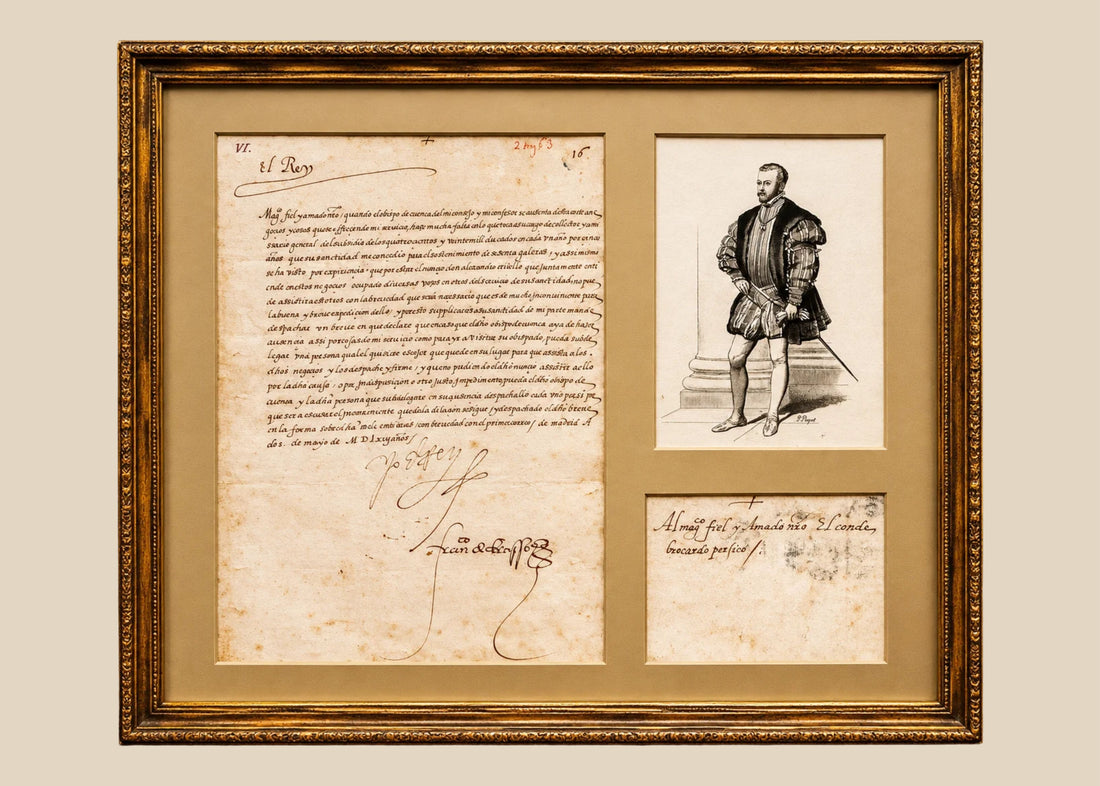
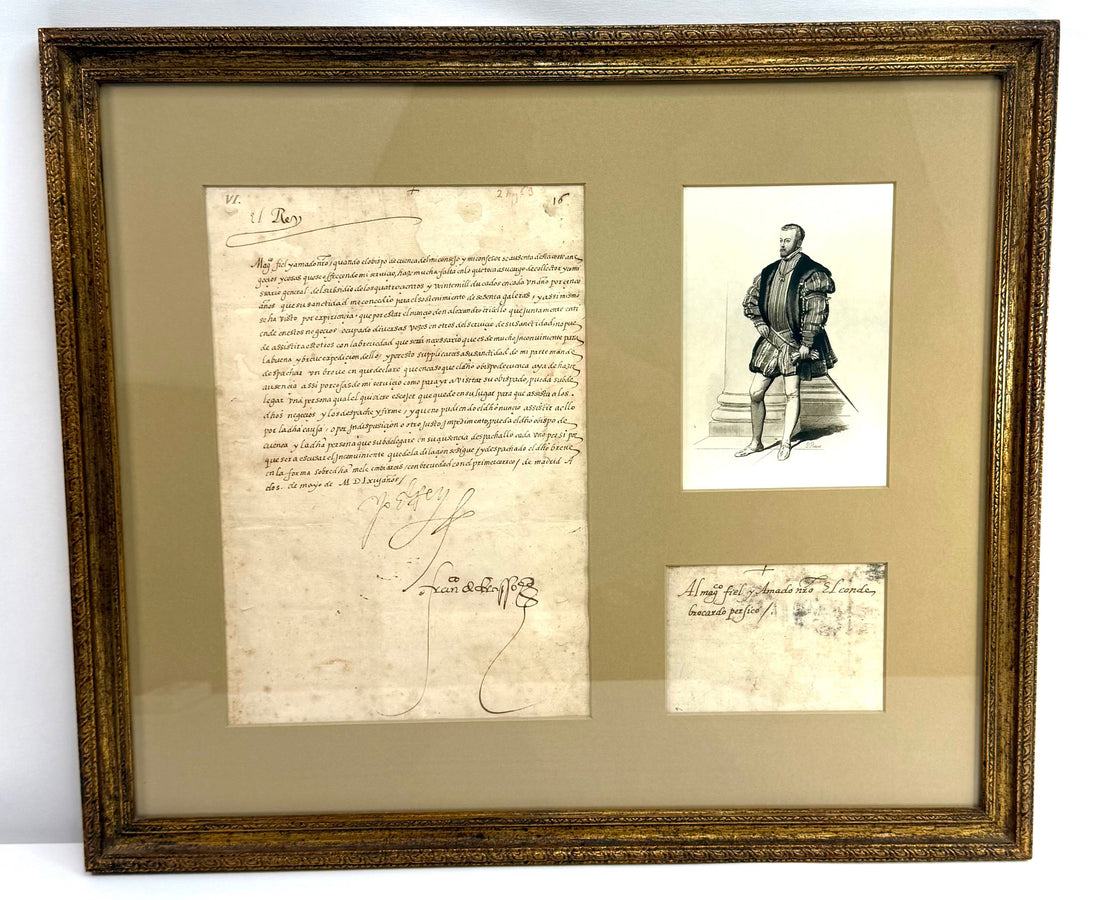
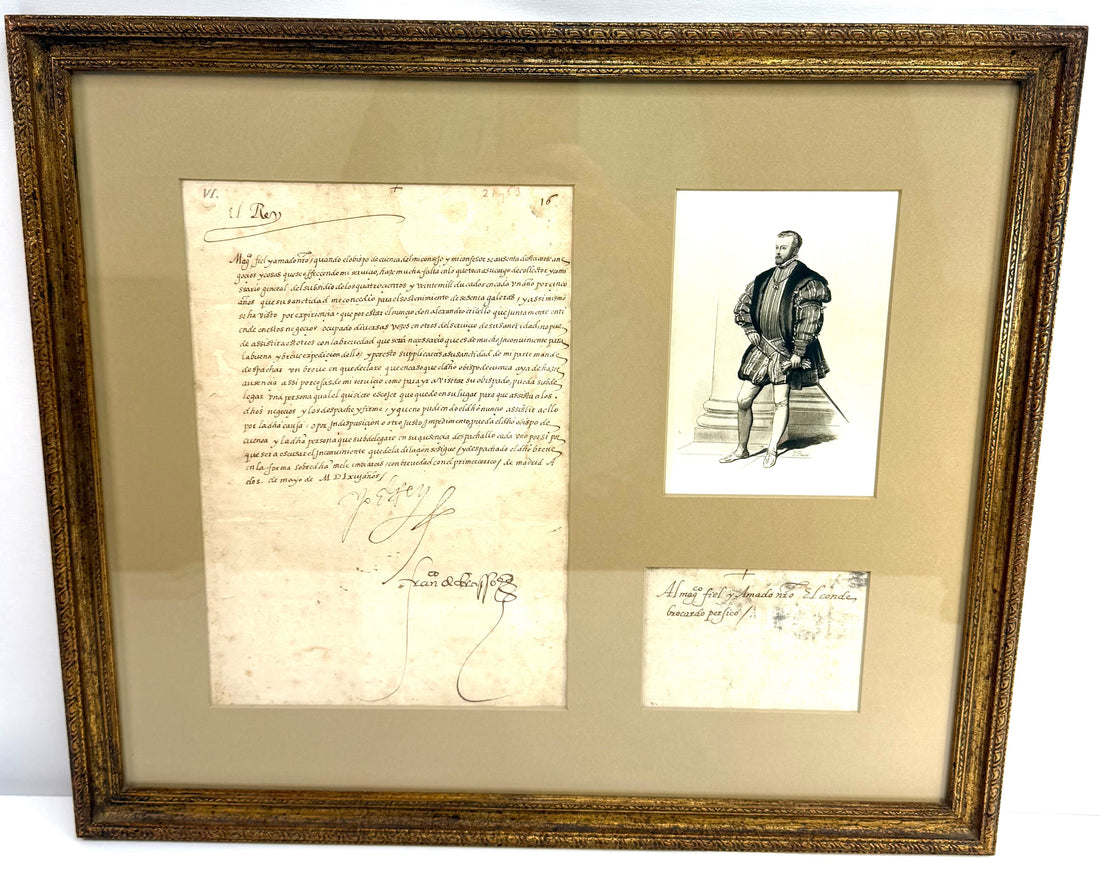
This remarkable historical presentation features a royal manuscript attributed to King Philip II of Spain (1527–1598), one of the most influential monarchs of the European Renaissance and ruler of the vast Spanish Habsburg Empire. The correspondence concerns the administration of a substantial papal financial subsidy intended to support sixty Mediterranean war galleys, offering a fascinating connection to the political, religious, and maritime history of 16th-century Spain.
Executed in closely spaced Spanish chancery script, the manuscript bears the heading "El Rey" (The King) and concludes with the prominent royal subscription "Yo el Rey" (I, the King), accompanied by a secretarial signature partially identified in the original auction catalogue as "Juan de B." The text appears to reference an annual contribution of 420,000 ducats over five years, discussing administrative difficulties involving the Bishop of Cuenca and papal nuncio Alessandro Crivelli. The correspondence instructs the recipient to seek papal authorization for a substitute official to ensure the continued administration of the subsidy.
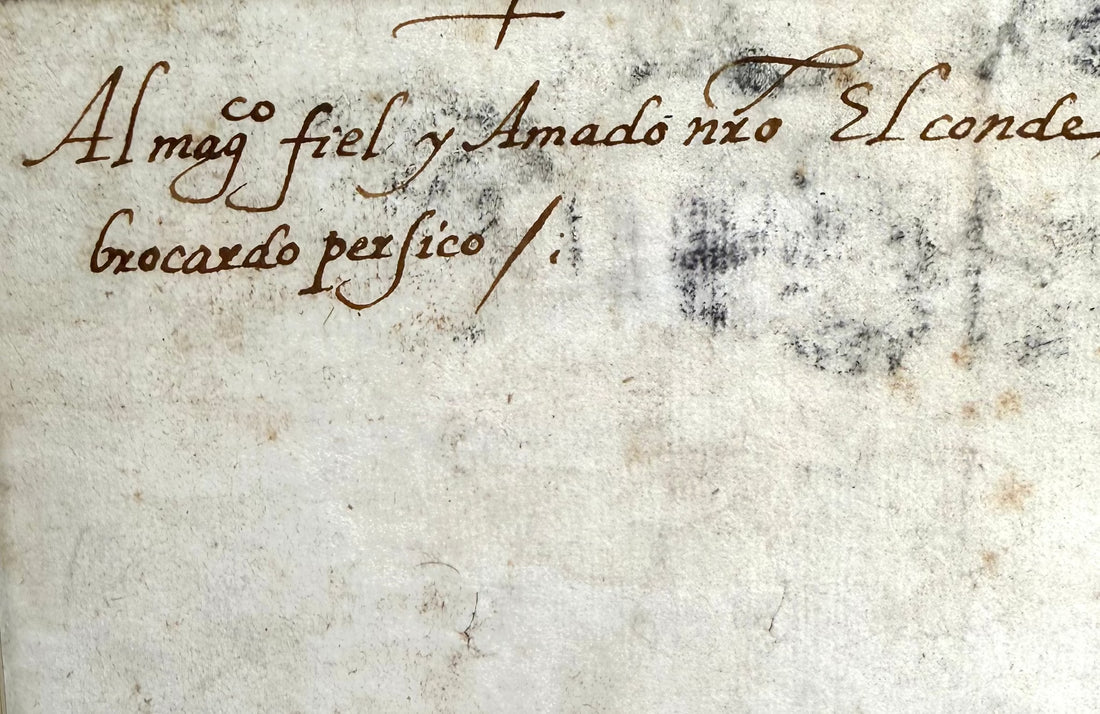
A separate handwritten address fragment, apparently identifying Count Brocardo Persico, accompanies the manuscript alongside a 19th-century portrait engraving of Philip II attributed to French artist P. Piquet. The engraving depicts the monarch standing in elaborate Renaissance court attire, complete with a decorated doublet, puffed sleeves, and a sword. All three elements are presented within a tan triple-window mat and decorative gilt-finished wooden frame, creating an elegant historical display.
Further distinguished by its provenance from the personal collection of Peter Benchley, acclaimed author of Jaws, this presentation brings together Renaissance royal correspondence, European maritime history, and notable literary ownership.
Features
- Spanish chancery script with prominent "El Rey" heading and "Yo el Rey" royal subscription
- Additional signature attributed to a royal secretary
- Historical correspondence concerning papal funding for sixty Mediterranean war galleys
- Separate handwritten address fragment apparently naming Count Brocardo Persico
- Accompanying 19th-century portrait engraving attributed to P. Piquet
- Decorative triple-window presentation mat and gilt-finished wooden frame
- Notable provenance from the personal collection of Peter Benchley, author of Jaws
Cultural Significance
King Philip II of Spain (1527–1598) presided over one of the most powerful empires of the Renaissance, governing extensive territories across Europe, the Americas, and Asia. His reign was characterized by imperial expansion, religious conflict, and maritime competition. Maintaining a formidable Mediterranean fleet was essential to protecting Spanish interests and confronting the growing influence of the Ottoman Empire.
The manuscript offers insight into the intricate relationship between the Spanish monarchy and the Catholic Church, illustrating how ecclesiastical revenues contributed to the financing of naval operations. Its apparent references to Count Brocardo Persico, the Bishop of Cuenca, and papal nuncio Alessandro Crivelli connect the correspondence to the complex diplomatic and administrative networks of Renaissance Europe.
The manuscript's later ownership by Peter Benchley adds a distinctive literary and maritime dimension to its history. Beyond his celebrated writing career, Benchley was an accomplished diver and advocate for ocean conservation. His interest in Spanish shipwrecks and historical documents connected his passion for maritime exploration with the enduring legacy of the Age of Discovery.
Condition
The principal manuscript and accompanying address fragment exhibit age-related toning, scattered foxing, localized discoloration, staining, and visible horizontal fold lines. The brown manuscript ink retains much of its definition, with the royal subscription and accompanying secretarial signature remaining prominently visible. Historical numerical annotations are present along the upper margins. The engraved portrait appears well preserved within the framed presentation, with its principal figural details remaining clearly recognizable. The gilt-finished wooden frame displays minor nicks, scattered surface wear, and localized irregularities to the decorative finish. Light dust and minor staining are visible on or beneath the glazing.
Dimensions (Approximate)
Manuscript (Visible Area):
Height: 11.5 in
Width: 7.75 in
Overall Framed Presentation:
Height: 17.5 in
Width: 20.25 in
Age (Approximate)
428–470 years old (manuscript, based on the reign of Philip II; catalogued as 1574)
127–226 years old (accompanying 19th-century engraving)
Provenance
Previously held in the Personal Collection of Peter Benchley (1940–2006), United States. Peter Benchley was an internationally acclaimed American novelist, screenwriter, diver, and ocean conservationist, best known as the author of Jaws (1974), the bestselling novel adapted into Steven Spielberg's groundbreaking 1975 motion picture. Beyond his literary career, Benchley maintained a lifelong fascination with maritime exploration, shipwrecks, historical manuscripts, and the natural world.
Subsequently handled by Willow Auction House, Lincoln Park, New Jersey, USA, as Lot 79 in The Peter Benchley Collection: Jaws, A Life of Writing, A Legacy of Ocean Conservation. Willow Auction House is an established auction and estate services firm specializing in fine art, antiques, historical artifacts, and significant private collections.
Learn More
Examine a comparable royal manuscript signed by King Philip II of Spain in 1588, concerning the administration of naval supplies for the Spanish Armada, through the collections of the National Maritime Museum, Greenwich
Explore additional Renaissance-era manuscripts, historical documents, and remarkable objects from the 1500s in our 16th Century (1500–1599) Artifacts Collection
Description
Historical Context & Origin
Region: Madrid, Spain; Spanish Habsburg monarchy
Material: Brown manuscript ink on historic paper, engraved portrait on paper, presentation matting, and gilt-finished wooden frame
Period: 16th century, reign of King Philip II (1556–1598); catalogued as May 2, 1574, although historical references suggest a possible earlier date. Accompanying portrait engraving attributed to the 19th century.
Description
This remarkable historical presentation features a royal manuscript attributed to King Philip II of Spain (1527–1598), one of the most influential monarchs of the European Renaissance and ruler of the vast Spanish Habsburg Empire. The correspondence concerns the administration of a substantial papal financial subsidy intended to support sixty Mediterranean war galleys, offering a fascinating connection to the political, religious, and maritime history of 16th-century Spain.
Executed in closely spaced Spanish chancery script, the manuscript bears the heading "El Rey" (The King) and concludes with the prominent royal subscription "Yo el Rey" (I, the King), accompanied by a secretarial signature partially identified in the original auction catalogue as "Juan de B." The text appears to reference an annual contribution of 420,000 ducats over five years, discussing administrative difficulties involving the Bishop of Cuenca and papal nuncio Alessandro Crivelli. The correspondence instructs the recipient to seek papal authorization for a substitute official to ensure the continued administration of the subsidy.
A separate handwritten address fragment, apparently identifying Count Brocardo Persico, accompanies the manuscript alongside a 19th-century portrait engraving of Philip II attributed to French artist P. Piquet. The engraving depicts the monarch standing in elaborate Renaissance court attire, complete with a decorated doublet, puffed sleeves, and a sword. All three elements are presented within a tan triple-window mat and decorative gilt-finished wooden frame, creating an elegant historical display.
Further distinguished by its provenance from the personal collection of Peter Benchley, acclaimed author of Jaws, this presentation brings together Renaissance royal correspondence, European maritime history, and notable literary ownership.
Features
- Spanish chancery script with prominent "El Rey" heading and "Yo el Rey" royal subscription
- Additional signature attributed to a royal secretary
- Historical correspondence concerning papal funding for sixty Mediterranean war galleys
- Separate handwritten address fragment apparently naming Count Brocardo Persico
- Accompanying 19th-century portrait engraving attributed to P. Piquet
- Decorative triple-window presentation mat and gilt-finished wooden frame
- Notable provenance from the personal collection of Peter Benchley, author of Jaws
Cultural Significance
King Philip II of Spain (1527–1598) presided over one of the most powerful empires of the Renaissance, governing extensive territories across Europe, the Americas, and Asia. His reign was characterized by imperial expansion, religious conflict, and maritime competition. Maintaining a formidable Mediterranean fleet was essential to protecting Spanish interests and confronting the growing influence of the Ottoman Empire.
The manuscript offers insight into the intricate relationship between the Spanish monarchy and the Catholic Church, illustrating how ecclesiastical revenues contributed to the financing of naval operations. Its apparent references to Count Brocardo Persico, the Bishop of Cuenca, and papal nuncio Alessandro Crivelli connect the correspondence to the complex diplomatic and administrative networks of Renaissance Europe.
The manuscript's later ownership by Peter Benchley adds a distinctive literary and maritime dimension to its history. Beyond his celebrated writing career, Benchley was an accomplished diver and advocate for ocean conservation. His interest in Spanish shipwrecks and historical documents connected his passion for maritime exploration with the enduring legacy of the Age of Discovery.
Condition
The principal manuscript and accompanying address fragment exhibit age-related toning, scattered foxing, localized discoloration, staining, and visible horizontal fold lines. The brown manuscript ink retains much of its definition, with the royal subscription and accompanying secretarial signature remaining prominently visible. Historical numerical annotations are present along the upper margins. The engraved portrait appears well preserved within the framed presentation, with its principal figural details remaining clearly recognizable. The gilt-finished wooden frame displays minor nicks, scattered surface wear, and localized irregularities to the decorative finish. Light dust and minor staining are visible on or beneath the glazing.
Dimensions (Approximate)
Manuscript (Visible Area):
Height: 11.5 in
Width: 7.75 in
Overall Framed Presentation:
Height: 17.5 in
Width: 20.25 in
Age (Approximate)
428–470 years old (manuscript, based on the reign of Philip II; catalogued as 1574)
127–226 years old (accompanying 19th-century engraving)
Provenance
Previously held in the Personal Collection of Peter Benchley (1940–2006), United States. Peter Benchley was an internationally acclaimed American novelist, screenwriter, diver, and ocean conservationist, best known as the author of Jaws (1974), the bestselling novel adapted into Steven Spielberg's groundbreaking 1975 motion picture. Beyond his literary career, Benchley maintained a lifelong fascination with maritime exploration, shipwrecks, historical manuscripts, and the natural world.
Subsequently handled by Willow Auction House, Lincoln Park, New Jersey, USA, as Lot 79 in The Peter Benchley Collection: Jaws, A Life of Writing, A Legacy of Ocean Conservation. Willow Auction House is an established auction and estate services firm specializing in fine art, antiques, historical artifacts, and significant private collections.
Learn More
Examine a comparable royal manuscript signed by King Philip II of Spain in 1588, concerning the administration of naval supplies for the Spanish Armada, through the collections of the National Maritime Museum, Greenwich
Explore additional Renaissance-era manuscripts, historical documents, and remarkable objects from the 1500s in our 16th Century (1500–1599) Artifacts Collection
Vous aimerez peut-être aussi
