



Pair of Colour Portrait Miniatures in Green Velvet Presentation Case | Sears Family Collection | Circa 1880–1910 CE
- Prix habituel
- $400.00
- Prix soldé
- $400.00
- Prix habituel
Impossible de charger la disponibilité du service de retrait







Pair of Colour Portrait Miniatures in Green Velvet Presentation Case | Sears Family Collection | Circa 1880–1910 CE
Description
Plus
Moins
Historical Context & Origin
Region: United States, associated with the historic Sears family of New England; exact place of production undetermined
Material: Two colour-finished oval portrait images, gilt-coloured metal surrounds, protective glazing, deep green velvet mounting, cream satin-like lining, and green leather-covered presentation case
Period: Late Victorian to Edwardian Era, circa 1880–1910 CE
Description
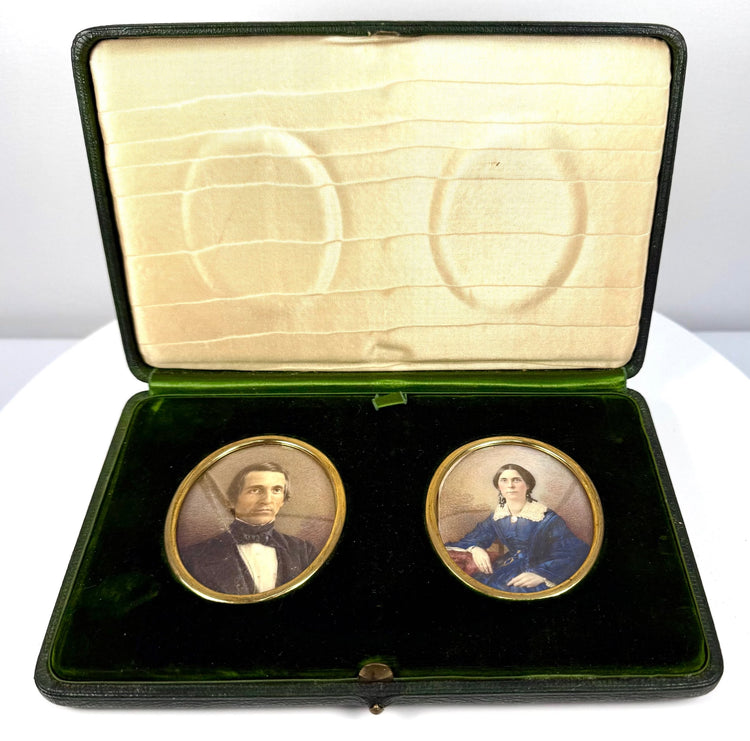
An elegant pair of antique colour portrait miniatures depicting a formally dressed gentleman and woman, preserved together within a distinctive deep green velvet-lined presentation case. Dating to circa 1880–1910 CE, this refined double portrait presentation reflects the longstanding tradition of preserving intimate family likenesses within finely crafted decorative enclosures.
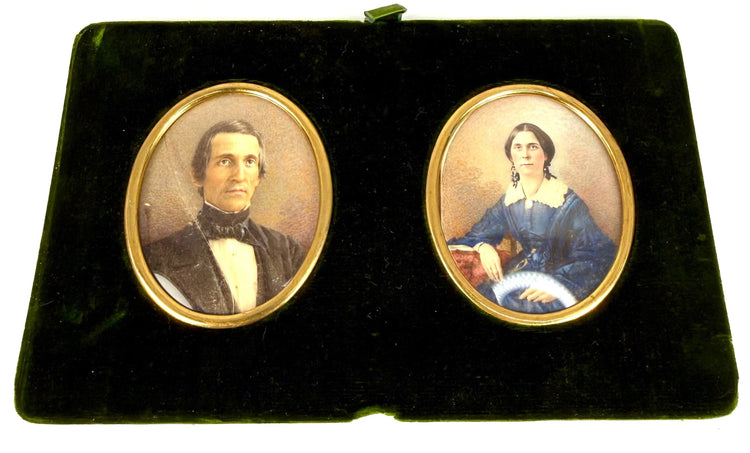
The two portraits are mounted side by side within individual oval gilt-coloured metal surrounds, carefully recessed into a richly coloured dark green velvet presentation panel. Their coordinated arrangement reflects the tradition of displaying family likenesses together, although the precise identities and relationship of the subjects have not been independently established.
The gentleman, positioned on the left, is portrayed wearing a dark formal coat over a white shirt, complemented by a carefully arranged black necktie. His dark brown hair is parted and combed neatly, framing a mature face with a composed and dignified expression. Subtle colouring throughout his face, clothing, and softly graduated background gives the portrait an attractive painterly appearance.
The female subject, positioned on the right, is depicted seated in an elegant deep blue gown featuring a fitted bodice, long sleeves, and a delicate white lace collar. Her dark hair is parted centrally and arranged in a fashionable nineteenth-century style, with decorative curls falling beside her face. She wears a small ornament at her neckline and rests one arm upon a piece of draped studio furniture, creating a graceful and carefully composed portrait.
A pale curved accessory is visible across her lap. The combination of richly coloured clothing, delicate facial modelling, and carefully rendered accessories creates an appealing representation of nineteenth-century feminine fashion and portraiture.
Both images feature softly graduated backgrounds that emphasize the subjects' facial features and clothing. Their colour treatment and artistic presentation reflect the traditions of miniature portrait painting and extensively hand-coloured photographic portraiture, techniques employed during the nineteenth century to produce highly personalized family keepsakes.
The precise artistic processes and underlying image supports have not been independently examined. The images are therefore described as colour-finished portrait miniatures without assigning a specific painting or photographic technique.
The two images are enclosed within narrow gilt-coloured oval metal surrounds, creating an attractive contrast against the dark green velvet mounting. Their symmetrical arrangement gives the presentation an intimate and balanced appearance.
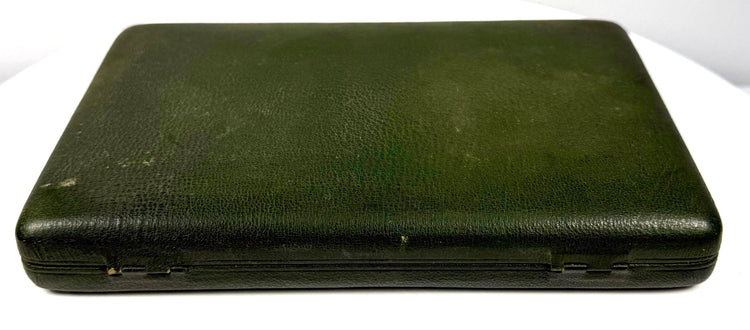
Particularly noteworthy is the accompanying fitted green presentation case, distinguished by its richly coloured velvet interior and dark green textured exterior covering.
The hinged lid opens to reveal a cream-coloured satin-like interior displaying a subtle moiré pattern and faint circular impressions corresponding to the placement of the two oval portraits. The contrasting cream lining and deep green velvet create an elegant decorative presentation characteristic of finely made late Victorian and Edwardian photographic accessories.
The oval portraits are mounted upon a removable velvet-covered presentation panel, allowing the images to be displayed independently of the outer protective case.
The reverse of the removable panel incorporates an integrated folding easel support, permitting the portraits to be positioned upright for display. A small green fabric pull tab is also present, providing a practical means of lifting the panel from its protective enclosure.
A small metal fastening along the front edge of the outer case allows the presentation to be secured when closed.
This thoughtful combination of protective storage and decorative display reflects the considerable sentimental importance attached to personal portraits during the Victorian and Edwardian periods, when family likenesses were often preserved and passed down through successive generations.
Features
- Pair of antique colour portrait miniatures dating to circa 1880–1910 CE
- Two coordinated oval portraits depicting a gentleman and woman
- Portrait compositions and clothing reflecting mid-19th-century fashions
- Carefully rendered facial features with subtle colour enhancement
- Male portrait featuring a dark formal coat, white shirt, and black necktie
- Female portrait featuring an elegant deep blue gown with a white lace collar
- Woman depicted seated with one arm resting upon draped studio furniture
- Finely detailed period hairstyles and decorative clothing elements
- Softly graduated portrait backgrounds
- Colour-finished images with an attractive painterly appearance
- Two individual gilt-coloured oval metal surrounds
- Richly coloured deep green velvet presentation panel
- Dark green leather-covered protective presentation case
- Cream-coloured satin-like interior with distinctive moiré pattern
- Hinged protective lid with front metal fastening
- Removable double-portrait presentation panel
- Integrated folding easel support for independent display
- Small green fabric pull tab for removing the portrait panel
- Historical association with the Sears family photographic collection
- Provenance from the estate of Joseph W. Haley, Pride's Crossing, Massachusetts
Cultural Significance
Portrait miniatures occupy an important place in the history of Western art and personal remembrance. Long before the invention of photography, small painted likenesses were treasured possessions among families wishing to preserve the appearances of loved ones.
During the eighteenth and early nineteenth centuries, finely executed portrait miniatures were frequently commissioned to commemorate marriages, family relationships, engagements, and significant personal occasions. Their intimate scale allowed portraits to be carried during travel or displayed within private domestic settings.
The introduction of photography in 1839 fundamentally transformed the production of personal portraits, making detailed likenesses accessible to an increasingly broad section of society.
Rather than disappearing entirely, the tradition of portrait miniatures evolved alongside photographic technology. Artists and photographers employed hand-colouring, painted enhancement, and increasingly sophisticated decorative mounting techniques to create portraits combining photographic realism with the aesthetic qualities of traditional miniature painting.
By the late nineteenth century, renewed interest in historical decorative arts and traditional portraiture encouraged a revival of miniature painting, particularly among artists working in Europe and North America.
Small portraits were frequently presented in oval mounts, velvet-lined cases, and protective leather enclosures, reflecting the importance attached to family memory and personal identity.
Pairs of portraits depicting a gentleman and woman were particularly appropriate for commemorating family relationships. Their coordinated presentation could symbolize marriage, kinship, or remembrance, preserving two individuals together within a single decorative object.
The portraits in this example reflect the formal conventions of nineteenth-century portraiture, emphasizing dignity, refinement, and personal character.
The gentleman's conservative dark formal clothing and carefully arranged neckwear reflect the restrained elegance associated with professional and middle-class male dress during the period.
The woman's richly coloured blue gown, delicate white collar, and centrally parted hairstyle preserve important elements of nineteenth-century women's fashion. Her seated pose and carefully arranged surroundings further illustrate the conventions of formal domestic and studio portraiture.
The use of colour contributes to the intimate nature of the portraits, preserving details of complexion, clothing, and decorative accessories in a manner reminiscent of traditional painted miniatures.
The accompanying green velvet presentation case also possesses significance as an example of late nineteenth-century decorative craftsmanship. Its fitted oval mounts, contrasting textile interiors, removable display panel, and folding easel support reflect the attention given to both presentation and preservation.
Condition
The pair survives in good antique condition overall, with both portraits retaining attractive colouring, recognizable facial features, and substantial decorative detail.
The gentleman's portrait remains comparatively clear, with well-defined facial features, clothing, and background. Minor surface marks, light abrasions, and subtle age-related variations are visible.
The female portrait retains its principal facial and clothing details, including the blue gown, white collar, and carefully arranged hairstyle. Minor surface marks, tonal irregularities, and signs of age are visible.
The gilt-coloured oval surrounds remain present, exhibiting expected minor rubbing, light surface wear, and subtle discolouration consistent with age.
The dark green velvet presentation panel retains its richly coloured appearance, although minor dust, lint, surface marks, and variations in the fabric's texture are visible.
The cream-coloured satin-like lining inside the lid exhibits expected age-related yellowing, minor spotting, folds, creases, and faint circular impressions corresponding to the oval portrait mounts.
The exterior presentation case displays light rubbing, minor scratches, surface abrasions, and expected wear associated with historical use and storage. Its distinctive green covering remains substantially intact.
The hinged lid and front metal fastening remain present, while the removable portrait panel retains its folding easel support and fabric pull tab.
Dimensions (Approximate)
Height: 7.5 in
Width: 5 in
Depth: 1 in
(case closed)
Age (Approximate)
116–146 years old
Provenance
Formerly part of the estate of the late Joseph W. Haley (1938–2026) of Pride's Crossing, Massachusetts, United States, whose extensive collection included American and European antiques, fine and decorative arts, historical documents, early books, and objects reflecting a lifelong interest in history, travel, and collecting.
The pair formed part of a larger collection of nine historical photographic portraits and daguerreotypes associated with members of the Sears family, including Henry Sears, Paul Sears, an individual described as Grandmother, and a woman identified in the original auction catalogue as Clarret Sears Bishop.
Sears Family Historical Research
Genealogical research connects several individuals named in the original photographic collection to the descendants of Dr. Nathan Sears (1791–1848), a Massachusetts-born physician who subsequently practised medicine in Ohio, Michigan, and Illinois.
Dr. Sears was born in Ashfield, Massachusetts, and later relocated with his family as American communities expanded westward during the nineteenth century.
His wife was Grace Loper Sears, and their children included Paul Sears, Clarissa Sears Bishop, and Nathan Henry Sears.
An important piece of contemporary historical evidence is preserved in The Ranney Letters: Family Correspondence During the Yankee Migration.
An original letter dated January 8, 1850, written by Lyman Ranney from Van Buren, Arkansas, independently identifies Paul Sears, Clarissa Sears Bishop, and Henry Sears as members of the same family.
Paul Sears was described as a successful physician practising in Mount Carmel, Illinois. His sister Clarissa had married Ephraim Brown Bishop, a merchant associated with Arkansas, while their younger brother Henry was attending school in that state.
These documented family relationships provide historical context for the Sears family collection, although the individual identities of the gentleman and woman depicted in this pair remain unconfirmed.
Learn More
A related pair of nineteenth-century portraits preserved together in a single case is held by the Museum of Fine Arts, Houston.
More Victorian-era keepsakes are featured in our Victorian Artifacts & Historic Relics Collection
Description
Historical Context & Origin
Region: United States, associated with the historic Sears family of New England; exact place of production undetermined
Material: Two colour-finished oval portrait images, gilt-coloured metal surrounds, protective glazing, deep green velvet mounting, cream satin-like lining, and green leather-covered presentation case
Period: Late Victorian to Edwardian Era, circa 1880–1910 CE
Description
An elegant pair of antique colour portrait miniatures depicting a formally dressed gentleman and woman, preserved together within a distinctive deep green velvet-lined presentation case. Dating to circa 1880–1910 CE, this refined double portrait presentation reflects the longstanding tradition of preserving intimate family likenesses within finely crafted decorative enclosures.
The two portraits are mounted side by side within individual oval gilt-coloured metal surrounds, carefully recessed into a richly coloured dark green velvet presentation panel. Their coordinated arrangement reflects the tradition of displaying family likenesses together, although the precise identities and relationship of the subjects have not been independently established.
The gentleman, positioned on the left, is portrayed wearing a dark formal coat over a white shirt, complemented by a carefully arranged black necktie. His dark brown hair is parted and combed neatly, framing a mature face with a composed and dignified expression. Subtle colouring throughout his face, clothing, and softly graduated background gives the portrait an attractive painterly appearance.
The female subject, positioned on the right, is depicted seated in an elegant deep blue gown featuring a fitted bodice, long sleeves, and a delicate white lace collar. Her dark hair is parted centrally and arranged in a fashionable nineteenth-century style, with decorative curls falling beside her face. She wears a small ornament at her neckline and rests one arm upon a piece of draped studio furniture, creating a graceful and carefully composed portrait.
A pale curved accessory is visible across her lap. The combination of richly coloured clothing, delicate facial modelling, and carefully rendered accessories creates an appealing representation of nineteenth-century feminine fashion and portraiture.
Both images feature softly graduated backgrounds that emphasize the subjects' facial features and clothing. Their colour treatment and artistic presentation reflect the traditions of miniature portrait painting and extensively hand-coloured photographic portraiture, techniques employed during the nineteenth century to produce highly personalized family keepsakes.
The precise artistic processes and underlying image supports have not been independently examined. The images are therefore described as colour-finished portrait miniatures without assigning a specific painting or photographic technique.
The two images are enclosed within narrow gilt-coloured oval metal surrounds, creating an attractive contrast against the dark green velvet mounting. Their symmetrical arrangement gives the presentation an intimate and balanced appearance.
Particularly noteworthy is the accompanying fitted green presentation case, distinguished by its richly coloured velvet interior and dark green textured exterior covering.
The hinged lid opens to reveal a cream-coloured satin-like interior displaying a subtle moiré pattern and faint circular impressions corresponding to the placement of the two oval portraits. The contrasting cream lining and deep green velvet create an elegant decorative presentation characteristic of finely made late Victorian and Edwardian photographic accessories.
The oval portraits are mounted upon a removable velvet-covered presentation panel, allowing the images to be displayed independently of the outer protective case.
The reverse of the removable panel incorporates an integrated folding easel support, permitting the portraits to be positioned upright for display. A small green fabric pull tab is also present, providing a practical means of lifting the panel from its protective enclosure.
A small metal fastening along the front edge of the outer case allows the presentation to be secured when closed.
This thoughtful combination of protective storage and decorative display reflects the considerable sentimental importance attached to personal portraits during the Victorian and Edwardian periods, when family likenesses were often preserved and passed down through successive generations.
Features
- Pair of antique colour portrait miniatures dating to circa 1880–1910 CE
- Two coordinated oval portraits depicting a gentleman and woman
- Portrait compositions and clothing reflecting mid-19th-century fashions
- Carefully rendered facial features with subtle colour enhancement
- Male portrait featuring a dark formal coat, white shirt, and black necktie
- Female portrait featuring an elegant deep blue gown with a white lace collar
- Woman depicted seated with one arm resting upon draped studio furniture
- Finely detailed period hairstyles and decorative clothing elements
- Softly graduated portrait backgrounds
- Colour-finished images with an attractive painterly appearance
- Two individual gilt-coloured oval metal surrounds
- Richly coloured deep green velvet presentation panel
- Dark green leather-covered protective presentation case
- Cream-coloured satin-like interior with distinctive moiré pattern
- Hinged protective lid with front metal fastening
- Removable double-portrait presentation panel
- Integrated folding easel support for independent display
- Small green fabric pull tab for removing the portrait panel
- Historical association with the Sears family photographic collection
- Provenance from the estate of Joseph W. Haley, Pride's Crossing, Massachusetts
Cultural Significance
Portrait miniatures occupy an important place in the history of Western art and personal remembrance. Long before the invention of photography, small painted likenesses were treasured possessions among families wishing to preserve the appearances of loved ones.
During the eighteenth and early nineteenth centuries, finely executed portrait miniatures were frequently commissioned to commemorate marriages, family relationships, engagements, and significant personal occasions. Their intimate scale allowed portraits to be carried during travel or displayed within private domestic settings.
The introduction of photography in 1839 fundamentally transformed the production of personal portraits, making detailed likenesses accessible to an increasingly broad section of society.
Rather than disappearing entirely, the tradition of portrait miniatures evolved alongside photographic technology. Artists and photographers employed hand-colouring, painted enhancement, and increasingly sophisticated decorative mounting techniques to create portraits combining photographic realism with the aesthetic qualities of traditional miniature painting.
By the late nineteenth century, renewed interest in historical decorative arts and traditional portraiture encouraged a revival of miniature painting, particularly among artists working in Europe and North America.
Small portraits were frequently presented in oval mounts, velvet-lined cases, and protective leather enclosures, reflecting the importance attached to family memory and personal identity.
Pairs of portraits depicting a gentleman and woman were particularly appropriate for commemorating family relationships. Their coordinated presentation could symbolize marriage, kinship, or remembrance, preserving two individuals together within a single decorative object.
The portraits in this example reflect the formal conventions of nineteenth-century portraiture, emphasizing dignity, refinement, and personal character.
The gentleman's conservative dark formal clothing and carefully arranged neckwear reflect the restrained elegance associated with professional and middle-class male dress during the period.
The woman's richly coloured blue gown, delicate white collar, and centrally parted hairstyle preserve important elements of nineteenth-century women's fashion. Her seated pose and carefully arranged surroundings further illustrate the conventions of formal domestic and studio portraiture.
The use of colour contributes to the intimate nature of the portraits, preserving details of complexion, clothing, and decorative accessories in a manner reminiscent of traditional painted miniatures.
The accompanying green velvet presentation case also possesses significance as an example of late nineteenth-century decorative craftsmanship. Its fitted oval mounts, contrasting textile interiors, removable display panel, and folding easel support reflect the attention given to both presentation and preservation.
Condition
The pair survives in good antique condition overall, with both portraits retaining attractive colouring, recognizable facial features, and substantial decorative detail.
The gentleman's portrait remains comparatively clear, with well-defined facial features, clothing, and background. Minor surface marks, light abrasions, and subtle age-related variations are visible.
The female portrait retains its principal facial and clothing details, including the blue gown, white collar, and carefully arranged hairstyle. Minor surface marks, tonal irregularities, and signs of age are visible.
The gilt-coloured oval surrounds remain present, exhibiting expected minor rubbing, light surface wear, and subtle discolouration consistent with age.
The dark green velvet presentation panel retains its richly coloured appearance, although minor dust, lint, surface marks, and variations in the fabric's texture are visible.
The cream-coloured satin-like lining inside the lid exhibits expected age-related yellowing, minor spotting, folds, creases, and faint circular impressions corresponding to the oval portrait mounts.
The exterior presentation case displays light rubbing, minor scratches, surface abrasions, and expected wear associated with historical use and storage. Its distinctive green covering remains substantially intact.
The hinged lid and front metal fastening remain present, while the removable portrait panel retains its folding easel support and fabric pull tab.
Dimensions (Approximate)
Height: 7.5 in
Width: 5 in
Depth: 1 in
(case closed)
Age (Approximate)
116–146 years old
Provenance
Formerly part of the estate of the late Joseph W. Haley (1938–2026) of Pride's Crossing, Massachusetts, United States, whose extensive collection included American and European antiques, fine and decorative arts, historical documents, early books, and objects reflecting a lifelong interest in history, travel, and collecting.
The pair formed part of a larger collection of nine historical photographic portraits and daguerreotypes associated with members of the Sears family, including Henry Sears, Paul Sears, an individual described as Grandmother, and a woman identified in the original auction catalogue as Clarret Sears Bishop.
Sears Family Historical Research
Genealogical research connects several individuals named in the original photographic collection to the descendants of Dr. Nathan Sears (1791–1848), a Massachusetts-born physician who subsequently practised medicine in Ohio, Michigan, and Illinois.
Dr. Sears was born in Ashfield, Massachusetts, and later relocated with his family as American communities expanded westward during the nineteenth century.
His wife was Grace Loper Sears, and their children included Paul Sears, Clarissa Sears Bishop, and Nathan Henry Sears.
An important piece of contemporary historical evidence is preserved in The Ranney Letters: Family Correspondence During the Yankee Migration.
An original letter dated January 8, 1850, written by Lyman Ranney from Van Buren, Arkansas, independently identifies Paul Sears, Clarissa Sears Bishop, and Henry Sears as members of the same family.
Paul Sears was described as a successful physician practising in Mount Carmel, Illinois. His sister Clarissa had married Ephraim Brown Bishop, a merchant associated with Arkansas, while their younger brother Henry was attending school in that state.
These documented family relationships provide historical context for the Sears family collection, although the individual identities of the gentleman and woman depicted in this pair remain unconfirmed.
Learn More
A related pair of nineteenth-century portraits preserved together in a single case is held by the Museum of Fine Arts, Houston.
More Victorian-era keepsakes are featured in our Victorian Artifacts & Historic Relics Collection
Vous aimerez peut-être aussi
