



American Cased Photographic Portrait Collection | Sears Family & Clarise Harrold Provenance | Set of Four | Circa 1845–1865 CE
- Prix habituel
- $650.00
- Prix soldé
- $650.00
- Prix habituel
Impossible de charger la disponibilité du service de retrait


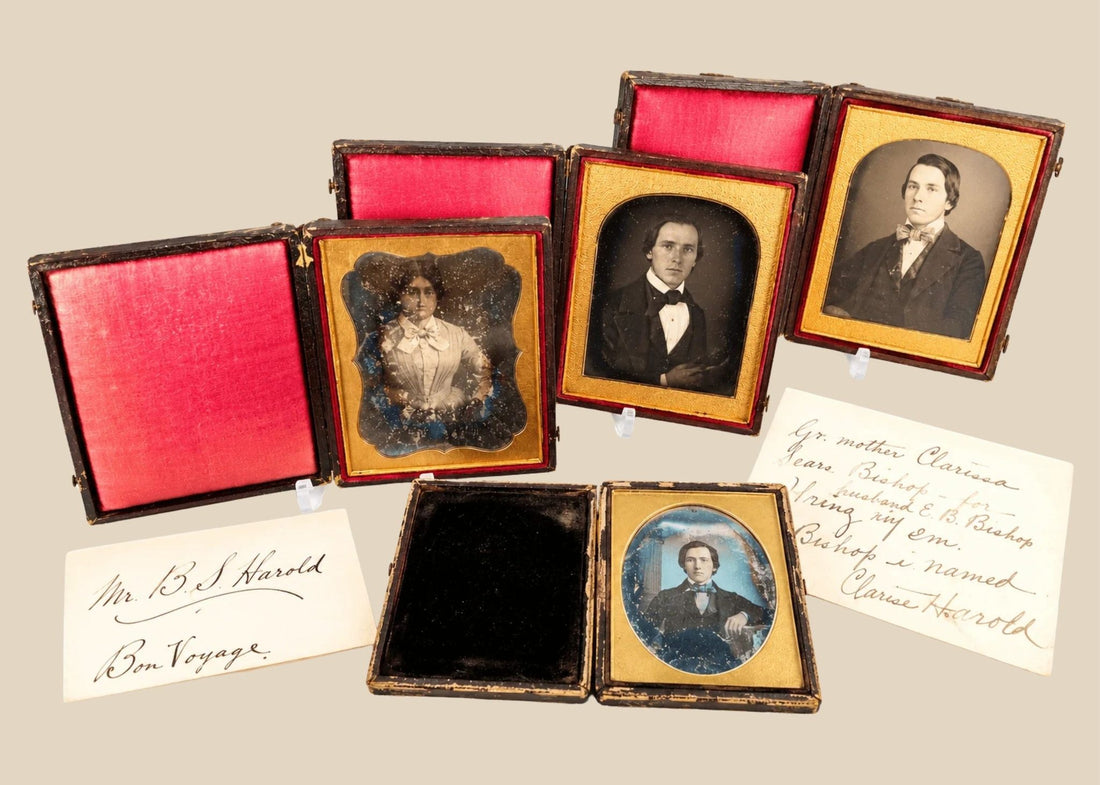
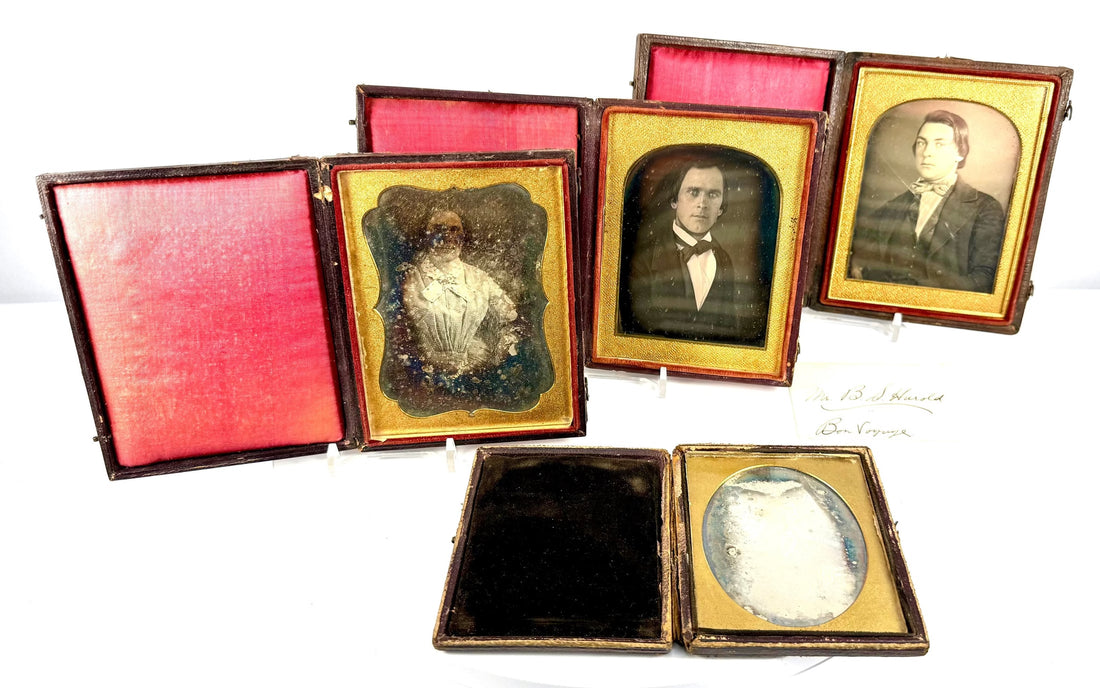






American Cased Photographic Portrait Collection | Sears Family & Clarise Harrold Provenance | Set of Four | Circa 1845–1865 CE
Description
Plus
Moins
Historical Context & Origin
Region: United States, associated with New England and the American Midwest
Material: Early photographic images, gilt-metal mats, protective glass, embossed photographic cases, textile linings, and accompanying handwritten family identification materials
Period: Mid-19th Century, Victorian Era, circa 1845–1865 CE
Description
A historically significant collection of four original mid-19th-century American cased photographic portraits associated with the Sears family and preserved within the estate of the late Joseph W. Haley of Pride's Crossing, Massachusetts. Dating to circa 1845–1865 CE, this collection represents the earliest generations of American portrait photography and is accompanied by surviving handwritten family identification materials connecting the photographs to several documented nineteenth-century individuals.
The collection comprises four individually cased photographic portraits depicting three gentlemen and one woman, each housed within an ornate hinged protective case. The photographs display characteristics associated with early daguerreotype and ambrotype processes, although the individual photographic media have not been independently verified.
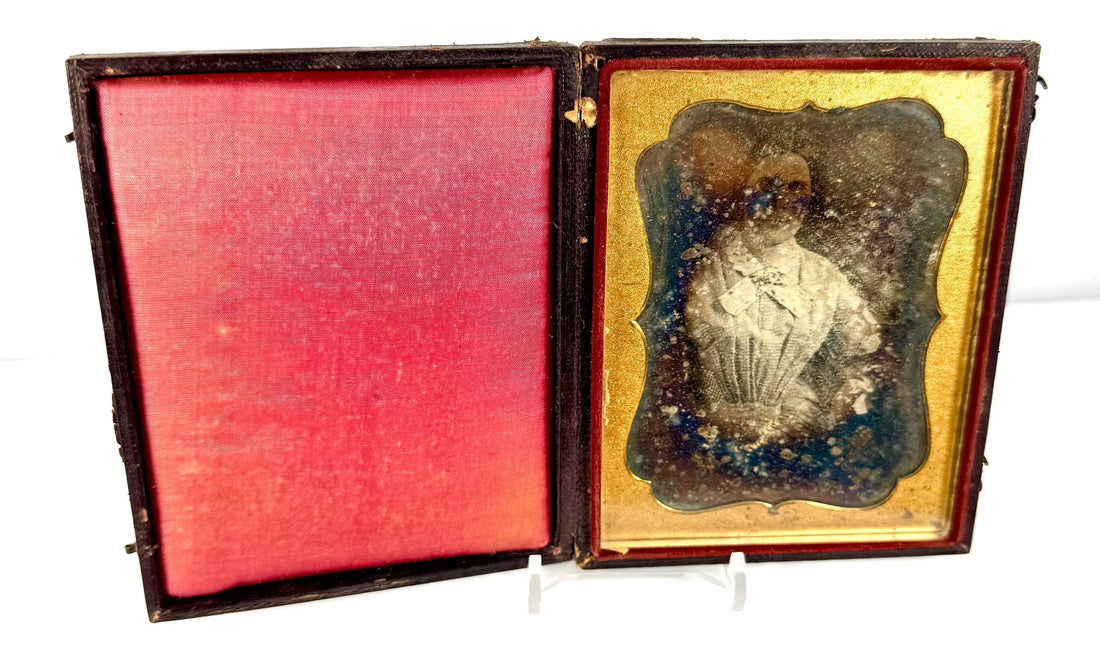
The first portrait depicts a seated Victorian woman wearing an elaborate light-coloured gown featuring a fitted bodice, decorative neckline, and voluminous sleeves. Although the photograph exhibits substantial age-related deterioration, the woman's silhouette, clothing, and formal studio presentation remain discernible.
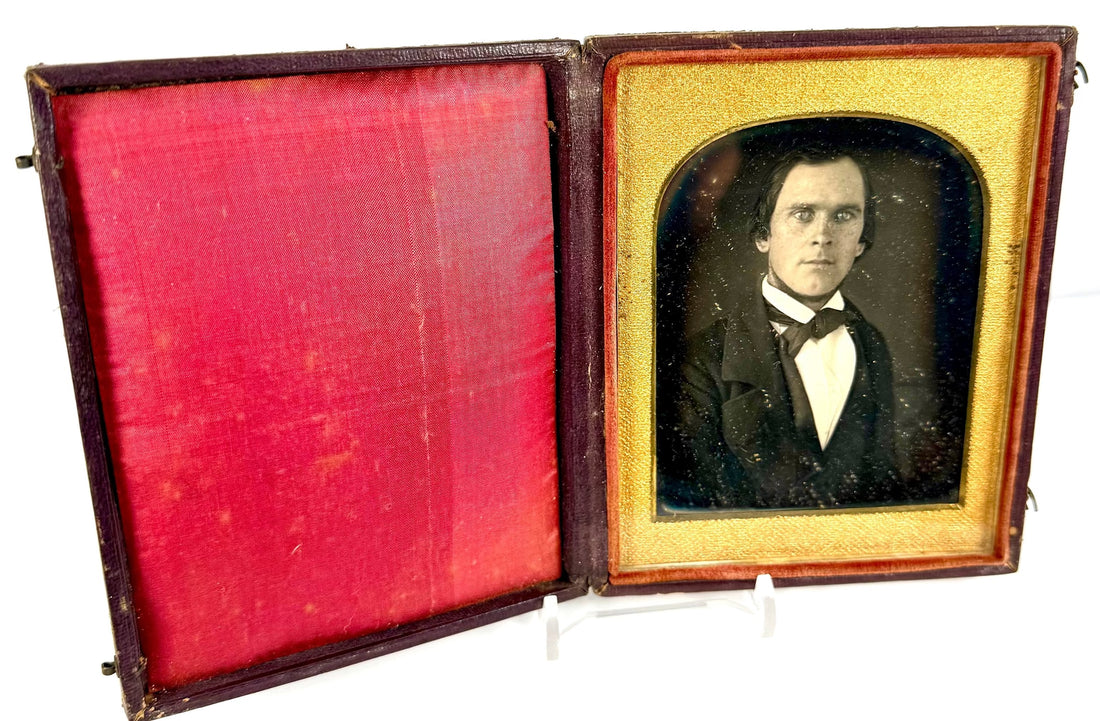
The second portrait depicts a dark-haired gentleman wearing a formal black coat, white shirt, and dark necktie. His carefully arranged hairstyle and direct expression are characteristic of nineteenth-century professional portraiture. The image retains substantial clarity, particularly throughout the sitter's facial features and clothing.
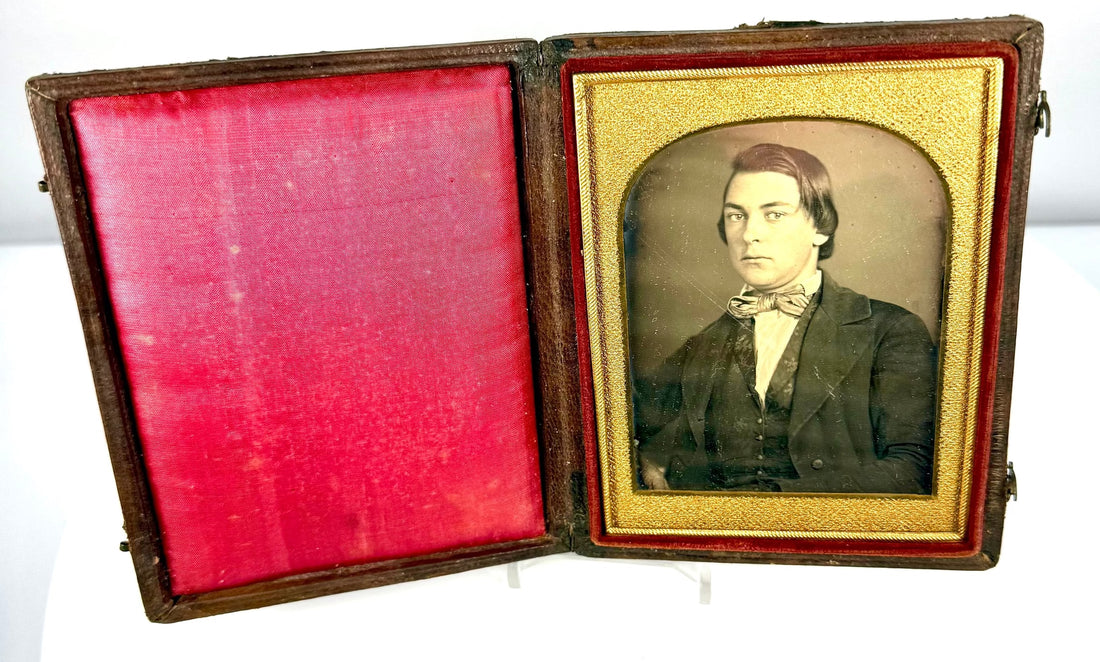
The third portrait features a younger gentleman wearing a dark tailored suit, waistcoat, white shirt, and decorative bow tie. His neatly arranged hair, composed expression, and formal attire reflect the fashionable appearance of American gentlemen during the middle decades of the nineteenth century.
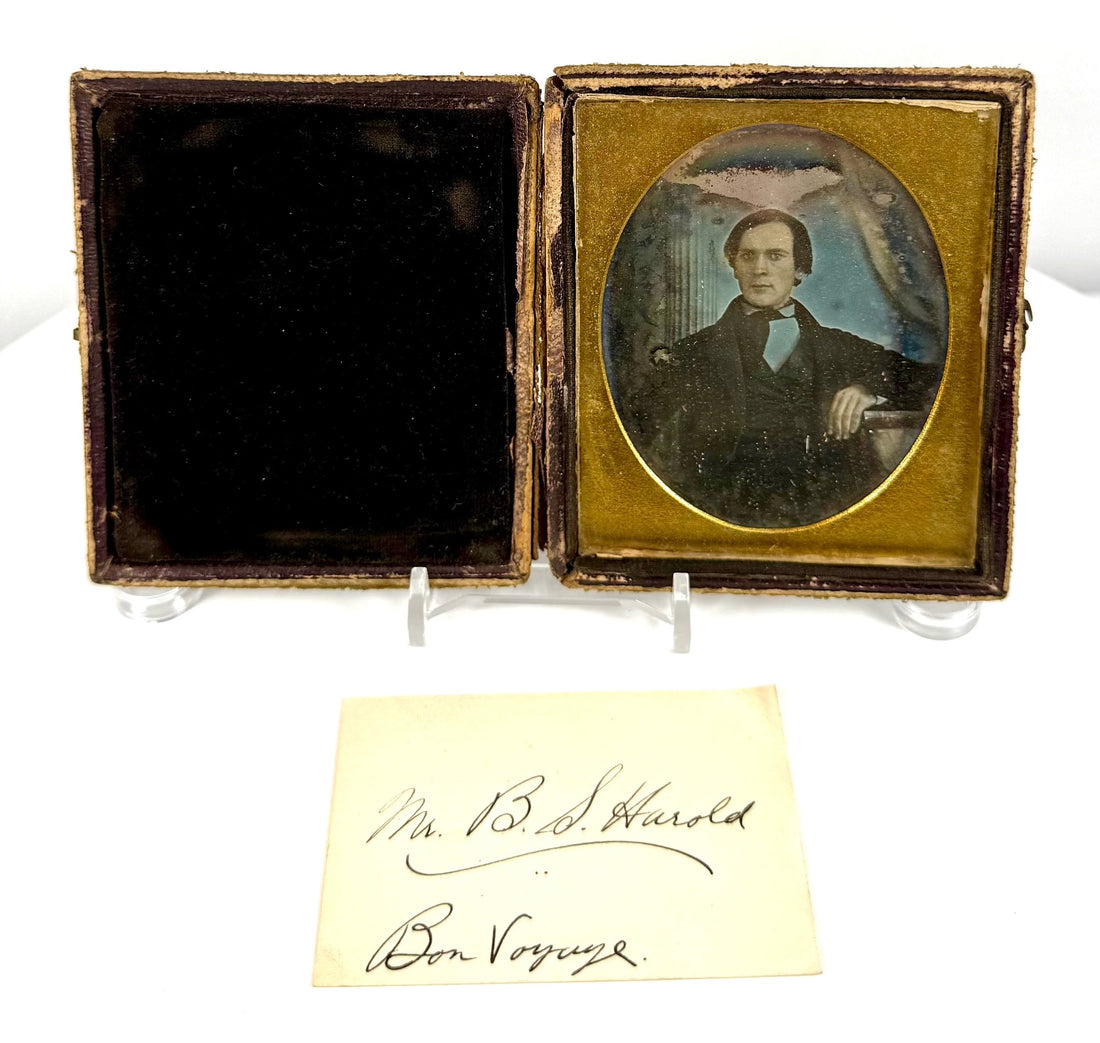
The fourth portrait depicts a seated gentleman wearing a dark formal coat and waistcoat, with one arm resting upon a piece of studio furniture. The image is presented within an oval photographic opening and displays a strongly reflective surface, causing the sitter's appearance to vary considerably depending upon the viewing angle.
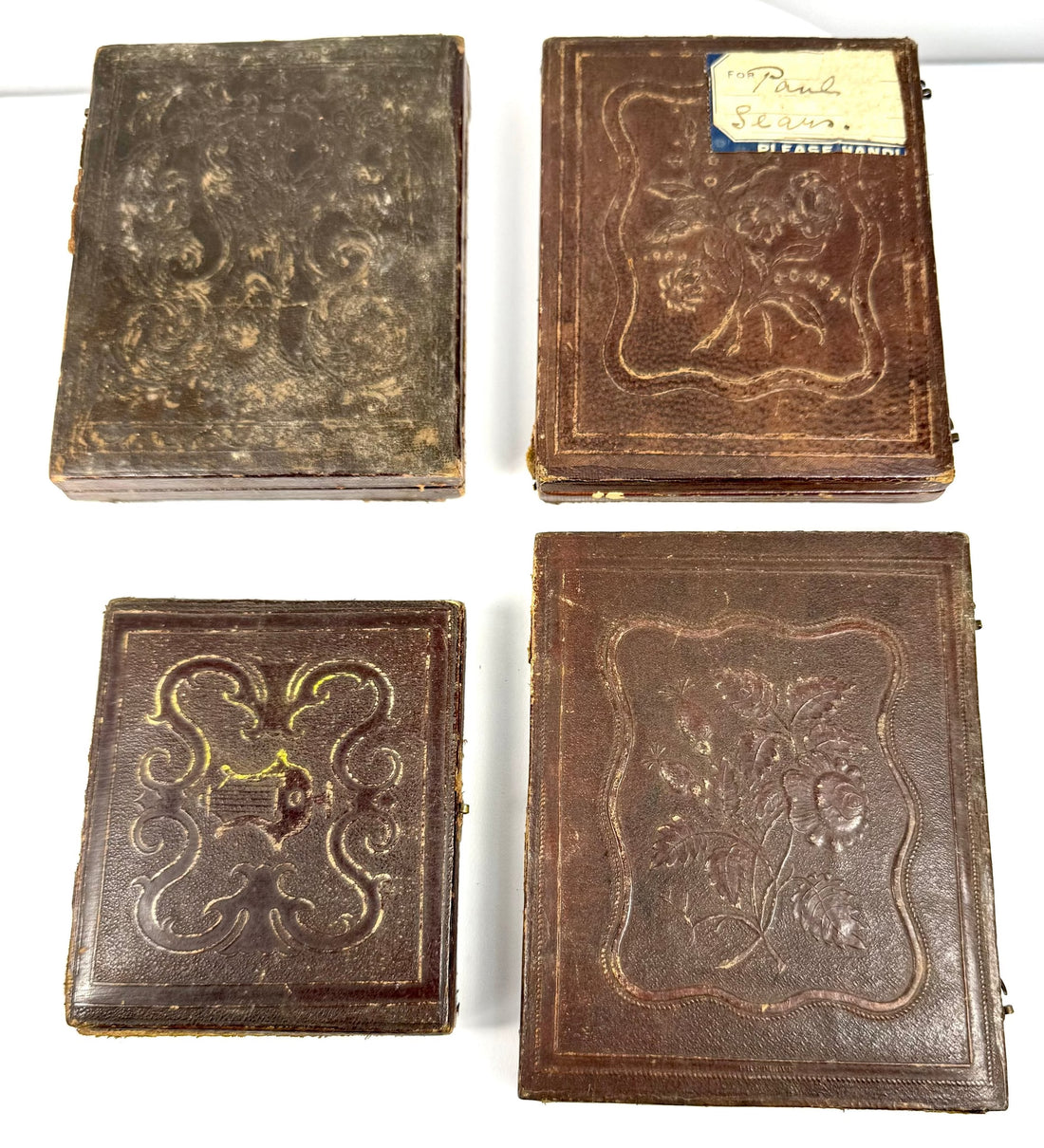
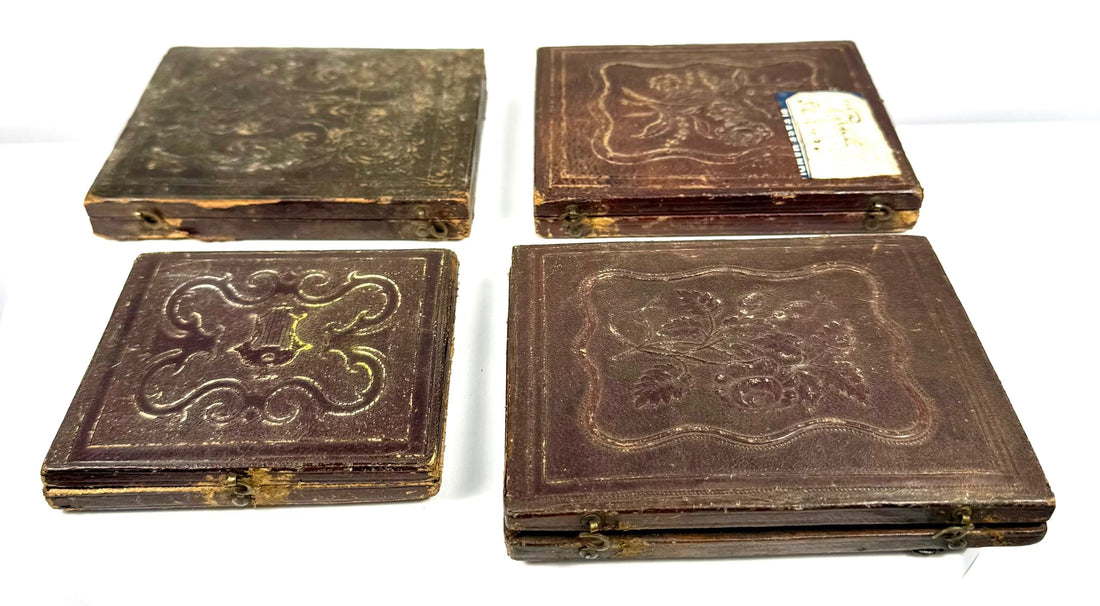
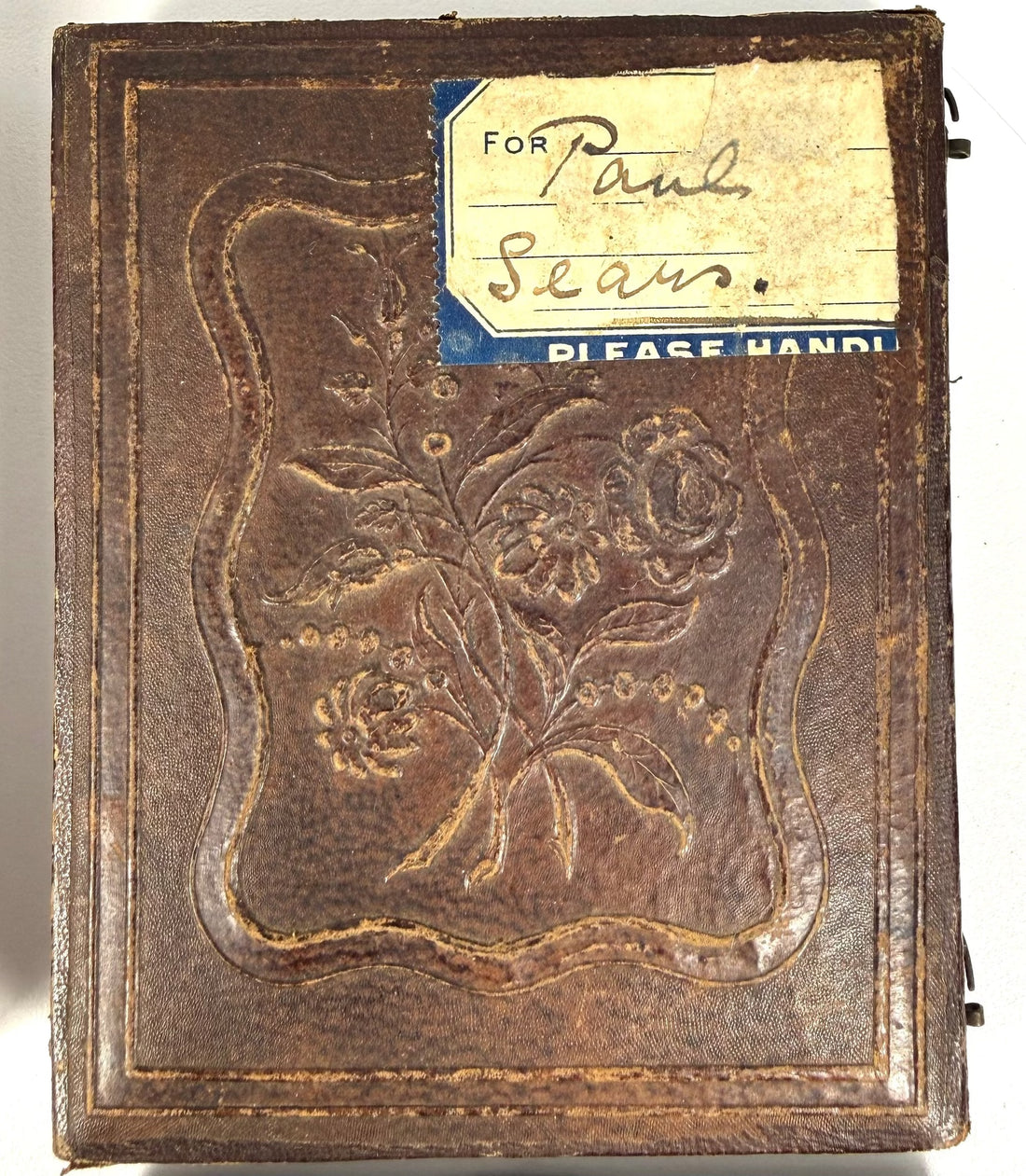
Each photograph is surrounded by a decorative gilt-metal mat and housed in an embossed case featuring floral, scrolling, or geometric designs. Several retain richly coloured reddish-pink textile interiors, while another features a dark interior lining.
Particularly noteworthy are the surviving handwritten identification materials accompanying the collection. One photographic case retains a label reading "Paul Sears," while another bears a handwritten label identifying "Henry Sears."
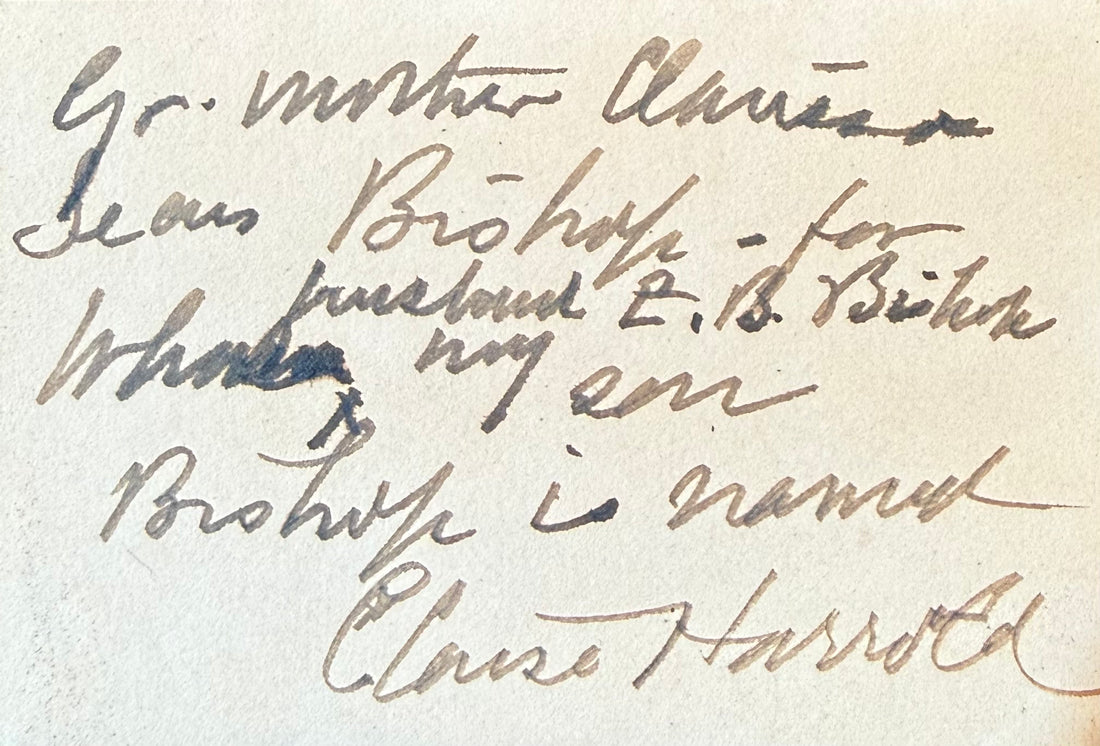
An additional handwritten family note provides an important historical connection to Clarissa Sears Bishop, her husband Ephraim Brown Bishop, and their descendants.
The note appears to identify Clarissa Sears Bishop as the writer's grandmother and refers to her husband, E. B. Bishop, explaining that the writer's son Bishop was named in his honour. The inscription concludes with what appears to be the name Clarise Harrold.
This information corresponds closely with documented historical records concerning Charlotte Clarise Sears Risley Harrold Ramsey (1867–1922), a descendant of Clarissa Sears Bishop, mother of Bishop Sears Harrold, and later owner of historic Westover Plantation in Charles City County, Virginia.
An additional handwritten card accompanying the photographs appears to contain the inscriptions "Mr. B. S. Harrold" and "Bon Voyage," providing a further possible association with the extended Harrold family. Its original purpose and relationship to the individual portraits remain undetermined.
Features
- Collection of four original mid-19th-century American photographic portraits, circa 1845–1865 CE
- Three male portraits and one female portrait in formal Victorian-era attire
- Four individual hinged protective photographic cases
- Decorative embossed exteriors featuring floral, scrolling, and geometric motifs
- Gilt-metal photographic mats with varied viewing openings
- Surviving reddish-pink and dark textile case interiors
- One photographic case retains a handwritten identification label reading "For Paul Sears"
- Another case bears a handwritten identification label reading "Henry Sears"
- Accompanied by a handwritten genealogical note identifying Clarissa Sears Bishop and Ephraim Brown Bishop
- Historical records identify Clarise Harrold as the mother of Bishop Sears Harrold
- Additional handwritten card associated with the Harrold family
- Historical association with the Sears family of New England and the American Midwest
- Extended family connections to historic Westover Plantation, Virginia
- Documented genealogical relationships supported by nineteenth-century correspondence
- Historical connections between the Sears, Prince, and Haley families
- Provenance from the estate of Joseph W. Haley, Pride's Crossing, Massachusetts
- Offered together as a collection of four historical photographic portraits with accompanying identification materials
Cultural Significance
The introduction of photography during the nineteenth century fundamentally transformed the preservation of personal identity and family history. Before practical photographic processes became available, painted and drawn portraits were often expensive commissions, generally limiting their accessibility to individuals with sufficient financial resources.
The introduction of the daguerreotype in 1839 revolutionized portraiture by allowing photographers to capture highly detailed likenesses directly from life. During the following decades, photographic studios became increasingly established throughout the United States, creating new opportunities for individuals and families to preserve personal portraits.
Daguerreotypes were particularly valued for their remarkable photographic detail and unique reflective appearance. The subsequent introduction of ambrotype photography during the 1850s provided a more affordable alternative, allowing detailed portraits to be produced using glass photographic plates.
Both processes were commonly housed within ornate protective cases featuring gilt-metal surrounds, decorative textile linings, and embossed exterior coverings. These cases served both practical and decorative purposes, protecting fragile photographic materials while transforming the images into treasured family keepsakes.
The accompanying handwritten identification materials give this collection additional historical significance. Unlike many surviving nineteenth-century photographic portraits whose subjects remain unidentified, these photographs retain documentary associations with individuals connected to the Sears family.
The preserved names and genealogical information offer insight into the ways American families documented relationships, preserved ancestral portraits, and passed personal historical records between generations.
Condition
The four photographs survive in varying antique condition, displaying age-related wear and photographic deterioration consistent with their considerable age.
The female portrait exhibits substantial deterioration, including extensive spotting, surface discolouration, and photographic losses, partially obscuring the sitter's facial features and clothing. The underlying figure remains discernible.
The two formal portraits of younger gentlemen retain comparatively good image clarity, with recognizable facial features, clothing, and studio compositions. Minor spotting, surface marks, photographic toning, and age-related imperfections are visible.
The fourth portrait, depicting a seated gentleman within an oval photographic opening, displays a highly reflective surface that causes the image to appear faint or partially obscured under certain lighting conditions. When viewed at an appropriate angle, the sitter's facial features, clothing, and surrounding studio arrangement remain visible.
The photographic cases display expected age-related wear, including rubbing, scratches, surface abrasions, minor losses to the exterior covering, edge deterioration, and areas of exposed underlying case construction.
The embossed floral and scrolling decorations remain substantially recognizable.
The reddish-pink textile interiors exhibit fading, surface marks, minor staining, and accumulated dust associated with prolonged storage. The dark-lined case displays comparable signs of age.
The gilt-metal photographic mats retain their decorative appearance, exhibiting minor discolouration, rubbing, and surface oxidation.
The handwritten identification labels remain present, displaying age-related discolouration, fading, and surface wear.
The accompanying handwritten family note remains legible in substantial part, although several words are difficult to distinguish with certainty.
Dimensions (Approximate)
Various sizes
Age (Approximate)
160–180 years old
Provenance
Formerly part of the estate of the late Joseph W. Haley of Pride's Crossing, Massachusetts, United States, whose extensive collection included American and European antiques, fine and decorative arts, historical documents, early books, and objects reflecting a lifelong interest in history, travel, and collecting.
The photographs formed part of a larger collection of nine historical photographs and daguerreotypes associated with members of the Sears family, including Henry Sears, Paul Sears, an individual described as Grandmother, and a woman catalogued as Clarret Sears Bishop.
Historical Family Identification and Handwritten Documentation
The collection retains important handwritten identification materials that provide additional historical context for the original Sears family association.
One photographic case bears a handwritten label reading "Paul Sears," while another retains an inscription reading "Henry Sears."
These names correspond with documented sons of Dr. Nathan Sears (1791–1848), a Massachusetts-born physician who subsequently practised medicine in Ohio, Michigan, and Illinois.
His children included Paul Sears, Clarissa Sears Bishop, and Nathan Henry Sears.
An original family letter dated January 8, 1850, preserved in The Ranney Letters: Family Correspondence During the Yankee Migration, independently identifies Paul Sears, Clarissa Sears Bishop, and Henry Sears as members of the same family.
Paul Sears was a physician practising in Mount Carmel, Illinois, while Clarissa was married to Ephraim Brown Bishop, a merchant associated with Arkansas. Henry Sears was attending school in Arkansas at the time of the correspondence.
The Clarise Harrold Family Note
A particularly significant item accompanying the photographs is a handwritten genealogical note identifying Clarissa Sears Bishop and her husband Ephraim Brown Bishop.
The inscription appears to describe Clarissa as the writer's grandmother and explains that the writer's son, Bishop, was named in honour of Ephraim Brown Bishop.
The note concludes with what appears to be the handwritten name Clarise Harrold.
This information corresponds with the documented family of Charlotte Clarise Sears Risley Harrold Ramsey (1867–1922).
Clarise was the daughter of Joseph Henry Risley and Mary Elizabeth Bishop, making her a granddaughter of Clarissa Sears Bishop and Ephraim Brown Bishop.
Clarise married Elam Worthington Harrold (1839–1897), with whom she had three children: John Sears Harrold (1887–1955), Bishop Sears Harrold (1888–1954), and Elisabeth Sears Harrold (1893–1965).
The existence of Bishop Sears Harrold, together with Clarise's documented ancestry, closely corroborates the family relationships described in the handwritten note.
Learn More
A mid-19th-century American cased family portrait dating to circa 1851 is preserved in the J. Paul Getty Museum's photographic collection.
Related nineteenth-century historical keepsakes and decorative objects are featured in our Victorian Artifacts & Historic Relics Collection.
Description
Historical Context & Origin
Region: United States, associated with New England and the American Midwest
Material: Early photographic images, gilt-metal mats, protective glass, embossed photographic cases, textile linings, and accompanying handwritten family identification materials
Period: Mid-19th Century, Victorian Era, circa 1845–1865 CE
Description
A historically significant collection of four original mid-19th-century American cased photographic portraits associated with the Sears family and preserved within the estate of the late Joseph W. Haley of Pride's Crossing, Massachusetts. Dating to circa 1845–1865 CE, this collection represents the earliest generations of American portrait photography and is accompanied by surviving handwritten family identification materials connecting the photographs to several documented nineteenth-century individuals.
The collection comprises four individually cased photographic portraits depicting three gentlemen and one woman, each housed within an ornate hinged protective case. The photographs display characteristics associated with early daguerreotype and ambrotype processes, although the individual photographic media have not been independently verified.
The first portrait depicts a seated Victorian woman wearing an elaborate light-coloured gown featuring a fitted bodice, decorative neckline, and voluminous sleeves. Although the photograph exhibits substantial age-related deterioration, the woman's silhouette, clothing, and formal studio presentation remain discernible.
The second portrait depicts a dark-haired gentleman wearing a formal black coat, white shirt, and dark necktie. His carefully arranged hairstyle and direct expression are characteristic of nineteenth-century professional portraiture. The image retains substantial clarity, particularly throughout the sitter's facial features and clothing.
The third portrait features a younger gentleman wearing a dark tailored suit, waistcoat, white shirt, and decorative bow tie. His neatly arranged hair, composed expression, and formal attire reflect the fashionable appearance of American gentlemen during the middle decades of the nineteenth century.
The fourth portrait depicts a seated gentleman wearing a dark formal coat and waistcoat, with one arm resting upon a piece of studio furniture. The image is presented within an oval photographic opening and displays a strongly reflective surface, causing the sitter's appearance to vary considerably depending upon the viewing angle.
Each photograph is surrounded by a decorative gilt-metal mat and housed in an embossed case featuring floral, scrolling, or geometric designs. Several retain richly coloured reddish-pink textile interiors, while another features a dark interior lining.
Particularly noteworthy are the surviving handwritten identification materials accompanying the collection. One photographic case retains a label reading "Paul Sears," while another bears a handwritten label identifying "Henry Sears."
An additional handwritten family note provides an important historical connection to Clarissa Sears Bishop, her husband Ephraim Brown Bishop, and their descendants.
The note appears to identify Clarissa Sears Bishop as the writer's grandmother and refers to her husband, E. B. Bishop, explaining that the writer's son Bishop was named in his honour. The inscription concludes with what appears to be the name Clarise Harrold.
This information corresponds closely with documented historical records concerning Charlotte Clarise Sears Risley Harrold Ramsey (1867–1922), a descendant of Clarissa Sears Bishop, mother of Bishop Sears Harrold, and later owner of historic Westover Plantation in Charles City County, Virginia.
An additional handwritten card accompanying the photographs appears to contain the inscriptions "Mr. B. S. Harrold" and "Bon Voyage," providing a further possible association with the extended Harrold family. Its original purpose and relationship to the individual portraits remain undetermined.
Features
- Collection of four original mid-19th-century American photographic portraits, circa 1845–1865 CE
- Three male portraits and one female portrait in formal Victorian-era attire
- Four individual hinged protective photographic cases
- Decorative embossed exteriors featuring floral, scrolling, and geometric motifs
- Gilt-metal photographic mats with varied viewing openings
- Surviving reddish-pink and dark textile case interiors
- One photographic case retains a handwritten identification label reading "For Paul Sears"
- Another case bears a handwritten identification label reading "Henry Sears"
- Accompanied by a handwritten genealogical note identifying Clarissa Sears Bishop and Ephraim Brown Bishop
- Historical records identify Clarise Harrold as the mother of Bishop Sears Harrold
- Additional handwritten card associated with the Harrold family
- Historical association with the Sears family of New England and the American Midwest
- Extended family connections to historic Westover Plantation, Virginia
- Documented genealogical relationships supported by nineteenth-century correspondence
- Historical connections between the Sears, Prince, and Haley families
- Provenance from the estate of Joseph W. Haley, Pride's Crossing, Massachusetts
- Offered together as a collection of four historical photographic portraits with accompanying identification materials
Cultural Significance
The introduction of photography during the nineteenth century fundamentally transformed the preservation of personal identity and family history. Before practical photographic processes became available, painted and drawn portraits were often expensive commissions, generally limiting their accessibility to individuals with sufficient financial resources.
The introduction of the daguerreotype in 1839 revolutionized portraiture by allowing photographers to capture highly detailed likenesses directly from life. During the following decades, photographic studios became increasingly established throughout the United States, creating new opportunities for individuals and families to preserve personal portraits.
Daguerreotypes were particularly valued for their remarkable photographic detail and unique reflective appearance. The subsequent introduction of ambrotype photography during the 1850s provided a more affordable alternative, allowing detailed portraits to be produced using glass photographic plates.
Both processes were commonly housed within ornate protective cases featuring gilt-metal surrounds, decorative textile linings, and embossed exterior coverings. These cases served both practical and decorative purposes, protecting fragile photographic materials while transforming the images into treasured family keepsakes.
The accompanying handwritten identification materials give this collection additional historical significance. Unlike many surviving nineteenth-century photographic portraits whose subjects remain unidentified, these photographs retain documentary associations with individuals connected to the Sears family.
The preserved names and genealogical information offer insight into the ways American families documented relationships, preserved ancestral portraits, and passed personal historical records between generations.
Condition
The four photographs survive in varying antique condition, displaying age-related wear and photographic deterioration consistent with their considerable age.
The female portrait exhibits substantial deterioration, including extensive spotting, surface discolouration, and photographic losses, partially obscuring the sitter's facial features and clothing. The underlying figure remains discernible.
The two formal portraits of younger gentlemen retain comparatively good image clarity, with recognizable facial features, clothing, and studio compositions. Minor spotting, surface marks, photographic toning, and age-related imperfections are visible.
The fourth portrait, depicting a seated gentleman within an oval photographic opening, displays a highly reflective surface that causes the image to appear faint or partially obscured under certain lighting conditions. When viewed at an appropriate angle, the sitter's facial features, clothing, and surrounding studio arrangement remain visible.
The photographic cases display expected age-related wear, including rubbing, scratches, surface abrasions, minor losses to the exterior covering, edge deterioration, and areas of exposed underlying case construction.
The embossed floral and scrolling decorations remain substantially recognizable.
The reddish-pink textile interiors exhibit fading, surface marks, minor staining, and accumulated dust associated with prolonged storage. The dark-lined case displays comparable signs of age.
The gilt-metal photographic mats retain their decorative appearance, exhibiting minor discolouration, rubbing, and surface oxidation.
The handwritten identification labels remain present, displaying age-related discolouration, fading, and surface wear.
The accompanying handwritten family note remains legible in substantial part, although several words are difficult to distinguish with certainty.
Dimensions (Approximate)
Various sizes
Age (Approximate)
160–180 years old
Provenance
Formerly part of the estate of the late Joseph W. Haley of Pride's Crossing, Massachusetts, United States, whose extensive collection included American and European antiques, fine and decorative arts, historical documents, early books, and objects reflecting a lifelong interest in history, travel, and collecting.
The photographs formed part of a larger collection of nine historical photographs and daguerreotypes associated with members of the Sears family, including Henry Sears, Paul Sears, an individual described as Grandmother, and a woman catalogued as Clarret Sears Bishop.
Historical Family Identification and Handwritten Documentation
The collection retains important handwritten identification materials that provide additional historical context for the original Sears family association.
One photographic case bears a handwritten label reading "Paul Sears," while another retains an inscription reading "Henry Sears."
These names correspond with documented sons of Dr. Nathan Sears (1791–1848), a Massachusetts-born physician who subsequently practised medicine in Ohio, Michigan, and Illinois.
His children included Paul Sears, Clarissa Sears Bishop, and Nathan Henry Sears.
An original family letter dated January 8, 1850, preserved in The Ranney Letters: Family Correspondence During the Yankee Migration, independently identifies Paul Sears, Clarissa Sears Bishop, and Henry Sears as members of the same family.
Paul Sears was a physician practising in Mount Carmel, Illinois, while Clarissa was married to Ephraim Brown Bishop, a merchant associated with Arkansas. Henry Sears was attending school in Arkansas at the time of the correspondence.
The Clarise Harrold Family Note
A particularly significant item accompanying the photographs is a handwritten genealogical note identifying Clarissa Sears Bishop and her husband Ephraim Brown Bishop.
The inscription appears to describe Clarissa as the writer's grandmother and explains that the writer's son, Bishop, was named in honour of Ephraim Brown Bishop.
The note concludes with what appears to be the handwritten name Clarise Harrold.
This information corresponds with the documented family of Charlotte Clarise Sears Risley Harrold Ramsey (1867–1922).
Clarise was the daughter of Joseph Henry Risley and Mary Elizabeth Bishop, making her a granddaughter of Clarissa Sears Bishop and Ephraim Brown Bishop.
Clarise married Elam Worthington Harrold (1839–1897), with whom she had three children: John Sears Harrold (1887–1955), Bishop Sears Harrold (1888–1954), and Elisabeth Sears Harrold (1893–1965).
The existence of Bishop Sears Harrold, together with Clarise's documented ancestry, closely corroborates the family relationships described in the handwritten note.
Learn More
A mid-19th-century American cased family portrait dating to circa 1851 is preserved in the J. Paul Getty Museum's photographic collection.
Related nineteenth-century historical keepsakes and decorative objects are featured in our Victorian Artifacts & Historic Relics Collection.
Vous aimerez peut-être aussi
