
Ancient Roman Bronze Finger Ring with Broad Engraved Bezel | Circa 2nd–4th Century CE
Couldn't load pickup availability







Ancient Roman Bronze Finger Ring with Broad Engraved Bezel | Circa 2nd–4th Century CE
Description
More
Less
Historical Context & Origin
Region: Roman World, Eastern Mediterranean or Europe
Material: Bronze (copper alloy)
Period: Roman Imperial style, circa 2nd–4th Century CE
Description
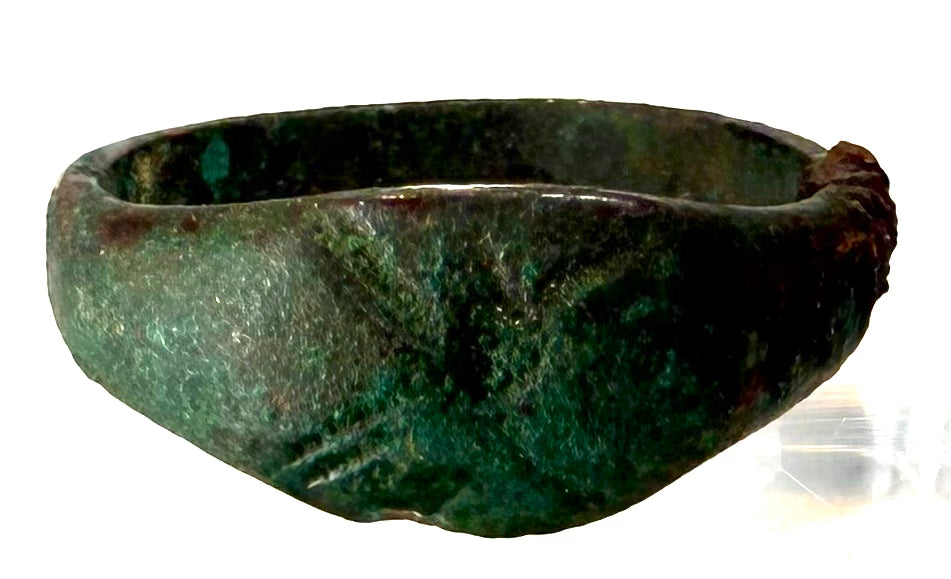
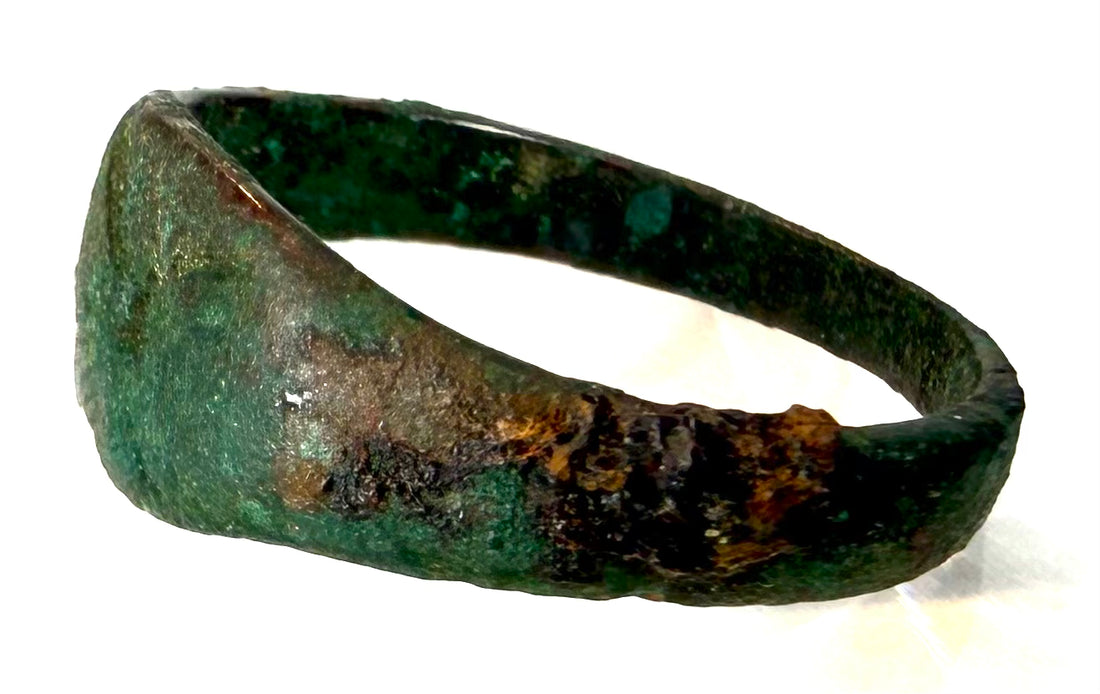
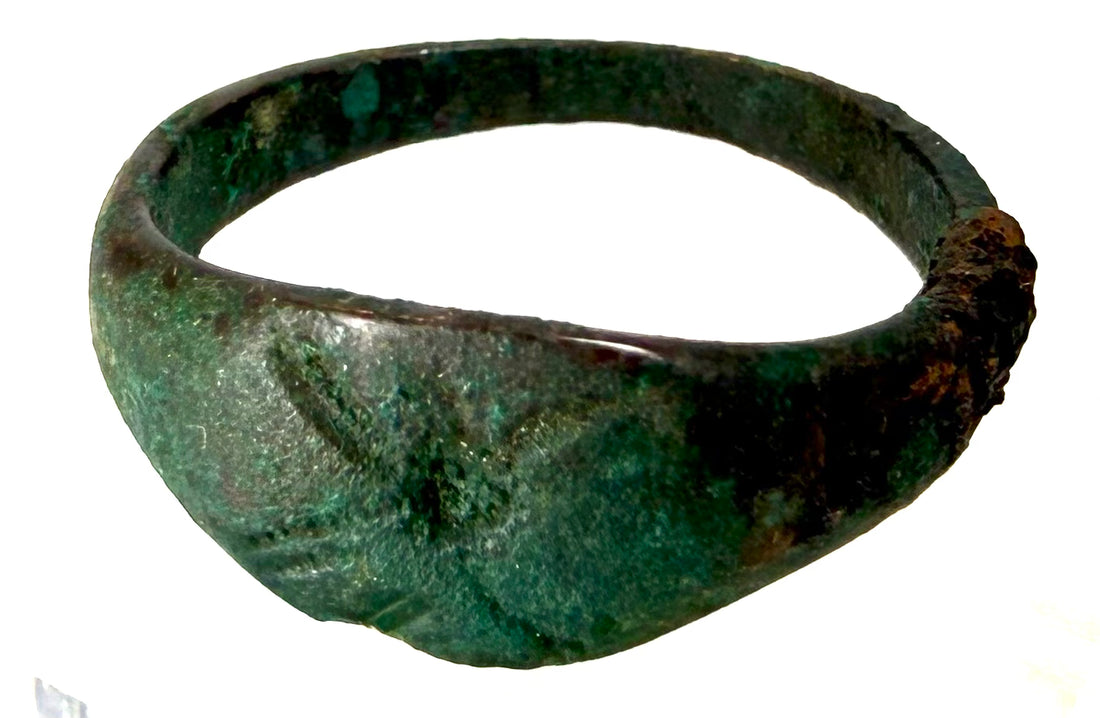
This distinctive ancient Roman-style bronze finger ring features a broad, integrated shield-like bezel, faint incised geometric decoration, and a richly weathered surface displaying striking green and earthy brown patination. Dating stylistically to the Roman Imperial Period, circa 2nd–4th century CE, the ring reflects the metalworking traditions and decorative forms associated with personal jewellery throughout the ancient Roman world.
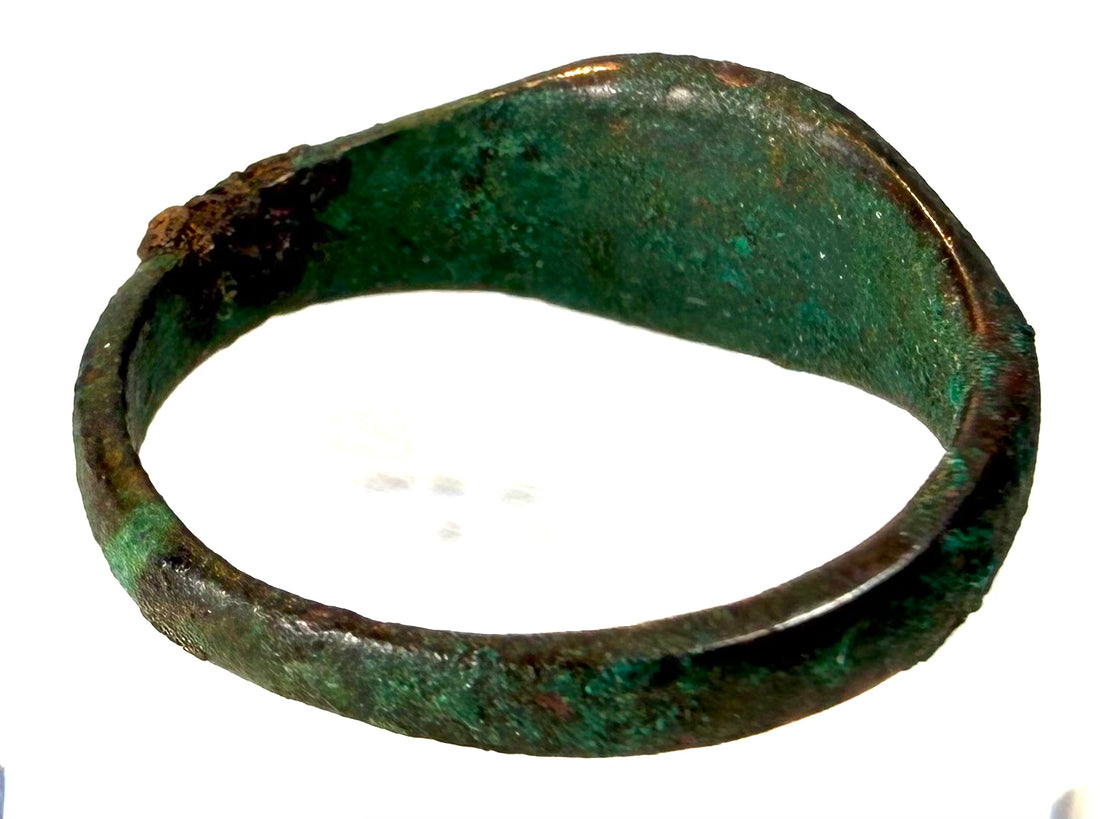
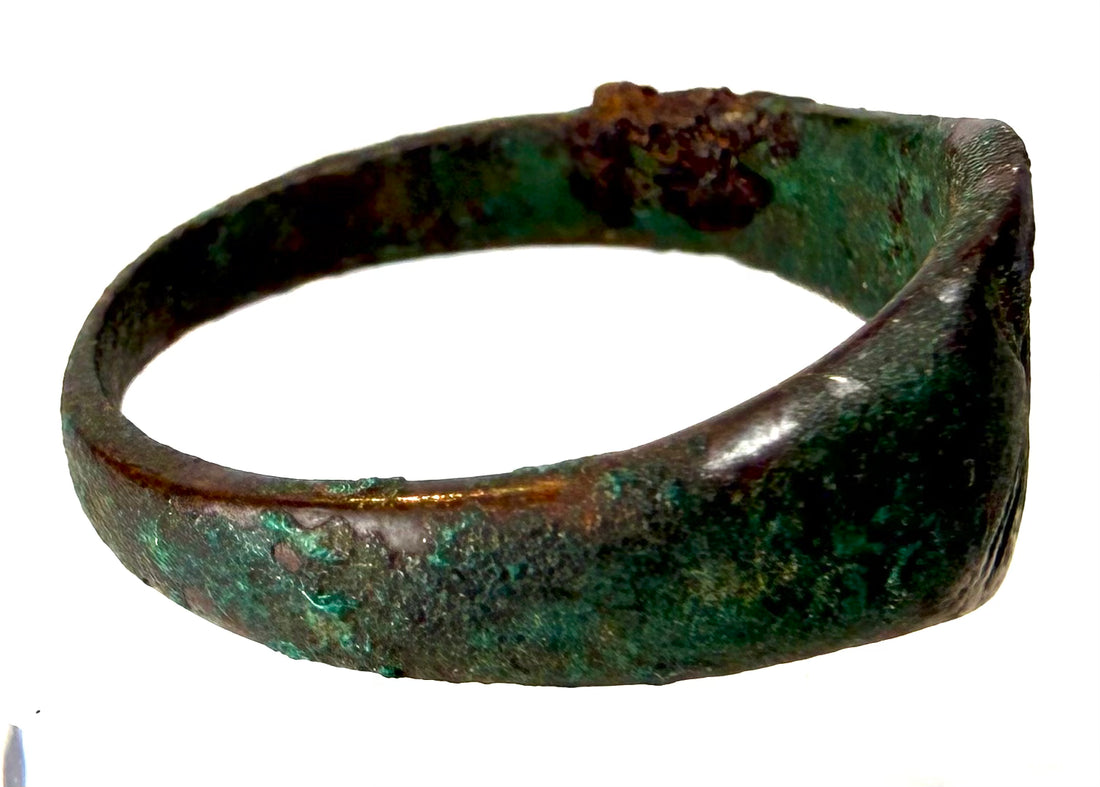
The ring is characterized by its substantial upper section, which gradually expands from the narrower band to form a broad, gently convex bezel integrated directly into the bronze structure. Unlike rings featuring separately mounted gemstones or raised settings, this example incorporates its decorative face into the body of the ring. Faint incised linear markings, including intersecting and angled grooves, remain partially visible across the bezel, suggesting a geometric or abstract ornamental composition. The broad shoulders gradually taper into a narrower, rounded hoop, creating a balanced and substantial profile.
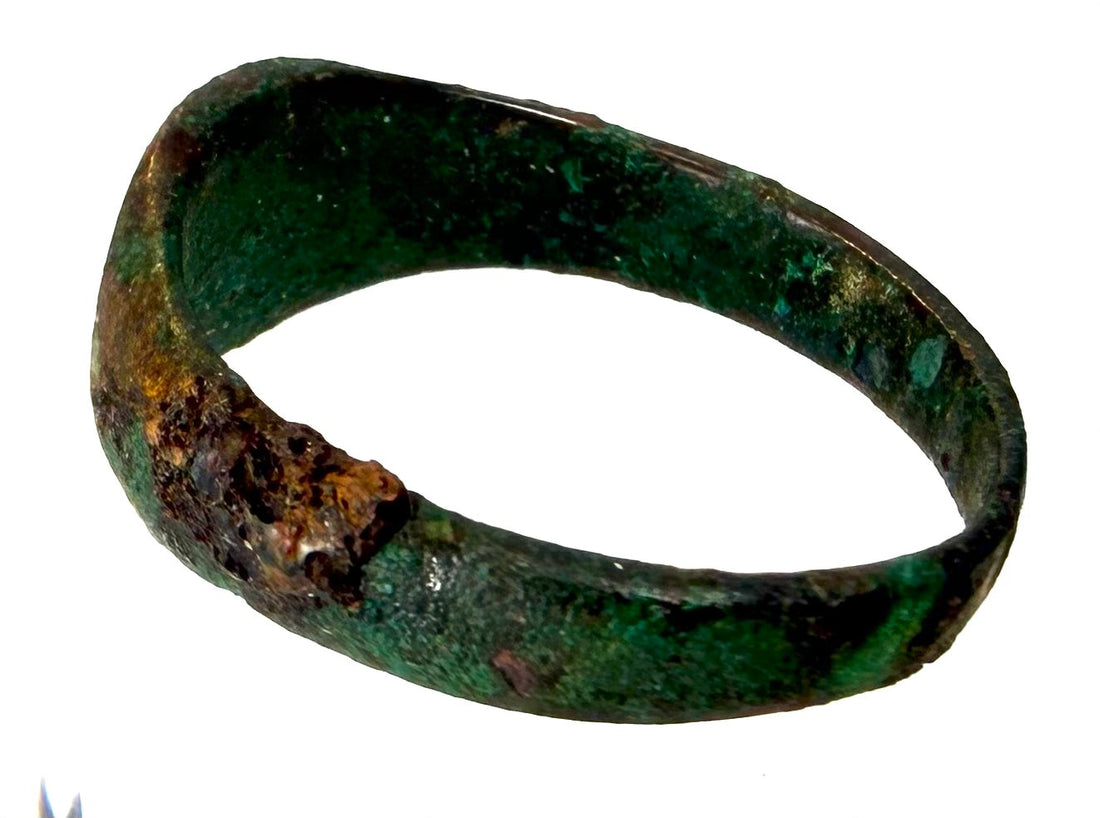
The bronze surface exhibits an extensive combination of deep emerald-green, turquoise, olive, and dark brown patination, with scattered mineral-like deposits and localized areas of reddish-brown oxidation. The engraved markings have been softened by considerable surface wear, while the surrounding bronze retains variations in texture and colour. Particularly noticeable is the concentrated reddish-brown surface buildup along one side of the band. The ring's integrated bezel, expanding shoulders, and restrained geometric decoration are comparable to forms encountered among Roman copper-alloy finger rings preserved in archaeological collections.
Features
- Broad, gently convex shield-like bezel formed directly into the bronze
- Faint incised geometric decoration with intersecting and angled linear markings
- Wide upper section transitioning into gradually tapering shoulders
- Continuous rounded bronze hoop with a comparatively smooth interior
- Rich emerald-green, turquoise, olive, and dark brown surface patination
- Localized reddish-brown oxidation, mineral-like deposits, and surface irregularities
Cultural Significance
Finger rings were an important form of personal adornment throughout the Roman Empire, reflecting individual identity, artistic preferences, and, in certain contexts, social standing. Roman jewellery was produced using a wide range of materials, including gold, silver, iron, bronze, and other copper alloys. While precious-metal rings were frequently associated with wealth and distinction, bronze examples provided a durable and relatively accessible form of personal ornamentation.
During the Roman Imperial Period, metalworkers developed numerous approaches to ring construction and decoration, including engraved gemstones, raised bezels, incised geometric patterns, and integrated metal settings. Broad bezels provided a prominent surface for decorative motifs without requiring separate gemstones or ornamental inserts. Such designs could incorporate personal symbols, abstract geometric compositions, inscriptions, and other decorative arrangements, reflecting the varied craftsmanship of Roman provincial jewellery.
Roman finger rings were worn for both practical and decorative purposes, with some functioning as personal seals and others serving primarily as ornaments. Geometric decoration was particularly versatile, allowing craftsmen to create distinctive designs through relatively simple engraving techniques. The present ring's broad integrated bezel, tapering shoulders, and surviving incised markings reflect the broader decorative traditions associated with Roman copper-alloy jewellery and ancient Mediterranean metalworking.
Condition
The ring retains its overall circular form, substantial integrated bezel, broad shoulders, and continuous bronze hoop. Extensive surface patination, oxidation, and age-related wear are visible throughout, producing a striking combination of deep green, turquoise, olive, dark brown, and blackish coloration. The broad bezel retains faint incised geometric markings, although much of the original decoration has been softened or partially obscured by surface deterioration and accumulated corrosion products. Scattered abrasions, fine scratches, localized pitting, and mineral-like deposits are present across the outer surfaces and adjoining shoulders. One side of the band exhibits a pronounced concentration of reddish-brown corrosion and irregular surface buildup, contrasting with the surrounding green patination. The hoop retains its overall shape with minor irregularities and localized surface wear. No obvious major structural breaks are visible in the supplied photographs.
Dimensions (Approximate)
Ring Size: US 8.25
Age (Approximate)
1,600–1,900 years old
Provenance
Formerly part of the Moneta Collection, a Tucson-based numismatic dealership specializing in collectible coins. Moneta is listed among professional dealers on the VCoins marketplace and participated in the 2017 U.S. Mexican Numismatic Association convention.
Subsequently handled by Palmyra Heritage Gallery, a third-generation family business specializing in ancient coins, antiquities, and historical artifacts, with a New York gallery operating since 1995. The gallery deals in Egyptian, Greek, Roman, Byzantine, Islamic, and Pre-Columbian material and is affiliated with the American Numismatic Society and Florida Numismatic Association.
Learn More
Explore a documented Late Roman copper-alloy finger ring dating to circa 300–402 CE, featuring an oval bezel with incised geometric decoration and traditional Roman metalworking characteristics, through the Portable Antiquities Scheme
Discover additional ancient Roman rings, historic jewellery, and decorative metalwork in our Ancient Rings & Jewelry Collection
Description
Historical Context & Origin
Region: Roman World, Eastern Mediterranean or Europe
Material: Bronze (copper alloy)
Period: Roman Imperial style, circa 2nd–4th Century CE
Description
This distinctive ancient Roman-style bronze finger ring features a broad, integrated shield-like bezel, faint incised geometric decoration, and a richly weathered surface displaying striking green and earthy brown patination. Dating stylistically to the Roman Imperial Period, circa 2nd–4th century CE, the ring reflects the metalworking traditions and decorative forms associated with personal jewellery throughout the ancient Roman world.
The ring is characterized by its substantial upper section, which gradually expands from the narrower band to form a broad, gently convex bezel integrated directly into the bronze structure. Unlike rings featuring separately mounted gemstones or raised settings, this example incorporates its decorative face into the body of the ring. Faint incised linear markings, including intersecting and angled grooves, remain partially visible across the bezel, suggesting a geometric or abstract ornamental composition. The broad shoulders gradually taper into a narrower, rounded hoop, creating a balanced and substantial profile.
The bronze surface exhibits an extensive combination of deep emerald-green, turquoise, olive, and dark brown patination, with scattered mineral-like deposits and localized areas of reddish-brown oxidation. The engraved markings have been softened by considerable surface wear, while the surrounding bronze retains variations in texture and colour. Particularly noticeable is the concentrated reddish-brown surface buildup along one side of the band. The ring's integrated bezel, expanding shoulders, and restrained geometric decoration are comparable to forms encountered among Roman copper-alloy finger rings preserved in archaeological collections.
Features
- Broad, gently convex shield-like bezel formed directly into the bronze
- Faint incised geometric decoration with intersecting and angled linear markings
- Wide upper section transitioning into gradually tapering shoulders
- Continuous rounded bronze hoop with a comparatively smooth interior
- Rich emerald-green, turquoise, olive, and dark brown surface patination
- Localized reddish-brown oxidation, mineral-like deposits, and surface irregularities
Cultural Significance
Finger rings were an important form of personal adornment throughout the Roman Empire, reflecting individual identity, artistic preferences, and, in certain contexts, social standing. Roman jewellery was produced using a wide range of materials, including gold, silver, iron, bronze, and other copper alloys. While precious-metal rings were frequently associated with wealth and distinction, bronze examples provided a durable and relatively accessible form of personal ornamentation.
During the Roman Imperial Period, metalworkers developed numerous approaches to ring construction and decoration, including engraved gemstones, raised bezels, incised geometric patterns, and integrated metal settings. Broad bezels provided a prominent surface for decorative motifs without requiring separate gemstones or ornamental inserts. Such designs could incorporate personal symbols, abstract geometric compositions, inscriptions, and other decorative arrangements, reflecting the varied craftsmanship of Roman provincial jewellery.
Roman finger rings were worn for both practical and decorative purposes, with some functioning as personal seals and others serving primarily as ornaments. Geometric decoration was particularly versatile, allowing craftsmen to create distinctive designs through relatively simple engraving techniques. The present ring's broad integrated bezel, tapering shoulders, and surviving incised markings reflect the broader decorative traditions associated with Roman copper-alloy jewellery and ancient Mediterranean metalworking.
Condition
The ring retains its overall circular form, substantial integrated bezel, broad shoulders, and continuous bronze hoop. Extensive surface patination, oxidation, and age-related wear are visible throughout, producing a striking combination of deep green, turquoise, olive, dark brown, and blackish coloration. The broad bezel retains faint incised geometric markings, although much of the original decoration has been softened or partially obscured by surface deterioration and accumulated corrosion products. Scattered abrasions, fine scratches, localized pitting, and mineral-like deposits are present across the outer surfaces and adjoining shoulders. One side of the band exhibits a pronounced concentration of reddish-brown corrosion and irregular surface buildup, contrasting with the surrounding green patination. The hoop retains its overall shape with minor irregularities and localized surface wear. No obvious major structural breaks are visible in the supplied photographs.
Dimensions (Approximate)
Ring Size: US 8.25
Age (Approximate)
1,600–1,900 years old
Provenance
Formerly part of the Moneta Collection, a Tucson-based numismatic dealership specializing in collectible coins. Moneta is listed among professional dealers on the VCoins marketplace and participated in the 2017 U.S. Mexican Numismatic Association convention.
Subsequently handled by Palmyra Heritage Gallery, a third-generation family business specializing in ancient coins, antiquities, and historical artifacts, with a New York gallery operating since 1995. The gallery deals in Egyptian, Greek, Roman, Byzantine, Islamic, and Pre-Columbian material and is affiliated with the American Numismatic Society and Florida Numismatic Association.
Learn More
Explore a documented Late Roman copper-alloy finger ring dating to circa 300–402 CE, featuring an oval bezel with incised geometric decoration and traditional Roman metalworking characteristics, through the Portable Antiquities Scheme
Discover additional ancient Roman rings, historic jewellery, and decorative metalwork in our Ancient Rings & Jewelry Collection
You May Also Like
