



Ancient Roman Polychrome Glass Bead Necklace | Restrung | Imperial Period | Circa 1st – 4th Century CE
Couldn't load pickup availability


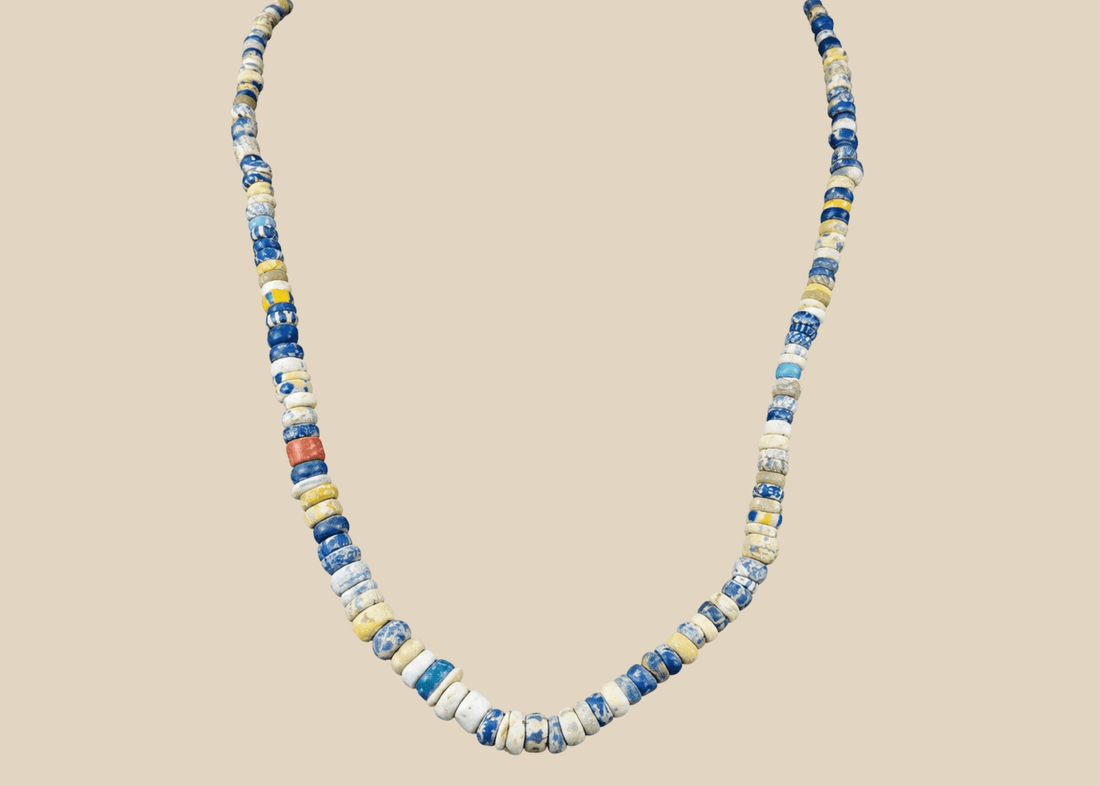


Ancient Roman Polychrome Glass Bead Necklace | Restrung | Imperial Period | Circa 1st – 4th Century CE
Description
More
Less
Historical Context & Origin
Region: Roman Empire / Eastern Mediterranean
Material: Polychrome glass beads with modern stringing material
Period: Roman Imperial Period, circa 1st–4th Century CE; subsequently restrung
Description
This delicate polychrome glass bead necklace is composed of a varied collection of small ancient beads consistent with types produced and circulated throughout the Roman Empire during the Imperial Period. The strand incorporates numerous annular, cylindrical, barrel-shaped, and irregularly formed beads in shades of cobalt blue, pale blue, turquoise, cream, white, yellow, amber, and muted red.
Several beads retain striped, trailed, or contrasting colour decoration, reflecting the wide range of glass-working techniques employed by Roman artisans. The assortment includes translucent, opaque, and semi-translucent examples, many displaying surface iridescence, mineral deposits, softened edges, and weathering associated with long-term burial or archaeological preservation.
Glass beads were traded widely throughout the Roman world and were worn as personal ornaments, sewn onto garments, exchanged as portable valuables, and occasionally deposited in funerary contexts. The individual beads were assembled into their present wearable arrangement in the modern period, allowing the ancient elements to be displayed while preserving their varied colours, textures, and forms.
Features
- Collection of ancient polychrome glass beads
- Mixed annular, cylindrical, barrel-shaped, and irregular forms
- Cobalt blue, turquoise, white, cream, yellow, amber, and red colouring
- Includes striped, trailed, and contrasting decorative beads
- Translucent, opaque, and semi-translucent glass
- Visible surface iridescence and mineral encrustation
- Individually handmade beads with natural variations
- Restrung in the modern period as a wearable necklace
- Representative of ancient Mediterranean glass production and trade
Cultural Significance
Glass bead production expanded considerably during the Roman Imperial Period as improved glassmaking technologies allowed ornaments to be manufactured in a broad range of colours and forms. Beads were worn by people throughout the empire and circulated through extensive commercial networks connecting the Mediterranean, Europe, North Africa, the Near East, and regions beyond Roman political control.
Because beads were durable, portable, and visually distinctive, they served as personal adornments as well as markers of taste, identity, status, and cultural exchange. Assemblages containing differently coloured and shaped beads provide tangible evidence of the diversity and interconnectedness of the ancient Roman world.
Condition
The beads display expected age-related wear, including surface weathering, mineral deposits, iridescence, abrasions, softened edges, minor chips, and scattered imperfections. Variations in size, shape, colour, and preservation are consistent with individually manufactured ancient glass beads.
The beads have been restrung in the modern period using modern stringing material.
Dimensions (Approximate)
Overall Length: 14 in
Age (Approximate)
1,625–2,025 years old
Provenance
Formerly part of a private Brooklyn, New York, USA collection of antiquities and archaeological objects, assembled over many years with a particular interest in ancient Mediterranean material culture.
Expert Assessment: Examined by Luca Salvaggio, an Italian archaeologist specializing in Greek, Roman, Near Eastern, and Cypriot material, with a Postgraduate Diploma from the Italian Archaeological School at Athens (IASA) and accreditation from the Italian Ministry of Culture (MiC). He identified the piece as a Roman and later polychrome glass bead necklace, dating to the 1st–4th century CE, composed of ancient glass beads of varying types, restrung in modern times. The assemblage features annular, cylindrical, barrel-shaped, and irregular beads in cobalt blue, turquoise, amber, yellow, and muted red, with examples displaying striped and trailed decoration. He further documented surface iridescence, mineral deposits, softened edges, and wear consistent with the beads' aged appearance.
Learn More
View a related Roman glass bead in the collection of The Metropolitan Museum of Art
Explore our curated Collection of Ancient Rings, Jewellery & Historic Relics
Description
Historical Context & Origin
Region: Roman Empire / Eastern Mediterranean
Material: Polychrome glass beads with modern stringing material
Period: Roman Imperial Period, circa 1st–4th Century CE; subsequently restrung
Description
This delicate polychrome glass bead necklace is composed of a varied collection of small ancient beads consistent with types produced and circulated throughout the Roman Empire during the Imperial Period. The strand incorporates numerous annular, cylindrical, barrel-shaped, and irregularly formed beads in shades of cobalt blue, pale blue, turquoise, cream, white, yellow, amber, and muted red.
Several beads retain striped, trailed, or contrasting colour decoration, reflecting the wide range of glass-working techniques employed by Roman artisans. The assortment includes translucent, opaque, and semi-translucent examples, many displaying surface iridescence, mineral deposits, softened edges, and weathering associated with long-term burial or archaeological preservation.
Glass beads were traded widely throughout the Roman world and were worn as personal ornaments, sewn onto garments, exchanged as portable valuables, and occasionally deposited in funerary contexts. The individual beads were assembled into their present wearable arrangement in the modern period, allowing the ancient elements to be displayed while preserving their varied colours, textures, and forms.
Features
- Collection of ancient polychrome glass beads
- Mixed annular, cylindrical, barrel-shaped, and irregular forms
- Cobalt blue, turquoise, white, cream, yellow, amber, and red colouring
- Includes striped, trailed, and contrasting decorative beads
- Translucent, opaque, and semi-translucent glass
- Visible surface iridescence and mineral encrustation
- Individually handmade beads with natural variations
- Restrung in the modern period as a wearable necklace
- Representative of ancient Mediterranean glass production and trade
Cultural Significance
Glass bead production expanded considerably during the Roman Imperial Period as improved glassmaking technologies allowed ornaments to be manufactured in a broad range of colours and forms. Beads were worn by people throughout the empire and circulated through extensive commercial networks connecting the Mediterranean, Europe, North Africa, the Near East, and regions beyond Roman political control.
Because beads were durable, portable, and visually distinctive, they served as personal adornments as well as markers of taste, identity, status, and cultural exchange. Assemblages containing differently coloured and shaped beads provide tangible evidence of the diversity and interconnectedness of the ancient Roman world.
Condition
The beads display expected age-related wear, including surface weathering, mineral deposits, iridescence, abrasions, softened edges, minor chips, and scattered imperfections. Variations in size, shape, colour, and preservation are consistent with individually manufactured ancient glass beads.
The beads have been restrung in the modern period using modern stringing material.
Dimensions (Approximate)
Overall Length: 14 in
Age (Approximate)
1,625–2,025 years old
Provenance
Formerly part of a private Brooklyn, New York, USA collection of antiquities and archaeological objects, assembled over many years with a particular interest in ancient Mediterranean material culture.
Expert Assessment: Examined by Luca Salvaggio, an Italian archaeologist specializing in Greek, Roman, Near Eastern, and Cypriot material, with a Postgraduate Diploma from the Italian Archaeological School at Athens (IASA) and accreditation from the Italian Ministry of Culture (MiC). He identified the piece as a Roman and later polychrome glass bead necklace, dating to the 1st–4th century CE, composed of ancient glass beads of varying types, restrung in modern times. The assemblage features annular, cylindrical, barrel-shaped, and irregular beads in cobalt blue, turquoise, amber, yellow, and muted red, with examples displaying striped and trailed decoration. He further documented surface iridescence, mineral deposits, softened edges, and wear consistent with the beads' aged appearance.
Learn More
View a related Roman glass bead in the collection of The Metropolitan Museum of Art
Explore our curated Collection of Ancient Rings, Jewellery & Historic Relics
You May Also Like
