




A small box worn against the chest could hold a folded prayer. A miniature ritual peg could carry the imagery of a protective deity. A weathered metal charm might be treasured for its association with thunder, even when its original maker was unknown. These objects help explain why a Tibetan amulet was often much more than an ornament.
Across Tibet and the wider Himalayan region, people have carried devotional objects in many forms: enclosed shrines, pendants, metal talismans, and miniature representations of ritual implements. Their purposes and meanings varied with religious tradition, personal practice, and the objects themselves. Some were connected with Tibetan Buddhism, while others reflected local protective customs and the long exchange of artistic traditions across the Himalayas.
For anyone studying Himalayan history, these objects offer clues about both craftsmanship and everyday religious life. A suspension loop, an enclosed chamber, a worn textile strap, or a carefully cast symbol can help explain how an amulet was made and carried.
Key Takeaways
- Tibetan amulets were traditionally carried for protection, devotion, and spiritual connection.
- Gau boxes served as portable shrines containing sacred images, prayers, and devotional objects.
- Tibetan gau boxes combined practical construction with intricate religious decoration.
- Bronze phurba amulets reflect the symbolism of Tibetan Buddhist ritual daggers.
- Thogchag sky iron talismans were traditionally valued for their protective significance.
- Silver amulet pendants combined decorative craftsmanship with religious symbolism.
- Buddhist symbols, including mantras and lotus motifs, carried spiritual meaning.
- Collectors should consider materials, condition, provenance, and cultural significance.
What Is a Tibetan Amulet?

The term Tibetan amulet describes a broad range of objects worn, carried, or kept nearby for religious and protective purposes. It does not refer to a single shape, material, or historical period.
Some examples were made to contain something important: a small written prayer, sacred image, or miniature votive figure. Others expressed meaning through their visible form. A protective mask, a ritual dagger motif, or a cast metal talisman could communicate ideas without requiring an enclosed chamber.
These distinctions matter because the Himalayan region contains many overlapping artistic and religious traditions. Not every amulet was made by the same community, and not every object described as Tibetan was necessarily used in an identical way. Its construction, imagery, and documented history provide a better starting point than its appearance alone.
The 19th-century Tibetan Gau with Shakyamuni Buddha Relief, for example, combines a portable container with the seated image of the Buddha and an attached leather strap.
The Bowers Museum's discussion of Tibetan gau shrines offers a useful introduction to the relationship between personal protection, portable containers, and the images or materials placed inside them.
Tibetan Amulets at a Glance
| Object Type | Traditional Association | Details to Notice |
|---|---|---|
| Gau box | Portable shrine or reliquary | Hollow chamber, opening panel, suspension loops |
| Phurba-form amulet | Symbolic protection and Vajrayana ritual imagery | Three-sided point, facial terminal, scale, attachment |
| Thogchag talisman | Protective metal charm associated with sky-iron traditions | Cast form, suspension, wear, metal composition |
| Silver or silver-tone pendant | Personal adornment, devotion, or reliquary use | Filigree, inlays, bales, hollow back, metal testing |
| Protective mask pendant | Guardian imagery in personal or ritual settings | Facial motifs, cast metal, textile attachments |
What Is a Tibetan Gau Box?

A gau box is a portable devotional container traditionally associated with Tibetan and Himalayan religious life. Often worn across the chest, it could function as a small shrine that travelled with its owner rather than remaining in a fixed place of worship.
The form varies considerably. Some gau boxes resemble small arched shrines with elaborate metal fronts. Others are rectangular or shaped as decorative pendants. They may be crafted from copper alloy, brass, silvered metal, silver, textiles, and other materials. Repoussé decoration, in which a design is raised from the metal surface, allowed makers to give these compact objects richly detailed fronts.
Relic & Rarity's Tibetan Silver Gau Amulet Box | Portable Shrine | 19th Century illustrates the tradition through a hinged compartment, raised floral ornament, and surviving suspension fittings. These features connect the object's decoration directly with its practical purpose as something that could be carried.
Gau boxes are particularly revealing because their significance was not limited to the visible surface. The contents, when they survive with reliable documentation, may provide a second layer of information about the owner's devotional practice.
What Was Kept Inside a Tibetan Gau Box?
A Tibetan gau box might contain a folded or rolled mantra, a small sacred image, a miniature votive sculpture, or a clay tsha-tsha tablet. In some traditions, boxes also held consecrated substances or other materials associated with a blessing or particular devotional purpose.
Some have a glazed window, allowing a small image or figure inside to remain visible. Others conceal their contents behind a metal panel. This difference affects how the object was encountered: one form displays a sacred image, while another carries it privately.
Documented museum examples include gau boxes containing small religious figures. These show why the arrangement inside the chamber can be as informative as the craftsmanship on the outside.
However, an empty chamber should not be taken as evidence that an antique box still contains its original contents. Devotional materials may have been removed, replaced, or lost during the object's history. A careful description should distinguish an object designed to hold sacred material from one whose original contents are actually preserved.
The Gau Box as a Travel Companion

Many Tibetan gau boxes were made to accompany their owners on journeys. Loops, cords, leather fittings, and textile cases were therefore more than secondary accessories: they were part of how the shrine was used.
A surviving Tibetan gau box with a red and green embroidered strap illustrates how fabric and metalwork could function together. Its arched metal front and raised inscription were part of a portable object, while the textile made it possible to carry the shrine close to the body.
Textile elements are especially important to examine because they are often more vulnerable than the metal container. Fading, fraying, stitching, and later repairs may reveal aspects of the piece's use and preservation. They also remind collectors that a complete gau is a combination of materials, not simply a decorative metal box.
The Bronze Phurba Amulet: A Ritual Form in Miniature

A phurba, also called a phurpa or ritual peg, is a three-sided implement associated with Tibetan Vajrayana Buddhist ceremonies. Though frequently described as a ritual dagger, its meaning is ceremonial rather than that of an ordinary fighting weapon.
The phurba is associated particularly with Vajrakilaya and practices concerning the transformation or overcoming of obstacles and harmful influences. Full-sized ritual examples may have elaborate deity faces, symbolic handles, and distinctive three-sided points. A small pendant can refer to these features without having the same ceremonial function.
A bronze phurba amulet translates that recognizable form into something much smaller. Miniature cast examples may include a suspension loop so that they can be worn or carried. Their design borrows the visual language of the ritual peg, but their size and fittings point to a different everyday use.
The Tibetan Phurba-Form Protective Amulet with Wrathful Deity, attributed to the early 20th century, combines a patterned Dzi-style bead, copper-alloy fittings, a cast face, and a tapered three-sided point. Its suspension loop is a practical detail: it indicates how the small object could be carried rather than used as a full-sized ritual implement.
Thogchag Sky Iron: Metal Talismans and Himalayan Belief
Among the more intriguing forms of Tibetan protective objects are thogchag sky iron talismans, also written thokcha or togcha. These small metal objects have traditionally been treasured in connection with beliefs about thunder, lightning, and things that have fallen from the sky.
Some were discovered in fields or highland landscapes and later worn or kept as amulets. Their forms can vary widely, and an object's protective significance may have developed long after its original manufacture. In this sense, a thogchag can have more than one history: the history of the metal object itself, and the history of its later use as a cherished talisman.
The Asian Art Museum's account of Tibetan togchas explains the association with sky and thunder, as well as the importance of handling and personal use.
There is an important distinction between tradition and material identification. The phrase sky iron does not establish that every thogchag was made from a meteorite. Examples may be described as bronze or other metal alloys, and some may have originated in different regions before being valued as Tibetan protective objects. Metal composition and dating require evidence beyond the name or surface patina.
Silver Amulet Pendants: Jewelry, Reliquaries and Decoration

The silver amulet pendant occupies an interesting place between personal jewelry and devotional art. An ornament could be visually elaborate while also incorporating a hollow reliquary space, religious symbolism, or a form designed to be worn close to the body.
Within Tibetan and Nepalese metalworking traditions, makers combined wirework, filigree, raised ornament, and contrasting inlays to create distinctive pieces. Coral and turquoise-coloured elements were especially striking alongside silver-coloured metal, but visual appearance alone cannot establish the exact composition of a stone or alloy.
A useful example is Relic & Rarity's Tibetan-Nepalese Ghau Pendant with Parcel-Gilt Filigree. Its hexagonal form includes tubular suspension fittings, small coral accents, a green cabochon, and a hollow reliquary cavity. The original rear panel is no longer present, an important condition detail when considering how the object once functioned.
This piece is described as silver-tone alloy, with metal content untested. That distinction is worth preserving. A silver-coloured amulet might be solid silver, silvered copper alloy, or another composition, and accurate descriptions should reflect what has actually been established.

Another gau-style pendant illustrates a more elaborate use of silvered copper, brightly coloured settings, and suspended drops. Its form resembles both a small shrine and a decorative chest ornament, showing how portable devotion and the history of jewelry can overlap.
Sacred Symbols and Protective Imagery in Tibetan Buddhist Items
Tibetan amulets often communicate meaning through motifs that are immediately recognizable to people familiar with Himalayan religious art. However, the same general symbol may appear in different settings, so interpretation is strongest when it follows the details of the actual object.
Mantras can appear on small metal charms or the written prayers kept within a gau. The well-known Om Mani Padme Hum is associated with Avalokiteshvara, the bodhisattva of compassion. A mantra's presence can make an object devotional even when the decoration is otherwise restrained.
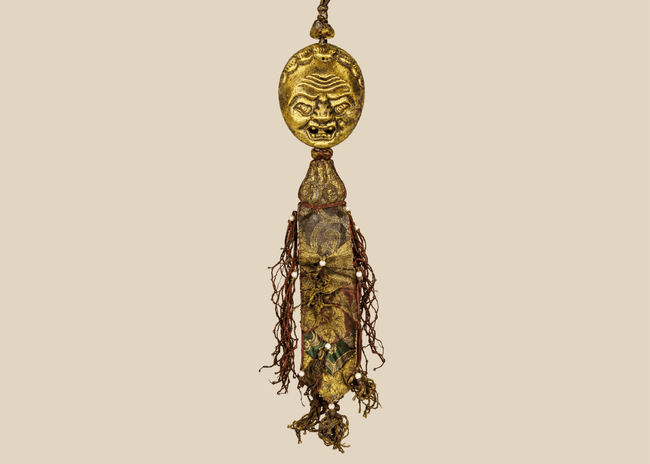
Protective faces and wrathful imagery may appear on cast ornaments or ritual-inspired pendants. Such figures are not simply intended to look frightening; in the appropriate religious context, they can express the overcoming of obstacles or the protection of Buddhist teachings. A gilt-bronze mask pendant with brocade tassels, for example, shows how imagery and textile fittings could become part of a single personal object.
Lotus motifs and auspicious symbols can also decorate portable shrines. The lotus is widely associated with purity in Buddhist art, while the endless knot and other auspicious emblems can form part of a larger symbolic arrangement. The design must still be examined carefully before identifying a specific deity, mantra, or ritual purpose.
As a group, these Buddhist items reveal how religious imagery could move between larger shrines and objects small enough to carry. The meaning of a symbol was not determined by size alone.
How Should Collectors Evaluate a Tibetan Amulet?
Antique amulets are often compact, but they can be complex to research. Similar forms have been made and remade over long periods, and older components may appear alongside later straps, repairs, or replacement settings. Collectors benefit from looking beyond whether a piece simply appears old.
- Identify the object type: Is it a gau box, a solid pendant, a ritual implement, or a miniature amulet inspired by another form?
- Examine the construction: Look for hinges, soldered seams, suspension loops, hollow chambers, cast details, or hand-worked decoration.
- Consider the material: Distinguish confirmed silver from silver-tone alloys, bronze from other copper alloys, and identified stones from visually similar substitutes.
- Study the imagery: Compare mantras, faces, floral decoration, and religious symbols with documented museum examples.
- Assess wear and condition: Check for fragile textiles, missing panels, loose inlays, corrosion, breaks, and earlier repairs.
- Review provenance: Ownership records, collection history, and supporting documentation can provide evidence that appearance alone cannot.
- Be precise about attribution: A broad Himalayan attribution may be more responsible than assigning an exact workshop, century, or ritual function without evidence.
Patina and surface wear can be informative, but neither is sufficient to authenticate an object independently. Documented ownership history and comparisons with museum collections can help distinguish supported identifications from attractive but unverified assumptions.
Can an Antique Tibetan Amulet Still Be Worn?
Some Tibetan amulets were originally made for everyday wear, yet a historic object's condition may no longer make that advisable. Fine filigree, worn cords, cracked stone settings, original paper contents, and fragile textile cases can all be vulnerable to repeated movement and handling.
For many collectors, stable display and careful preservation are the better choice. Avoid aggressive polishing, forcing an old gau box open, or replacing historic fittings simply to make a piece wearable. If sacred contents or unusually fragile materials survive, specialist conservation advice may be appropriate.
Respecting an amulet's original devotional context is also part of preserving its history. Its cultural significance does not disappear when it enters a collection, and accurate research can make that significance easier to understand.
What Tibetan Amulets Reveal About Himalayan History
A Tibetan amulet brings together several histories in one small object: the maker's craft, the religious or protective ideas attached to its form, and the experience of the person who carried it.
A gau box could bring a sacred image into daily life. A miniature phurba could borrow the form of a ceremonial instrument. A thogchag could be treasured through beliefs about thunder and sky iron. A silver-coloured pendant could unite elaborate metalwork with a hidden reliquary space. None of these forms needs to be reduced to decoration alone.
To compare examples, readers can browse Relic & Rarity's Tibetan artifacts and amulets and its Buddhist & Hindu Relics collection. Beyond their decorative appeal, these objects offer a closer look at how art, belief, and personal possessions have intersected across the Himalayan world.


