
Ancient Roman Bronze Coin Collection | Mixed Imperial Issues | Circa 3rd–4th Century CE
Couldn't load pickup availability


Ancient Roman Bronze Coin Collection | Mixed Imperial Issues | Circa 3rd–4th Century CE
Description
More
Less
Historical Context & Origin
Region: Roman Empire, various imperial mints
Material: Bronze and copper alloy
Period: Predominantly Late Roman Imperial, circa 3rd–4th Century CE
This collection comprises ten ancient bronze coins representing the everyday currency of the later Roman Empire, a period marked by profound political, military, religious, and economic transformation.
During the late 3rd and 4th centuries CE, emperors including Diocletian, Constantine the Great, and the succeeding Constantinian dynasty undertook major reforms to Roman government and coinage. Bronze denominations such as the nummus, commonly referred to by collectors as the follis for some earlier issues, circulated throughout the empire and carried imperial portraits alongside carefully selected images of military strength, divine protection, civic architecture, victory, and imperial authority.
Description
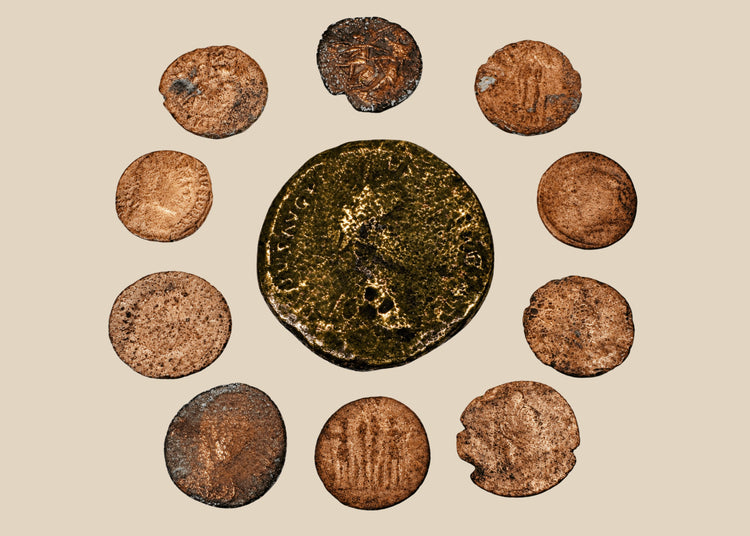
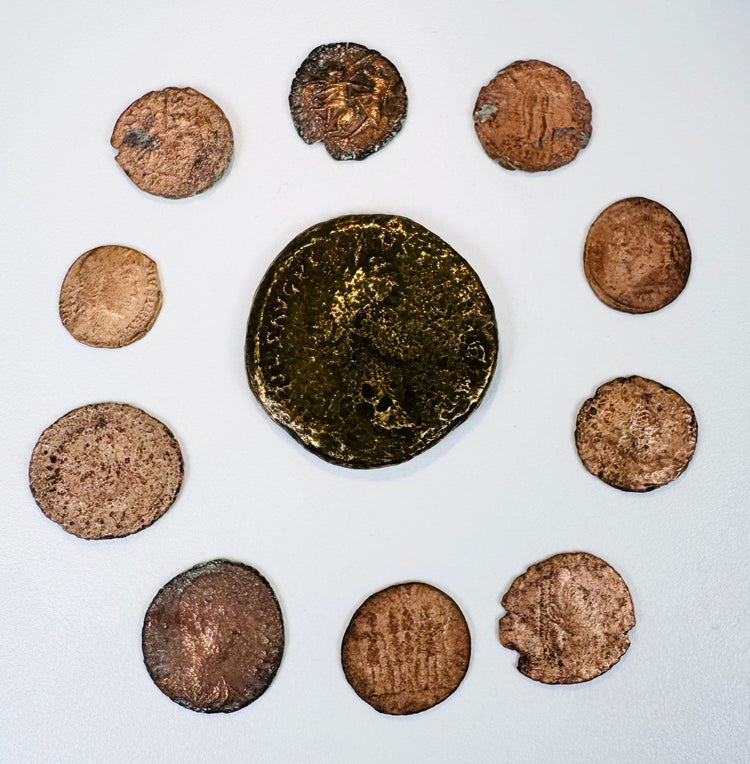
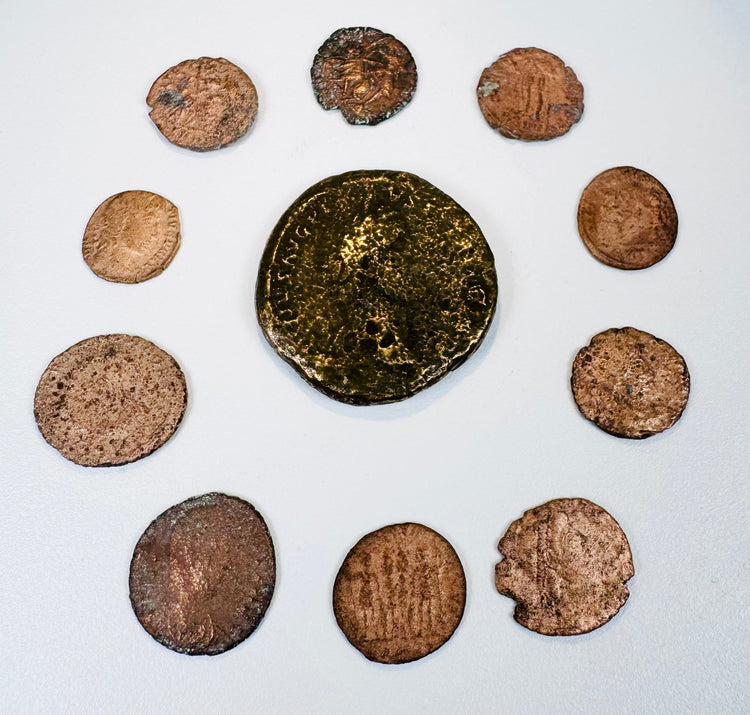
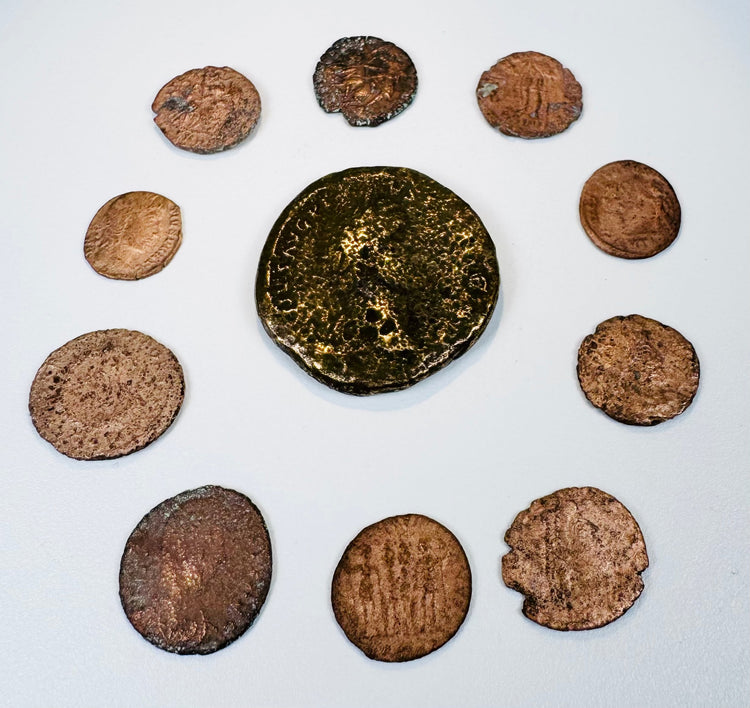
An evocative group of ten ancient Roman bronze and copper-alloy coins, assembled as a collection and displaying a broad variety of surviving imperial imagery.
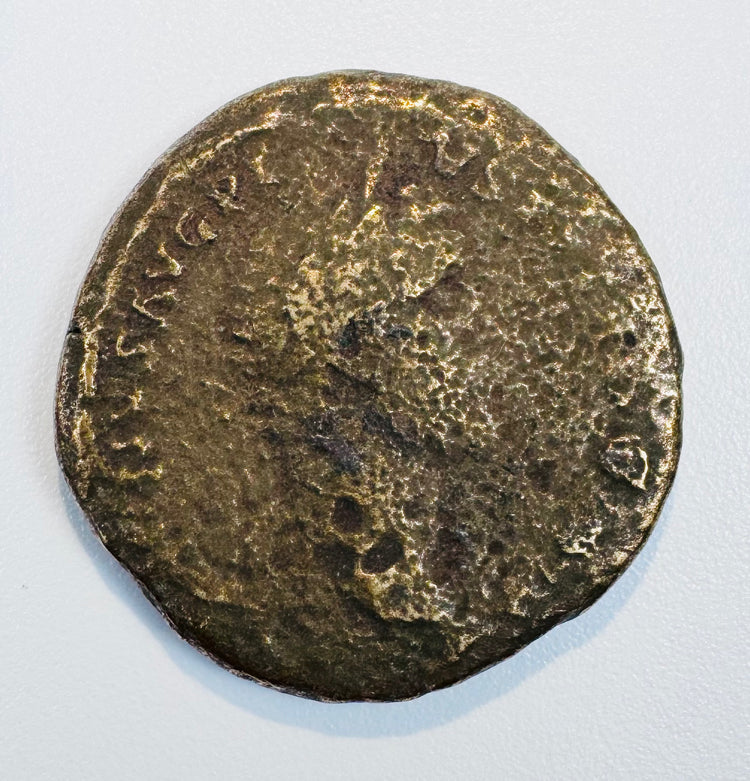
The group is dominated by a substantially larger bronze coin bearing the worn profile portrait of a Roman emperor surrounded by traces of a Latin inscription. Its broad flan and substantial construction are characteristic of the larger bronze denominations employed during the Roman Imperial period.
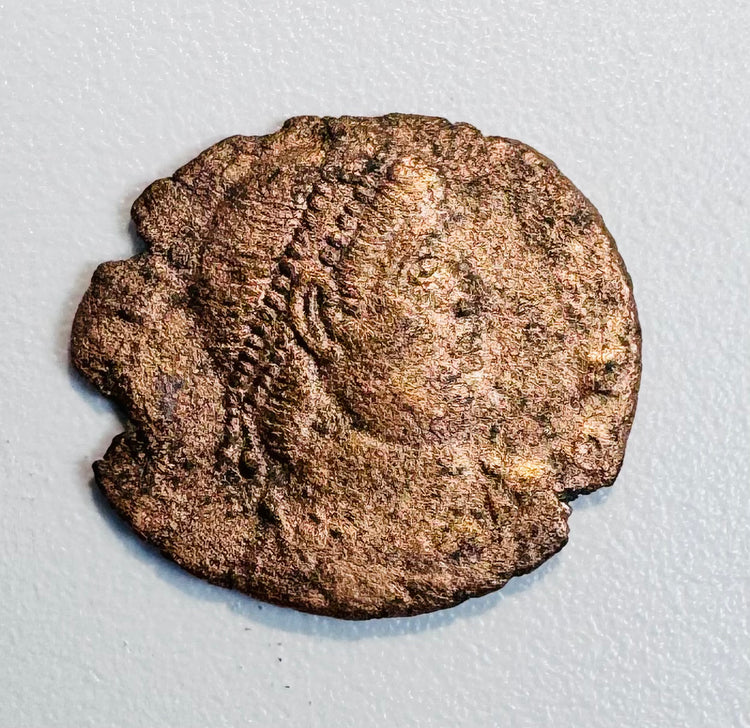
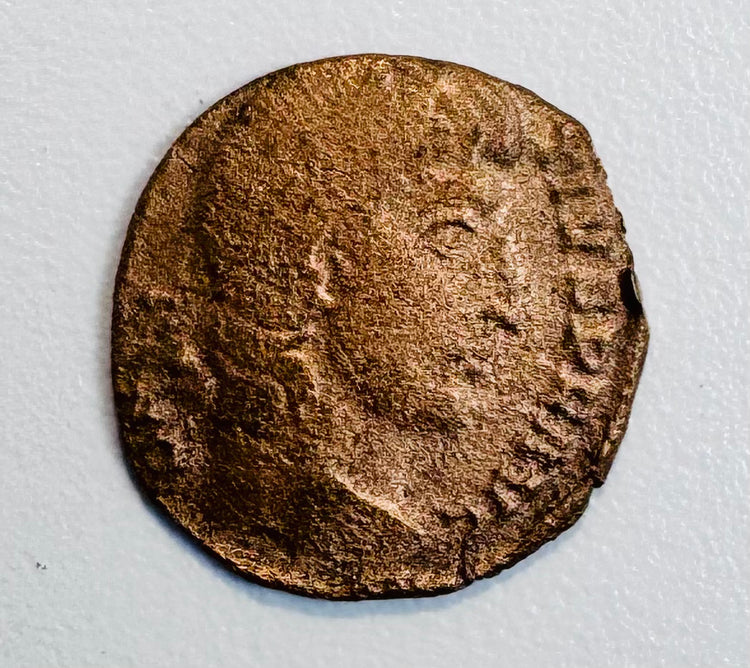
Surrounding the central example are nine smaller coins in varying states of preservation. Several retain identifiable elements despite extensive circulation and burial wear, including imperial portrait busts, standing figures, architectural forms, military imagery, remnants of inscriptions, and geometric or symbolic reverse designs.
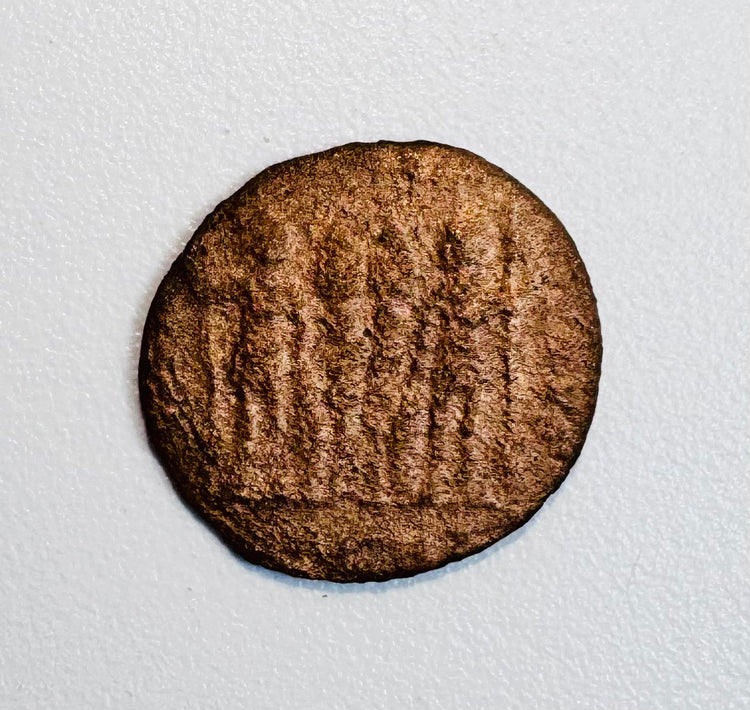
One of the more legible architectural reverses appears consistent with the camp-gate coinage popular during the Constantinian era, where stylized fortified gateways with towers were used as symbols of security and imperial strength. Comparable camp-gate bronze nummi of Constantius II are known from approximately 324–325 CE.
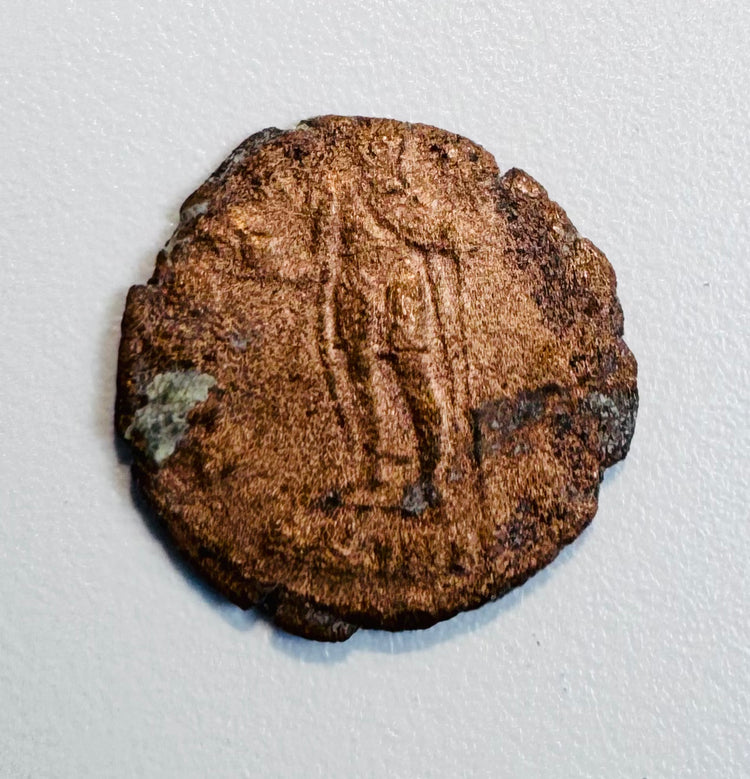
Another coin displays a composition suggestive of standing military figures or standards. Similar Constantinian bronze issues depict two soldiers facing one another with spears and shields and military standards positioned between them, a design widely circulated around 330 CE.
Other pieces preserve partial busts and standing figures characteristic of Late Roman bronze currency, when imperial portraiture remained an essential means of projecting the emperor's image across an empire extending from Britain and Western Europe through the Mediterranean, North Africa, and the Near East.
Because many legends and design elements are incomplete, the coins are being offered as a mixed Roman Imperial group rather than individually attributed specimens. Further identification of individual rulers, mints, and denominations may be possible through specialist numismatic study of both faces of each coin.
Features
- Group of ten ancient bronze and copper-alloy coins
- Predominantly Roman Imperial in attribution
- Likely dating principally from the 3rd–4th centuries CE
- Large central imperial bronze coin with portrait bust
- Multiple smaller Late Roman bronze denominations
- Surviving Latin inscription fragments
- Imperial portrait imagery
- Architectural and possible camp-gate reverse design
- Military and standing-figure imagery
- Variety of different flan sizes and forms
- Naturally developed brown, reddish, dark bronze, and green patination
Cultural Significance
Roman coinage was considerably more than a means of commercial exchange. Coins represented one of the most effective forms of mass communication available to the Roman state.
An imperial portrait immediately identified the issuing authority, while reverse designs communicated messages of military victory, security, prosperity, religious devotion, dynastic continuity, and the emperor's relationship with the army and population.
This became especially significant during the 3rd and 4th centuries, when political authority frequently shifted and successive emperors required recognizable currency to circulate throughout the provinces. Constantine and his family produced an enormous variety of bronze issues, including representations of fortifications, soldiers, military standards, emperors, personifications, and religious imagery. Surviving museum examples demonstrate bronze Constantinian coinage ranging from approximately 15–18 mm minor denominations to considerably larger earlier nummi.
As a group, these coins provide a tangible cross-section of the monetary system encountered by soldiers, merchants, artisans, farmers, and ordinary inhabitants of the later Roman world.
Condition
Ancient excavated condition with considerable variation between individual coins.
The collection displays extensive circulation wear, surface oxidation, mineral deposits, encrustation, patination, pitting, areas of corrosion, edge losses, irregular flans, softened details, and partially or substantially illegible inscriptions. Several examples nevertheless retain identifiable portraits, figures, architectural elements, and other design details.
Colors range from reddish and brown copper tones to darker bronze and areas of green mineral patination.
Dimensions (Approximate)
Various sizes.
The collection includes one substantially larger central bronze coin together with nine smaller denominations. Individual diameters and weights can be recorded separately if required.
Age (Approximate)
1,600–1,800 years old
Provenance
Private collection, Massachusetts, USA.
Previously part of the inventory of Spartan Numismatics, Furlong, Pennsylvania, a specialist numismatic firm focused on ancient and historic coinage. Spartan Numismatics is directed by Nicholas Economopoulos, a numismatist with more than 45 years of experience and advanced academic training in Classics and Classical Archaeology, with particular expertise in ancient and Byzantine coinage.
Subsequently handled by Blackstone Valley Auctions and Estates LLC, Sutton, Massachusetts, an established auction and estate firm specializing in antiques, fine and decorative art, coins, collectibles, militaria, and historically significant material.
Learn More
Compare a related bronze follis of Constantine I, dated circa 311–312 CE, in the collection of the Smithsonian National Museum of American History
Browse our Collection of Roman & Greek Artifacts
Description
Historical Context & Origin
Region: Roman Empire, various imperial mints
Material: Bronze and copper alloy
Period: Predominantly Late Roman Imperial, circa 3rd–4th Century CE
This collection comprises ten ancient bronze coins representing the everyday currency of the later Roman Empire, a period marked by profound political, military, religious, and economic transformation.
During the late 3rd and 4th centuries CE, emperors including Diocletian, Constantine the Great, and the succeeding Constantinian dynasty undertook major reforms to Roman government and coinage. Bronze denominations such as the nummus, commonly referred to by collectors as the follis for some earlier issues, circulated throughout the empire and carried imperial portraits alongside carefully selected images of military strength, divine protection, civic architecture, victory, and imperial authority.
Description
An evocative group of ten ancient Roman bronze and copper-alloy coins, assembled as a collection and displaying a broad variety of surviving imperial imagery.
The group is dominated by a substantially larger bronze coin bearing the worn profile portrait of a Roman emperor surrounded by traces of a Latin inscription. Its broad flan and substantial construction are characteristic of the larger bronze denominations employed during the Roman Imperial period.
Surrounding the central example are nine smaller coins in varying states of preservation. Several retain identifiable elements despite extensive circulation and burial wear, including imperial portrait busts, standing figures, architectural forms, military imagery, remnants of inscriptions, and geometric or symbolic reverse designs.
One of the more legible architectural reverses appears consistent with the camp-gate coinage popular during the Constantinian era, where stylized fortified gateways with towers were used as symbols of security and imperial strength. Comparable camp-gate bronze nummi of Constantius II are known from approximately 324–325 CE.
Another coin displays a composition suggestive of standing military figures or standards. Similar Constantinian bronze issues depict two soldiers facing one another with spears and shields and military standards positioned between them, a design widely circulated around 330 CE.
Other pieces preserve partial busts and standing figures characteristic of Late Roman bronze currency, when imperial portraiture remained an essential means of projecting the emperor's image across an empire extending from Britain and Western Europe through the Mediterranean, North Africa, and the Near East.
Because many legends and design elements are incomplete, the coins are being offered as a mixed Roman Imperial group rather than individually attributed specimens. Further identification of individual rulers, mints, and denominations may be possible through specialist numismatic study of both faces of each coin.
Features
- Group of ten ancient bronze and copper-alloy coins
- Predominantly Roman Imperial in attribution
- Likely dating principally from the 3rd–4th centuries CE
- Large central imperial bronze coin with portrait bust
- Multiple smaller Late Roman bronze denominations
- Surviving Latin inscription fragments
- Imperial portrait imagery
- Architectural and possible camp-gate reverse design
- Military and standing-figure imagery
- Variety of different flan sizes and forms
- Naturally developed brown, reddish, dark bronze, and green patination
Cultural Significance
Roman coinage was considerably more than a means of commercial exchange. Coins represented one of the most effective forms of mass communication available to the Roman state.
An imperial portrait immediately identified the issuing authority, while reverse designs communicated messages of military victory, security, prosperity, religious devotion, dynastic continuity, and the emperor's relationship with the army and population.
This became especially significant during the 3rd and 4th centuries, when political authority frequently shifted and successive emperors required recognizable currency to circulate throughout the provinces. Constantine and his family produced an enormous variety of bronze issues, including representations of fortifications, soldiers, military standards, emperors, personifications, and religious imagery. Surviving museum examples demonstrate bronze Constantinian coinage ranging from approximately 15–18 mm minor denominations to considerably larger earlier nummi.
As a group, these coins provide a tangible cross-section of the monetary system encountered by soldiers, merchants, artisans, farmers, and ordinary inhabitants of the later Roman world.
Condition
Ancient excavated condition with considerable variation between individual coins.
The collection displays extensive circulation wear, surface oxidation, mineral deposits, encrustation, patination, pitting, areas of corrosion, edge losses, irregular flans, softened details, and partially or substantially illegible inscriptions. Several examples nevertheless retain identifiable portraits, figures, architectural elements, and other design details.
Colors range from reddish and brown copper tones to darker bronze and areas of green mineral patination.
Dimensions (Approximate)
Various sizes.
The collection includes one substantially larger central bronze coin together with nine smaller denominations. Individual diameters and weights can be recorded separately if required.
Age (Approximate)
1,600–1,800 years old
Provenance
Private collection, Massachusetts, USA.
Previously part of the inventory of Spartan Numismatics, Furlong, Pennsylvania, a specialist numismatic firm focused on ancient and historic coinage. Spartan Numismatics is directed by Nicholas Economopoulos, a numismatist with more than 45 years of experience and advanced academic training in Classics and Classical Archaeology, with particular expertise in ancient and Byzantine coinage.
Subsequently handled by Blackstone Valley Auctions and Estates LLC, Sutton, Massachusetts, an established auction and estate firm specializing in antiques, fine and decorative art, coins, collectibles, militaria, and historically significant material.
Learn More
Compare a related bronze follis of Constantine I, dated circa 311–312 CE, in the collection of the Smithsonian National Museum of American History
Browse our Collection of Roman & Greek Artifacts
You May Also Like
