


African Carved Wooden Ceremonial Shield with Geometric Decoration | Circa Early to Mid-20th Century
Couldn't load pickup availability


African Carved Wooden Ceremonial Shield with Geometric Decoration | Circa Early to Mid-20th Century
Description
More
Less
Historical Context & Origin
Region: Central / West Africa, possibly Cameroon Grassfields
Material: Hand-carved wood with incised and pigmented decoration
Period: 20th Century, likely early to mid-20th century
Description
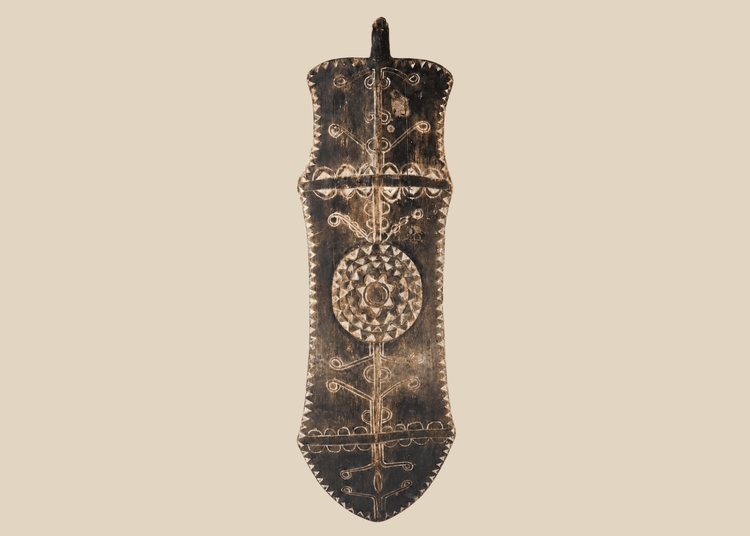
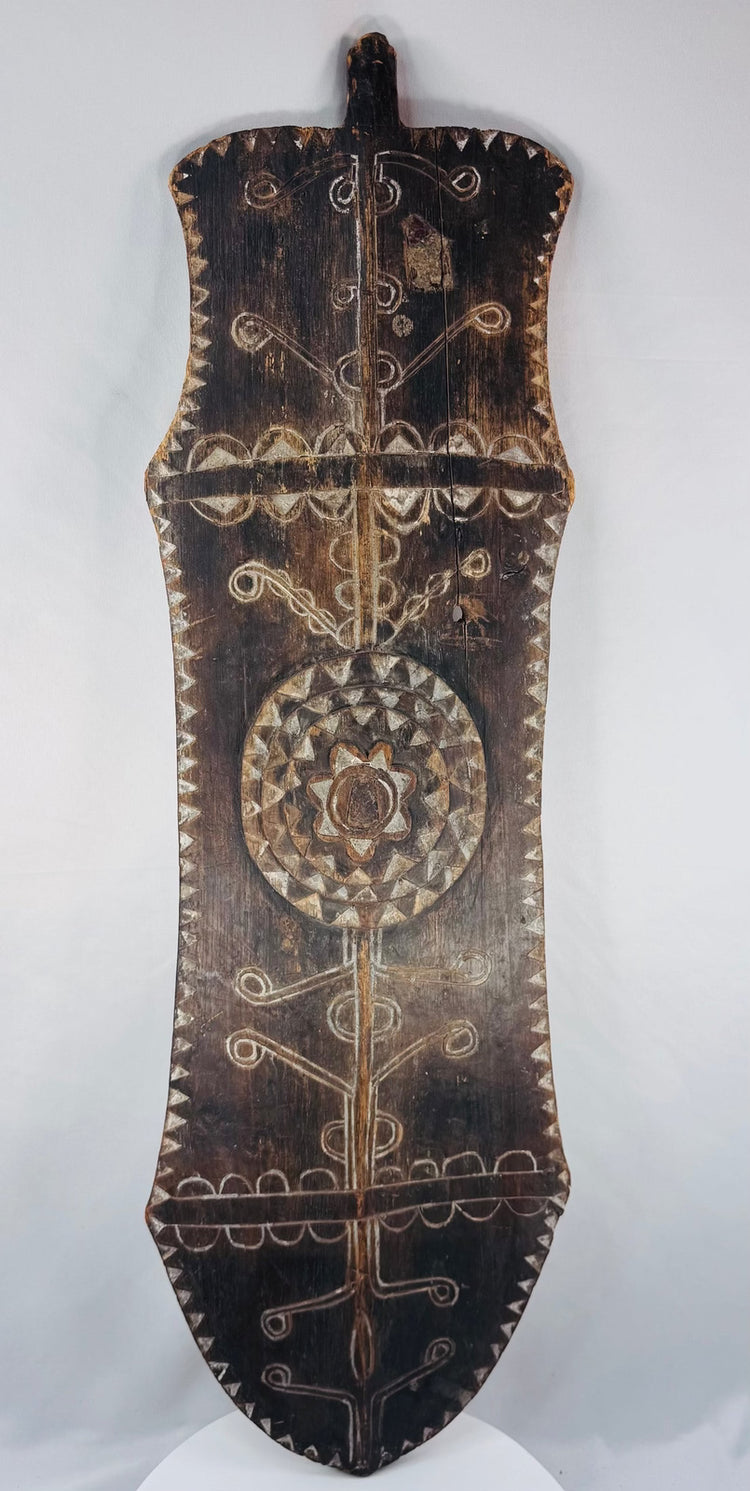
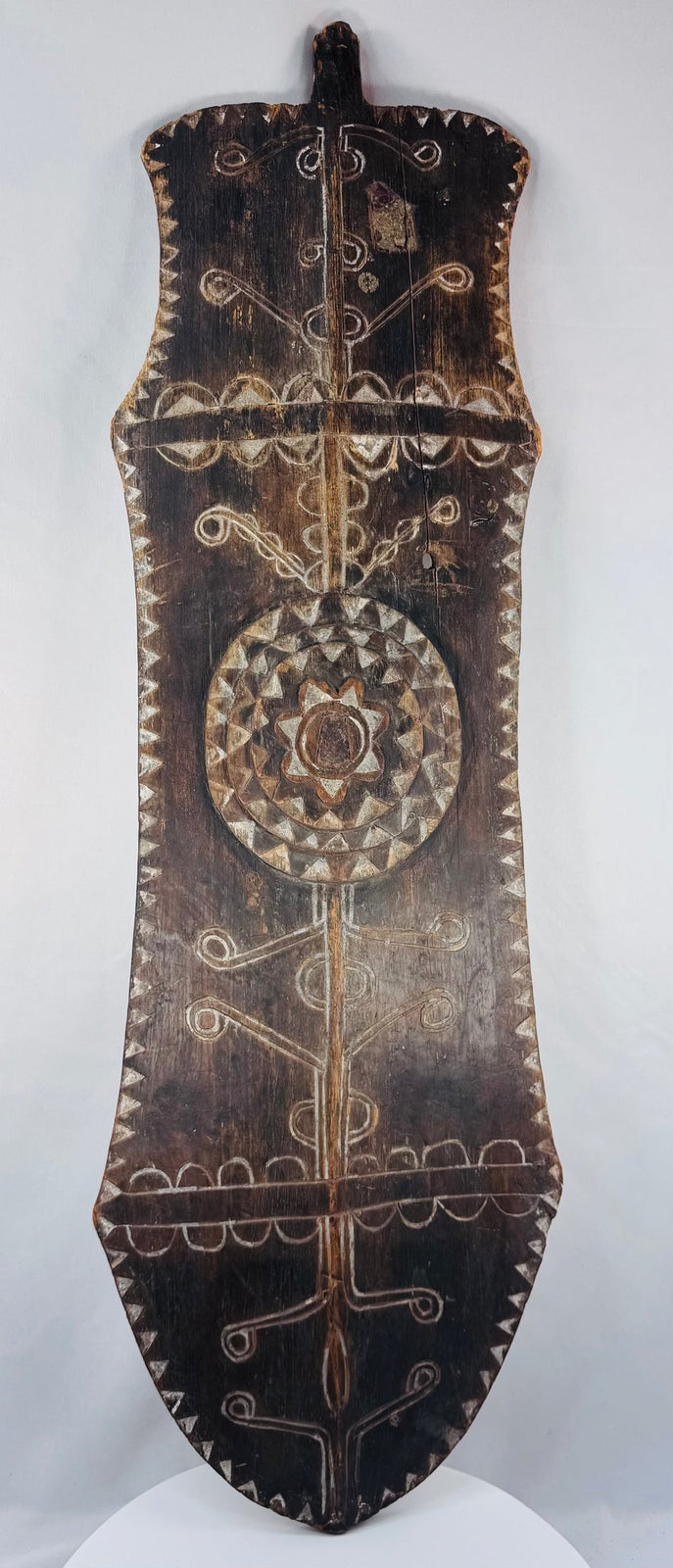
This substantial carved wooden shield is an impressive example of African ceremonial and material culture, distinguished by its elongated form, deeply aged surface, extensive incised decoration, and substantial carved handgrip on the reverse.
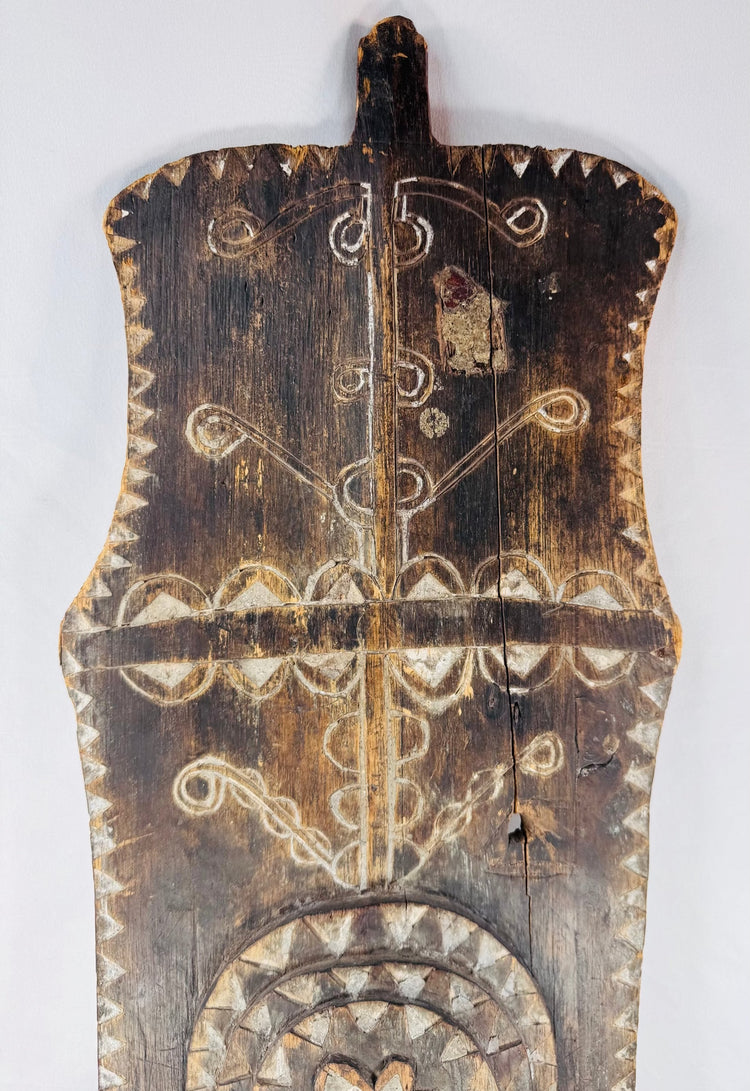
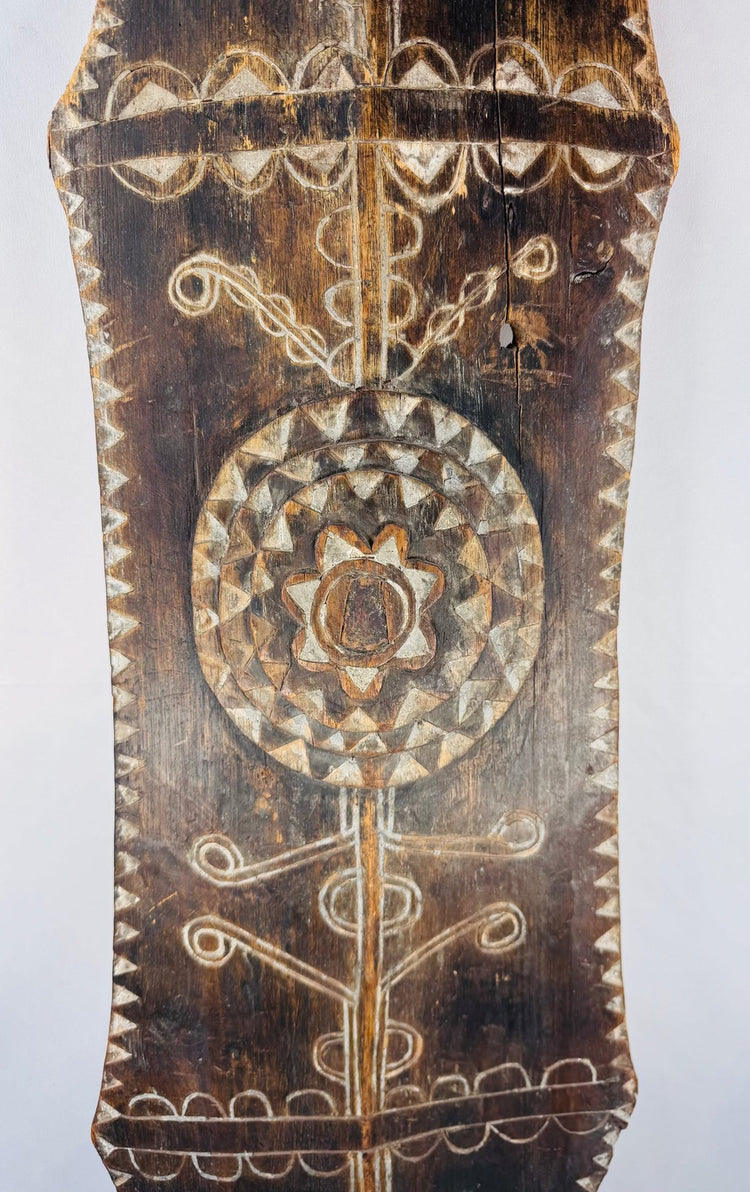
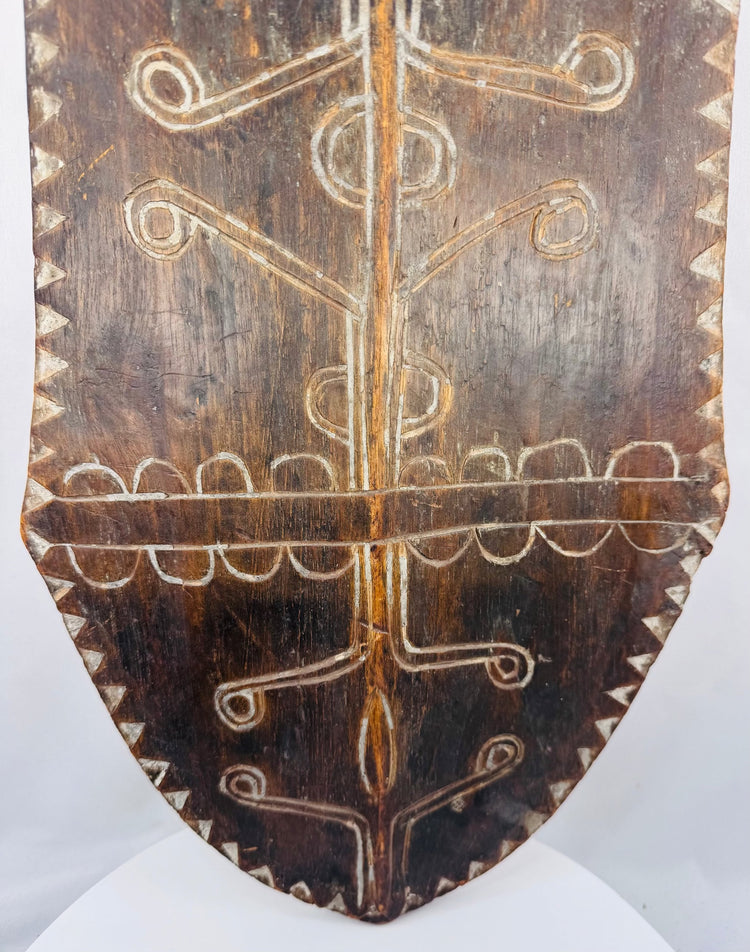
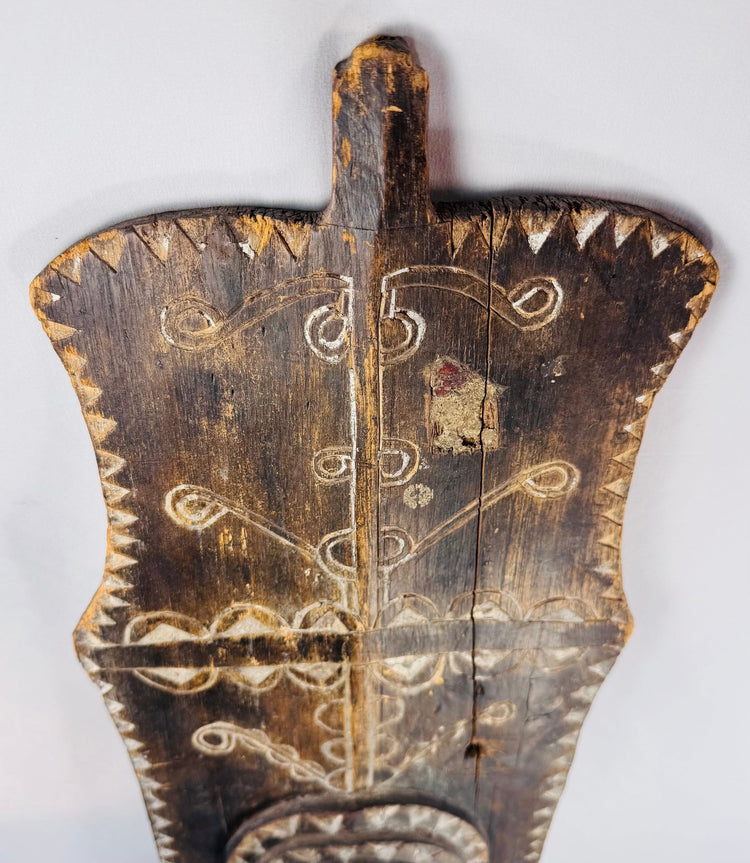
The shield presents a broad upper section with gently flaring shoulders, a narrowed central profile, and an elongated lower section terminating in a rounded point. The darkened wooden surface is extensively ornamented with finely incised linear and geometric motifs, many of which retain contrasting pale or white pigment.
Dominating the center is a large circular medallion composed of concentric bands of triangular carving surrounding a central rosette-like motif. Above and below this medallion extend symmetrical vertical designs resembling branching or vegetal forms, incorporating curled terminals, loops, semicircles, and horizontal patterned registers. A repeating triangular border follows much of the outer edge, giving the entire composition a carefully organized and strongly graphic appearance.
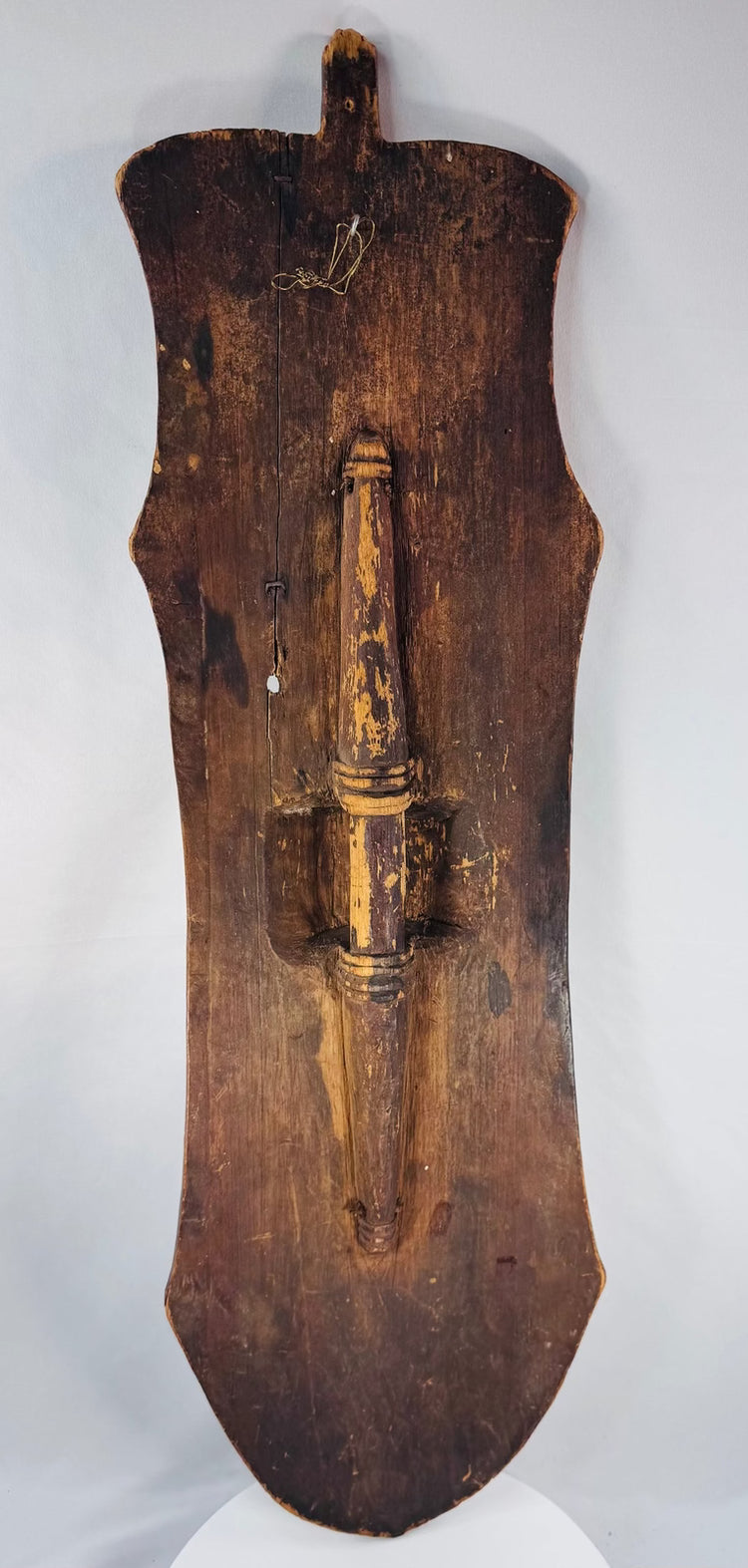
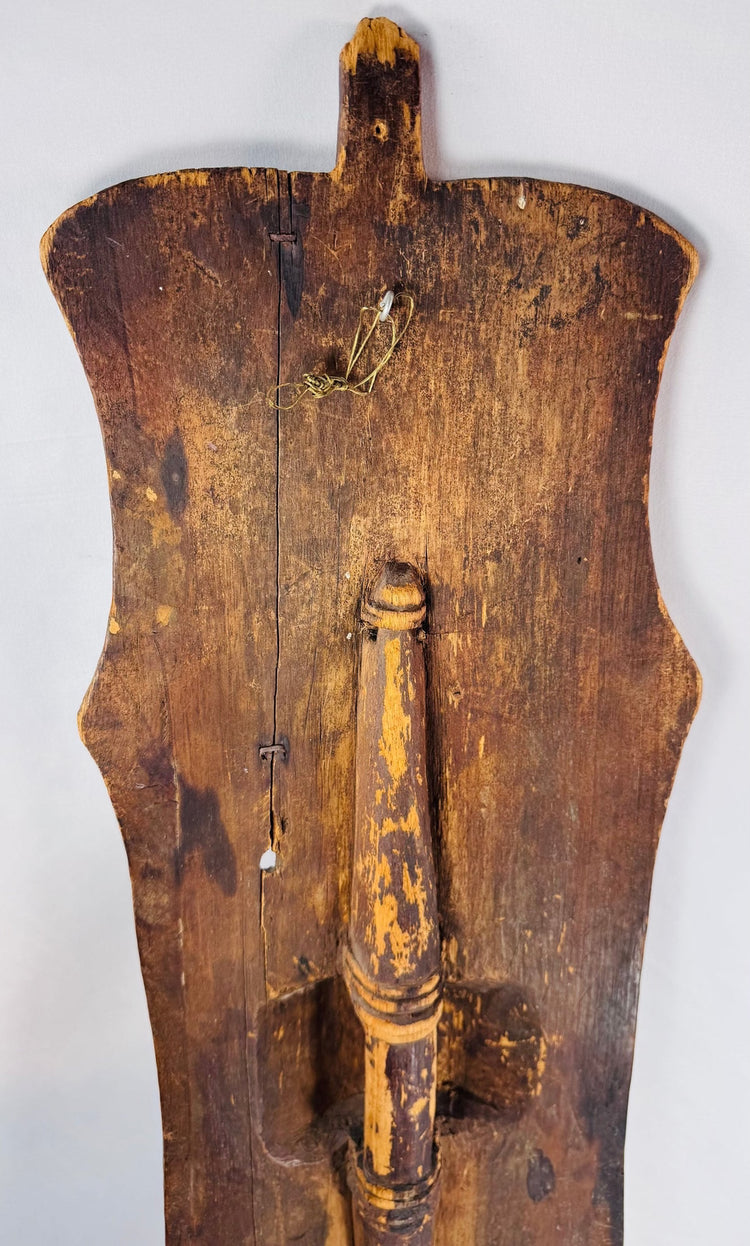
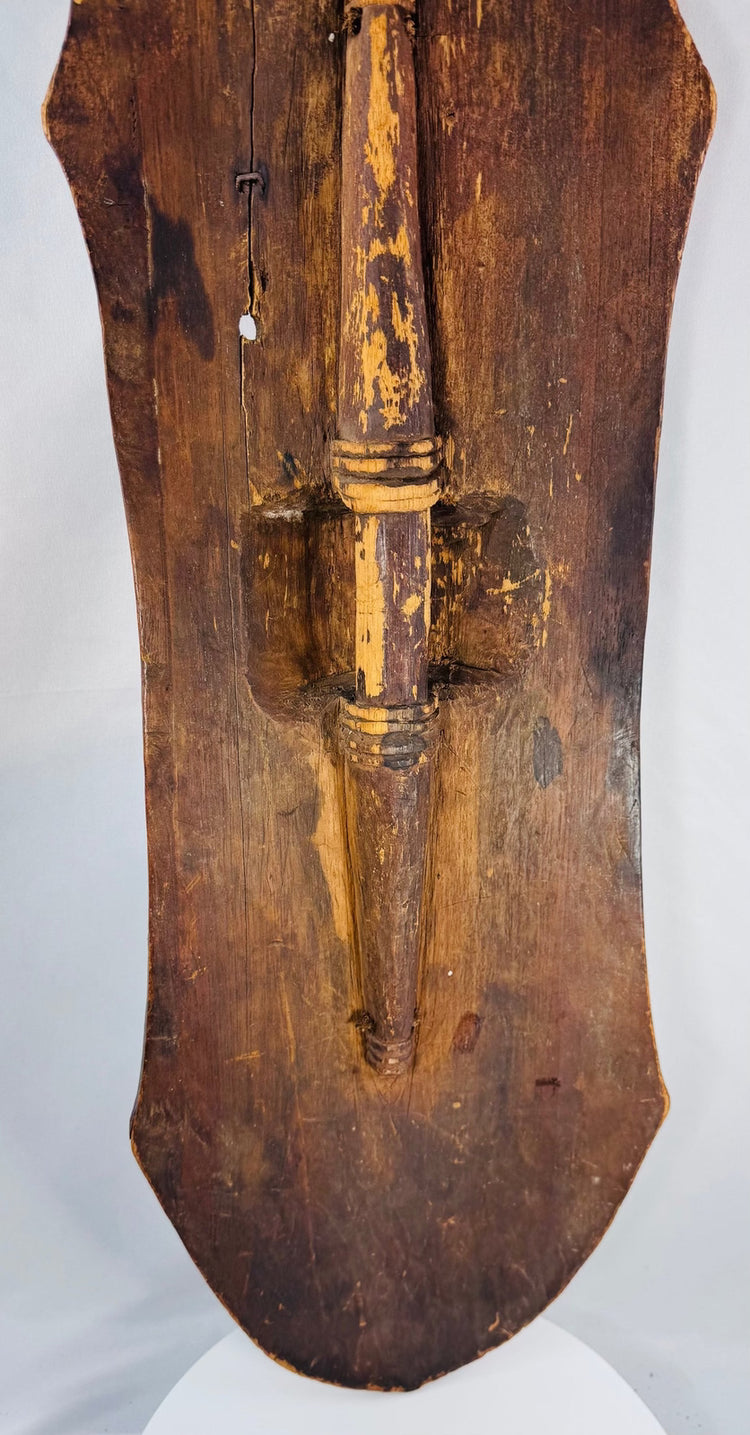
The reverse is comparatively undecorated and retains a substantial projecting wooden handgrip, demonstrating that the object was constructed to be physically carried rather than functioning solely as a wall panel. The deeply worn grip, surface patina, cracks, and old repairs further contribute to the object's historic character.
The construction and decorative treatment share characteristics with carved shields associated with Cameroon and the broader Central African region, where wooden shields may incorporate geometric carving, contrasting pale pigmentation, and substantial rear handgrips. Comparable Bamileke-attributed examples from Cameroon are documented with carved geometric surfaces and natural white pigment against darker wood.
Features
- Large hand-carved wooden ceremonial shield
- Elongated sculptural form measuring over 34 inches high
- Substantial projecting wooden handgrip on reverse
- Dark naturally aged surface
- Extensive incised geometric ornamentation
- Contrasting pale or white pigment retained within carved designs
- Large central circular medallion with concentric triangular decoration
- Central rosette or sun-like motif
- Symmetrical branching and curled linear designs
- Repeating triangular border around the outer edge
- Old cracks, wear, repairs, and extensive surface patina
Cultural Significance
Across a number of African traditions, shields developed beyond their practical defensive function to become visually significant objects associated with identity, ceremony, performance, prestige, and social display. Their shape and ornamentation could transform an otherwise utilitarian object into a highly distinctive element of material culture.
In Cameroon, surviving and contemporary Grassfields shield traditions demonstrate the use of carved wooden bodies, geometric ornament, contrasting white pigmentation, and rear handles. While these comparisons support a possible Cameroon attribution for the present example, the specific meaning of its central medallion and branching motifs should not be assigned without stronger documentation.
Condition
Good ethnographic condition with extensive age- and use-related wear throughout. The wood displays substantial surface abrasion, scratches, pigment loss, discoloration, edge losses, chips, cracks, and areas of weathering.
A pronounced longitudinal crack or separation is visible through part of the shield, with evidence of older stabilization or repair, including small metal elements visible on the reverse. Additional smaller splits and cracks are present throughout. The carved and pale-filled decoration has worn unevenly but remains clearly visible across the majority of the front.
The reverse handgrip exhibits substantial wear and losses to its original surface finish. A later hanging wire has been attached to the reverse for display.
Dimensions (Approximate)
Height: 34.25 in
Width: 10 in
Age (Approximate)
60–100 years old
Provenance
From a private collection in Scarborough, Ontario, Canada, assembled with a focus on ethnographic art and material culture. The shield remained in the collection for more than 25 years.
Learn More
Trace the artistic traditions of the Cameroon Grassfields through the Menil Collection.
Browse our Collection of Tribal and Indigenous Artifacts.
Description
Historical Context & Origin
Region: Central / West Africa, possibly Cameroon Grassfields
Material: Hand-carved wood with incised and pigmented decoration
Period: 20th Century, likely early to mid-20th century
Description
This substantial carved wooden shield is an impressive example of African ceremonial and material culture, distinguished by its elongated form, deeply aged surface, extensive incised decoration, and substantial carved handgrip on the reverse.
The shield presents a broad upper section with gently flaring shoulders, a narrowed central profile, and an elongated lower section terminating in a rounded point. The darkened wooden surface is extensively ornamented with finely incised linear and geometric motifs, many of which retain contrasting pale or white pigment.
Dominating the center is a large circular medallion composed of concentric bands of triangular carving surrounding a central rosette-like motif. Above and below this medallion extend symmetrical vertical designs resembling branching or vegetal forms, incorporating curled terminals, loops, semicircles, and horizontal patterned registers. A repeating triangular border follows much of the outer edge, giving the entire composition a carefully organized and strongly graphic appearance.
The reverse is comparatively undecorated and retains a substantial projecting wooden handgrip, demonstrating that the object was constructed to be physically carried rather than functioning solely as a wall panel. The deeply worn grip, surface patina, cracks, and old repairs further contribute to the object's historic character.
The construction and decorative treatment share characteristics with carved shields associated with Cameroon and the broader Central African region, where wooden shields may incorporate geometric carving, contrasting pale pigmentation, and substantial rear handgrips. Comparable Bamileke-attributed examples from Cameroon are documented with carved geometric surfaces and natural white pigment against darker wood.
Features
- Large hand-carved wooden ceremonial shield
- Elongated sculptural form measuring over 34 inches high
- Substantial projecting wooden handgrip on reverse
- Dark naturally aged surface
- Extensive incised geometric ornamentation
- Contrasting pale or white pigment retained within carved designs
- Large central circular medallion with concentric triangular decoration
- Central rosette or sun-like motif
- Symmetrical branching and curled linear designs
- Repeating triangular border around the outer edge
- Old cracks, wear, repairs, and extensive surface patina
Cultural Significance
Across a number of African traditions, shields developed beyond their practical defensive function to become visually significant objects associated with identity, ceremony, performance, prestige, and social display. Their shape and ornamentation could transform an otherwise utilitarian object into a highly distinctive element of material culture.
In Cameroon, surviving and contemporary Grassfields shield traditions demonstrate the use of carved wooden bodies, geometric ornament, contrasting white pigmentation, and rear handles. While these comparisons support a possible Cameroon attribution for the present example, the specific meaning of its central medallion and branching motifs should not be assigned without stronger documentation.
Condition
Good ethnographic condition with extensive age- and use-related wear throughout. The wood displays substantial surface abrasion, scratches, pigment loss, discoloration, edge losses, chips, cracks, and areas of weathering.
A pronounced longitudinal crack or separation is visible through part of the shield, with evidence of older stabilization or repair, including small metal elements visible on the reverse. Additional smaller splits and cracks are present throughout. The carved and pale-filled decoration has worn unevenly but remains clearly visible across the majority of the front.
The reverse handgrip exhibits substantial wear and losses to its original surface finish. A later hanging wire has been attached to the reverse for display.
Dimensions (Approximate)
Height: 34.25 in
Width: 10 in
Age (Approximate)
60–100 years old
Provenance
From a private collection in Scarborough, Ontario, Canada, assembled with a focus on ethnographic art and material culture. The shield remained in the collection for more than 25 years.
Learn More
Trace the artistic traditions of the Cameroon Grassfields through the Menil Collection.
Browse our Collection of Tribal and Indigenous Artifacts.
You May Also Like
