

American Sixth-Plate Daguerreotype Portrait of Mrs. Ruth R. Smith | Memphis, Tennessee | Circa 1849
Couldn't load pickup availability





American Sixth-Plate Daguerreotype Portrait of Mrs. Ruth R. Smith | Memphis, Tennessee | Circa 1849
Description
More
Less
Historical Context & Origin
Region: United States (possibly Tennessee)
Material: Silvered copper plate, glass, gilt brass mat, velvet lining, and leatherette-covered wood case
Period: Mid-19th Century CE, circa 1845–1855
Description
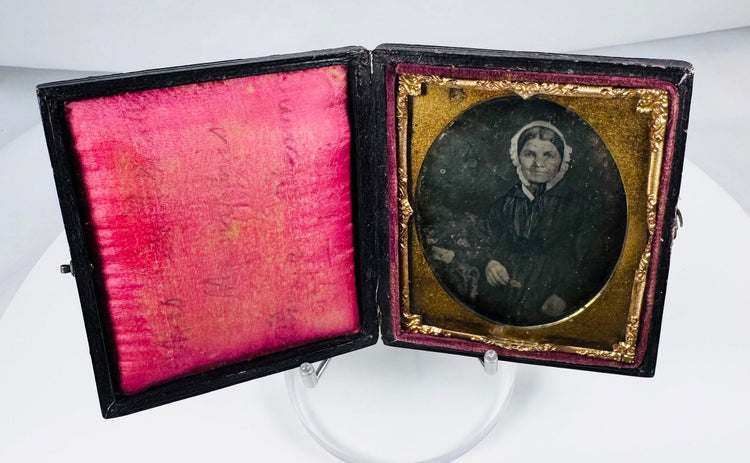
This compelling and historically significant portrait appears to be a sixth-plate daguerreotype housed in its original full leatherette case. The image depicts a mature woman seated in a three-quarter-length pose, dressed in a dark gown and wearing a white bonnet tied beneath the chin in a style characteristic of the mid-nineteenth century. Her direct gaze and formal attire reflect the dignified conventions of early American portrait photography.
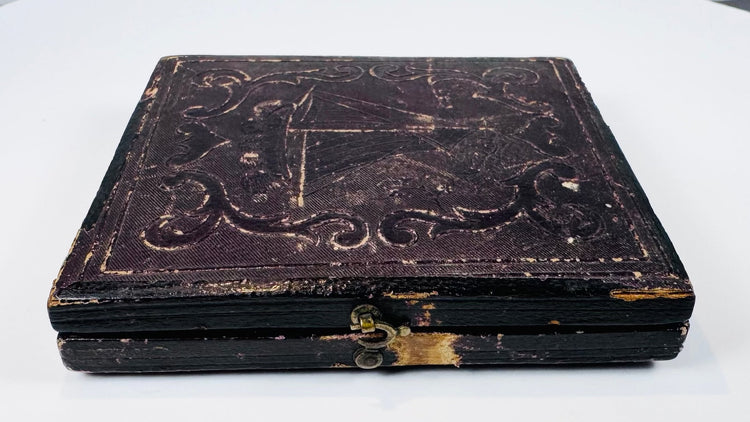
The daguerreotype remains mounted beneath its original gilt brass mat and preserved within a hinged leatherette-covered case lined with rich crimson velvet. The exterior of the case features an embossed design centered on a sailing vessel beneath decorative foliate scrollwork, a motif commonly found on American photographic cases of the 1840s and 1850s.
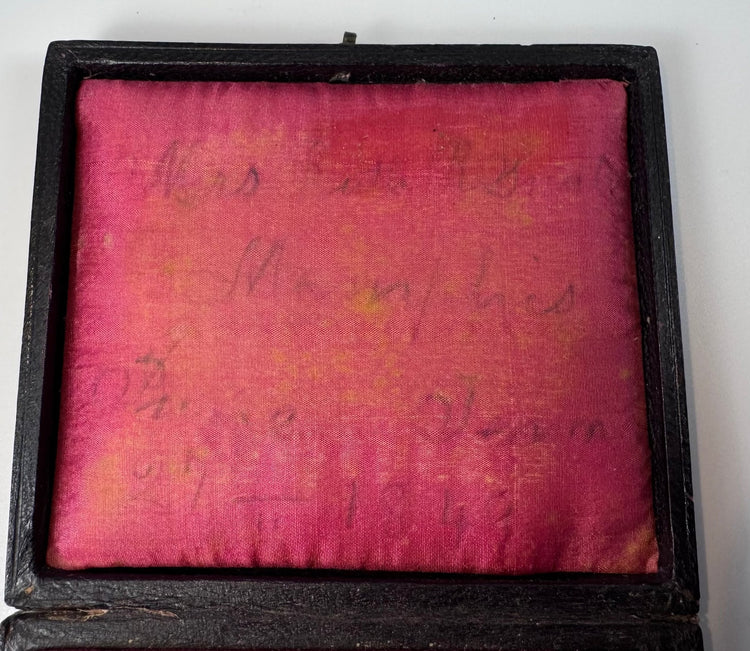
Particularly notable is the period inscription preserved on the interior silk pad, which appears to identify the sitter and reads:
“Mrs. Ruth R. Smith / Memphis / Prince / Tenn. / 27th / 1849”
Although portions of the inscription are difficult to decipher with certainty, the reference to Memphis, Tennessee suggests a possible regional provenance and adds considerable historical interest to the piece.
Daguerreotypes, introduced publicly in 1839, represented the first commercially successful photographic process and produced exceptionally detailed images on polished silvered copper plates. By the mid-nineteenth century, these portraits had become treasured family keepsakes, often housed in ornate protective cases such as the present example.
Features
- Depicts an unidentified woman in a white bonnet and dark dress
- Housed in its original full leatherette case
- Decorative sailing ship motif embossed on the exterior
- Original gilt brass mat and crimson velvet interior
- Retains a handwritten period inscription identifying the sitter
- Possible association with Memphis, Tennessee
- Exceptional example of early American photography
Cultural Significance
The daguerreotype revolutionized portraiture in the nineteenth century, allowing ordinary families to preserve the likenesses of loved ones with unprecedented realism. Prior to photography, painted portraits were expensive and accessible only to the wealthy. Daguerreotypes democratized portraiture and became treasured heirlooms, carefully stored in protective cases and passed down through generations. Examples retaining contemporary inscriptions are especially important, as they provide valuable genealogical and historical context that is often lost to time.
Condition
The daguerreotype exhibits expected age-related wear and oxidation consistent with nineteenth-century photographic materials. Areas of tarnishing, surface abrasions, and spotting are visible throughout the image. The gilt brass mat remains intact, while the velvet and silk interior display fading and wear. The leatherette case exhibits losses, edge wear, and scuffing commensurate with age and handling. The handwritten inscription remains partially legible.
Dimensions (Approximate)
Height: 3.75 in
Width: 3.25 in
Depth: 0.75 in
Age (Approximate)
170–180 years old
Provenance
From a substantial private collection of nineteenth and early twentieth-century photography assembled in Columbus, Ohio, USA. The collection was formed over many decades and comprised a wide range of photographic processes, including daguerreotypes, ambrotypes, tintypes, cabinet cards, cartes de visite, and related photographic ephemera.
Learn More
Explore the role of daguerreotypes as intimate records of family memory through the Isabella Stewart Gardner Museum
Discover additional pieces in our Collection of Victorian Artifacts & Historic Relics
Description
Historical Context & Origin
Region: United States (possibly Tennessee)
Material: Silvered copper plate, glass, gilt brass mat, velvet lining, and leatherette-covered wood case
Period: Mid-19th Century CE, circa 1845–1855
Description
This compelling and historically significant portrait appears to be a sixth-plate daguerreotype housed in its original full leatherette case. The image depicts a mature woman seated in a three-quarter-length pose, dressed in a dark gown and wearing a white bonnet tied beneath the chin in a style characteristic of the mid-nineteenth century. Her direct gaze and formal attire reflect the dignified conventions of early American portrait photography.
The daguerreotype remains mounted beneath its original gilt brass mat and preserved within a hinged leatherette-covered case lined with rich crimson velvet. The exterior of the case features an embossed design centered on a sailing vessel beneath decorative foliate scrollwork, a motif commonly found on American photographic cases of the 1840s and 1850s.
Particularly notable is the period inscription preserved on the interior silk pad, which appears to identify the sitter and reads:
“Mrs. Ruth R. Smith / Memphis / Prince / Tenn. / 27th / 1849”
Although portions of the inscription are difficult to decipher with certainty, the reference to Memphis, Tennessee suggests a possible regional provenance and adds considerable historical interest to the piece.
Daguerreotypes, introduced publicly in 1839, represented the first commercially successful photographic process and produced exceptionally detailed images on polished silvered copper plates. By the mid-nineteenth century, these portraits had become treasured family keepsakes, often housed in ornate protective cases such as the present example.
Features
- Depicts an unidentified woman in a white bonnet and dark dress
- Housed in its original full leatherette case
- Decorative sailing ship motif embossed on the exterior
- Original gilt brass mat and crimson velvet interior
- Retains a handwritten period inscription identifying the sitter
- Possible association with Memphis, Tennessee
- Exceptional example of early American photography
Cultural Significance
The daguerreotype revolutionized portraiture in the nineteenth century, allowing ordinary families to preserve the likenesses of loved ones with unprecedented realism. Prior to photography, painted portraits were expensive and accessible only to the wealthy. Daguerreotypes democratized portraiture and became treasured heirlooms, carefully stored in protective cases and passed down through generations. Examples retaining contemporary inscriptions are especially important, as they provide valuable genealogical and historical context that is often lost to time.
Condition
The daguerreotype exhibits expected age-related wear and oxidation consistent with nineteenth-century photographic materials. Areas of tarnishing, surface abrasions, and spotting are visible throughout the image. The gilt brass mat remains intact, while the velvet and silk interior display fading and wear. The leatherette case exhibits losses, edge wear, and scuffing commensurate with age and handling. The handwritten inscription remains partially legible.
Dimensions (Approximate)
Height: 3.75 in
Width: 3.25 in
Depth: 0.75 in
Age (Approximate)
170–180 years old
Provenance
From a substantial private collection of nineteenth and early twentieth-century photography assembled in Columbus, Ohio, USA. The collection was formed over many decades and comprised a wide range of photographic processes, including daguerreotypes, ambrotypes, tintypes, cabinet cards, cartes de visite, and related photographic ephemera.
Learn More
Explore the role of daguerreotypes as intimate records of family memory through the Isabella Stewart Gardner Museum
Discover additional pieces in our Collection of Victorian Artifacts & Historic Relics
You May Also Like
