



Mid-19th Century American Cased Portrait Photograph of a Victorian Woman | Sears Family Collection | Circa 1850–1865 CE
Couldn't load pickup availability




Mid-19th Century American Cased Portrait Photograph of a Victorian Woman | Sears Family Collection | Circa 1850–1865 CE
Description
More
Less
Historical Context & Origin
Region: United States, likely New England
Material: Early photographic image, protective glass, gilt-metal mat, embossed photographic case, and decorative velvet lining
Period: Mid-19th Century, Victorian Era, circa 1850–1865 CE
Description
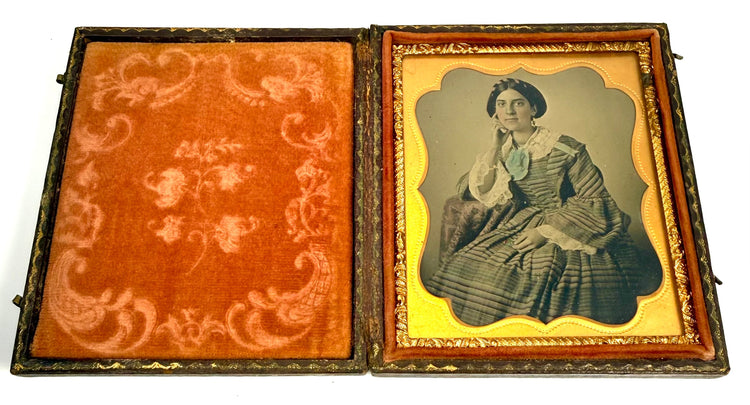
An original mid-19th-century American cased photographic portrait depicting an elegantly dressed woman seated in a formal studio setting. Dating to circa 1850–1865 CE, this historical photograph represents the formative decades of American portrait photography, when daguerreotypes and ambrotypes became treasured possessions among families seeking to preserve the likenesses of loved ones.
The unidentified female subject is portrayed wearing an elaborate striped gown with a fitted bodice, full skirt, decorative lace collar, and intricately detailed sleeves. Her dark hair is carefully arranged in a fashionable mid-19th-century style, while a light-coloured ornament at her neckline provides a delicate contrast to her clothing. She rests her head gently against one hand, gazing directly toward the camera with a composed and contemplative expression characteristic of formal Victorian-era portraiture.
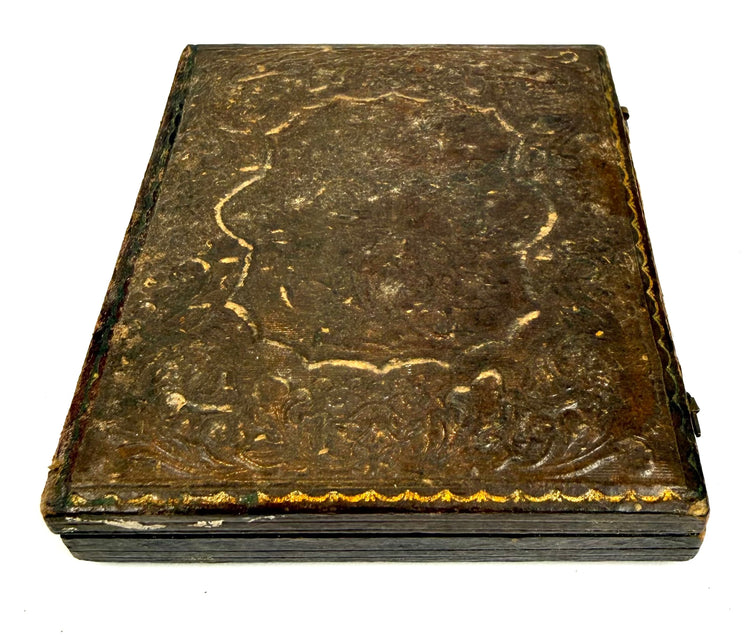
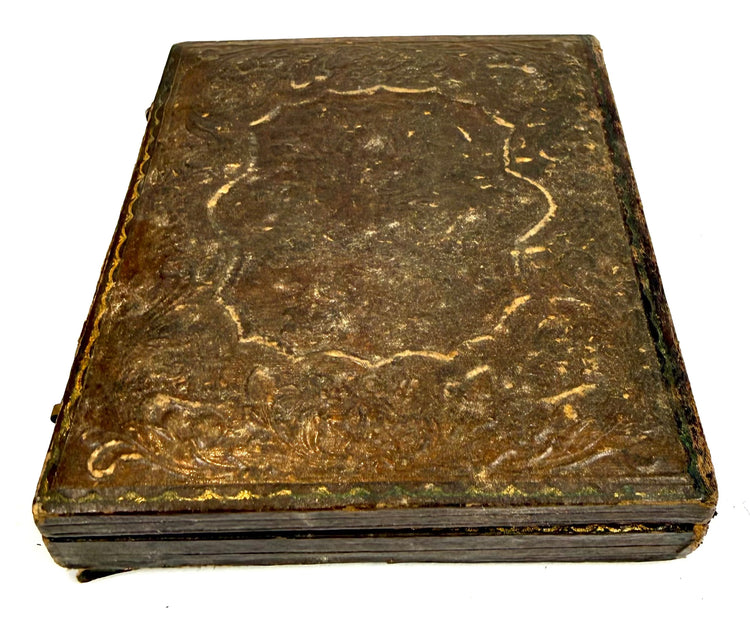
The photographic image is housed within an ornate hinged protective case featuring an embossed exterior decorated with scrolling floral and foliate motifs. Surviving gilt accents along the borders and decorative elements reflect the craftsmanship commonly associated with early photographic presentation cases.
The interior retains a richly coloured reddish-orange velvet lining embellished with an elaborate floral and scrolling design. Opposite the velvet-lined cover, the photograph is surrounded by a decorative gilt-metal mat with a distinctive scalloped opening, carefully framing the sitter and emphasizing the intimate nature of the portrait.
Such cases were designed both to protect delicate photographic images and to create personal keepsakes suitable for preservation within the family. Their decorative presentation reflected the considerable sentimental and cultural importance attached to photographic portraits during the nineteenth century.
The portrait's appearance and presentation are consistent with the cased daguerreotype and ambrotype photographic traditions of the mid-19th century. The precise photographic process has not been independently established.
Of particular historical interest is the photograph's documented association with a collection of nine early American photographs and daguerreotypes depicting members of the Sears family. Historical genealogical research has identified a connection between the individuals named in the original auction catalogue and descendants of Dr. Nathan Sears (1791–1848), a Massachusetts-born physician whose family participated in the westward migration of New England families during the nineteenth century.
This historical association, together with its provenance from the estate of Joseph W. Haley of Pride's Crossing, Massachusetts, adds genealogical and documentary interest to this finely presented example of early American photographic portraiture.
Features
- Original mid-19th-century American cased photographic portrait, circa 1850–1865
- Depicts an elegantly dressed seated woman in Victorian-era attire
- Elaborate striped gown with fitted bodice, full skirt, lace collar, and decorative sleeves
- Traditional hinged protective photographic case
- Ornate embossed exterior featuring scrolling floral and foliate motifs
- Surviving gilt accents along the exterior borders and decorative elements
- Reddish-orange velvet lining with elaborate floral decoration
- Decorative gilt-metal photographic mat with a scalloped opening
- Clearly preserved facial features, hairstyle, and clothing details
- Traditional presentation associated with early American daguerreotype and ambrotype photography
- Historical association with a documented collection of Sears family photographs
- Provenance from the estate of Joseph W. Haley, Pride's Crossing, Massachusetts
Cultural Significance
The emergence of photography during the nineteenth century fundamentally transformed the way individuals and families preserved their personal histories. Before the development of practical photographic processes, commissioned painted portraits were often expensive and generally accessible only to those with sufficient financial resources.
The introduction of the daguerreotype in 1839 revolutionized portraiture by making it possible to capture highly detailed likenesses directly from life. By the middle of the nineteenth century, photographic studios had become increasingly common throughout the United States, offering individuals and families the opportunity to preserve lasting visual records of themselves and their loved ones.
Daguerreotypes were especially valued for their remarkable clarity and fine detail. During the 1850s, the introduction of ambrotype photography provided another popular method of producing individual portraits. Both processes were frequently housed in small protective cases decorated with velvet interiors, gilt-metal surrounds, and embossed coverings.
These miniature photographic portraits became important objects within nineteenth-century family life. They were exchanged between relatives, carried during periods of separation, displayed in domestic interiors, and preserved as cherished reminders of deceased family members.
The clothing and hairstyle visible in this portrait also provide insight into the social customs and fashions of mid-nineteenth-century America. The sitter's carefully arranged pose, elaborate gown, and formal presentation reflect the importance placed upon personal appearance and photographic representation during the Victorian era.
The ornate photographic case is itself an important element of the object's historical character. Its decorative metal surround, embossed exterior, and velvet-lined interior demonstrate how early photographs were presented as valued personal possessions rather than ordinary printed images.
Beyond its significance as an example of early photography, this particular portrait possesses additional genealogical interest through its association with the Sears family, whose documented history extends through several generations of New England and nineteenth-century American life.
Condition
The photograph survives in good antique condition consistent with its age, with the female subject remaining clearly visible and retaining substantial detail throughout the face, clothing, and surrounding composition.
The decorative case exhibits age-related wear, including surface abrasions, rubbing, minor losses to the exterior finish, and deterioration to portions of the embossed decoration. Gilt accents remain visible along the edges and ornamental borders.
The reddish-orange velvet interior retains its elaborate floral and scrolling decoration, displaying minor wear, surface irregularities, and variations in colour consistent with age.
The decorative gilt-metal photographic surround remains present, retaining its distinctive scalloped opening and ornamental detailing. Minor oxidation, discolouration, and handling marks are visible.
The photographic image exhibits some toning and minor surface irregularities, although the principal subject remains well defined and visually appealing.
Dimensions (Approximate)
Height: 3.75 in
Width: 3.25 in
Depth: 0.7 in
(case closed)
Age (Approximate)
160–175 years old
Provenance
Formerly part of the estate of the late Joseph W. Haley of Pride's Crossing, Massachusetts, United States, whose extensive collection included American and European antiques, fine and decorative arts, historical documents, early books, and objects reflecting a lifelong interest in history, travel, and collecting.
The photograph originally formed part of a collection of nine historical photographs and daguerreotypes associated with members of the Sears family, including Henry Sears, Paul Sears, an individual identified as Grandmother, and a woman catalogued as Clarret Sears Bishop.
Genealogical research suggests that the individuals identified in the original photographic collection were members of the family of Dr. Nathan Sears (1791–1848), a physician born in Ashfield, Massachusetts. Dr. Sears subsequently practised medicine in Ohio, Michigan, and Illinois, eventually settling in Mount Carmel, Illinois, where he died in 1848. His wife was Grace Loper Sears, and their documented children included Paul Sears, Clarissa Sears Bishop, and Nathan Henry Sears.
An especially noteworthy historical connection is preserved in The Ranney Letters: Family Correspondence During the Yankee Migration, which includes a family letter dated January 8, 1850. Written by Lyman Ranney from Van Buren, Arkansas, the correspondence explicitly identifies Paul Sears, Clarissa Sears Bishop, and Henry Sears as members of the same family.
The letter describes Paul Sears as an established physician practising in Mount Carmel, Illinois, while Clarissa was married to Ephraim Brown Bishop, a merchant in Arkansas. Their younger brother Henry was attending school in Arkansas at the time.
The correspondence between these documented family members and the names recorded in the original auction listing provides support for the proposed Sears family association. The name catalogued as Clarret Sears Bishop may represent a transcription error for Clarissa Sears Bishop. The identity of the woman depicted in this particular portrait has not been individually established.
Learn More
Compare a similar 1850s cased portrait of a seated woman, featuring an ornate gilt-metal mat and velvet-lined interior, in the Metropolitan Museum of Art's collection.
Discover more historical keepsakes and decorative objects in our Victorian Artifacts & Historic Relics Collection.
Description
Historical Context & Origin
Region: United States, likely New England
Material: Early photographic image, protective glass, gilt-metal mat, embossed photographic case, and decorative velvet lining
Period: Mid-19th Century, Victorian Era, circa 1850–1865 CE
Description
An original mid-19th-century American cased photographic portrait depicting an elegantly dressed woman seated in a formal studio setting. Dating to circa 1850–1865 CE, this historical photograph represents the formative decades of American portrait photography, when daguerreotypes and ambrotypes became treasured possessions among families seeking to preserve the likenesses of loved ones.
The unidentified female subject is portrayed wearing an elaborate striped gown with a fitted bodice, full skirt, decorative lace collar, and intricately detailed sleeves. Her dark hair is carefully arranged in a fashionable mid-19th-century style, while a light-coloured ornament at her neckline provides a delicate contrast to her clothing. She rests her head gently against one hand, gazing directly toward the camera with a composed and contemplative expression characteristic of formal Victorian-era portraiture.
The photographic image is housed within an ornate hinged protective case featuring an embossed exterior decorated with scrolling floral and foliate motifs. Surviving gilt accents along the borders and decorative elements reflect the craftsmanship commonly associated with early photographic presentation cases.
The interior retains a richly coloured reddish-orange velvet lining embellished with an elaborate floral and scrolling design. Opposite the velvet-lined cover, the photograph is surrounded by a decorative gilt-metal mat with a distinctive scalloped opening, carefully framing the sitter and emphasizing the intimate nature of the portrait.
Such cases were designed both to protect delicate photographic images and to create personal keepsakes suitable for preservation within the family. Their decorative presentation reflected the considerable sentimental and cultural importance attached to photographic portraits during the nineteenth century.
The portrait's appearance and presentation are consistent with the cased daguerreotype and ambrotype photographic traditions of the mid-19th century. The precise photographic process has not been independently established.
Of particular historical interest is the photograph's documented association with a collection of nine early American photographs and daguerreotypes depicting members of the Sears family. Historical genealogical research has identified a connection between the individuals named in the original auction catalogue and descendants of Dr. Nathan Sears (1791–1848), a Massachusetts-born physician whose family participated in the westward migration of New England families during the nineteenth century.
This historical association, together with its provenance from the estate of Joseph W. Haley of Pride's Crossing, Massachusetts, adds genealogical and documentary interest to this finely presented example of early American photographic portraiture.
Features
- Original mid-19th-century American cased photographic portrait, circa 1850–1865
- Depicts an elegantly dressed seated woman in Victorian-era attire
- Elaborate striped gown with fitted bodice, full skirt, lace collar, and decorative sleeves
- Traditional hinged protective photographic case
- Ornate embossed exterior featuring scrolling floral and foliate motifs
- Surviving gilt accents along the exterior borders and decorative elements
- Reddish-orange velvet lining with elaborate floral decoration
- Decorative gilt-metal photographic mat with a scalloped opening
- Clearly preserved facial features, hairstyle, and clothing details
- Traditional presentation associated with early American daguerreotype and ambrotype photography
- Historical association with a documented collection of Sears family photographs
- Provenance from the estate of Joseph W. Haley, Pride's Crossing, Massachusetts
Cultural Significance
The emergence of photography during the nineteenth century fundamentally transformed the way individuals and families preserved their personal histories. Before the development of practical photographic processes, commissioned painted portraits were often expensive and generally accessible only to those with sufficient financial resources.
The introduction of the daguerreotype in 1839 revolutionized portraiture by making it possible to capture highly detailed likenesses directly from life. By the middle of the nineteenth century, photographic studios had become increasingly common throughout the United States, offering individuals and families the opportunity to preserve lasting visual records of themselves and their loved ones.
Daguerreotypes were especially valued for their remarkable clarity and fine detail. During the 1850s, the introduction of ambrotype photography provided another popular method of producing individual portraits. Both processes were frequently housed in small protective cases decorated with velvet interiors, gilt-metal surrounds, and embossed coverings.
These miniature photographic portraits became important objects within nineteenth-century family life. They were exchanged between relatives, carried during periods of separation, displayed in domestic interiors, and preserved as cherished reminders of deceased family members.
The clothing and hairstyle visible in this portrait also provide insight into the social customs and fashions of mid-nineteenth-century America. The sitter's carefully arranged pose, elaborate gown, and formal presentation reflect the importance placed upon personal appearance and photographic representation during the Victorian era.
The ornate photographic case is itself an important element of the object's historical character. Its decorative metal surround, embossed exterior, and velvet-lined interior demonstrate how early photographs were presented as valued personal possessions rather than ordinary printed images.
Beyond its significance as an example of early photography, this particular portrait possesses additional genealogical interest through its association with the Sears family, whose documented history extends through several generations of New England and nineteenth-century American life.
Condition
The photograph survives in good antique condition consistent with its age, with the female subject remaining clearly visible and retaining substantial detail throughout the face, clothing, and surrounding composition.
The decorative case exhibits age-related wear, including surface abrasions, rubbing, minor losses to the exterior finish, and deterioration to portions of the embossed decoration. Gilt accents remain visible along the edges and ornamental borders.
The reddish-orange velvet interior retains its elaborate floral and scrolling decoration, displaying minor wear, surface irregularities, and variations in colour consistent with age.
The decorative gilt-metal photographic surround remains present, retaining its distinctive scalloped opening and ornamental detailing. Minor oxidation, discolouration, and handling marks are visible.
The photographic image exhibits some toning and minor surface irregularities, although the principal subject remains well defined and visually appealing.
Dimensions (Approximate)
Height: 3.75 in
Width: 3.25 in
Depth: 0.7 in
(case closed)
Age (Approximate)
160–175 years old
Provenance
Formerly part of the estate of the late Joseph W. Haley of Pride's Crossing, Massachusetts, United States, whose extensive collection included American and European antiques, fine and decorative arts, historical documents, early books, and objects reflecting a lifelong interest in history, travel, and collecting.
The photograph originally formed part of a collection of nine historical photographs and daguerreotypes associated with members of the Sears family, including Henry Sears, Paul Sears, an individual identified as Grandmother, and a woman catalogued as Clarret Sears Bishop.
Genealogical research suggests that the individuals identified in the original photographic collection were members of the family of Dr. Nathan Sears (1791–1848), a physician born in Ashfield, Massachusetts. Dr. Sears subsequently practised medicine in Ohio, Michigan, and Illinois, eventually settling in Mount Carmel, Illinois, where he died in 1848. His wife was Grace Loper Sears, and their documented children included Paul Sears, Clarissa Sears Bishop, and Nathan Henry Sears.
An especially noteworthy historical connection is preserved in The Ranney Letters: Family Correspondence During the Yankee Migration, which includes a family letter dated January 8, 1850. Written by Lyman Ranney from Van Buren, Arkansas, the correspondence explicitly identifies Paul Sears, Clarissa Sears Bishop, and Henry Sears as members of the same family.
The letter describes Paul Sears as an established physician practising in Mount Carmel, Illinois, while Clarissa was married to Ephraim Brown Bishop, a merchant in Arkansas. Their younger brother Henry was attending school in Arkansas at the time.
The correspondence between these documented family members and the names recorded in the original auction listing provides support for the proposed Sears family association. The name catalogued as Clarret Sears Bishop may represent a transcription error for Clarissa Sears Bishop. The identity of the woman depicted in this particular portrait has not been individually established.
Learn More
Compare a similar 1850s cased portrait of a seated woman, featuring an ornate gilt-metal mat and velvet-lined interior, in the Metropolitan Museum of Art's collection.
Discover more historical keepsakes and decorative objects in our Victorian Artifacts & Historic Relics Collection.
You May Also Like
